• Starting today August 7th, 2024, in order to post in the Married Couples, Courting Couples, or Singles forums, you will not be allowed to post if you have your Marital status designated as private. Announcements will be made in the respective forums as well but please note that if yours is currently listed as Private, you will need to submit a ticket in the Support Area to have yours changed.

  • CF has always been a site that welcomes people from different backgrounds and beliefs to participate in discussion and even debate. That is the nature of its ministry. In view of recent events emotions are running very high. We need to remind people of some basic principles in debating on this site. We need to be civil when we express differences in opinion. No personal attacks. Avoid you, your statements. Don't characterize an entire political party with comparisons to Fascism or Communism or other extreme movements that committed atrocities. CF is not the place for broad brush or blanket statements about groups and political parties. Put the broad brushes and blankets away when you come to CF, better yet, put them in the incinerator. Debate had no place for them. We need to remember that people that commit acts of violence represent themselves or a small extreme faction.
  • We hope the site problems here are now solved, however, if you still have any issues, please start a ticket in Contact Us

  • The rule regarding AI content has been updated. The rule now rules as follows:

    Be sure to credit AI when copying and pasting AI sources. Link to the site of the AI search, just like linking to an article.

Christianity Without the Bible

When a skeptic argues against the Bible, he is usually not attacking the book but the ideas in the book. Skeptics are not really concerned about how many generations there are between Adam and Jesus or how many angels were at Jesus’ tomb. It is Christianity that concerns them (and hence the New Testament in particular). Since many Christians and skeptics alike consider the Bible to be the foundation of Christianity, to call its historicity, manuscript transmission, scientific accuracy, etc. into question is to call Christianity into question.

Defenses of Christianity, then, often either begin or conclude with a defense of the Bible. But what if the trustworthiness of the Bible could not be satisfactorily defended?

I don’t think this is the case, but it is worth thinking about for at least these two reasons: 1) most skeptics think the Bible has not been defended sufficiently, and 2) the case for Christianity will be even stronger if it can survive the failure of these popular methods. If the defense of Christianity is not coextensive with that of the Bible, then attacks on the latter can’t be used against the former.

I would argue that even if we lost the Bible completely, Christianity would remain undefeated. Therefore, the defeat of the Bible would not entail the defeat of Christianity.

How can we be sure of this?

First, Christianity preceded the Christian Bible. The New Testament writings did not begin until at least a decade after Christ started the Church, yet those who believed were Christians and therefore constituted the Church (1 Cor. 1:2 cf. 15:1-5).

Continued below.
  • Like
Reactions: Pioneer3mm

‘We Celebrate Her Courage’—LDS Post Praising Eve’s Choice To Eat Forbidden Fruit Goes Viral

Wow! So Elohim was born to human parents, and He obeyed them to become God. I wonder where the human parents came from, and what made them different from other human parents.
Yup, I don’t get it either. Have no idea if the modern LDS Church still teaches that.

I assume they see Elohim and Yahweh as the same.
Upvote 0

New York Archdiocese Says Longtime Insurer Waged ‘Shadow Campaign,’ Posed as Victims’ Rights Group

The archdiocese alleged that Chubb Insurance posed as the “Church Accountability Project.”

The Archdiocese of New York is arguing in state court that its longtime insurer has secretly been “waging a shadow campaign” and posing as a victims’ rights group in order to “undermine and weaken” the archdiocese amid an ongoing insurance dispute.

In a Jan. 31 legal filing at the New York State Supreme Court obtained by EWTN News, the archdiocese said that Chubb Insurance — which the archdiocese sued in 2024 over an alleged failure to pay out financial claims for sex abuse victims — has for several years been “secretly” posing as the “Church Accountability Project,” allegedly encouraging abuse victims to “pursue claims against the [archdiocese].”

The archdiocesan filing said the insurer has secretly run the website in order to “elevate Chubb’s own financial interests” and improve its leverage in the ongoing lawsuit.

As of Feb. 4 the “Church Accountability Project” website prominently displays the Chubb logo at the top of its page. But archives of the website from around a year ago make no mention of the site’s alleged alignment with Chubb.


Continued below.

Mike Johnson says 'borders are biblical,' responds to Pope Leo's criticism of Trump policies

House Speaker Mike Johnson, R-La., has responded to Pope Leo XIV’s concerns about President Donald Trump’s immigration policies, proclaiming that “borders are biblical.”
How about speaking to Russia's border policy where Russia's own people can't escape their own country?'
North Korea, China and many others.

Why is it we only hear about the leader of the free world when it comes to the Popes?
Upvote 0

Limited Atonement and 2 Peter 2

Good day, Jonnas

You may find this helpful: “Problematic Texts” for Definite Atonement in the Pastoral and General Epistles by Thomas R. Schreiner

Or 2 Peter 2:1 and Universal Redemption - Alpha and Omega Ministries

I know that DA Carson has addressed this text as well, just having a hard time putting my finger on it at this time.

In Him

Bill
Good day, Bill

I almost read half of 2 Peter 2:1 and Universal Redemption - Alpha and Omega Ministries, until I came to these words:
…a word study of agorazo in both the Greek Old and New Testaments, reveal that the word itself does not include a payment price. When it is translated with a meaning “to buy,” whether in a salvation or non-salvation context, a payment price is always stated or made explicit by the context. …in contexts where no payment price is stated or implied, agorazo may often be better translated as ‘acquire’ or ‘obtain.’
Then if the Calvinist argument is based on some finenesses about the meaning of a Greek word, then I am not able to make any judgement. I am not qualified for such questions, as it is for people with a good knowledge of the Greek. So I understand that I am left with an assertion (in bold in the quote) that I cannot prove whether it is true or false.

I can however make some comment about how this argument was made by the author:
…of its thirty occurrences in the New Testament, agorazo is never used in a salvation context (unless II Peter 2:1 is the exception) without the technical term “price” (times– a technical term for the blood of Christ) or its equivalent being stated or made explicit in the context (cf. I Cor. 6:20; 7:23; Rev. 5:9; 14:3,435).36
Counting occurrences doesn't prove anything: I could also find 30 occurrences of orange carrots, but it wouldn't prove that all carrots are orange! What would be needed is at least one verse where agorazo is used without the information about the price and where it is clear from context that agorazo cannot mean purchasing (implying that a price wasn't paid). To my knowledge, there isn't such a verse in the Bible. “In the mouth of two or three witnesses shall every word be established” (2 Cor. 13:1b), so it is not the absence but the presence of witnesses that can prove anything, then I conclude that the author of the article has found no witness in the Bible to establish the word agorazo such as he claims.

Literally, the text reads: “denying the One who bought them Master.” The insertion of implicit meanings like “to purchase,” (...) is textually untenable.
I believe it to be a very strange assertion that buying and purchasing could be two different things! In my view, this assertion represents the most “textually untenable” of all options. The author often complains about non-Reformers making unproved assertions, but in this case the author has to assume the burden of the proof and prove his assertion!

Now I would like to make some more general comments about the first part of the article, although this isn't directly about the question asked here:

There is no question that the Bible is clear in its message. God’s Word was not written to the “spiritual elite” or restricted to the intellectual theologian. It was written for all the people of God. It was written to the housewife, the parts department salesman, and to the child. This is not to say that all of the Bible is equally understandable as Peter himself states (2 Peter 3:16). Some passages take a little more work and hence God has blessed his Church with learned and stable men who are able to distill from God’s truth elements that are more difficult than others.
I agree with that, as long as it concerns some advanced doctrinal points. But as far as the basics are involved, the common people should have no issue to find it in the Bible, provided that they are born again. We don't want to do the same as the Catholic church did, don't we? Then if the limited atonement should belong to the basics, then there should be at least 3 or 4 verses that makes it plain for the common people. That said, it doesn't mean that there couldn't be in the Bible other verses (such as here: 2 Pet. 2:1) where only the intellectual theologian could harmonize with the basic doctrines, but the common people can live without such explanations as they have other much clearer verses that shine strongly enough for them!

Where do we find in 2 Peter 2:1 the implied concepts, “they will not be redeemed after all,” “Jesus died to purchase (bought) them,” “that, although Jesus died for their salvation (implied potentiality), they will not be saved after all?” Is it not actually the Reformed believer who in this case is reading the text simply as it is? Do we need to add the words “potential,” “died,” “to purchase” to the text?
First, to know whether the Reformed believer is reading the text simply as it is, we need to know how the Reformed believer reads the text. This was however not yet explained in the article; then although the obvious answer should be yes according to the author, it wasn't obvious for the reader (at least at this point of reading).

Second, it wonders me, why the author is arguing against a particular view of a non-Reformer, taking much pains to defend that agorazo could be used in a non-redemptive context, while in my eyes the most obvious non-Reformer explanation is left silent, which seems to me to accord well with just reading the text simply as it is and which doesn't require a redemptive-only meaning of agorazo. Here it is:

By bearing the sins of all men at the cross, Jesus bought all men. This means, He owns them all, He has an unlimited freedom to do to them as He wishes: He will save the elects, because they are bought “for God” (Rev. 5:9), for Him to enjoy them; He will condemn to Hell the unbelievers, because they were bought to be the object of God's wrath (comp. Rev. 6:19-20 + 16:19). In both cases God is glorified. Therefore Jesus bought all men in order to glorify God. This view seems in my eyes to accord well with Rom 14:9: “For to this end Christ both died, and rose, and revived, that he might be Lord both of the dead and living”, although I couldn't find a verse that very clearly supports this view.

Upvote 0

Cardinal Dolan: By No Means Finished Yet

Here are three aspects of the outgoing archbishop of New York that have not received sufficient notice.

There’s a steakhouse on East 50th Street in midtown Manhattan, to which Cardinal Timothy Dolan and I would sometimes walk for dinner after a pre-prandial or two in his sitting room. The restaurant was less than a block away from the residence of the archbishops of New York, and the walk would ordinarily take two or three minutes.

With Cardinal Dolan, it often took 10 minutes, sometimes 15, because virtually everyone we passed along the way wanted to greet the archbishop, share a story, thank him for this or that, or just say hello.

I watched this time and again, and it reminded me of something one of Cardinal Dolan’s predecessors, Cardinal John O’Connor, had said when I asked him in 1996 what Pope John Paul meant. “What he means,” Cardinal O’Connor replied, “is that people know they have a pope.”

Not abstractly. Not as a historical factoid or Jeopardy answer. But as someone in high office with whom people believed they had a personal relationship that made a difference in their lives. Someone they could rely on. Someone they could look up to. Someone who understood them, empathized with them — in fact, loved them.

Continued below.

Sweet Liberty: 4 Desserts for the Fourth of July

Oh yeah, I forgot about the 4th of July. I think its 5 months from now? That's still a while to wait. I like it that its also in my birth month, its like I get a holiday and my birthday all in the same month. ^_^ An excuse to celebrate twice as much!
  • Like
Reactions: Michie
Upvote 0

Is it OK to use the 'F' word?

The most useless words currently are "racist", "Nazi", "fascist", and "gestapo", since they have been misused so much so as to lose all meaning.

The problem with feminism is that feminists have tied their ideology to left wing thinking, so it's no wonder if conservatives react negatively to the word. Not that I'm advocating for something here, but if you took women voters out of the equation, conservatives would have solid control of the country on an indefinite basis.
Upvote 0

Maybe Protestants are still too Catholic

On this forum, I have come to realize that Protestants don’t just disagree with the Catholic Church, they also disagree with the Protestant Reformers for being too Catholic.

I think it’s clear that 22nd century Protestants will look back on you guys and say, “Those 21st century Protestants meant well, but they were still too Catholic.”
I wonder if there will be any protestants in the 22nd century.
Upvote 0

When your politics overrides your faith.

Conflating temporal power with Divine authority is always a trap and a temptation that needs to be resisted.

Though I also believe that as Christians we do bear a civil obligation toward our neighbor--the vocational ministry of citizen demands from us certain moral obligations. While we cannot demand Caesar be baptized (figuratively speaking), we shouldn't tolerate injustice either. We have moral obligations toward upholding the human dignity of our neighbors. While we cannot use violence to seize control away from Caesar and make ourselves masters and lords of the State; we do have an obligation to be a voice of conscience.

It is never the Church's job to create a "Christian State", but it is always the Church's job to bear witness to Christ's Kingdom through word and action; as a people of peace, mercy, and the Gospel.

Where there is the intersection of faith and politics, faith must rule over politics--that is, Christ must always be Lord, never Caesar. Caesar is not lord. Jesus is Lord. So if Caesar demands that we forsake Christ, we must tell Caesar no. If Caesar tells us let the widow suffer, or let the hungry starve, we must say no; and care for the widow and see that the hungry are fed. This is our Christian calling within the ministry of loving our neighbors as ourselves. And when, as citizens, we do participate within the political processes, our aim should be to see an elimination of unjust laws and the procurement of just laws; our aim should be to see hungry mouths fed, the naked clothed, the stranger welcomed and not turned away for simply being different. It should not be the aim to force Caesar's baptism, as though if we erect a monument of the Decalogue in the public square it will accomplish anything except make us feel powerful and in control--rather our Christian political ministry must always be focused on the wellbeing of our neighbor, emphasizing peace, justice, and goodwill in order that our neighbor might prosper. It is not to force God's kingdom through temporal powers; but rather to bear witness to that Kingdom by exercising our vocational ministry as it pertains to loving our neighbor.
Upvote 0

Brazil’s Catholic Prince Says the West Must Restore Christendom to Survive

The head of the Imperial House of Brazil, Dom Bertrand, explains his views on government and faith, arguing that ‘if God is removed from the picture, the state becomes God.’

Many would raise an eyebrow if you claimed that Brazil was once the actual seat of a European monarchy and that Rio de Janeiro served as the capital of the realm. Even more striking is the fact that the Brazilian royal family still exists (more precisely, the imperial family), even though it has no public duties or roles, and that the current head of the Imperial House of Brazil, Prince Bertrand of Orleans-Braganza, is a devout Catholic who receives Communion daily. “I have received Holy Communion every day of my life since I was 17 (he is 84 now). I remember missing Communion only twice: once in Bolivia because of a curfew, and once in Washington, D.C., due to a snowstorm.”

The prince, formally addressed in Portuguese as Dom Bertrand set aside a few minutes to speak about his views on the relationship between politics and the Catholic faith.

A Brief History​


Continued below.

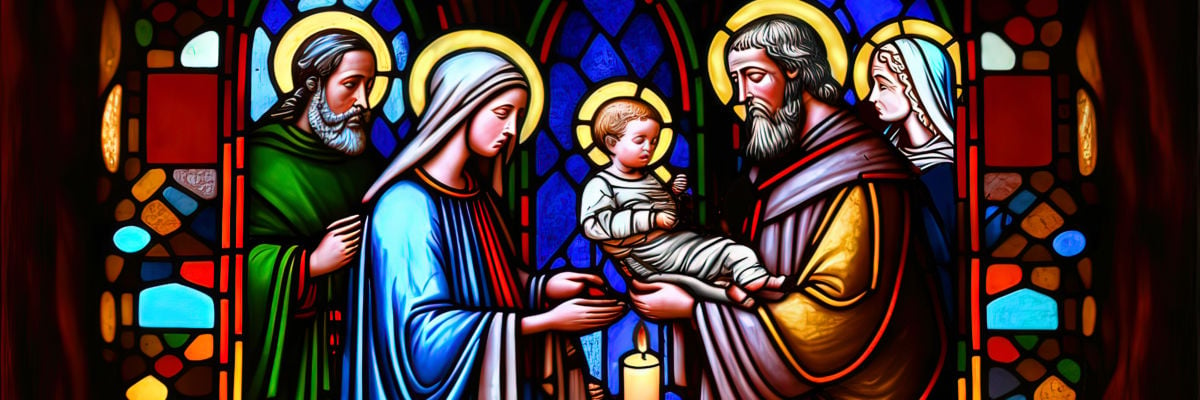
If Mary’s Immaculate, Why a Sin Offering? Why bother, unless she was 'unclean'?

Under the Law of Moses, forty days after the birth of a son, a woman would offer a “sin offering” in the Temple (Lev. 12:1-4). And so today, forty days after Christmas, we celebrate the Feast of the Presentation. Since this is the final Christmas-related feast, it’s also when people began looking for signs of spring, a practice that gave rise to Groundhog Day.

What exactly is going on today? And why is it so important? We’ll start by explaining the deeply Jewish background of the Feast of the Presentation, because without that, it’s hard to make sense of any of it.

For instance, there’s an ongoing debateabout whether the Holy Family was “middle class” or poor. Leaving aside the anachronistic nature of using “middle class” to describe anyone in the first century, the question is largely answered by Luke 2:24, which says that Mary’s offering in the Temple was “a pair of turtledoves, or two young pigeons.” What’s the significance of that? Ordinarily, a woman offered “a lamb a year old for a burnt offering, and a young pigeon or a turtledove for a sin offering” (Lev. 12:6). But “if she cannot afford a lamb, then she shall take two turtledoves or two young pigeons, one for a burnt offering and the other for a sin offering” (v. 8). In this case, the fact that Mary is offering two birds tells us that the Holy Family were poor enough that they couldn’t afford a lamb.

But we’ve just established that she’s offering a “sin offering” here in the Temple. Doesn’t that prove that Mary is a sinner, just like the rest of us? That’s how many Protestants read the passage. John MacArthur writes, “That Mary offered a sin offering is consistent with the reality that she was a sinner in need of a Savior. The Catholic dogma that Mary was immaculately conceived and lived a sinless life finds no support in Scripture.” And CARM’s Matt Slick asks, “If Mary was sinless, how could she also be unclean?”

So according to MacArthur and Slick, the Feast of the Presentation is all about Mary offering a sin offering to atone for the “sin” of . . . well, what, exactly? Giving birth to Jesus Christ? The obsession with trying to debunk the Catholic view of Mary has led these men into strange and impious places.

As you might have guessed, these Protestant objections are ignorant of the Jewish background to Luke 2. Let’s start with Slick’s question: “if Mary was sinless, how could she also be unclean?” Quite easily. Ritual impurity isn’t the same thing as being in a state of sin. As Jonathan Klawans explains in his book Impurity and Sin in Ancient Judaism, “sin does not produce ritual impurity, and ritual impurity does not render one sinful. Also ritual purification is not a part of the process of atonement.” Klawans further explains that ritual impurity is “generally natural and more or less unavoidable,” and “it is not sinful to contract these impurities.”

We see this distinction illustrated quite clearly in the parable of the Good Samaritan (Luke 10:25-37), in which the priest and Levite see a man on the road, wounded so badly that he appeared to be dead, and “passed by on the other side.” Why did they pass by? Because touching a dead body would render one ritually impure (Num. 19:13). By obsessing about ritual impurity, they were failing to treat the man with charity. Jesus is clear that the Samaritan, unconcerned with such matters, is the only one who treats the man lovingly.


Continued below.

In Defense of St. Francis Garden Statues

Recently I listened to a talk given at a Franciscan retreat center. I felt right at home among the colorful, sprightly paintings of St. Francis and St. Clare dancing joyfully with the sun and the moon. I had reverted to Catholicism while working at a Franciscan eco-spirituality center, and that is still a huge part of my faith life.

The speaker did not share that affinity. She opened her talk with “We all think of St. Francis as just a nice, hippy guy who talks to animals in the forest like some fairy tale princess, like on those garden statues you used to see everywhere. But he was actually a revolutionary.”

I paused. Where did that animosity come from?

Did she have a problem trusting the historical accuracy of saint hagiography? You can’t hold the Medieval imagination to the standard of our post-Enlightenment understanding of history.

I don’t think the umbrage is with any of those things. I hear comments like this enough that I’ve come up with possibly a too-analytical explanation of what is probably not meant to be dissected too thoroughly.

Are Men Allowed to be Nurturing?​


Continued below.

Faith-based organizations can now get funding for addiction recovery programs, HHS announces

U.S. Health and Human Services Secretary Robert F. Kennedy Jr. says faith-based organizations that meet evidence-based addiction recovery standards will now be able to access federal funding under the Trump administration’s new policy on tackling drug addiction and homelessness nationwide.

“We are bringing faith-based providers fully into this work,” Kennedy said at Prevention Day, the largest government-sponsored gathering dedicated to advancing the prevention of substance use, hosted by the Substance Abuse and Mental Health Services Administration on Monday.

“This is a chronic disease. It's a physical disease. It's a mental disease, it's an emotional disease. But above all, it's a spiritual disease. And we need to recognize that. And faith-based organizations play a critical role ... [in] helping people reestablish their connections to community.”

Continued below.

Filter

Forum statistics

Threads
5,883,421
Messages
65,495,991
Members
276,653
Latest member
GospelWitness