I think the Catholic church is not very big on Matthew Fox's teachings. That's why I am trying to understand this in light of Orthodox teaching.
Easy G. I should say I agree with what you are saying and you put it beautifully. I just wanted to stay within the bounds of traditional teaching. Hence, why I discounted Matthew Fox..for now.
My apologies for not being more clear in what I noted, as the Book reference I gave out was not meant to convey that I in ANY way support Matthew Fox in his teachings (seeing that he was brought up at one point in the book). The intention was to point to what the author noted on the early Fathers when it came to the subject of Panentheism and what philosophy has often said on it in general....
For some more direct articles on the issue, including what other Orthodox members have said on the matter:
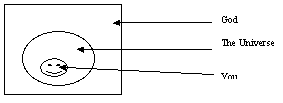
I truly do believe that panentheism implies a dualistic nature of God–one of transcendence and immanence. The immanent attributes include those applicable to the universe, namely Thought and Extension (following Spinoza). The transcendent attributes include those attributes applicable only to God, of which infinitely many exist, such as omniscience, omnipotence, omnibenevolence, atemporality, omnipresence, etc. It is a feature of panentheism and even Cartesian theism that the infinite is the unconditioned cause of the finite. And therefore the finite and its various modes and properties are not causally adequate to pose ontological threats (or logical contradictions) to the reality of the infinite and its various properties.
Panentheists make a qualitative, not quantitative distinction between God and the universe. Their position is very much like the idea of Divine Personalism, espoused as far back as the Book of the Wisdom of Solomon. In order to have a full view, there are different models you have to use simultaneously to capture what panentheists are talking about. One is a mother/womb analogy and another is a mind/body analogy. God’s character is perfectly good, and that character conditions the universe but doesn’t determine it. We can distinguish between the mind and the body without thinking them completely separate. A womb is within a mother, but we can make a distinction between a mother and the womb she contains. (What happens to the baby doesn’t necessarily ‘happen’ to the mother, though it affects the mother).
By the logic of many against Panentheism, if a person has cancer that cancer somehow becomes reflective of that person’s character, or implies that a person doesn’t have control over who they are as a person. IMHO, God’s mind and Spirit remain the ground of all that is good, and beautiful and ordered for that matter, even if it is true that the physical universe fails to perfectly reflect that goodness, or beauty, or order. God and the universe, for the panentheist do not form an UNDIFFERENTIATED unity.
In some ways, one could also see some descriptions of panentheism to be a description of "occasionalism", which posits that Theos is the sustaining cause of each and every moment of the cosmos' existence, as if the Theos were in fact creating the cosmos at each, smallest unit of time.



 .
.