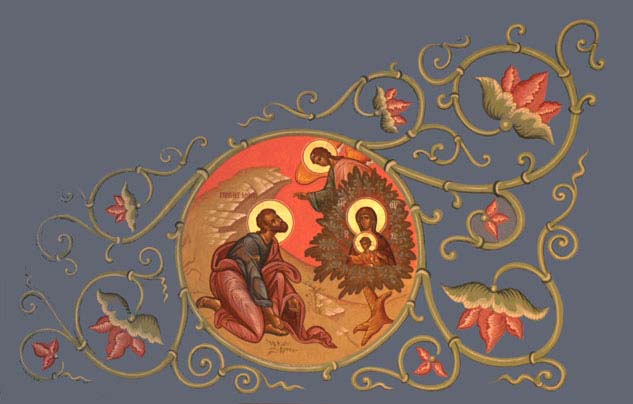
Certainly, one does not need icons to worship God, but they do enhance and focus that worship.

What you said reminded me of an experience I was able to have in October of 2011 with one Orthodox parish - known as
Saint Mary Coptic Orthodox Church of Atlanta. In my studies on Orthodoxy over the years, the Copts have always been one group that has fascinated me amongst others.
Having previous relationship/connection with them (as my priest had interacted the priest of that parish), we were invited to come again. My friends/familyWe got there earlier than the service began, so we sat in the sanctuary pews for prayer..awaiting till others got in. We were able to see what happened with the leaders practicing--and it was cool to see how it was mainly youths/children who were assisting with the songs. We later met with the priests who came in/greeted us...and I was very glad that they were warm people. The songs then commenced later on...and it was a bit difficult to keep up since it seemed that they went through many of the prayers/liturgy so quickly. Though we had assistance thankfully...and others helped us by showing us where in the prayer books we were to read. They also had things up on the screen---and they changed the service where the songs were sung in both English and Arabic/Egyptian.
The icons were truly stunning to behold - the prayers and the priests walking around with the incense was truly amazing--and I was so amazed at how much I felt the Spirit of God present when we were in prayer/worship. I've always found it amazing to see how Orthodox Worship is very much akin to what happened in the OT when it came to the temple/tabernacle and using physical actions and equipment to symbolize worship before the Lord---as in many churches, worship is reduced to how many songs one sings rather than seeing it as an interactive experience with all of one's senses.
I was very thankful to have done research prior to going
many Protestants or others who'd go and immediately think there was no precedence for what they were doing in their interactive worship format. But that'd be foolish since the Orthodox liturgy is in many ways a living continuity with the worship of Judaism (temple and synagogue) and the Early Church. Historically, early Christians preserved a continuity of worship from the Old Covenant to the New, employing elements from the Jewish Temple liturgy, the synagogue liturgy and the rituals of the Jewish home.
On that note, there are thankfully other places that have done good discussion on the ways liturgical circles actually reflect Jewish culture better than most...and for some good ones to go to:
And as one of my Messianic brothers said best on the ways Orthodoxy connects with Judaic practices:
Originally Posted by
Philothei

Originally Posted by
ContraMundum
Thanks for bringing this up...
I'll make a couple of corrections, in humilty, just to try to help.
Jews don't kiss the
Shema, we pray the
Shema. It's the name of a prayer. "
Shema" is the first word in the prayer "Hear oh Israel, Adonai is our God, Adonai is One" when prayed in Hebrew.
We kiss the Mezuzah, the Torah, our Tallit (prayer shawl), and other things. We have on an individual level more ritual than any Christian, except perhaps a Priest in an Orthodox liturgy. For example, at Pesach, we have over three hours of
ritual to get through, touching on such things as which way to lean when we eat, how quickly to eat certain courses, what questions are asked and so forth. We also have many, many customs about a myriad of other things.
Also, when one reads the Talmud regarding the Temple services, there is so much ritual and artwork in the place that the mind is both boggled and fascinated. What's more, there is found a huge amount of things the priests did in the Temple that is still done by priests from the Apostolic traditions to this day.
Furthermore, the modern-day "Messianic" Jews are not necessarily Jews. They are largely Gentiles who want to be like the Jews. True converted Jews have never elected those modern Protestant-ized denominations to speak for us and although there are Jews within those congregations, a lot of us are involved in Apostolic Christianity- for the obvious reasons that ancient Christianity is more like Temple era Judaism than a pentecostal church with lots of Jewish symbols.
Moving on...
After all of the prayers/liturgy were done, the priest came and shared his message---specifically, on Titus 3 and other scriptures discussing how Christians are to be peaceable/bless everyone since we're "children of the light." I wish I had written it all down--but it was very challenging.
One of the most powerful things he did was talk about how we live our lives today is to be in light of eternity since we're just passing through---and then he pointed to an Icon of Christ on top of the entrance to the sanctuary. It was a portait of the Lord in His resurrected state and returning in glory. When the priest was speaking, he noted how everyone was to look at the icon and remember that they were to leave the church and enter the world outside in the rememberance of their belonging to Christ---and that He would carry them through. More was said besides that--but that alone floored me...as well as his speaking on what it meant to respond differently as a Christian when the world chooses to fight back if wronged.
After the sermon was done, we had some very excellent time of fellowship with the people. I was very glad I was able to talk with the priest and have some wonderful discussion with him and find out more on some of the questions I had. Some things I learned from him was how iconagraphy in their church was something done because Egyptians at one point didn't have the written Word/Scriptures---and thus, pictures were needed to illustrate what the Bible said. It was cool to see since the ways I'd often seen iconagraphy was in the sense of reminders of what scripture notes and as an expression of worship---but I never saw it as something done for practical purposes of helping others learn when there no other outlets.
Coptic Icons have a very specific style of Coptic art that is used universally within the churches and involves others deliberately making them to look unrealistic and out of proportion... to some extent “cartoony” so as to differentiate the icons from idols and making sure nobody worships it or prays to the imagery directly.
Coptic artwork is truly stunning....and as an artist, I'd love to learn how to master the skill in doing such unto the Lord.
It's more than just pictures in a building - as it's about changing the atmosphere to make what happens on Earth appear like what's occurring in Heaven.
If I could make a book (or at least find one in existence) of the artistic design in many of the Coptic Orthodox churches--as well as Oriental Orthodoxy and E
astern Christian Iconagraphy in general--I'd buy it quickly.
So appreciative of the reality of what many within Orthodoxy understand (and those outside as well with the same mindset) when it comes to seeing how much art is apart of ministry unto the Lord - no more different than what occurred in the OT with artistic designs as a representation of the Heavenlies (
Exodus 26:1-3,
Exodus 35:34-35,
Exodus 31:1-10 ,
Exodus 36:7-9,
Exodus 39:26-28, etc ). I wish more were aware of the sheer importance of
Iconagraphy when it comes to worshipping Christ - but so many downplay what
Iconagraphy symbolizes whenever it seems that the focus is upon the saints gathering together and worshipping predominately in song or the ministry of the Word/Scriptures and Sacraments.
For some excellent places one can go for review as it concerns Coptic Iconagraphy and Coptic artwork :
For those that find Orthodox Icons beautiful---and
especially Coptic Icons---
they'll always be ready to face things...whereas those who don't appreciate it will find a way to demonize it somehow
But beauty is beauty - and thankful for other Coptic Icons made available to enhance the worship experience of others

.
Some of my favorites: