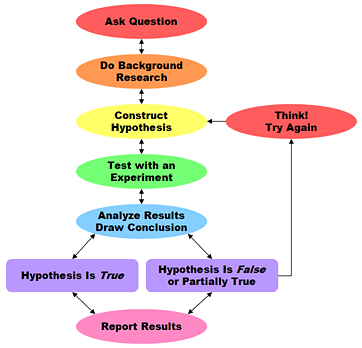
But it is also a false science that ignores its own methods of inquiry when the conclusins go against the initial bias of the "scientist,"... right?
Indeed. 'Science' is a method, while religion is more comparable to a series of claims - religion can have faulty methods and yet still have correct claims, so a religion with faulty methods isn't
necessarily 'false'. Bad science that leads to conclusions that just so happen to be right is still bad science - we criticise the methodology, not the conclusion (though, naturally, a conclusion born out of bad science is inherently untrustworthy until
good science comes along).
Personal bias is heavily criticised in peer-review, which is why scientists are extremely good at removing as much potential bias as possible. That's why we now have double-blind trials - we don't even trust ourselves not to give unconscious signals to, say, a psychic dowsing for the hidden water bottle.
For instance, the science educated people avoid the things I point out to them that support the bible reports tah actually can find scientific support.
You say 'avoid', I say 'easily refute'. Just because we don't agree with your forgone conclusions doesn't mean we're ignoring you.
They even argue that maybe their Big Bang was not an In the beginning.
It's a very common misconception, even among scientists, that the Big Bang is the beginning of the universe - there is no evidence of that whatsoever. As Professor Hawking says, we can treat it
as if it's the beginning, but, ultimately, it may well not be.
They avoid the uncanny mention of one Panthalassic Ocean around Panges as stated in Gen 1:9.
I can find no mention of any 'Panthalassic Ocean', nor any 'Panges', in Genesis 1:9 (which, in fact, states, "And God said, Let the water under the sky be gathered to one place, and let dry ground appear. And it was so").
Throw enough spaghetti at the wall, and some of it is bound to stick. Hinduism got the age of the universe broadly right (the Vedas say it is billions of years old), but that doesn't lend any credence to Hinduism. The Bible says a great many things, and I'm not surprised some of them allude to modern scientific knowledge.
They quibble that the Palnt Kingdom came before the Animal Kingdom evolved.
They "quibble"? It's pretty firmly established that plants first evolved before any animal walked (or swam) the Earth.
Yet I use the same scientific approach in this kind of analysis of thr bible, proposing a hypothesis about certain verses, and then verifying them with scince.
ZEach time this represents a process of building Theories that ought also be true as we read further on.
Your deluding yourself. Your method is taking an
a priori conclusion and looking for verses in the Bible that corroborate it, and then saying, "Aha! The Bible was right all along!". This can be done with any book, religious or not. I've seen many examples of alleged foreknowledge in the Qu'ran (the 'three viels' of gestation mirror the three stages of embryology, or so the Imams say). If you want to
really demonstrate the truth of the Bible, you have to reverse your process: make a prediction from the Bible and perform an experiment to test that prediction. If your prediction is borne out by the evidence, then that part of the Bible will be vindicated.
Some parts of the Bible are readily demonstrable - there really is a place called Egypt wherein the Pharaohs lived - but these are all, to a one, mundane. No supernatural phenomenon alleged to have occurred in the Bible (the stopping of the Sun, Balaam's talking donkey, Eden's talking serpent, etc) has thus far been verified. But, by all means, go right ahead.
No. In the kindest possible way, I really don't think you understand half the things you refer to. There's no real debate in the scientific community as to whether plants or animals came first.