• Starting today August 7th, 2024, in order to post in the Married Couples, Courting Couples, or Singles forums, you will not be allowed to post if you have your Marital status designated as private. Announcements will be made in the respective forums as well but please note that if yours is currently listed as Private, you will need to submit a ticket in the Support Area to have yours changed.

  • CF has always been a site that welcomes people from different backgrounds and beliefs to participate in discussion and even debate. That is the nature of its ministry. In view of recent events emotions are running very high. We need to remind people of some basic principles in debating on this site. We need to be civil when we express differences in opinion. No personal attacks. Avoid you, your statements. Don't characterize an entire political party with comparisons to Fascism or Communism or other extreme movements that committed atrocities. CF is not the place for broad brush or blanket statements about groups and political parties. Put the broad brushes and blankets away when you come to CF, better yet, put them in the incinerator. Debate had no place for them. We need to remember that people that commit acts of violence represent themselves or a small extreme faction.
  • We hope the site problems here are now solved, however, if you still have any issues, please start a ticket in Contact Us

  • The rule regarding AI content has been updated. The rule now rules as follows:

    Be sure to credit AI when copying and pasting AI sources. Link to the site of the AI search, just like linking to an article.

What is Science?

Tinker Grey

Wanderer
Site Supporter
Feb 6, 2002
11,817
6,375
Erewhon
Visit site
✟1,207,445.00
Faith
Atheist
Wouldn't you say that rather, science presupposes that there is a reality to be observed in the first place?

I was responding to post #10, which was:
If science can't prove it, does it cease to be reality?

As to your question, I might respond in the vein of "Cogito, ergo sum". If there is no reality, we wouldn't be having this conversation.
 
Upvote 0
J

Jazer

Guest
Science can't technically "prove" anything :p
I think we are looking for are predictable results. For example what are the odds that an airplane will land safely. One way to get the results we want is to have lots of back up systems. We want something to be fail safe. If we do not get what we paid for: IE a safe trip, then we may have grounds to recover a cash award from the airline.
 
Upvote 0

GrowingSmaller

Muslm Humanist
Apr 18, 2010
7,424
346
✟64,499.00
Country
United Kingdom
Faith
Humanist
Marital Status
Private
What is science? Does science have a "boundary" beyond in which there contains facts inaccessible to it?

For those that do, how to you justify it, and likewise, how do those that believe that there are facts beyond science justify it?
I would say science it the technology of true belief in empirical matters.
 
Upvote 0

RickG

Senior Veteran
Site Supporter
Oct 1, 2011
10,092
1,430
Georgia
✟128,873.00
Faith
Presbyterian
Marital Status
Married
overview_scientific_method2.gif


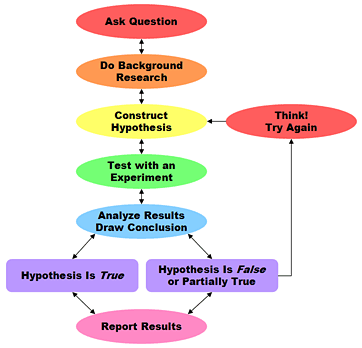
The important thing to understand about legitimate science is that it takes scientists to where it leads. False or pseudoscience begins with an answer and tries to fits bits of information to support that answer, ignoring all the information that does not support it.
 
Upvote 0

Wiccan_Child

Contributor
Mar 21, 2005
19,419
673
Bristol, UK
✟46,731.00
Faith
Atheist
Marital Status
In Relationship
Politics
UK-Liberal-Democrats
What is science?
The systematic acquisition of knowledge, through the mechanism of testing hypotheses and accruing evidence.

Does science have a "boundary" beyond in which there contains facts inaccessible to it?
As far as I'm aware, the absolute extreme boundary of scientific inquiry can be defined as encompassing everything that can, however indirectly, ultimately influence us. Stars fall within the purview of science because they give of light which, eventually, interferes with our eyes, allowing us to deduce the existence of said stars. Neutrinos are part of science because, although they don't interfere with us directly (pretty much), vast vats of water can detect them and relay that information to us.

If there is a type of particle that in no way can interfere with us - not by any chain of particle decay (such as with Kaons), not by any indirect tug of gravity (such as with dark matter), not by communicating with us directly (such as with aliens and pixies) - if such a particle exists, then it falls outside of the purview of science. Likewise, if we can infer something doesn't exist (such as purple elephants or leprechauns), it too would technically fall within the purview of science - we have, after all, systematically acquired knowledge, even if such knowledge is apophatic.

So, the boundaries of science are limited only to those things we can ever potentially infer exist or don't exist.

For those that do, how to you justify it,
For those that do... what?

and likewise, how do those that believe that there are facts beyond science justify it?
The possibility exists, however remotely, however untestably, that there is some thing whose existence or non-existence cannot be even indirectly inferred or deduced. Since it is logically impossible to rule out the existence or non-existence of such things (if you could, they'd fall within the purview of science), I must assert that science has boundaries.
 
Upvote 0

AgapeGrace

Saved by Gracee
Oct 31, 2011
128
19
England
✟22,895.00
Faith
Protestant
Marital Status
In Relationship
Politics
UK-Liberal-Democrats
overview_scientific_method2.gif


The important thing to understand about legitimate science is that it takes scientists to where it leads. False or pseudoscience begins with an answer and tries to fits bits of information to support that answer, ignoring all the information that does not support it.

unfortunately you could say that about religion too :/
 
Upvote 0

Wiccan_Child

Contributor
Mar 21, 2005
19,419
673
Bristol, UK
✟46,731.00
Faith
Atheist
Marital Status
In Relationship
Politics
UK-Liberal-Democrats
Any religion that dismisses, ignores or explains away evidence simply because it disagrees with what the religion says and not because of some specific flaw in the evidence itself is a false religion.
Surely a false religion is one that is, in whole or in part, wrong?
 
Upvote 0

AV1611VET

SCIENCE CAN TAKE A HIKE
Site Supporter
Jun 18, 2006
3,856,435
52,722
Guam
✟5,182,747.00
Country
United States
Gender
Male
Faith
Baptist
Marital Status
Married
Politics
US-Republican
Any religion that dismisses, ignores or explains away evidence simply because it disagrees with what the religion says and not because of some specific flaw in the evidence itself is a false religion.
That's what they told Noah when he was warning of impending doom, yet it had never rained before.
 
Upvote 0

Tiberius

Well-Known Member
Jun 28, 2005
6,032
116
47
✟6,911.00
Faith
Atheist
Marital Status
In Relationship
Surely a false religion is one that is, in whole or in part, wrong?

True, and if a religion was NOT wrong, it wouldn't need to:

dismiss evidence;
ignore evidence, or;
explain away evidence simply because it disagrees with what the religion says and not because of some specific flaw in the evidence.
 
Upvote 0

Wiccan_Child

Contributor
Mar 21, 2005
19,419
673
Bristol, UK
✟46,731.00
Faith
Atheist
Marital Status
In Relationship
Politics
UK-Liberal-Democrats
True, and if a religion was NOT wrong, it wouldn't need to:

dismiss evidence;
ignore evidence, or;
explain away evidence simply because it disagrees with what the religion says and not because of some specific flaw in the evidence.
Still, you want to be careful of falling into their trap. They like to promulgate the myth that atheists believe in "No evidence for X, therefore X doesn't exist/is false". Whatever underhanded tricks they may use, we shouldn't use that as proof positive that they're wrong.
 
Upvote 0
C

cupid dave

Guest
Surely a false religion is one that is, in whole or in part, wrong?


But it is also a false science that ignores its own methods of inquiry when the conclusins go against the initial bias of the "scientist,"... right?

For instance, the science educated people avoid the things I point out to them that support the bible reports tah actually can find scientific support.

They even argue that maybe their Big Bang was not an In the beginning.
They avoid the uncanny mention of one Panthalassic Ocean around Panges as stated in Gen 1:9.

They quibble that the Palnt Kingdom came before the Animal Kingdom evolved.

etc


Yet I use the same scientific approach in this kind of analysis of thr bible, proposing a hypothesis about certain verses, and then verifying them with scince.
ZEach time this represents a process of building Theories that ought also be true as we read further on.

Hypocritical???
 
Upvote 0

Wiccan_Child

Contributor
Mar 21, 2005
19,419
673
Bristol, UK
✟46,731.00
Faith
Atheist
Marital Status
In Relationship
Politics
UK-Liberal-Democrats
But it is also a false science that ignores its own methods of inquiry when the conclusins go against the initial bias of the "scientist,"... right?
Indeed. 'Science' is a method, while religion is more comparable to a series of claims - religion can have faulty methods and yet still have correct claims, so a religion with faulty methods isn't necessarily 'false'. Bad science that leads to conclusions that just so happen to be right is still bad science - we criticise the methodology, not the conclusion (though, naturally, a conclusion born out of bad science is inherently untrustworthy until good science comes along).

Personal bias is heavily criticised in peer-review, which is why scientists are extremely good at removing as much potential bias as possible. That's why we now have double-blind trials - we don't even trust ourselves not to give unconscious signals to, say, a psychic dowsing for the hidden water bottle.

For instance, the science educated people avoid the things I point out to them that support the bible reports tah actually can find scientific support.
You say 'avoid', I say 'easily refute'. Just because we don't agree with your forgone conclusions doesn't mean we're ignoring you.

They even argue that maybe their Big Bang was not an In the beginning.
It's a very common misconception, even among scientists, that the Big Bang is the beginning of the universe - there is no evidence of that whatsoever. As Professor Hawking says, we can treat it as if it's the beginning, but, ultimately, it may well not be.

They avoid the uncanny mention of one Panthalassic Ocean around Panges as stated in Gen 1:9.
I can find no mention of any 'Panthalassic Ocean', nor any 'Panges', in Genesis 1:9 (which, in fact, states, "And God said, “Let the water under the sky be gathered to one place, and let dry ground appear.” And it was so").

Throw enough spaghetti at the wall, and some of it is bound to stick. Hinduism got the age of the universe broadly right (the Vedas say it is billions of years old), but that doesn't lend any credence to Hinduism. The Bible says a great many things, and I'm not surprised some of them allude to modern scientific knowledge.

They quibble that the Palnt Kingdom came before the Animal Kingdom evolved.
They "quibble"? It's pretty firmly established that plants first evolved before any animal walked (or swam) the Earth.

Yet I use the same scientific approach in this kind of analysis of thr bible, proposing a hypothesis about certain verses, and then verifying them with scince.
ZEach time this represents a process of building Theories that ought also be true as we read further on.
Your deluding yourself. Your method is taking an a priori conclusion and looking for verses in the Bible that corroborate it, and then saying, "Aha! The Bible was right all along!". This can be done with any book, religious or not. I've seen many examples of alleged foreknowledge in the Qu'ran (the 'three viels' of gestation mirror the three stages of embryology, or so the Imams say). If you want to really demonstrate the truth of the Bible, you have to reverse your process: make a prediction from the Bible and perform an experiment to test that prediction. If your prediction is borne out by the evidence, then that part of the Bible will be vindicated.

Some parts of the Bible are readily demonstrable - there really is a place called Egypt wherein the Pharaohs lived - but these are all, to a one, mundane. No supernatural phenomenon alleged to have occurred in the Bible (the stopping of the Sun, Balaam's talking donkey, Eden's talking serpent, etc) has thus far been verified. But, by all means, go right ahead.

Hypocritical???
No. In the kindest possible way, I really don't think you understand half the things you refer to. There's no real debate in the scientific community as to whether plants or animals came first.

 
  • Like
Reactions: razeontherock
Upvote 0

Wiccan_Child

Contributor
Mar 21, 2005
19,419
673
Bristol, UK
✟46,731.00
Faith
Atheist
Marital Status
In Relationship
Politics
UK-Liberal-Democrats
If Jesus was born of a virgin and was crucified and resurrected, would you believe it?
That's a non sequitur, surely - whether we believe it or not is based on the evidence supporting that claim that he was, in fact, born of a virgin, etc. Asking "If X happened, would you believe it?" skips a crucial step: " - and there was sufficient evidence demonstrating that X did, in fact, occur - ". A thing can occur, yet end up having no evidence for it, so we have no reason to believe in it. Small events in ages past (such as the birth of a single, otherwise unimportant human at a nondescript point in human history) are unlikely to have any evidence for them. We know people were born in Bethlehem around 3BCE-4CE, but we have little evidence for any specific person, Christ included.

Important political figures, like Julius Caeser, generally have an abundance of evidence, but other people are generally only recorded by third-party historians, and only if they warrant recording. It may simply be that no one recorded Jesus' birth, death, or resurrection until long after the events, by which point such documentation becomes indistinguishable with myth and legend.

So, to answer your question, without further qualification: No, I wouldn't believe it. If sufficient evidence was presented, then yes, I would believe it. So the question then becomes: do you have any evidence for the birth, death, and resurrection of Jesus Christ?
 
Upvote 0
J

Jazer

Guest
lolProve there was a Noah.
Adam & Noah were very closely related. So they are considered to have the Cohen Gene. So we do have DNA evidence to back up the Bible and all the vast Jewish/Hebrew Tradition. The fact of the matter is if the Bible were not true then Science would have falsifed the Bible a LONG time ago. If Adam, Noah & Abraham were not real people then in the last 10 years all the new information we have on DNA would have falsifed the Bible. But all the studies and research on Genetics and Evolution and DNA confirms that the Bible is true.

I have just given you LOTS of evidence. I am willing to bet from past experance that you will give me NOTHING except to SAY NOT TRUE. That is not good enough on your part. I win the debate because I present abundant evidence, you lose because you present NOTHING other then a opinion. I have taken graduate level classes in debate, so I DO know the rules.

302433_163572983721461_100002062816270_348023_4622218_n.jpg


317129_163498140395612_100002062816270_347895_8236625_n.jpg


The Fertile Crescent, nicknamed "The Cradle of Civilization" for the fact the first civilizations started there, is a crescent-shaped region containing the comparatively moist and fertile land of otherwise arid and semi-arid Western Asia. The term was first used by University of Chicago archaeologist James Henry Breasted. Having originated in the study of ancient history, the concept soon developed and retains today meanings in international geopolitics and diplomatic relations.

In current usage the Fertile Crescent has a maximum extent and a minimum extent. All definitions include Mesopotamia, the land in and around the Tigris and Euphrates Rivers. The major nation in this region is Iraq, with small portions of Iran near the Persian Gulf, Kuwait to the south and Turkey in the north. More typically the Fertile Crescent includes also the Levantine coast of the Mediterranean, with Syria, Jordan, Israel, Lebanon and the West Bank. Water sources include the Jordan River. Finally, at maximum extent, the Fertile Crescent also may include Egypt and the Nile Valley within it.

The inner boundary is delimited by the dry climate of the Syrian Desert to the south. Around the outer boundary are the arid and semi-arid lands of the Zagros Mountains to the east, the Anatolian highlands to the north, and the Sahara Desert to the west.

The region was defined to be the cradle of civilization; it saw the development of many of the earliest human civilizations. Some of its technological inventions (but not necessarily first or uniquely) are writing, glass, and the wheel. The earliest known western civilizations manifestly arose and flourished using the water supplies and agricultural resources available in the Fertile Crescent. They were not necessarily the first or the only source of civilization, as Breasted believed. Moreover, plants and animals were not domesticated there, but in the surrounding nuclear area, where the original plant species still grow wild. There are several other known nuclear areas in the world, with which Breasted was not acquainted. wili

300px-Map_of_fertile_cresent.svg.png
 
Upvote 0