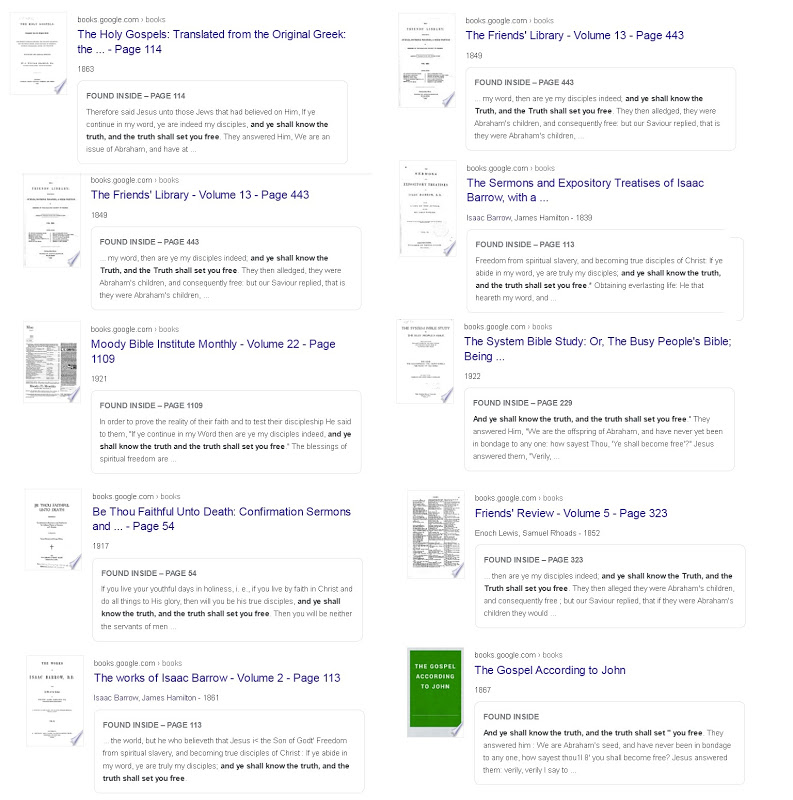
Oh, here's a little bit more residue if you care to look at it. All of these are the authorized version (KJV) I believe.
So I went and looked at all of these. Unfortunately, you don't give links, only images, so it took some effort to look these up--some of them I actually couldn't find with the exact title and dates listed, though they might have been adjusted. The amount of time it took to look all of this up, incidentally, is why this post comes so far after the post being replied to.
Anyway, you say you "believe" that they are all from the KJV, but some of these are obviously not the KJV if you actually look at them. I mean, the full title of the first one listed is "The Holy Gospels: Translated from the Original Greek: the the Spurious Passages Expunged; the Doubtful Bracketed; and the Whole Revised After the Texts of Griesbach, Lachmann, Tischendorf, Alford, and Tregelles : with Notes and Critical Appendix." That sort of by itself shows it's a different translation. If there was any doubt left it was a new translation, the first paragraph of the preface confirms as such.
Similarly, "The System Bible Study: Or, the Busy People's Bible" is a collection of several different writings, and the one that the quote comes from is an attempt at an "interwoven" Gospel, i.e. a combining of the four gospels into one narrative. It says in the preface for this portion "His work is based upon the original Greek text, following closely the Authorized Version [the KJV], occasionally using the Revised, very rarely departing from both." In other words, while it is based strongly on the KJV, it by its admission includes readings not found in it. Finally, "The Gospel According to John" doesn't specify who did the translation but it again is clearly a separate translation entirely from the KJV if you look at it.
Additionally, some of these are actually duplicates. You'll notice that, indeed, "The Friends Library - Volume 13 - Page 443" is listed TWICE! The exact same work shows up twice in the image, artificially increasing the number of examples.
Then we have cases where one work is included in different collections and thus is listed more than once, despite being the same work. The quote in the earlier Friends Library Volume 13 comes from a letter sent by John Fothergill... and that letter is also published in the Friends' Review Volume 5 (which I couldn't find on Google Books, but I was able to find it on archive.org). In other words, here we have ONE work, but it's erroneously listed three times on your list.
We also see this with "The Works of Isaac Barrow - Volume 2" and "The Sermons and Expository Treatises of Isaac Barrow." As you might have noticed by the title, these are both collections of things Isaac Barrow wrote, and thus both of these collections include the work that this occurs in (Sermon 4). Thus, this is actually one work that is present in two different collections. (I was not able to find the copy of "The Works of Isaac Barrow - Volume 2" that matched the picture you had... I found one with that title but it was of a different date and had the quote on a different page number. But in any event, the quote can be confirmed as being in Sermon 4)
So let's cut down the list a bit, and I'll even provide direct links for the convenience of people. "
The Holy Gospels: Translated from the Original Greek", "
The System Bible Study: Or, the Busy People's Bible", and "
The Gospel According to John" are all non-KJV translations and thus can be disregarded as any kind of witness to the text thereof.
As noted before, both instances of the
Friends' Library and also the
Friends' Journal (again, I had to link to archive.org because I wasn't able to find it on Google Books) are just the same writing, so this should be condensed to one. I'll refer to it as "John Fothergill's Letter."
Similarly, we have one sermon from Isaac Barrow in two separate collections (one of which was "
The Sermons and Expository Treatises of Isaac Barrow"), and should be condensed into one. This will be called "Isaac Barrow's fourth sermon."
Thus, when we excise full translations that are not the KJV as well as duplicates, we are left with only four works:
John Fothergill's Letter
Isaac Barrow's fourth sermon
Moody Bible Institute Monthly
Be Thou Faithful Unto Death
This obviously cuts down the number considerably. Now let us consider each in turn. The problem we come across is that we do not see evidence that they are constantly quoting the KJV. If their other references or quotations don't match the KJV, then there's logically no reason to assume that their usage of the statement of "the truth shall set you free" is them quoting directly from the KJV. It's possible they were influenced by the rendering of the KJV, but that's different from saying they were literally looking up the verse and writing down exactly what they saw. I suppose someone could try to claim that their other quotes that deviate from the KJV are
also from the "true" KJV and that's why they differ, but that's really just begging the question. Still, let's go through them.
John Fothergill's Letter: If we examine the context of the supposed quotation, we see that Fothergill is giving a description of the applicable section of John 8, but is not directly quoting from the KJV... or if he is, he's giving a rather loose rendering. For example, he starts with "If ye abide in my word, then are ye my disciples indeed" (KJV says "continue"). Heck, even the explicitly clear invocation of James 2:26 on the previous page differs from the KJV. Thus there really cannot serve as evidence for some original text of the KJV.
Isaac Barrow's fourth sermon: Like Fothergill, we can simply look at the other quotations he uses and see he his quotations do not match up with the KJV. Heck, immediately after he gives this rendition of John 8:32, he then invokes John 5:24 and John 20:31, in both cases deviating from the KJV rendering. All you have to do is look at his scriptural citations, compare them to the KJV, and repeatedly you'll see they don't match up exactly.
Moody Bible Institute Monthly: This one is harder to evaluate as the one-page article in question gives only one other scripture quotation, which does not match up with the KJV either ("whosoever committed sin is the bond servant of sin" in opposition to how the KJV renders it "whosoever committeth sin is the servant of sin"). This would indicate that the KJV is not being used here. There is also a bit on the lower right part of the page that appears to be from the KJV, but that seems to be an insert rather than part of the actual article. So again it would be a rather big assumption to assume that this was specifically invoking an exact quote from the KJV when the other quote is different also.
Be Thou Faithful Unto Death: The full title of this is "Be Thou Faithful Unto Death: Confirmation Sermons and Addresses by Lutheran Pastors in Germany and America. The sermon this quotes comes from is "Youthful Holiness", though in what's either a misprinting or an error in the digitalization, it inserts pages 130-131 between pages 46 and 47. But anyway, this one presents the best argument, as unlike the earlier ones, we do see a lot of quotes that are clearly straight from the KJV. However, there are some that differ. One being the verse in question, but on page 51 it renders 2 Thessalonians 3:10 as "he that will not work shall not eat" in opposition to the KJV's "if any would not work, neither should he eat". Similarly, it quotes Genesis 3:19 as "In the sweat of thy face shalt thou eat thy bread" but the KJV writes "in the sweat of thy face shalt thou eat bread". The latter is obviously a more minor change (simply adding the word "thy") but if we see these deviations, even in the same sermon, it leaves it dubious that we can simply assume every single quotation is supposed to be word-for-word directly from the KJV.
So ultimately, after we get rid of the duplicates and the things that are different translations altogether, we end up with a few documents that we really shouldn't be assuming are witnesses to the text of John 8:32 in the KJV due to them not matching the KJV in other verses used.
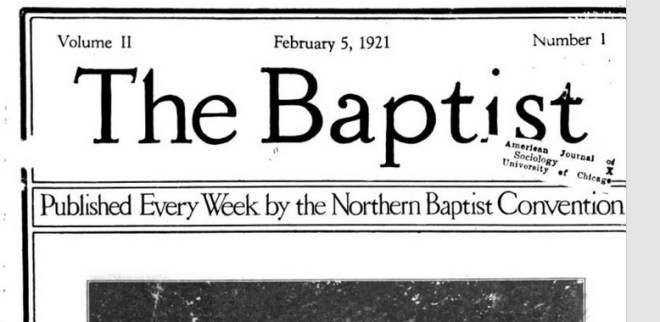
Originally I was only going to do the things in the above quoted post, but was still curious about what you wrote in the post above it in citing that "The Baptist" newspaper:
Oh, alrighty then. Let's deal with a bit of evidence from my Baptist brethren from 1921.
This is the Northern Baptist Convention newsletter with an exert from one of the articles. Take a look at what it says: (
please expand it, and read it)
Article 13 says: “There is a personal devil, a being of great cunning and power, the prince of the power of the air. . . . He shall ultimately be cast into the lake of fire and brimstone, and shall be tormented day and night forever.” The Moody Bible Institute accepting the statement of Christian faith set forth by the International Prophetic Conference has no reference to the personal devil. These are not Baptist institutions and yet they can disagree. I speak for myself. I accept neither statement. I am a Baptist. Tell me plainly what you propose to do to me. I and my Christian brothers and sisters believe what Christ said : “Ye shall know the truth and the truth shall set you free.” Will you harm us because we will follow truth? Kalamazoo, Mich.
They used the King James, that's evident from reading this newsletter. Yet the exact quote can't be found in any English language bible anywhere. As of today, the verse reads "the truth shall
MAKE you free, not
SET you free. You don't find that in the least bit Odd???
________________________________
John 8:32 And ye shall know the truth, and the truth shall
make you free. 8:33 They answered him, We be Abraham’s seed, and were never in bondage to any man: how sayest thou, Ye shall be
made free?
________________________________
This verse in 'it’s original form' was the basis for the song, “He Set Me Free” by the song writer, Albert E. Brumley in 1939.
Again no link is provided, but for convenience of the readers I'll note it is found
here, on page 567. The statement is claimed that "they used the King James, that's evident from reading this newsletter." But it's not. The context of the quote of "the truth shall set you free" is that it's a letter to the editor from a
reader; even if the writers of the newspaper exclusively used the KJV renderings (and looking through it, they don't seem to have always done so)
, it doesn't mean someone who wasn't a writer for the newspaper did so. Even if the reader used the KJV, it hardly means that they actually opened up the book to make sure they got the exact quote right. And if we're going to be invoking that newspaper for supposed proof of the original text of the KJV in how this verse is rendered, I should note that "Ye shall know the truth, and the truth shall make you free" is found on page 701.
Not sure if any of this was useful to people... but because I actually went in and looked at this stuff, I thought it might be helpful for people to know of what I found. You can take it or leave it.