Ah, I see !
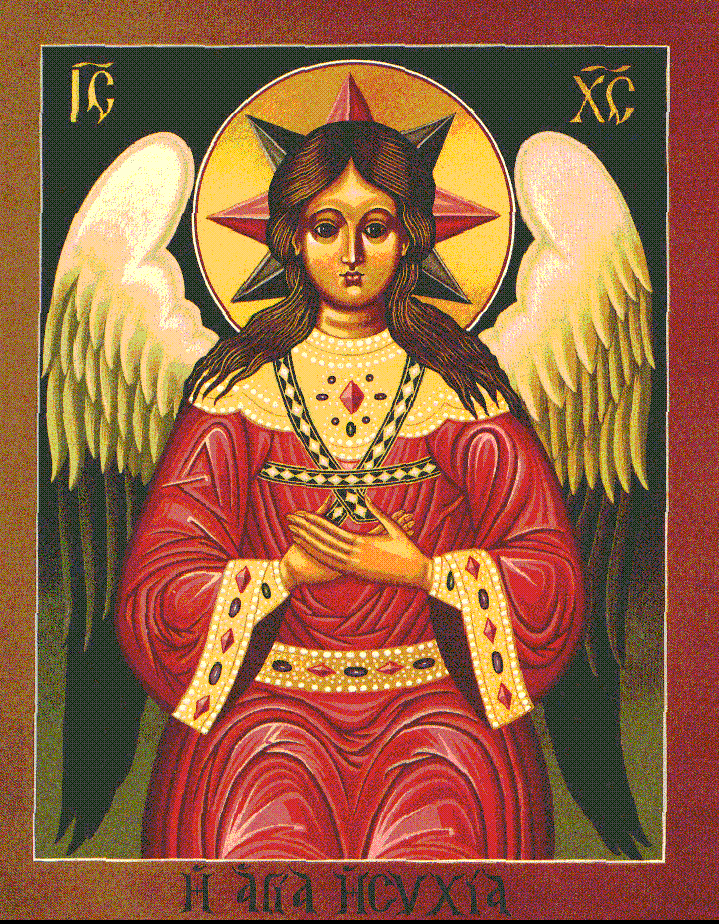
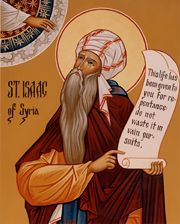
I think this is part of why there are "rules" governing the making of icons (and canonical vs. non-canonical icons).
About a decade ago, a monastery that called itself Orthodox (but with no canonical links) was selling "Orthodox Icons". I have to say, I didn't much like these and found them deeply "creepy". (Before I entered the Church, I admit I liked them, and had one of Archangel Michael iirc. By the time we had entered the EO, I had given this to my parents; they contacted an EO monastery about the icon, and were told they could post it to the monastery to be burned.) When more info. was found out about this business, the Orthodox vendors in the US stopped carrying their products en masse.
Seen that before - and it's truly a trip how you can have the imagery of something which seems legitimate...yet the spirit behind it can make one very unsettled and thus suspicious that there's more going on that the imagery itself in certain cases. Had it where I also went to a book store for a monastery I visited - and in the store, although it was a good experience overall being there, there were several things my priest noted to me to be careful of since it seemed there was also some things bordering on new-age focus within the store itself.
And with some of the icons (as well as statues), it simply didn't fit right.
As you recall (if you recall), had this happen to me once with a girl I was teaching at school whose parents were Orthodox.
Having friends/family in Greek Orthodox and working with other Orthodox already, I noted to her that the aspect of symbolism in Divine Liturgy/Orthodox experience isn't the same as magical charms to chase things away...and when she started to say Greek Orthodox believe in such things (as well as praying the Rosary) and she explained on how she had other members buy some kind of dust that was prayed over to use in helping her keep away ghosts she saw/saying it work (even though the family members who bought it were SIMULTANEOUSLY involved in witchcraft and magic), I had to note that it was still something she needed to be cautious of..
The same dynamic is present with icons when people note being able to talk to the saints/carry on a conversation with them and yet they don't even read scripture noting where them sleeping around is considered a sin (as they may be doing) - thus contaminating the experience the icons were meant to have since it has led them to have a false sense of reality and not even seeing where it may be demonic what's going down at times rather than truly prayer to the Lord.
Another non-Orthodox Icon vendor had also became quite popular; when the catalogue came I showed it to a friend who worked at the parish bookstore. She found them so repulsive, she wouldn't even look at the catalogue further. As I investigated more closely, I noticed the descriptions given re: "Orthodox Saints" - clearly wrong. Yet she knew just by looking.
Indeed. Just as it can be with prophecy or tongues or any other gift, there can be a negative version of it even if it seems similar - and that's not to say that variation of contexualization can never occur for new developments of course....for styles in iconagraphy has changed in differing circles (some being more life-like whereas others are more cartoon like as with the Coptics ) - but there's something about what actually is prayed that makes a difference.
Part of the reason why there was such a focus on the objects one obtained in the OT and not keeping them in many cases due to how others had prayed on spirits to act as Trojan Horses on items which seemed innocent - and yet God said to not keep it since spiritual rules STILL applied even if one had no intention of doing wrong.
For more specifics,
The special case of 1 Corinthians 10:14-22/1 Corinthians 10:6 14Therefore, my dear friends, flee from idolatry. 15I speak to sensible people; judge for yourselves what I say. 16Is not the cup of thanksgiving for which we give thanks a participation in the blood of Christ? And is not the bread that we break a participation in the body of Christ? 17Because there is one loaf, we, who are many, are one body, for we all partake of the one loaf. 18Consider the people of Israel: Do not those who eat the sacrifices participate in the altar? 19Do I mean then that a sacrifice offered to an idol is anything, or that an idol is anything? 20No, but the sacrifices of pagans are offered to demons, not to God, and I do not want you to be participants with demons. 21You cannot drink the cup of the Lord and the cup of demons too; you cannot have a part in both the Lord's table and the table of demons. 22Are we trying to arouse the Lord's jealousy? Are we stronger than he?
Clearly, Paul thought it possible for a Christian to become a "sharer" or "partner" with demons. The word he uses here is
koinonia = fellowship, communion with. It is the same word used in v. 16 for our sharing in or fellowshiping with Christ at His table! What does this mean? Is he referring merely to "agreement with" or the "holding of a common purpose with" Christ and/or a demon? Is it merely a description of external attendance at a pagan feast? Or does Paul have in mind a more active sharing of an internal spiritual bond or link or fellowship with a demon?
His point seems to be that when you sit to worship at the table of the Lord, or conversely, in the presence of idols, you open yourself to the power and influence of one or the other. There is a sharing of an intimate spiritual experience, an association of sorts, a relationship that is personal and powerful. But does it entail inhabitation by a demon?
Quote:
Acts 19:2
13Some Jews who went around driving out evil spirits tried to invoke the name of the Lord Jesus over those who were demon-possessed. They would say, "In the name of Jesus, whom Paul preaches, I command you to come out." 14Seven sons of Sceva, a Jewish chief priest, were doing this. 15(One day) the evil spirit answered them, "Jesus I know, and I know about Paul, but who are you?" 16Then the man who had the evil spirit jumped on them and overpowered them all. He gave them such a beating that they ran out of the house naked and bleeding.
17When this became known to the Jews and Greeks living in Ephesus, they were all seized with fear, and the name of the Lord Jesus was held in high honor.
18Many of those who believed now came and openly confessed their evil deeds. 19A number who had practiced sorcery brought their scrolls together and burned them publicly. When they calculated the value of the scrolls, the total came to fifty thousand drachmas.[
d] 20In this way the word of the Lord spread widely and grew in power.
__________________
When we do some things "just for fun" (such as going to a palm reader or a fortune teller or listening to a song with death/negative lyrics), when we cast spells and hexes "just for fun" while playing fantasy games such as Dungeons and Dragons or Pokemon, when we listen to certain songs and consider them to be harmless, etc., we are entering dangerous territory. Demons don't care if we were just kidding or "just having fun." If we invoke their language or dabble in their realm then they may become active in our life. Consider a prisoner of war who says, "I was just joking around, having some fun. I didn't
mean for you to capture me!" That's what it is like when we naively play games or listen to songs which are associated with the demonic realm, no matter how "harmless" these things may seem to us.
And icons are just as subject to this as anything.....hence, why we have to ask if there are demonic icons or icons that can be made with the wrong spirit - or icons that were made with the RIGHT spirit but used for the WRONG intent, leading to a demonic encounter and a tainting of the icon by the attitude of the person touching it/using it to try connecting to the spiritual realm.
If you own any artwork that has occult symbols or pictures of pagan gods or goddesses on them, WE are to be aware that these may be more dangerous than you realize. Idols are associated with demons in Scripture, and the Israelites in the Old Testament were told over and over to smash and completely destroy all sacred images and idols from other cultures. Notice carefully what God's attitude is toward any artwork or objects associated with pagan beliefs:
"Speak to the Israelites and say to them: 'When you cross the Jordan into Canaan, drive out all the inhabitants of the land before you. Destroy all their carved images and their cast idols, and demolish all their high places.'" (Numbers 33:51-53)
"This is what you are to do to them: Break down their altars, smash their sacred stones, cut down their Asherah poles and burn their idols in the fire." (Deuteronomy 7:5)
"Destroy completely all the places on the high mountains and on the hills and under every spreading tree where the nations you are dispossessing worship their gods. Break down their altars, smash their sacred stones and burn their Asherah poles in the fire; cut down the idols of their gods and wipe out their names from those places." (Deuteronomy 12:2-3)
"They made him jealous with their foreign gods and angered him with their detestable idols. They sacrificed to demons, which are not God" (Deuteronomy 32:16-17)
"They worshiped their idols, which became a snare to them. They sacrificed their sons and their daughters to demons." (Psalm 106:36-37)
"Consider the people of Israel: Do not those who eat the sacrifices participate in the altar? Do I mean then that a sacrifice offered to an idol is anything, or that an idol is anything? No, but the sacrifices of pagans are offered to demons, not to God, and I do not want you to be participants with demons." (1 Corinthians 10:18-20)
We can clearly see in these passages that there are demons behind pagan idols and gods. When people sacrificed to the gods they were sacrificing to demons (see 1 Corinthians 10:18-20 above), and God commanded the Israelites to completely destroy all objects and artwork associated with these foreign gods. This was an act of spiritual warfare against the demonic realm, and we would be wise to destroy and get rid of any objects in our homes which are associated with the things in the list above. This simple act of destroying such objects and renouncing the spirits attached to them and dedicating the home and family to the Lord has brought freedom to families which were afflicted with strife in the home or afflicted with a string of "accidents" or illnesses, and so on. Unfortunately, modern Christians tend to be very naive when it comes to the spiritual realm, and we place ourselves in potential danger when we associate ourselves with anything having to do with pagan gods, goddesses, idols, vows, oaths, curses, etc.
There are many ministries that have CD Burning events where they burn all CDs by musicians that are ungodly.....AND the same thing can also apply to icons if they were made in the WRONG spirit - or with the wrong intent.