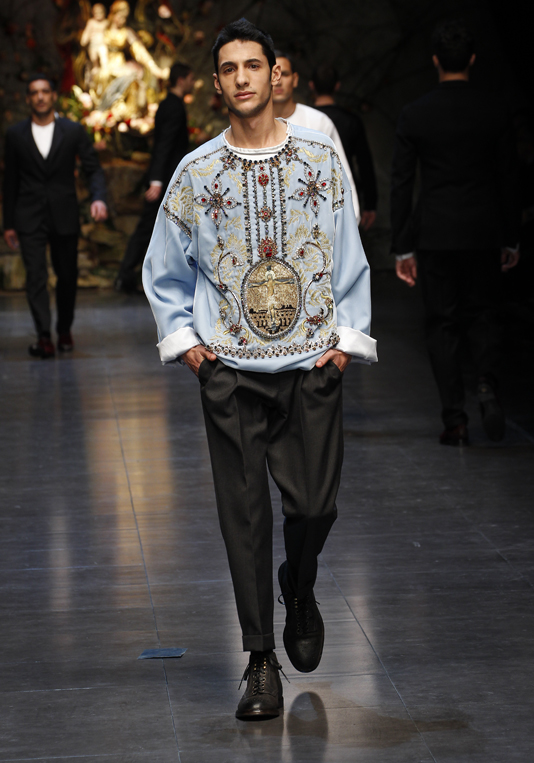
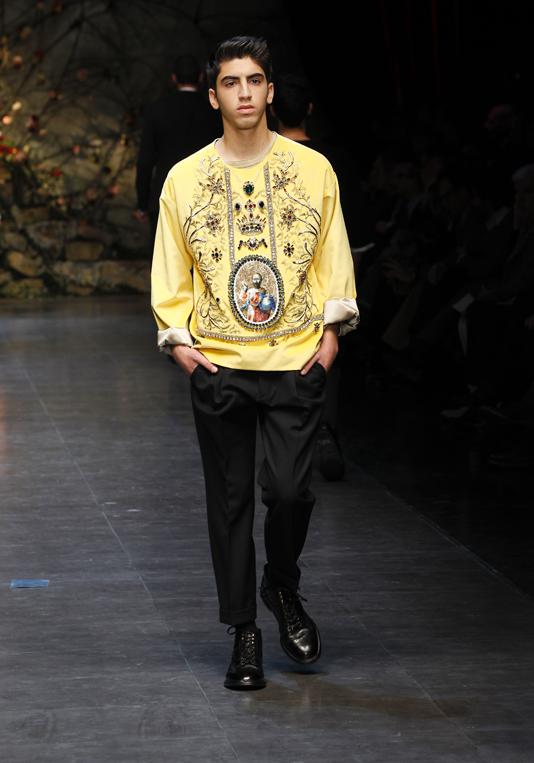
Interesting topic for the OP.
I was JUST talking with an Orthodox priest on the issue when talking about how culture loves those things which are beautiful - even if they may use them outside of beautiful goals and associate them with ugly lifestyles. And I told the man that I'd bet money that there's gonna come a day when fashion styles in Hip Hop/Pop culture will have it where the vestments used and icons utilized will be what the musicians wear at their concerts...and that there'd probably come a day when vestments or icons used in a religious sense would be taken for their asthetic/beautiful appeal and used for everyday fashion.
With the fashion show, the shirts for the men stood out to me, as it was captivating:
But prayerfully, it doesn't turn into something where folks begin wearing the shirts with icons on them like a lot of folks do when wearing shirts that have pictures of Christ on it and yet those folks are not even saved.


With the Icons, something that I did find interesting in the "Hidden and Triumphant" book was seeing how Iconography flourished in spite of the government restrictions/attacks on religion itself. It seemed ironic for the government to be against the ways others were supporting icons, first deeming it to be superstition that influenced people...and then seeking to wipe it out...
and yet choosing, for some odd reason, to allow the then current icons to be housed in the museums thereby relegating them to art so as to remove their religious significance. It was as if the government realized that the only way they could destory the power of icons/the stories they tell and the Savior they ultimately point to (Christ) was to simply have it where they made the icons seem like ordinary artwork alone.
Much of what the government did with taking icons/seeking to "normalize" them seems similar to what many in the world have sought to do with Christ when seeing that it's fultile to get others to not love/revere him or believe he doesn't exist---and thus, they switch to trying to make him a mere historical figure and say he was just a "good teacher" or someone with great ideas who is to be respected. The entire dynamic with attempting to bring greatness down to levels where it's no longer considered as it was meant to be...and effectively, finding a way to "own" what was meant to be in control.
This tends to happen with anything artistic in general - be it what happens in the world of paintings/drawings or music and anything else the culture tries to get a hold of in order to control how others see things. Germany sought to do so with controlling the music that was present and so did Russia after the Russian Revolution and ensuring that some things never got out of control.
As Sister Thekla once said to me on the issue:
I do think that the 'gutting' of the Arts is part of our culture's problems. As one Orthodox bishop pointed out, Art is the repository of what is valuable in a culture (and prepares the sensibility for spirituality). Gut Art, and culture is diminished as well as the sense of the spiritual. This, I think, is a US problem -- Nazi Germany and the USSR banned, our culture instead makes Art non-existent (shallow). A note on the "museum" relocation of the spiritual in the USSR; my college professor used to travel to the USSR frequently, and moved in the underground Christian communities there. He noted that believers would visit museums (they did this to the monasteries as well), lag behind the tour group, pray and reverence the icons. His book "The Illuminating Icon" (Anthony Ugolnik) might be of interest to you.