
• Starting today August 7th, 2024, in order to post in the Married Couples, Courting Couples, or Singles forums, you will not be allowed to post if you have your Marital status designated as private. Announcements will be made in the respective forums as well but please note that if yours is currently listed as Private, you will need to submit a ticket in the Support Area to have yours changed.

  • CF has always been a site that welcomes people from different backgrounds and beliefs to participate in discussion and even debate. That is the nature of its ministry. In view of recent events emotions are running very high. We need to remind people of some basic principles in debating on this site. We need to be civil when we express differences in opinion. No personal attacks. Avoid you, your statements. Don't characterize an entire political party with comparisons to Fascism or Communism or other extreme movements that committed atrocities. CF is not the place for broad brush or blanket statements about groups and political parties. Put the broad brushes and blankets away when you come to CF, better yet, put them in the incinerator. Debate had no place for them. We need to remember that people that commit acts of violence represent themselves or a small extreme faction.
  • We hope the site problems here are now solved, however, if you still have any issues, please start a ticket in Contact Us

How big should the USA get?

Status
Not open for further replies.

susanann

Senior Veteran
Nov 5, 2005
4,432
178
✟28,020.00
Faith
Christian
Even California can not afford its current population:

------------------------------------------------


[SIZE=+1]California's hidden deficit[/SIZE]
SFGate.com ^ | 3/16/06 | Editorial


Over the past four decades, health-care premiums have grown dramatically, as has the extent of coverage the state has promised to retirees and their spouses or domestic partners. Today, the state is paying $738 a month to cover the premiums of a fully vested 60-year-old retiree and his or her spouse. The state's overall health-care outlay for retirees is approaching $1 billion a year.

But the strain on today's budget would be far greater if our elected leaders in Sacramento were willing to face up to the true cost of the promises they are making to state employees. ...

In other words, the state is not setting aside a dime to provide retirement-health care to today's workers, even though 35 percent to 45 percent of them are expected to retire in the next decade, with the cost of insurance expected to keep rising.

Starting next year, the federal government is going to require state and local governments to do what corporations have been doing as a standard accounting practice since 1990 -- include their future retiree-health benefits on the books.

The state is going to be in for quite a shock.
According to a recent Legislative Analyst's Office report on this ominous, but heretofore hidden, growth in the cost of government, the state's unfunded liability for future retiree health-care costs could reach $70 billion or more over the next 30 years. ... Outrageously, the loud alarm from this report generated little more than a shrug from most of the people in power in Sacramento.
 
Upvote 0
susanann

Senior Veteran
Nov 5, 2005
4,432
178
✟28,020.00
Faith
Christian
Praetor said:
Aerospace-Susanann mentioned that the mining of exploration wasn't profitable. With today's technology she might be right. However, we didn't have the technology to go to the moon in 1960 when JFK announced we were going to the moon. So we launched a crash program to go to the moon and in 8 years we were there. We can research, develop and mass produce the technology to get us to the moon, establish a colony there, and mine the moon of its raw materials.

Missions to the moon were curtailed over thirty years ago largely because there is nothing of value on the moon, just a bunch of gray sand and rocks, and apparently nothing else to be learned by going there.

Even if the moon were made of uranium, it wouldn't be economically feasible to go there to look for "potential new sources of energy", as some have proposed.

A rudimentary, stripped-down Moon base and supplies might weigh 200 tons. (The winged "orbiter" part of the space shuttle weighs 90 tons unfueled, and it's cramped with food, oxygen, water, and power sufficient only for about two weeks.) Placing 200 tons on the Moon might require 400 tons of fuel and vehicle in low-Earth orbit, so that's 600 tons that need to be launched just for the cargo part of the Moon base. Currently, using the space shuttle it costs about $25 million to place a ton into low-Earth orbit. Thus means the bulk weight alone for a Moon base might cost $15 billion to launch: building the base, staffing it, and getting the staff there and back would be extra. Fifteen billion dollars is roughly equivalent to NASA's entire annual budget. Using existing expendable rockets might bring down the cargo-launch price, but add the base itself, the astronauts, their transit vehicles, and thousands of support staff on Earth and a ten-year Moon base program would easily exceed $200 billion.
-------------------------------------------------
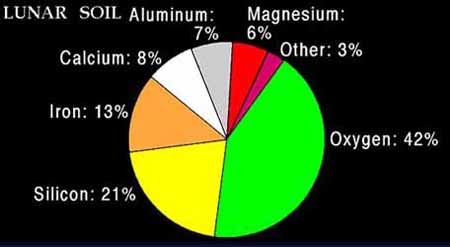
The NASA Apollo missions found that Lunar soil is composed of oxygen, silicon, and metals such as iron and aluminum.

moonsoil.jpg
 
Upvote 0

Praetor

Regular Member
Feb 3, 2004
606
5
Washington DC Metro Area
Visit site
✟23,276.00
Faith
Christian
Marital Status
Single
Politics
US-Others
LogicChristian and Susanann:

Given we just ascertained that China and India are economic powerhouses, their consumption of Iron, Aluminum, and silicon is surley going to increase. I'm not sure there will be enough aluminum to go around between the three world powers so we may have to import aluminim from the moon.

Ang given 40% of lunar rock is oxygen, that is an ingredient for self sufficency of a lunar colony. Given there is ice on the Moon, that will take care of the colony's initial water needs. Food can be grown in lunar greenhouses which would also recycle CO2 into Oxygen. Solar Panels manufactured from silicon on the Moon can meet the colony's energy needs. Lunar factories can manufacture everything the colony needs for survival.

Moreover, the Moon won't necessarily be a mine for materials for export to Earth but to low Earth orbit where it iwll be used to build orbital space stations, self-sufficient space colonies, and sattelite solar power stations (SSPS). The SSPS will in turn harness the sun's solar energy in low Earth orbit and beam it to collectors on Earth in the form of microwaves where the collectors will convert the waves into electricity for consumption or refining freshwater and hydrogen fuel from the oceans to meet America and the world's water and energy needs.

And the lunar labortories (with 1/6 Earth gravity) and the Zero-G labortoties in space can synthise new compunds and products that can't be synthesized on Earth or with great difficulty due to ever-present gravity. To think cures for Cancer, AIDS, MS, ALS and other diseases may be discovered in these labortories. To think of all the new industries that can be spawned in space that will add to the wealth of the USA.

And you are still talking in terms of today's rechnology. We can still develop new technology to bring down the costs of space colonization. The effort would be a "science driver" for the economy which would lead to new discoveries, new products, new resources, new industries, new jobs, new wealth and a higher quality of life.

The lunar colony will also be a springboard to other planets in the solar system that posess new land and treasures for the American people and the people of Earth.

But you want to talk about a real population problem. What about the population of the world? The world currently has 6.2 billion people. By the year 2050, the world will have ten billion people. Initially, we will probably solve the problem by colonizing the oceans and rebuilding cities worldwide to house more people. The world's oceans will probably be home to another 30 billion people. But when the world hits 40 billion, were going to have to look off-Earth to feed and house the population of humanity.
 
Upvote 0

Praetor

Regular Member
Feb 3, 2004
606
5
Washington DC Metro Area
Visit site
✟23,276.00
Faith
Christian
Marital Status
Single
Politics
US-Others
Here are the facts about the American economy from the CIA World factbook.


Economy - overview:

The US has the largest and most technologically powerful economy in the world, with a per capita GDP of $41,800. In this market-oriented economy, private individuals and business firms make most of the decisions, and the federal and state governments buy needed goods and services predominantly in the private marketplace. US business firms enjoy considerably greater flexibility than their counterparts in Western Europe and Japan in decisions to expand capital plant, to lay off surplus workers, and to develop new products. At the same time, they face higher barriers to entry in their rivals' home markets than the barriers to entry of foreign firms in US markets. US firms are at or near the forefront in technological advances, especially in computers and in medical, aerospace, and military equipment; their advantage has narrowed since the end of World War II. The onrush of technology largely explains the gradual development of a "two-tier labor market" in which those at the bottom lack the education and the professional/technical skills of those at the top and, more and more, fail to get comparable pay raises, health insurance coverage, and other benefits. Since 1975, practically all the gains in household income have gone to the top 20% of households. The response to the terrorist attacks of 11 September 2001 showed the remarkable resilience of the economy. The war in March/April 2003 between a US-led coalition and Iraq, and the subsequent occupation of Iraq, required major shifts in national resources to the military. The rise in GDP in 2004 and 2005 was undergirded by substantial gains in labor productivity. The economy suffered from a sharp increase in energy prices in mid-2005, but by late in the year those prices dropped back to earlier levels. Hurricane Katrina caused extensive damage in the Gulf Coast region, but had a small impact on overall GDP growth for the year. Long-term problems include inadequate investment in economic infrastructure, rapidly rising medical and pension costs of an aging population, sizable trade and budget deficits, and stagnation of family income in the lower economic groups.

GDP (purchasing power parity):
$12.37 trillion (2005 est.)

GDP (official exchange rate):
$12.77 trillion (2005 est.)

GDP - real growth rate:
3.5% (2005 est.)

GDP - per capita:
purchasing power parity - $41,800 (2005 est.)

GDP - composition by sector:
agriculture: 1%
industry: 20.7%
services: 78.3% (2005 est.)

Labor force:
149.3 million (includes unemployed) (2005)

Labor force - by occupation:
farming, forestry, and fishing 0.7%, manufacturing, extraction, transportation, and crafts 22.9%, managerial, professional, and technical 34.7%, sales and office 25.4%, other services 16.3%
note: figures exclude the unemployed (2005)

Unemployment rate:
5.1% (2005)
Population below poverty line:
12% (2004 est.)

Household income or consumption by percentage share:
lowest 10%: 1.8%
highest 10%: 30.5% (1997)
Distribution of family income - Gini index:
45 (2004)
Inflation rate (consumer prices):
3.2% (2005 est.)
Investment (gross fixed):
16.8% of GDP (2005 est.)
Budget:
revenues: $2.119 trillion
expenditures: $2.466 trillion, including capital expenditures of NA (2005 est.)

Public debt:
64.7% of GDP (2005 est.)

Agriculture - products:

wheat, corn, other grains, fruits, vegetables, cotton; beef, pork, poultry, dairy products; forest products; fish

Industries:
leading industrial power in the world, highly diversified and technologically advanced; petroleum, steel, motor vehicles, aerospace, telecommunications, chemicals, electronics, food processing, consumer goods, lumber, mining

Industrial production growth rate:
3.2% (2005 est.)
Electricity - production:
3.892 trillion kWh (2003)
Electricity - consumption:
3.656 trillion kWh (2003)
Electricity - exports:
23.97 billion kWh (2003)
Electricity - imports:
30.39 billion kWh (2003)
Oil - production:
7.61 million bbl/day (2005 est.)
Oil - consumption:
20.03 million bbl/day (2003 est.)
Oil - exports:
NA (2001)
Oil - imports:
NA (2001)
Oil - proved reserves:
22.45 billion bbl (1 January 2002)
Natural gas - production:
548.1 billion cu m (2001 est.)
Natural gas - consumption:
640.9 billion cu m (2001 est.)
Natural gas - exports:
11.16 billion cu m (2001 est.)
Natural gas - imports:
114.1 billion cu m (2001 est.)
Natural gas - proved reserves:
5.195 trillion cu m (1 January 2002)
Current account balance:
$-829.1 billion (2005 est.)
Exports:
$927.5 billion f.o.b. (2005 est.)
Exports - partners:
Canada 23%, Mexico 13.6%, Japan 6.7%, UK 4.4%, China 4.3% (2004)
Imports:
$1.727 trillion f.o.b. (2005 est.)
Imports - partners:
Canada 17%, China 13.8%, Mexico 10.3%, Japan 8.7%, Germany 5.2% (2004)
Reserves of foreign exchange and gold:
$86.94 billion (2004 est.)
Debt - external:
$8.837 trillion (30 June 2005 est.)
Economic aid - donor:
ODA, $6.9 billion (1997)
Currency (code):
US dollar (USD)
Exchange rates:
1 British pounds per US dollar - 0.5457 (2004), 0.6139 (2003), 0.6661 (2002), 0.6944 (2001), 0.6596 (2000); Canadian dollars per US dollar - 1.3014 (2004), 1.4045 (2003), 1.5693 (2002), 1.5488 (2001), 1.4851 (2000); Japanese yen per US dollar - 108.13 (2004), 116.08 (2003), 125.39 (2002), 121.53 (2001), 107.77 (2000); euros per US dollar - 0.8048 (2004), 0.8866 (2003), 1.0626 (2002), 1.1175 (2001), 1.08540 (2000)
Fiscal year:
1 October - 30 September
 
Upvote 0

LogicChristian

Well-Known Member
Aug 28, 2005
3,344
94
39
Saint Louis
✟26,502.00
Faith
Protestant
Politics
US-Others
Praetor said:
LogicChristian and Susanann:

Given we just ascertained that China and India are economic powerhouses, their consumption of Iron, Aluminum, and silicon is surley going to increase. I'm not sure there will be enough aluminum to go around between the three world powers so we may have to import aluminim from the moon.

How would this be more economically feasible than recycling aluminum on Earth? Heck, recycling aluminum is already a profitable enough industry to support transients. I'd love to see that done while having to pay hundreds of millions in fuel costs for spacecraft.
Praetor said:
Ang given 40% of lunar rock is oxygen, that is an ingredient for self sufficency of a lunar colony.
Given there is ice on the Moon, that will take care of the colony's initial water needs. Food can be grown in lunar greenhouses which would also recycle CO2 into Oxygen. Solar Panels manufactured from silicon on the Moon can meet the colony's energy needs. Lunar factories can manufacture everything the colony needs for survival.

That sounds all well and good, but how is that going to make the mining of aluminum economically feasible. Even if the colony can support itself with oxygen and water, they need food and machinery. That's going to require a lot of spacecraft, and a whole heck of a lot of fuel and an expensive launch appartus to get to the moon.
Praetor said:
Moreover, the Moon won't necessarily be a mine for materials for export to Earth but to low Earth orbit where it iwll be used to build orbital space stations, self-sufficient space colonies, and sattelite solar power stations (SSPS). The SSPS will in turn harness the sun's solar energy in low Earth orbit and beam it to collectors on Earth in the form of microwaves where the collectors will convert the waves into electricity for consumption or refining freshwater and hydrogen fuel from the oceans to meet America and the world's water and energy needs.

Again, that sounds cute, but you've ignored the fact that the technology to do this is no where near deployable right now, and that establishing all of this would be vastly more expensive than even the lunar program.

How are you going to get Americans to pay for this? That's the central question I have about just about every one of your party's goals, and you've never managed to answer it in any kind of manner that would demonstrate an understanding of economics, or even of basic arithmetic.
Praetor said:
And the lunar labortories (with 1/6 Earth gravity) and the Zero-G labortoties in space can synthise new compunds and products that can't be synthesized on Earth or with great difficulty due to ever-present gravity. To think cures for Cancer, AIDS, MS, ALS and other diseases may be discovered in these labortories. To think of all the new industries that can be spawned in space that will add to the wealth of the USA.

Again, are these laboratories just going to build themselves? How much is it going to cost to import all that material from Earth.

Do you have any idea whatsoever the costs involved here?
Praetor said:
And you are still talking in terms of today's rechnology. We can still develop new technology to bring down the costs of space colonization. The effort would be a "science driver" for the economy which would lead to new discoveries, new products, new resources, new industries, new jobs, new wealth and a higher quality of life.

The problem is, you can't just make plans and pray technology catches up to your schemes. That's why SDI failed, and why Bush's vision of a Mars landing is seriously lagging.

The fact you haven't even listed an estimate of what this all costs demonstrates yet again that while your goals are lofty, you have no clue as to how you might acheive them.
Praetor said:
But you want to talk about a real population problem. What about the population of the world? The world currently has 6.2 billion people. By the year 2050, the world will have ten billion people. Initially, we will probably solve the problem by colonizing the oceans and rebuilding cities worldwide to house more people. The world's oceans will probably be home to another 30 billion people. But when the world hits 40 billion, were going to have to look off-Earth to feed and house the population of humanity.

Hate to tell you this, but the world isn't running out of space, and furthermore, birth rates are declining at a faster and faster pace. At the rate we're going, we're probably not going to make it much past 10-12 billion, and given the rate of increase in food production, we can keep up with that.

Anyway, if you want to look impressive, don't just make up a bunch of goals you think everyone will like the sound of. Instead, tell us how you'd actually get things done. If you were able to list a single dollar amount for all the stuff you've proposed, your arguments might sound halfway logical.
 
Upvote 0

Praetor

Regular Member
Feb 3, 2004
606
5
Washington DC Metro Area
Visit site
✟23,276.00
Faith
Christian
Marital Status
Single
Politics
US-Others
LC-you might want to tell Susanann that world population is going to decline because she thinks America is already overpopulated. If America is overpopulated, I hate to see how the rest of the world is faring because the world is experience more population pressure than we are at the moment.

We still have to have recycling of aluminum of course. I wouldn't go as far to say recycling is profitable for transients otherwise we wouldn't have a transient problem because then they would be able to afford places to live. But witht he way aluminim is going to be consumed by industrializing nations like India and China, aluminum demand will be at a point where recycling alone will not be sufficient.

SSPS will hapen after the lunar colony is developed. While the moon is farther away, it will still be cheaper to manfuacture the components of SSPS in lunar factories, launch them to low Earth orbit by mass drivers, and assemblining SSPS in low Earth orbit. Reason being is because of the 1/6 gravity of the moon.

We may have to raise taxes, or borrow to pay for this program. However, this space colonization program will make back many fold what we would put into space colonization. I can't give specific amonunts. But you can imagine that all the new products, new industries, new technological advancements, and new resources unleashed by space colonization will be much more valuable to the American economy than what we put into it.

As for all of our programs, they will pay for themselves in the long run. Rebuilding America's infrastructure will not just facilitate commerce, rebuilding America's infrastructure will not just employ ten million people at living wages rebuilding America, rebuilding America's infrastructure will also create demand for American Iron and Steel which will put millions of Americans back to work in the steel mills. Building a high-speed rail network will put hundreds of thousands of Americans to work building magnalev rails and railcars.

Oh, by putting people back to work rebuilding America, policing America, educating America, defending America, and building that space colonization apparatus you spoke of, that means millions of people we no longer have to pay unemployment and SSI checks to. That means millions of families that would be lifted out of poverty and millions of children that will no longer qualify for AFDC checks. Instead of benefits recipients, these Americans will become taxpayers. Also, because these millions are put back to work, they in turn are able to buy more goods and services which in turn creates even more demand and makes industry expand its capacity and hire even more people. Also, these same Americans will also become investors as all these Americans will have their money set aside in a public or private savings-investment plan.

What I am saying is the programs we propose aren't just spending programs, they are investing programs.
 
Upvote 0

LogicChristian

Well-Known Member
Aug 28, 2005
3,344
94
39
Saint Louis
✟26,502.00
Faith
Protestant
Politics
US-Others
Praetor said:
LC-you might want to tell Susanann that world population is going to decline because she thinks America is already overpopulated. If America is overpopulated, I hate to see how the rest of the world is faring because the world is experience more population pressure than we are at the moment.

I don't think I have to tell her that, I think she can read my post for herself.

Praetor said:
We still have to have recycling of aluminum of course. I wouldn't go as far to say recycling is profitable for transients otherwise we wouldn't have a transient problem because then they would be able to afford places to live. But witht he way aluminim is going to be consumed by industrializing nations like India and China, aluminum demand will be at a point where recycling alone will not be sufficient.

It's profitable enough for them to dig through the trash and fill shopping carts with them. There's obviously at least some money in it, and that money is worth at least some of their work.

Aluminum is easily recyclable, and as yet, I haven't read about any crisis regarding an aluminum shortage. Moreover, there's no economical way to extract it from the moon.

Praetor said:
SSPS will hapen after the lunar colony is developed. While the moon is farther away, it will still be cheaper to manfuacture the components of SSPS in lunar factories, launch them to low Earth orbit by mass drivers, and assemblining SSPS in low Earth orbit. Reason being is because of the 1/6 gravity of the moon.

And where are those mass drivers to launch them? Oh yeah, they don't exist. Do you have any earthly idea what they would cost to develop and build?

Where's the fuel going to come from to boost all of that into low earth orbit?

Again, your plans seem lofty, but you don't even have a clue as to the costs involved.

Praetor said:
We may have to raise taxes, or borrow to pay for this program. However, this space colonization program will make back many fold what we would put into space colonization. I can't give specific amonunts. But you can imagine that all the new products, new industries, new technological advancements, and new resources unleashed by space colonization will be much more valuable to the American economy than what we put into it.

How will colonization make more money than we put into it?

All that new technology is nice, but you don't even have an estimate of how much that will be worth compared to what we put into it? Sorry buddy, but as we learned with the space shuttle, blowing billions of programs and just assuming that they'll pay off in the long run doesn't fly in today's society.

I think you need to read up a little on the history of NASA and the costs of space travel.

Praetor said:
As for all of our programs, they will pay for themselves in the long run. Rebuilding America's infrastructure will not just facilitate commerce, rebuilding America's infrastructure will not just employ ten million people at living wages rebuilding America, rebuilding America's infrastructure will also create demand for American Iron and Steel which will put millions of Americans back to work in the steel mills. Building a high-speed rail network will put hundreds of thousands of Americans to work building magnalev rails and railcars.

And while creating all those make work jobs sounds nice, what are you going to do with all the employees once the infrastructure is built up? Why will it create demand for American iron and steel when that can be purchased more cheaply overseas?

Why are you so desperate to spend taxpayer money on projects the taxpayers don't find economically worthwhile?

Praetor said:
Oh, by putting people back to work rebuilding America, policing America, educating America, defending America, and building that space colonization apparatus you spoke of, that means millions of people we no longer have to pay unemployment and SSI checks to.

No, instead of SSI, you have the government paying full salaries to people it doesn't necessarily have the cash to pay those salaries to. While it sounds all well and good that these people have jobs, where is the money going to come from to pay them? Are you going to increase taxes on the poor folks that already have jobs? Or are you just going to print more money?

That means millions of families that would be lifted out of poverty and millions of children that will no longer qualify for AFDC checks. Instead of benefits recipients, these Americans will become taxpayers. Also, because these millions are put back to work, they in turn are able to buy more goods and services which in turn creates even more demand and makes industry expand its capacity and hire even more people. Also, these same Americans will also become investors as all these Americans will have their money set aside in a public or private savings-investment plan.
Praetor said:
What I am saying is the programs we propose aren't just spending programs, they are investing programs.

The problem is, the government doesn't have all that money to "invest," and neither do the people of the United States. You can either cripple the economy by charging people more taxes, or you can raise inflation by printing more money, but that's about it.

Praetor, the problem is, you saying investment program rather than spending program doesn't change the fact that you'd have to spend money on these programs. The fact is, you have absolutely no clue where that money is coming from, and you haven't been able to show me any fact you've dug up that would make me think otherwise.

Before you tell us why we should be mining the moon, maybe you and everyone else in your party should go take some classes in economics.
 
Upvote 0

susanann

Senior Veteran
Nov 5, 2005
4,432
178
✟28,020.00
Faith
Christian
Praetor said:
Rebuilding America's infrastructure will not just facilitate commerce, rebuilding America's infrastructure will not just employ ten million people at living wages rebuilding America, rebuilding America's infrastructure will also create demand for American Iron and Steel which will put millions of Americans back to work in the steel mills.


That is funny!!

But please...... no more jokes, because we cant tell when you are serious and when you are joking.
 
Upvote 0

Super Gnat

Take my hand, precious Lord, and lead me home
Sep 15, 2003
998
49
41
Cleveland, Ohio--Go Cavs!
Visit site
✟31,409.00
Faith
Protestant
Marital Status
Single
Another thing, Praetor, is that your four-year military draft is incompatible with growing the scientific and engineering communities. I mean, I think about myself. Went to college at 17, graduating at 21, and now I'm looking at 5 more years of graduate school to earn my MS and PhD in biomedical engineering. I'll be 26 before I get out of school. With one-year drafts, as countries such as Israel have, that'd be 27, which isn't *such* a big deal. But with a four year draft, I'd be 30 years old before I ever got to enter the industry. Not to mention that it's very difficult to go back to school even after one year of doing other things. With four years... I mean, honestly, I don't know if I'd go back. I'd either end up with a BS in biomedical engineering and end up selling prosthetics, or I'd go into another field entirely. How would you fix this? Would people like me get waivers, or what?
 
Upvote 0

Praetor

Regular Member
Feb 3, 2004
606
5
Washington DC Metro Area
Visit site
✟23,276.00
Faith
Christian
Marital Status
Single
Politics
US-Others
Were actually considering reducing the requirement from four years to two. And some members of our party proposed drafting people at ages 25 and above as opposed to age 18. I may be inclined to be in support of a mandatory tw0-year stint of federal service. I'm not so sure about raising the draft age to 26.

However, Super Gnat, you may actually be able to qualify for a comission in the Navy or Air Force with a biomedical engineering degree and be engaged in either research or application of biomedical engineering.


Susanann-what is so funny? I don't understand your joke. You think it is preferable to see people on welfare or unemployment lines as opposed to the steel mills.

LC-I forgot to add one more stipulation to our policy.

Anyone who does business with the USG, may it be building roads, bridges, power plants, railways, rail cars, must purchase all their machines and materiel from factories based in the USA. That means all steel used to build bridges must be manufactured here in the USA. All cables for power lines must be manufactured here in the USA and so on.

The Mass-Drivers are in the conceptual stage right now but it doesn't mean they can't be built. And the mass-drivers are for the Moon, not Earth-side.

And the initial fuel will be expensive. Even if we use nuclear reactors to refine hydrogen from seawater. However, once SSPS is in orbit, the energy costs are going to drop. The USA will be an exporter of energy once SSPS is operational.
 
Upvote 0

susanann

Senior Veteran
Nov 5, 2005
4,432
178
✟28,020.00
Faith
Christian
Praetor said:
Susanann-what is so funny? I don't understand your joke. You think it is preferable to see people on welfare or unemployment lines as opposed to the steel mills.

The United States cannot compete with foreign countries in the production of steel, which is why there arent any steel companies left in Pennsylvania anymore.
 
Upvote 0

susanann

Senior Veteran
Nov 5, 2005
4,432
178
✟28,020.00
Faith
Christian
Super Gnat said:
Another thing, Praetor, is that your four-year military draft is incompatible with growing the scientific and engineering communities. I mean, I think about myself. Went to college at 17, graduating at 21, and now I'm looking at 5 more years of graduate school to earn my MS and PhD in biomedical engineering. I'll be 26 before I get out of school. With one-year drafts, as countries such as Israel have, that'd be 27, which isn't *such* a big deal. But with a four year draft, I'd be 30 years old before I ever got to enter the industry. Not to mention that it's very difficult to go back to school even after one year of doing other things. With four years... I mean, honestly, I don't know if I'd go back. I'd either end up with a BS in biomedical engineering and end up selling prosthetics, or I'd go into another field entirely. How would you fix this? Would people like me get waivers, or what?

First of all, I am against a draft because it is not freedom, and because if our country was ever attacked, if we thought it was worth saving, we would join up without needing to be drafted.

Secondly, losing 4 years will not stop you, because millions of men went thry ww2 and then went to college AFTER the war, and became quite successful. YOur statement of not being able to do it, doesnt fly.

However, on the other hand, while you are losing 4 years wasting your time in the military, chinese and Indian kids are finishing college and will be 4 years ahead of you - so you will never be able to compete with them.

Making American kids delay their education by 4 years while foreign kids are in college ( and many of them in our colleges) will just make things worse because our engineers will always have 4 less years experience than Indian or chinese engineers.

Making everyone spend 4 years in the military is just wasting everyone's 4 most productive years.
 
Upvote 0

LogicChristian

Well-Known Member
Aug 28, 2005
3,344
94
39
Saint Louis
✟26,502.00
Faith
Protestant
Politics
US-Others
Praetor said:
Anyone who does business with the USG, may it be building roads, bridges, power plants, railways, rail cars, must purchase all their machines and materiel from factories based in the USA. That means all steel used to build bridges must be manufactured here in the USA. All cables for power lines must be manufactured here in the USA and so on.
So in other words, you'll cripple them by forcing them pay more for items that might be inferior.

Why can't people buy the best products they can for the money? If the Japanese make a better widget for cheaper, what's wrong with giving them the money to do something more efficiently?

North Korea has a policy much like this, it's called Juche, or self-reliance. Look at the state of the North Korean economy today Praetor.

Praetor said:
The Mass-Drivers are in the conceptual stage right now but it doesn't mean they can't be built. And the mass-drivers are for the Moon, not Earth-side.

It does mean that it will take an unknown amount of time and money to build them, and an even longer amount of time to where they can be used for reliable and repeatable launches to the moon. If the Falconists plan on getting to power in 100 years, that might not be a problem.

Praetor said:
And the initial fuel will be expensive. Even if we use nuclear reactors to refine hydrogen from seawater. However, once SSPS is in orbit, the energy costs are going to drop. The USA will be an exporter of energy once SSPS is operational.

You have no idea how expensive though. It costs the government upwards of $10,000/lb to get something into Earth orbit. Even if these power stations only weighed 500 tons, that's $1 billion in launch costs alone per power station. And those power stations would likely weigh far more than 500 tons.

That's the problem, you Falconists are horrible students of history, economics, and arithmetics, but you expect America to bow before your fascist wishes as if you know how to govern better than anyone else. I'd be sickened if it wasn't so hilariously entertaining.
 
Upvote 0

susanann

Senior Veteran
Nov 5, 2005
4,432
178
✟28,020.00
Faith
Christian
Quote Originally Posted by: Praetor
quot-top-right-10.gif

Anyone who does business with the USG, may it be building roads, bridges, power plants, railways, rail cars, must purchase all their machines and materiel from factories based in the USA. That means all steel used to build bridges must be manufactured here in the USA. All cables for power lines must be manufactured here in the USA and so on.
quot-bot-left.gif


LogicChristian said:
So in other words, you'll cripple them by forcing them pay more for items that might be inferior.

Why can't people buy the best products they can for the money? If the Japanese make a better widget for cheaper, what's wrong with giving them the money to do something more efficiently?

.

Actually, a tariff system does work , if it is done properly - example: The United States from 1789 - the 1960's.

Our tariff system enabled the United States to become an industrial superpower, while letting foreigners do most of the financing of our government for nearly 2 centuries.

The fact is, that the United States had a tariff system until very recently, and until we started to get rid of it, the United States was the richest and most powerful nation on earth with the best jobs and the highest standard of living.

In "theory", free trade sounds good, but in reality it is not working.

Tariffs sound bad, but they worked.

And the reason for that, is because in the real world -you cannot really have "free trade". Free trade assumes equality with the countries you are trading with, and they are not free, they dont have the same rules we do, they do not have child labor laws, they do not have OSHA, they are not restricted on polluting, they do not allow free movement of labor, they do not allow free entry into (their) markets, etc.
 
Upvote 0

Super Gnat

Take my hand, precious Lord, and lead me home
Sep 15, 2003
998
49
41
Cleveland, Ohio--Go Cavs!
Visit site
✟31,409.00
Faith
Protestant
Marital Status
Single
susanann said:
First of all, I am against a draft because it is not freedom, and because if our country was ever attacked, if we thought it was worth saving, we would join up without needing to be drafted.

Secondly, losing 4 years will not stop you, because millions of men went thry ww2 and then went to college AFTER the war, and became quite successful. YOur statement of not being able to do it, doesnt fly.

However, on the other hand, while you are losing 4 years wasting your time in the military, chinese and Indian kids are finishing college and will be 4 years ahead of you - so you will never be able to compete with them.

Making American kids delay their education by 4 years while foreign kids are in college ( and many of them in our colleges) will just make things worse because our engineers will always have 4 less years experience than Indian or chinese engineers.

Making everyone spend 4 years in the military is just wasting everyone's 4 most productive years.
Sorry, I get the feeling I was being unclear. I'm not saying that it would be impossible for me to continue my education, and if I were drafted for something like an invasion onto US soil, I'd happily go. My own grandfather was able to finish high school and go to college thanks to the GI bill. However, I would be less likely to continue my education to the PhD level, based on my personality. I want to work; I don't want to be in school/military until I'm 30 years old. Heck, waiting until I'm 26 is a struggle, and I did seriously consider whether or not I wanted to make that committment. If I had to wait until I was 30, I almost certainly would not. I agree with the rest of what you're saying, of course.

Praetor: Er, I'm not sure I'd be comfortable with working on military applications. I suppose I could go to the PHS, but they're regulatory, and I probably wouldn't be able to do research or design work.
 
Upvote 0

LogicChristian

Well-Known Member
Aug 28, 2005
3,344
94
39
Saint Louis
✟26,502.00
Faith
Protestant
Politics
US-Others
susanann said:
Actually, a tariff system does work , if it is done properly - example: The United States from 1789 - the 1960's.

This completely ignores the US position of relative weakness or strengths as well as the trading policy of other nations

Our tariff system enabled the United States to become an industrial superpower, while letting foreigners do most of the financing of our government for nearly 2 centuries.

This completely ignores the global political situation from 1789-1898 as well as the global monetary situation from 1919 until the collapse of Bretton Woods. But I'd prefer not to steal Praetor's "thunder" at present.


susanann said:
The fact is, that the United States had a tariff system until very recently, and until we started to get rid of it, the United States was the richest and most powerful nation on earth with the best jobs and the highest standard of living.

The US was relatively the most powerful at the end of WWII, when our GDP made up over half of the planet's GDP. The problem is, poor nations don't stay poor forever if you allow them to compete in the global marketplace, and that is exactly what happened. The US might not be as powerful as it was in 1945 (though we are still by far the most economically and militarily powerful nation on Earth) but the world has benefitted greatly from free trade. More people have higher standards of living today than at any other time in the industrial era. Should we be more concerned about the US' well being alone, or the world as a whole?

Free trade is not a zero sum game.

susanann said:
In "theory", free trade sounds good, but in reality it is not working.

The US has gained more jobs than it has lost through free trade, and has kept inflation low and consumer goods cheap to boot. Also, free trade has allowed the US to export its culture and values abroad, spreading democracy better than any war ever did. So far, it looks like free trade is working extremely well.

susanann said:
Tariffs sound bad, but they worked.

If you mean, worked at keeping the majority of the world's population impoverished while keeping the US extremely wealthy in a relative sense, then yes, tariffs worked.

susanann said:
And the reason for that, is because in the real world -you cannot really have "free trade". Free trade assumes equality with the countries you are trading with, and they are not free, they dont have the same rules we do, they do not have child labor laws, they do not have OSHA, they are not restricted on polluting, they do not allow free movement of labor, they do not allow free entry into (their) markets, etc.

No, free trade does not assume equality. Free trade and liberalism assume that you cannot wholly export market capitalist values without ensuing political liberalization. This has been true in most cases throughout the world, from the United Kingdom to the People's Republic of China.
 
Upvote 0

JPPT1974

Happy New Year 2026 January Jumping!!
Mar 18, 2004
291,433
11,557
51
Small Town, USA
✟621,799.00
Country
United States
Gender
Female
Faith
Baptist
Marital Status
Single
Politics
CA-Conservatives
Teens are against a draft
And that is why they voted for Kerry
For fears that Bush would be drafting
I doubt he would ever think about a draft
Unless it was something like the Vietnam War!
 
Upvote 0

mhz

Member
Jan 16, 2006
7
1
✟22,632.00
Faith
Presbyterian
Marital Status
Single
Politics
US-Libertarian
To the OP:

As many have stated before, I think the US should get small, not larger. Many - if not most - US states would be good-sized nations in Europe or Africa. I seem to remember hearing that if California were to leave the Union, it (CA) would have the 7th largest GDP in the world (thus making it part of the G7).

I think, as people get more and more used to choices, they will start to question the top-heavy, one-size-fits-all Federal govt.
 
Upvote 0

Praetor

Regular Member
Feb 3, 2004
606
5
Washington DC Metro Area
Visit site
✟23,276.00
Faith
Christian
Marital Status
Single
Politics
US-Others
Susanann, the federal service requirement will apply to Chinese and Indian students who will study in the USA as well as the native-born American students. However, the Falconist Grand Council is now debating whether or not to reduce the stint of service from 4 years to 2.

Super Gnat:

Are you honestly going to stop pursuing something just because you hit a certain age. If you have a burning passion to pursue something, then you pursue it no matter how long it takes. If you let time and other obstacles deter you from your goal, then maybe you really don't have the burning passion for it.

And the thing about a stint of federal service is that it may provide young people with time to seriously think about what they want to do after their stint may it be to go to college or trade school or enter the labor force. In fact, they will be more focused after their stint of service.

But if everyone thinks drafting people in their early 20s is a bad idea, then maybe we should raise the draft age to 50 and draft people in their least productive years. If we do that, we will get everyone that escaped the draft in Vietnam as well as all the GenXers. ^_^
 
Upvote 0
Status
Not open for further replies.