• Starting today August 7th, 2024, in order to post in the Married Couples, Courting Couples, or Singles forums, you will not be allowed to post if you have your Marital status designated as private. Announcements will be made in the respective forums as well but please note that if yours is currently listed as Private, you will need to submit a ticket in the Support Area to have yours changed.

  • CF has always been a site that welcomes people from different backgrounds and beliefs to participate in discussion and even debate. That is the nature of its ministry. In view of recent events emotions are running very high. We need to remind people of some basic principles in debating on this site. We need to be civil when we express differences in opinion. No personal attacks. Avoid you, your statements. Don't characterize an entire political party with comparisons to Fascism or Communism or other extreme movements that committed atrocities. CF is not the place for broad brush or blanket statements about groups and political parties. Put the broad brushes and blankets away when you come to CF, better yet, put them in the incinerator. Debate had no place for them. We need to remember that people that commit acts of violence represent themselves or a small extreme faction.
  • We hope the site problems here are now solved, however, if you still have any issues, please start a ticket in Contact Us

  • The rule regarding AI content has been updated. The rule now rules as follows:

    Be sure to credit AI when copying and pasting AI sources. Link to the site of the AI search, just like linking to an article.

Pete's Quite Thread post

Pete Harcoff

PeteAce - In memory of WinAce
Jun 30, 2002
8,304
72
✟9,884.00
Faith
Other Religion
mark kennedy said:
I think it is fair to say that you will never admit what 6.44% of 42 million is and how it got there.

Given that I've seen the total mutation rate for humans estimated to be anywhere from 64 to 175 per individual, I don't think 6.44% difference of 42 million bps in a single chromosome is such a dramatic change.

Btw, where did you get this 6.44% number from?
 
Upvote 0

Pete Harcoff

PeteAce - In memory of WinAce
Jun 30, 2002
8,304
72
✟9,884.00
Faith
Other Religion
mark kennedy said:
I think in order for a mutation or any change to be fixed in the genome there would have to be a species wide event that excluded none of the descendants.

But if there was a population bottleneck (as there most certainly would have been), would you not agree that a particular genome could have been "fixed", regardless of whether or not it was strictly beneficial?

In the effective genome, absolutely! It's called the physiological cost of adaptation and if it costs more then it benefits it is eliminated by the force of natural selection. Some times I think creationists are doing themselves a diservice by opposing natural selection, the crucial line of proof is found in the costs of adaptive evolution.

So you think that beneficial mutations must occur on a per-nucleotide basis... hmmm, can you back that up with relevant scientific data?

What does one beneficial effect from a mutation cost in deleterious effects?

I would say this entirely depends on the mutation, organism, and selective factors involved.

What is the proportion of neutral effects as compared to deleterious and neutral effects?

Everything I've read suggests that the neutral mutation rate is far higher than the deleterious rate, for the total genome. But for the effective genome, I've seen diverging estimates. I'd argue that the jury's still out on that one.
 
Upvote 0

mark kennedy

Natura non facit saltum
Site Supporter
Mar 16, 2004
22,030
7,265
62
Indianapolis, IN
✟594,630.00
Gender
Male
Faith
Calvinist
Marital Status
Single
Politics
US-Democrat
Pete Harcoff said:
Given that I've seen the total mutation rate for humans estimated to be anywhere from 64 to 175 per individual, I don't think 6.44% difference of 42 million bps in a single chromosome is such a dramatic change.

Btw, where did you get this 6.44% number from?

Where did I get 5% of the differences being the result of indels and 1.44% being the result of single base substitutions?

"The conclusion is the old saw that we share 98.5% of our DNA sequence with chimpanzee is probably in error. For this sample, a better estimate would be that 95% of the base pairs are exactly shared between chimpanzee and human DNA. In this sample of 779 kb, the divergence due to base substitution is 1.4%, and there is an additional 3.4% difference due to the presence of indels. "

http://www.ncbi.nlm.nih.gov/entrez/...ve&db=pubmed&dopt=Abstract&list_uids=12368483
 
Upvote 0

Pete Harcoff

PeteAce - In memory of WinAce
Jun 30, 2002
8,304
72
✟9,884.00
Faith
Other Religion
mark kennedy said:
Where did I get 5% of the differences being the result of indels and 1.44% being the result of single base substitutions?

"The conclusion is the old saw that we share 98.5% of our DNA sequence with chimpanzee is probably in error. For this sample, a better estimate would be that 95% of the base pairs are exactly shared between chimpanzee and human DNA. In this sample of 779 kb, the divergence due to base substitution is 1.4%, and there is an additional 3.4% difference due to the presence of indels. "

http://www.ncbi.nlm.nih.gov/entrez/...ve&db=pubmed&dopt=Abstract&list_uids=12368483

So where did you get the 6.44% again? :scratch:
 
Upvote 0

mark kennedy

Natura non facit saltum
Site Supporter
Mar 16, 2004
22,030
7,265
62
Indianapolis, IN
✟594,630.00
Gender
Male
Faith
Calvinist
Marital Status
Single
Politics
US-Democrat
Pete Harcoff said:
But if there was a population bottleneck (as there most certainly would have been), would you not agree that a particular genome could have been "fixed", regardless of whether or not it was strictly beneficial?

Wow, you are now looking at real world conseqences of mutations and geologic isolation. Ok, when there is a bottleneck effect the number of alleles by definition acutal decreases so we can rule out adaptive evolution at this point. In the event that there is a marginal selective advantage it will probably only occur in a small minority and disappear when the species starts to make a comeback. I don't know where you thought you were going with this but a bottleneck effect is not a good thing Pete, its a bad thing, you know this right?


So you think that beneficial mutations must occur on a per-nucleotide basis... hmmm, can you back that up with relevant scientific data?

I can back this up with any relevant scientific data that addresses the effects of mutations on overall effective genomes and populations at large. We have looked at this from all kinds of different perspectives and you have yet to account for deleterious and neutral effects in proportion the ones you presume have beneficial effects.


I would say this entirely depends on the mutation, organism, and selective factors involved.

Of course it would but the overall effect as measured against the deleterious and neutral effect probably would not.


Everything I've read suggests that the neutral mutation rate is far higher than the deleterious rate, for the total genome. But for the effective genome, I've seen diverging estimates. I'd argue that the jury's still out on that one.

Yes, but in this one chromosome comparison the protein coding genes show a 20% difference. What do you suppose the number of deleterious and neutral mutations would have been in proportion to that?
 
Upvote 0

Pete Harcoff

PeteAce - In memory of WinAce
Jun 30, 2002
8,304
72
✟9,884.00
Faith
Other Religion
mark kennedy said:
Wow, you are now looking at real world conseqences of mutations and geologic isolation. Ok, when there is a bottleneck effect the number of alleles by definition acutal decreases so we can rule out adaptive evolution at this point. In the event that there is a marginal selective advantage it will probably only occur in a small minority and disappear when the species starts to make a comeback. I don't know where you thought you were going with this but a bottleneck effect is not a good thing Pete, its a bad thing, you know this right?

I'm saying that in a smaller population, genetic drift plays a greater roll. Therefore you can acheive fixation of certain genotypes, regardless of whether something is beneficial or not.

I can back this up with any relevant scientific data that addresses the effects of mutations on overall effective genomes and populations at large. We have looked at this from all kinds of different perspectives and you have yet to account for deleterious and neutral effects in proportion to you presumed beneficial effects.

I want you to back up the notion that beneficial mutations must occur on a per nucleotide basis. Can you do this? Yes or no?

Of course it would but the overall effect as measured against the deleterious and neutral effect probably would not.

What are you suggesting? That every population of organisms is going to mutate into extinction?

Yes, but in this one chromosome comparison the protein coding genes show a 20% difference. What do you suppose the number of deleterious and neutral mutations would have been in proportion to that?

I don't know the exact numbers, but the rates of deleterious and neutral mutations are far higher. Remember, I'm the one who suggested that the rate of beneficial mutations in protein-coding DNA was 1 in 625 000.

But the million-dollar question is: what's the effect on the evolving population? Can you ever answer that one?
 
Upvote 0

Manic Depressive Mouse

Active Member
Dec 1, 2004
327
14
39
✟23,039.00
Faith
Christian
Mark Kennedy said:
All single common ancestory does is eliminate theistic reasoning from evolutionary biology and it has no genetic basis in this crucial line of descent of homo sapeins from apes.
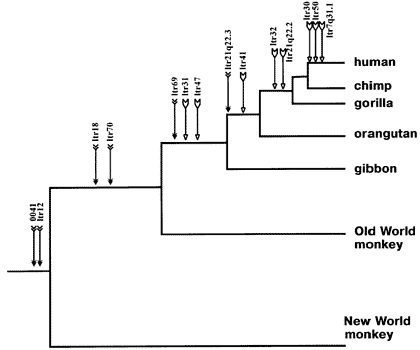
Only if you ignore ctytochrome c studies, transposons, redundant pseudogenes and most imporantly of all these babies:

retrovirus.gif


You'd be very hard pressed to find even a single geneticist that agrees with your statement Mark.

You've been asked on many occasions to stop making baseless assertions.

Are you ready to explain all the species of humans if humans can't speciate?

Mark Kennedy said:
I am still waiting you to account for the changes that led to the expansion of the human brain from on the size of the chimpanzee.

You do realise that the human brain size varies more than the difference in average brain size between humans and chimps, right? She doesn't have to account for anything, since we know changes of that magnitude are easily achievable, we observe bigger variations in humans right now.
 
Upvote 0

mark kennedy

Natura non facit saltum
Site Supporter
Mar 16, 2004
22,030
7,265
62
Indianapolis, IN
✟594,630.00
Gender
Male
Faith
Calvinist
Marital Status
Single
Politics
US-Democrat
Pete, I'm going to work but I'll get to your post this evening.

MDM, Just one thing...

Are you ready to explain all the species of humans if humans can't speciate?

If by human you mean homo sapein there is only one species of homo sapeins. If you know of two distict species of humans then by all means, do tell.
 
Upvote 0

Tomk80

Titleless
Apr 27, 2004
11,570
429
45
Maastricht
Visit site
✟36,582.00
Faith
Agnostic
mark kennedy said:
Pete, I'm going to work but I'll get to your post this evening.

MDM, Just one thing...


If by human you mean homo sapein there is only one species of homo sapeins. If you know of two distict species of humans then by all means, do tell.
Homo sapiens and Homo Neanderthal.
 
Upvote 0

Manic Depressive Mouse

Active Member
Dec 1, 2004
327
14
39
✟23,039.00
Faith
Christian
If by human you mean homo sapein there is only one species of homo sapeins.

Which Homo sapien are you talking about, Mark: Homo sapiens, Homo sapiens neanderthalensis or Homo sapiens sapiens?

And that's just the sapiens, what about the other homo species?
 
Upvote 0

mark kennedy

Natura non facit saltum
Site Supporter
Mar 16, 2004
22,030
7,265
62
Indianapolis, IN
✟594,630.00
Gender
Male
Faith
Calvinist
Marital Status
Single
Politics
US-Democrat
Pete Harcoff said:
I'm saying that in a smaller population, genetic drift plays a greater roll. Therefore you can acheive fixation of certain genotypes, regardless of whether something is beneficial or not.

The focus is on beneficial mutations and the consequences of high mutation rates. I don't think that the kinds of adaptations that are considered a fact of evolutionary biology in human descent from apes and ultimatly Gibbons are considered beneficial. My interest in the actual mechanisms that are used in nature that change the effective genome in a positive way.

I want you to back up the notion that beneficial mutations must occur on a per nucleotide basis. Can you do this? Yes or no?

I don't think I am following you here, whether it is a truncated alteration of an open reading frame or a single nucleotide base pair the amino acid sequence has to result in a functional protein. I know you probably think I have dismissed your string of abstracts on beneficial effects of mutations does interest me. I still think the term mutation has become a misnomer because there must be mechanisms that create adaptive evolutionary changes.

What are you suggesting? That every population of organisms is going to mutate into extinction?

What I am saying is that if you accept that 80% of the mutations that occur in the effective genome are deleterious that does not give you a lot of room speculate on an occasional benefical effect. That 1.6 mutations per sexual generation per genome replication gives me pause. High mutation rates would result in terrible disease and disorder and it is natural selection that is purging them from the genomes for that very reason.

I don't know the exact numbers, but the rates of deleterious and neutral mutations are far higher. Remember, I'm the one who suggested that the rate of beneficial mutations in protein-coding DNA was 1 in 625 000.

Just tell me one thing, if that 1 effect in 625,000 is beneficial what are the other 624,999 going to effect. Now, I don't think anyone would argue that something like an inhanced ability to withstand the ravages of disease is harmfull but is this the same thing as macroevolutionary morphology?

But the million-dollar question is: what's the effect on the evolving population? Can you ever answer that one?

The most common effect is nothing at all and they are purged through sexual reproduction as one of the mechanisms for removing them. That is why deleterious mutations don't threaten us with extinction, the enzymes and the crossing over of genes tends to eliminate them in bunches, I think its called truncated selection. In order for protein coding genes, regulatory gene, outliers...etc to be modified or altered in a beneficial way I expect it would have to be done in a simular fashion.

I am not talking about punctuated equilibrium here, punk eek is suggested to happen rather suddenly and conceivable in one generation. These supposed beneficial effects are still competing with truncated selection, deleterious, lethal and neutral effects. The thing is, for the beneficial effects to increase the deleterious effects will increase as well.
 
Upvote 0

Tomk80

Titleless
Apr 27, 2004
11,570
429
45
Maastricht
Visit site
✟36,582.00
Faith
Agnostic
mark kennedy said:
I am not talking about punctuated equilibrium here, punk eek is suggested to happen rather suddenly and conceivable in one generation.
Just wanted to pick out this. Punk eek is not suggested to be conceivable in one generation. It is suggested to happen suddenly on a geological timescale, not within a generation.
 
Upvote 0

gluadys

Legend
Mar 2, 2004
12,958
682
Toronto
✟39,020.00
Faith
Protestant
Politics
CA-NDP
mark kennedy said:
My interest in the actual mechanisms that are used in nature that change the effective genome in a positive way.

But you are looking in the wrong place. The mechanism which causes the mutation is not what makes it beneficial. The type of mutation it is (substitution, insertion, etc.) is not what makes it beneficial. Even the change in the protein is not what makes it beneficial.

"Beneficial" applies to none of these things. "Beneficial" applies to the effect of environmental conditions on the survival of the the organisms, and their descendants due to the expression (or non-expression) of the protein in the morphology/physiology/behaviour of the organism.

You cannot determine the benefit of a mutation by looking at its causal mechanism. You have to look at its effect on the proportional survival of organisms which express it as compared to organisms which do not.

You are so focused on the minutiae of mutations themselves that you are blind to the environment that they operate in.


I still think the term mutation has become a misnomer because there must be mechanisms that create adaptive evolutionary changes.

You are right. And those mechanisms are not mutations, but the mechanisms which regulate the distribution of mutations in the gene pool. Mutation is a perfectly good word to describe changes in DNA sequences, since "change" is the meaning of "mutation". But adaptation is more than a matter of changing DNA.


What I am saying is that if you accept that 80% of the mutations that occur in the effective genome are deleterious that does not give you a lot of room speculate on an occasional benefical effect.

Sure it does. Look at what happens to the survival rate of organisms afflicted by deleterious mutations as compared to other organisms in the population. What is happening to the other organisms, and to their contribution to the gene pool?

That 1.6 mutations per sexual generation per genome replication gives me pause. High mutation rates would result in terrible disease and disorder and it is natural selection that is purging them from the genomes for that very reason.

Now why can't you connect this thought with the one above. Yes, natural selection is purging these disease causing mutations. Not from the genome, though. From the gene pool. Are you clear on the difference between "genome" and "gene pool"?

Now since diseased and deformed organisms have their contribution to the gene pool reduced by purging, whose genes are taking their place? What kind of genes are surviving?


Just tell me one thing, if that 1 effect in 625,000 is beneficial what are the other 624,999 going to effect.

Nothing. They will be purged, remember. How can they have an effect when they are purged?


The most common effect is nothing at all and they are purged through sexual reproduction as one of the mechanisms for removing them. That is why deleterious mutations don't threaten us with extinction,

If you understand this, why do you keep raising it as a problem for evolution?

In order for protein coding genes, regulatory gene, outliers...etc to be modified or altered in a beneficial way I expect it would have to be done in a simular fashion.

Right, except that instead of being purged they are preserved and fixed, so that future changes have to be added to what is already fixed in the genome.

 
Upvote 0

Pete Harcoff

PeteAce - In memory of WinAce
Jun 30, 2002
8,304
72
✟9,884.00
Faith
Other Religion
mark kennedy said:
The focus is on beneficial mutations and the consequences of high mutation rates. I don't think that the kinds of adaptations that are considered a fact of evolutionary biology in human descent from apes and ultimatly Gibbons are considered beneficial. My interest in the actual mechanisms that are used in nature that change the effective genome in a positive way.

Then stop suggesting genome-wide changes require strictly beneficial mutations.

I don't think I am following you here, whether it is a truncated alteration of an open reading frame or a single nucleotide base pair the amino acid sequence has to result in a functional protein. I know you probably think I have dismissed your string of abstracts on beneficial effects of mutations does interest me. I still think the term mutation has become a misnomer because there must be mechanisms that create adaptive evolutionary changes.

It's a simple question. Do you think that every single nucleotide that has changed in protein-coding DNA requires its own unique beneficial mutation? IOW, do you think that the ratio of beneficial mutations to differences in protein-coding DNA on a per-nucleotide basis is 1:1?

What I am saying is that if you accept that 80% of the mutations that occur in the effective genome are deleterious that does not give you a lot of room speculate on an occasional benefical effect. That 1.6 mutations per sexual generation per genome replication gives me pause. High mutation rates would result in terrible disease and disorder and it is natural selection that is purging them from the genomes for that very reason.

First of all, I don't know if accept 80% as the rate of deleterious mutations (given that it's more than double what others have estimated; and even those estimates were high).

But even so, you yourself have factored in NS as a mechanism which purges the deleterious effects in a population. So what would happen to beneficial effects?

Just tell me one thing, if that 1 effect in 625,000 is beneficial what are the other 624,999 going to effect.

Neutral or deleterious.

Now, I don't think anyone would argue that something like an inhanced ability to withstand the ravages of disease is harmfull but is this the same thing as macroevolutionary morphology?

The mechanism for change is the same. It's just a matter of determining what effect it has on the phenotype in context of the environment.
 
Upvote 0

Loudmouth

Contributor
Aug 26, 2003
51,417
6,143
Visit site
✟98,025.00
Faith
Agnostic
mark kennedy said:
My interest in the actual mechanisms that are used in nature that change the effective genome in a positive way.

Firstly, what evidence led you to the conclusion that there has to be a separate mechanism for creating beneficial mutations?

Secondly, current theory states that the mechanism for creating beneficial mutations is analogous to the mechanism that produces lottery winners. That is, given enough mutations one of them has to be beneficial.

I still think the term mutation has become a misnomer because there must be mechanisms that create adaptive evolutionary changes.

There is a mechanism, changes made to the DNA code. The name for changes in DNA is called mutation.

What I am saying is that if you accept that 80% of the mutations that occur in the effective genome are deleterious that does not give you a lot of room speculate on an occasional benefical effect.

If 99.999999% of players lose a lottery, is it impossible for one to win? NO. If 80% of runners fall out of a marathon, does that mean no one will win? Of course not. Same applies to mutation rates.

That 1.6 mutations per sexual generation per genome replication gives me pause. High mutation rates would result in terrible disease and disorder and it is natural selection that is purging them from the genomes for that very reason.

Or result in a hemoglobin type that prevents death from malaria while incurring no to very little sideffect. Hemoglobin C does just that and is a recent beneficial mutation.

Just tell me one thing, if that 1 effect in 625,000 is beneficial what are the other 624,999 going to effect. Now, I don't think anyone would argue that something like an inhanced ability to withstand the ravages of disease is harmfull but is this the same thing as macroevolutionary morphology?

Macroevolution of morphology might involve restructuring of the development cascades, as per evo-devo theory. You, yourself, went through quite a drastic transformation; starting as a single cell you developed into a complex, multicellular organism. You did this through developmental pathways. Evolution of these developmental pathways may have caused the same change over millions of years.

I am not talking about punctuated equilibrium here, punk eek is suggested to happen rather suddenly and conceivable in one generation.

False. Punk Eek is suggested to happen over tens of thousands or hundreds of thousands of years.

These supposed beneficial effects are still competing with truncated selection, deleterious, lethal and neutral effects. The thing is, for the beneficial effects to increase the deleterious effects will increase as well.

Luckily, beneficial mutations have natural selection on their side. For this reason, hemoglobin C is set to replace the sickle cell allele in certain areas of Africa over the next 50 generations.
 
Upvote 0

mark kennedy

Natura non facit saltum
Site Supporter
Mar 16, 2004
22,030
7,265
62
Indianapolis, IN
✟594,630.00
Gender
Male
Faith
Calvinist
Marital Status
Single
Politics
US-Democrat
Pete Harcoff said:
Then stop suggesting genome-wide changes require strictly beneficial mutations.

Random (spontaneous) mutations are what was gauged in your source material and you applied that rather loosely to fixed differences between humans and chimpanzees. You never took into consideration the deleterious, neutral effects, or even the extent to which they might sightly beneficial. Over 20% of the protein coding genes are different and a small fraction are actually identical and I have no clue where you think these beneficial effects come from or what they do.


It's a simple question. Do you think that every single nucleotide that has changed in protein-coding DNA requires its own unique beneficial mutation? IOW, do you think that the ratio of beneficial mutations to differences in protein-coding DNA on a per-nucleotide basis is 1:1?

It all depends on what the series of nucleotides do at an amino acid level and ultimately the proteins themselves. Then as the complex interactions begin to merge in the expression of the phenotype it will produce a slight selective advantage, possibly, but lasting adaptative evolution is the result of recombination the vast majority of the time.


First of all, I don't know if accept 80% as the rate of deleterious mutations (given that it's more than double what others have estimated; and even those estimates were high).

That is 80% of the mutations the effect the protein coding genes and I cited credible source material to substantiate that.

But even so, you yourself have factored in NS as a mechanism which purges the deleterious effects in a population. So what would happen to beneficial effects?

If they could be stabilized I suppose they would be fixed in that seqment of the population. It's really hard to say when all the evidence indicates marginal effects in a minoity of the population and then only a slight advantage has been observed in virtually all of the cases documented.

[neutral or deleterious.[/quote]

Let's go with 80% neutral, 18% deleterious (or just slightly deleterious) and 2% lethal just for the sake of argument.

The mechanism for change is the same. It's just a matter of determining what effect it has on the phenotype in context of the environment.

I can agree with that in principle since, like you say, it all depends on how the population interacts with their environmental challenges. I'm going to let that one go for now but we can come back to it later if you like.
 
Upvote 0

mark kennedy

Natura non facit saltum
Site Supporter
Mar 16, 2004
22,030
7,265
62
Indianapolis, IN
✟594,630.00
Gender
Male
Faith
Calvinist
Marital Status
Single
Politics
US-Democrat
Loudmouth said:
Firstly, what evidence led you to the conclusion that there has to be a separate mechanism for creating beneficial mutations?

There is going to be a far more unlikely scenerio for creating a selective advantage then a deleterious one, that's for sure. The mechanisms I have seen and accept somewhat would be things like gene duplication and transposons. One of the major differences is in keeping the reading frame open but I think you can get the general idea of the differences I would expect.

Secondly, current theory states that the mechanism for creating beneficial mutations is analogous to the mechanism that produces lottery winners. That is, given enough mutations one of them has to be beneficial.

One big difference, there is going to be a winner eventually in every state lottery, that's a given. When it comes to mutations (transcript errors as opposed to functional advantages) there is no such guaranteed winner and a lot of losers.


There is a mechanism, changes made to the DNA code. The name for changes in DNA is called mutation.

There is also an expression for the process by which they are preserved called natural selection. That is a misnomer as well and there should be a distiction made between common use and practical advantage.

If 99.999999% of players lose a lottery, is it impossible for one to win? NO. If 80% of runners fall out of a marathon, does that mean no one will win? Of course not. Same applies to mutation rates.

Yes, but what do you win, when you win and what is lost when you lose. There are no lethal effects that result from a random quick pick at the local lottery ticket distributer, there are for random mutations.

Or result in a hemoglobin type that prevents death from malaria while incurring no to very little sideffect. Hemoglobin C does just that and is a recent beneficial mutation.

A slight selective advantage that has sever deleterious effects in a minority of the population. If the actual immunitiy systems were being improved they would have far reaching effects that would fix them in populations with advantages that far exceed resistance to malaria. This is not happening and its more of the same anecdotal evidence for evolution that is equivacated with adaptation ever time.

Macroevolution of morphology might involve restructuring of the development cascades, as per evo-devo theory. You, yourself, went through quite a drastic transformation; starting as a single cell you developed into a complex, multicellular organism. You did this through developmental pathways. Evolution of these developmental pathways may have caused the same change over millions of years.

Well, unless you are suggesting that the single common ancestor was a human germcell I don't think you are comparing apples to apples here. What is more it was not mutations that caused my genome to expand from hundreds/thousands of bps to millions of them. The DNA code was allready there in virtually every cell that was produced and mutations that effected my development most likely would have been deleterious if not lethal. Thus, my whole problem with the recapitulation argument.


False. Punk Eek is suggested to happen over tens of thousands or hundreds of thousands of years.

Tom brought that up and the extent to which I understand anything about punk eek is the breif discussion by S. Gould in 'The Hopefull Monster'. He spoke of this 'monster' in the singular so I was in the impression that he meant a single individule or a small population, generation or something along those lines. I realize that gradualism is sacrosanct in TOE these days but it was a passing remark meant to be a disclaimer not a substantive issue.

Luckily, beneficial mutations have natural selection on their side. For this reason, hemoglobin C is set to replace the sickle cell allele in certain areas of Africa over the next 50 generations.

Apparently we have very different ideas on what constitutes a benefitial effect. Now for an improved immunity to malaria and other diseases to manifest itself I would be as excited as any evolutionists to see it. An inheritable trait that improves vital organs to the point of giving then a selective advantage could go so far as to convert me to died in the wool darwinism. I have seen no such thing looking through my little internet keyhole and I don't expect that anyone with a birdeye view of modern genetics has either. What is more I see no reason to conclude based on anecdotal evidence that such a thing is even possible.
 
Upvote 0

mark kennedy

Natura non facit saltum
Site Supporter
Mar 16, 2004
22,030
7,265
62
Indianapolis, IN
✟594,630.00
Gender
Male
Faith
Calvinist
Marital Status
Single
Politics
US-Democrat
gluadys said:
But you are looking in the wrong place. The mechanism which causes the mutation is not what makes it beneficial. The type of mutation it is (substitution, insertion, etc.) is not what makes it beneficial. Even the change in the protein is not what makes it beneficial.

I wanted to save this one for last. The mechanism is a fixed mutation in populations leading to the rise of a distictly different genus like humans. There is definately a process that must involve things changing at a nucleotide level, an amino acid sequence level, a protein level and none of these changes without signifigant, if not grave, risks.

"Beneficial" applies to none of these things. "Beneficial" applies to the effect of environmental conditions on the survival of the the organisms, and their descendants due to the expression (or non-expression) of the protein in the morphology/physiology/behaviour of the organism.

Ok, so we are going to abandon the steps required for mutations to result in adaptive evolution and get right to the effects when expressed in the phenotype. That is begging the question a little is it not? Sure, it will be preserved if it gets to the point where there is a signifigant advantage but getting from point A to point B, C and D has many pitfalls and trappings that we can't ignore.

You cannot determine the benefit of a mutation by looking at its causal mechanism. You have to look at its effect on the proportional survival of organisms which express it as compared to organisms which do not.

We can look at the intensity of the overall effects of mutations by comparing a single base substitution to an indel, that much is certain. We know what happens most of the time when they are expressed in the phenotype, that is even clearer still. What is even more important, we know the limits of this kind of change in positivly benefiting populations by looking at their rare occurance in nature. A slight selective advantage for a small minority for a short time, couldn't be any clearer if you were looking at it under a microscope.

You are so focused on the minutiae of mutations themselves that you are blind to the environment that they operate in.

Funny you should mention that, it is the effect of the environment that I am most interested in. I won't go into the particulars right now but that is what I am browsing on the internet when I'm not talking to you guys.


You are right. And those mechanisms are not mutations, but the mechanisms which regulate the distribution of mutations in the gene pool. Mutation is a perfectly good word to describe changes in DNA sequences, since "change" is the meaning of "mutation". But adaptation is more than a matter of changing DNA.

Mutations is not a perfectly good word since a mutations are transcript errors and there are evolutionary mechanisms that are triggered by environmental challenges. I am not on here trying to convince anyone of anything, I am trying to get to the part where we explore these mechanisms but it takes a lot of time.


Sorry, out of time. I'll check back later and see if anything of interest has developed.
 
Upvote 0