• Starting today August 7th, 2024, in order to post in the Married Couples, Courting Couples, or Singles forums, you will not be allowed to post if you have your Marital status designated as private. Announcements will be made in the respective forums as well but please note that if yours is currently listed as Private, you will need to submit a ticket in the Support Area to have yours changed.

  • CF has always been a site that welcomes people from different backgrounds and beliefs to participate in discussion and even debate. That is the nature of its ministry. In view of recent events emotions are running very high. We need to remind people of some basic principles in debating on this site. We need to be civil when we express differences in opinion. No personal attacks. Avoid you, your statements. Don't characterize an entire political party with comparisons to Fascism or Communism or other extreme movements that committed atrocities. CF is not the place for broad brush or blanket statements about groups and political parties. Put the broad brushes and blankets away when you come to CF, better yet, put them in the incinerator. Debate had no place for them. We need to remember that people that commit acts of violence represent themselves or a small extreme faction.
  • We hope the site problems here are now solved, however, if you still have any issues, please start a ticket in Contact Us

  • The rule regarding AI content has been updated. The rule now rules as follows:

    Be sure to credit AI when copying and pasting AI sources. Link to the site of the AI search, just like linking to an article.

Ask a Geologist

AV1611VET

SCIENCE CAN TAKE A HIKE
Site Supporter
Jun 18, 2006
3,856,435
52,722
Guam
✟5,182,747.00
Country
United States
Gender
Male
Faith
Baptist
Marital Status
Married
Politics
US-Republican
I've really enjoyed the 'ask a physicist' thread, so I figured I'd do a spin-off since there are several geologists roaming this board. Please feel free to ask any question involving geosciences, and I (or another geologist) will answer to the best of our ability.
Was anyone around to witness this → Pε ?
 
Upvote 0

Orogeny

Trilobite me!
Feb 25, 2010
1,599
54
✟24,590.00
Faith
Agnostic
Marital Status
Single
What field of geology do you specialize in, Orogeny?

I'm a carbonate stratigrapher and salt tectonicist. I study the strata deposited adjacent to passive salt diapirs in an effort to understand how diapirs develop, and how diapir growth influences local sedimentation patterns. Nothing nerdy goin' on over here! ;)
 
Upvote 0

RickG

Senior Veteran
Site Supporter
Oct 1, 2011
10,092
1,430
Georgia
✟128,873.00
Faith
Presbyterian
Marital Status
Married
Aren't rocks just rocks?

Actually no. First look at what a mineral is. A mineral is an element or chemical compound generally crystalline. Some examples would be halides, sulfates, phosphates and oxides. On the other hand, a rock is an aggregate of minerals of which there are three types, sedimentary, igneous and metamorphic.

But it doesn't stop there, within these groups of rocks and minerals, each has specific environments and conditions under which they form. Those processes are called the study of petrology. That area being Orogeny's area more than mine, I'll let him elaborate on that.
 
Upvote 0

Orogeny

Trilobite me!
Feb 25, 2010
1,599
54
✟24,590.00
Faith
Agnostic
Marital Status
Single
Ok, what broke the earths crust
I think that there's a general misunderstanding about what initiated plate tectonics, and that you're falling victim to it. Earth's crust isn't broken and, to my knowledge, has never been broken (except perhaps by the theorized 'Mars sized impactor', but this would have likely resulted in a complete demolition of the crust rather than simple breakage) in the sense that you think it has.

During Earth's early formation, most if not all of the material making up the planet was molten. This allowed for differentiation- separation of materials based on density. So the dense things (Iron, nickle, and heavier elements) sank to the center and formed our core. Likewise, the lighter elements, oxygen, carbon, aluminum, silicon et al. rose to the surface and formed an early crust. The mantle, in between the crust and the core, is composed of both light and heavy elements. So there is an overall density increase as we move downward through the crust and mantle and into the core.

earth.jpg


Radioactive decay and residual frictional heat from accretion of the earth make the core and mantle quite hot. There is a temperature stratification (and resultant density stratification) in the mantle because areas near the surface are cooled via black body radiation (see the 'ask a physicist' thread for explanation of this concept) and magmatic eruption, while near-core regions are insulated by the overlying rock. This temperature stratification produces very slow convection of the mantle (over the long term, the mantle behaves as a viscous liquid, although it is, in effect, a solid or a very viscous mush). The mantle has dozens of individual convective cells, cycling material and heat from the core-mantle boundary up toward the crust and then back down again. Think about a boiling pot of water or a lava lamp. It is from this convection that plate tectonics arose.

The crust, as you know because you stand on it every day, is cool and hard. As the mantle convects, it pulls on the base of the crust, making it move. Where the crust is being pulled in opposite directions, it breaks and a spreading center is formed, and molten material from the mantle is extruded at the surface forming hot new basaltic oceanic crust. Where the basaltic crust is old, it has had a long time to cool, so it becomes cold and dense, eventually reaching a density near that of the upper mantle, and so it begins to sink back down into the mantle. We call these areas 'subduction zones'. This video is a bit melodramatic, but illustrates this concept well.

plate tectonics - YouTube

what are the continental plates sitting on?
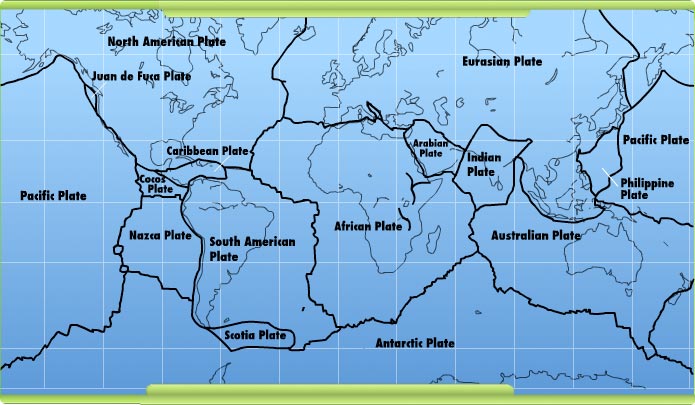
The tectonic plates rest atop the mantle. It is important to note that the continents themselves are not free-floating objects, rather, they are fixed parts of the tectonic plates, which are made of both oceanic and continental crust.

new_map.jpg


The reason we have continents is that some minerals melt (and crystallize) at lower temperatures than others, as demonstrated by Bowen's Reaction Series:
bowen.gif


Typically the lower-temperature minerals (quartz, mica, and feldspar) are less dense than the high-temperature minerals (pyroxenes and olivines). So when a rock at the top of the mantle or base of the crust is heated, only the less dense minerals melt and rise to the surface, and are either extruded as volcanic eruptions or cool in the shallow subsurface into granites. Because the granites are less dense than the basaltic ocean crust, they 'float' higher on the mantle than the ocean crust does, forming the continents. This is a process known as 'isostasy'. This of course is an oversimplification, but if you'd like a bit more depth, pick up a petrology book. ;)

A slightly goofy explanation of how isostasy relates to continental crust here:
Isostasy demo - YouTube

 
  • Like
Reactions: dlamberth
Upvote 0

Orogeny

Trilobite me!
Feb 25, 2010
1,599
54
✟24,590.00
Faith
Agnostic
Marital Status
Single
Actually no. First look at what a mineral is. A mineral is an element or chemical compound generally crystalline. Some examples would be halides, sulfates, phosphates and oxides. On the other hand, a rock is an aggregate of minerals of which there are three types, sedimentary, igneous and metamorphic.

But it doesn't stop there, within these groups of rocks and minerals, each has specific environments and conditions under which they form. Those processes are called the study of petrology. That area being Orogeny's area more than mine, I'll let him elaborate on that.
Yes, petrology is the study of rocks in order to understand the environment in which the formed. This can apply to igneous, sedimentary, and metamorphic rocks, and can tell us a lot about tectonic setting, depth and rate of formation of igneous and metamorphic rocks, and the sediment source areas, tectonics, and local climate of formation for sedimentary rocks.

I do have a bit of a petrologic bent. My studies mostly deal with limestones (carbonates) and the environments they form in. Limestone is typically produced in warm, clear ocean water where there is a lot of light penetration; in other words, where sea life like corals and other sea organisms (the dead bits of which are the main constituents of limestone) like to live. The best example (or at least the most widely studied modern example) of a carbonate-forming environment is the Bahamas:

Bahamas-Exumas-beach.jpg


The Great Barrier Reef is another great example of a modern carbonate environment:

The-Great-Barrier-Reef-diving.jpg


Ancient carbonates can be found around the world, with one of the most spectacular examples being the Permian reef complex that forms the Guadalupe Mountains of Texas and New Mexico. It is a preserved reef complex similar in scale to the Great Barrier Reef:

guadalupe_2130_600x450.jpg

Fun fact: The vertical cliffs you see are a pretty close approximation of the actual morphology of the reef system itself. The entire cliff is made up of cemented-together red algae and coral, while the slopes you see in front of the cliffs are the talus pile and forereef debris the fell off of the front of the reef as it grew. If you're ever unlucky enough to be in west Texas, stop off at the Guadalupe Mountains. It's well worth the time.
 
Upvote 0

Assyrian

Basically pulling an Obama (Thanks Calminian!)
Mar 31, 2006
14,868
991
Wales
✟42,286.00
Faith
Christian
Marital Status
Married
Yeah dude, absolutely. You know, in the same way that an animal is just an animal, a star is just a star, and a tree is just a tree. :p
Sorry, somebody had to say it :D

More seriously, is there any connection between the Deccan Traps erupting and Chicxulub hitting the other side of the planet, or were the dinosaurs just very very unlucky?
 
Upvote 0

Orogeny

Trilobite me!
Feb 25, 2010
1,599
54
✟24,590.00
Faith
Agnostic
Marital Status
Single
Sorry, somebody had to say it :D

More seriously, is there any connection between the Deccan Traps erupting and Chicxulub hitting the other side of the planet, or were the dinosaurs just very very unlucky?
You know, I think that's a really interesting theory, but I'm not aware of any solid data relating the two. In fact, the Deccan Traps began erupting around 67 million years ago, while the chicxulub impact event has been dated to around 65.3 million years. So it appears that the dinosaurs just got really darn unlucky.

It's interesting that two of the most prominent extinction events (the K-T event and the Permo-Triassic event, which was significantly larger) are associated with Large Igneous Province (trap) eruptions (for the P-Tr it was the Siberian Traps). It is thought that the traps released significant methane and CO2, contributing to global warming. Also, both traps eruptions are thought to have extruded massive amounts of lava into nearby ocean basins, which would have warmed the ocean water in the area. Conveniently, both erupted onto continental slopes, which probably contained methane clathrates. Melting of the methane clathrates by warm ocean water would result in rapid methane degassing and, methane being an efficient greenhouse gas, contribute to rampant global warming. So it appears that global warming plays an important part in contributing to mass extinction.
 
Upvote 0

thaumaturgy

Well-Known Member
Nov 17, 2006
7,541
882
✟12,333.00
Faith
Atheist
Marital Status
Married
I do have a bit of a petrologic bent. My studies mostly deal with limestones (carbonates)

My wife did fluid inclusion studies on carbonates back in grad school. ohmygawsh it looked so hard looking through a scope all day freezing and bursting tiny bubbles in these rocks. I tried it one afternoon and after 5 minutes my brain hurt (and my eyes).

She did, however, end up with a part of study that was a cathodoluminescence study of these same carbonates and she had the coolest photo of a zoned calcite under cathodoluminescence. But it was pre-digital photo days and we only have the slide. I'm going to have to dig that up some day and put it up on the internet.

The one thing to be said about clay mineralogy and petrology is it is about the only thing that makes carbonate petrology look exciting and sexy!

But in the meantime I think generally geologists are best exemplified by this page:

GEOLOGISTS: REAL ULTIMATE POWER
 
  • Like
Reactions: Cabal
Upvote 0

Orogeny

Trilobite me!
Feb 25, 2010
1,599
54
✟24,590.00
Faith
Agnostic
Marital Status
Single
My wife did fluid inclusion studies on carbonates back in grad school. ohmygawsh it looked so hard looking through a scope all day freezing and bursting tiny bubbles in these rocks. I tried it one afternoon and after 5 minutes my brain hurt (and my eyes).
Yeah, that'll happen when you stare through another person's scope. If you're doing serious microscopy, it's critical to have a scope that has been specifically adjusted for your eyes. I did thin section petrography on about 130 samples earlier this year, and I just stole one of the scopes from the lab and took it to my desk so nobody would be able to mess with it.
She did, however, end up with a part of study that was a cathodoluminescence study of these same carbonates and she had the coolest photo of a zoned calcite under cathodoluminescence. But it was pre-digital photo days and we only have the slide. I'm going to have to dig that up some day and put it up on the internet.
Oh man CL studies can yield a lot of cool results, but wow are they boring!

The one thing to be said about clay mineralogy and petrology is it is about the only thing that makes carbonate petrology look exciting and sexy!
HEY. Carbonate petrology ALREADY IS exciting and sexy! Where else do you get to see overcompacted ooids with dolomitic neomorphism of the ooid nucleus and penecontemporaneously formed penetrative authigenic euhedral megaquartz? :p

But in the meantime I think generally geologists are best exemplified by this page:

GEOLOGISTS: REAL ULTIMATE POWER
I'll see your page and raise you this one: Geologist!
 
Upvote 0

thaumaturgy

Well-Known Member
Nov 17, 2006
7,541
882
✟12,333.00
Faith
Atheist
Marital Status
Married
Yeah, that'll happen when you stare through another person's scope. If you're doing serious microscopy, it's critical to have a scope that has been specifically adjusted for your eyes.

My coal pet scope wasn't specifically adjusted for me, the key difference was that flinc stuff was just so tiny and you almost had to IMAGINE you were able to see the fluid inclusion (IMHO). How she looked at white circles on a white background day after day and inside those find the white bubble and watch it blow up and shrink down was beyond me.

HEY. Carbonate petrology ALREADY IS exciting and sexy!

Oh wait, no, I meant more exciting and sexy! I mean mud supported wackestone is already about as much excitement as anyone should be allowed to experience, I merely meant that...

Where else do you get to see overcompacted ooids with dolomitic neomorphism of the ooid nucleus and penecontemporaneously formed penetrative authigenic euhedral megaquartz? :p

Huh huh huh...you said penecontemporaneous. Huh huh huh.

Now I'm a bit rusty on some of the terms (I work almost exclusively with kaolin in paper coatings these days so lemme see if I got this right:

you have an oolitic carbonate in which the central nucleus of the ooid is later dolomitized and well-formed quartz crystals from in the voids?

Is the entire carbonate formation dolomitized or is it just the ooid "nucleus"?

Sadly the last time I got to play with dolomite was when I was working on SEMO MVT's (Pb-Zn sulfide minerals hosted in a dolomitized reef carbonate in Southeast Missouri).

I was only interested in the organic stuff in the shale above and below it.

I saw some cool carbonates but mostly really cool galenas and sphalerites. The carbonates weren't much to look at.

The coolest calcite I ever saw was in someone's collection and it was an hexagonal prism, not a rhombohedron, not a scalenohedron, but a nice big well-formed hexagonal prism.

I like calcite and in my line of work (coatings) we get to use some carbonates (especially in the coatings I work with ) but sadly it is all just white powder at this level.

I miss minerals. I'm the mineralogy go-to guy in my area but that's only because everyone else is obsessed with polymers and they only need me occasionally when they need someone to talk about the "dirt" that goes into the coatings.
 
Upvote 0