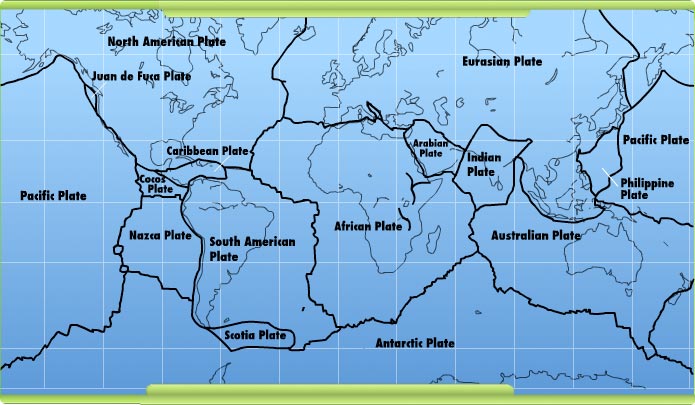
Ok, what broke the earths crust
I think that there's a general misunderstanding about what initiated plate tectonics, and that you're falling victim to it. Earth's crust isn't broken and, to my knowledge, has never been broken (except perhaps by the theorized 'Mars sized impactor', but this would have likely resulted in a complete demolition of the crust rather than simple breakage) in the sense that you think it has.
During Earth's early formation, most if not all of the material making up the planet was molten. This allowed for differentiation- separation of materials based on density. So the dense things (Iron, nickle, and heavier elements) sank to the center and formed our core. Likewise, the lighter elements, oxygen, carbon, aluminum, silicon et al. rose to the surface and formed an early crust. The mantle, in between the crust and the core, is composed of both light and heavy elements. So there is an overall density increase as we move downward through the crust and mantle and into the core.

Radioactive decay and residual frictional heat from accretion of the earth make the core and mantle quite hot. There is a temperature stratification (and resultant density stratification) in the mantle because areas near the surface are cooled via black body radiation (see the 'ask a physicist' thread for explanation of this concept) and magmatic eruption, while near-core regions are insulated by the overlying rock. This temperature stratification produces very slow convection of the mantle (over the long term, the mantle behaves as a viscous liquid, although it is, in effect, a solid or a very viscous mush). The mantle has dozens of individual convective cells, cycling material and heat from the core-mantle boundary up toward the crust and then back down again. Think about a boiling pot of water or a lava lamp. It is from this convection that plate tectonics arose.
The crust, as you know because you stand on it every day, is cool and hard. As the mantle convects, it pulls on the base of the crust, making it move. Where the crust is being pulled in opposite directions, it breaks and a spreading center is formed, and molten material from the mantle is extruded at the surface forming hot new basaltic oceanic crust. Where the basaltic crust is old, it has had a long time to cool, so it becomes cold and dense, eventually reaching a density near that of the upper mantle, and so it begins to sink back down into the mantle. We call these areas 'subduction zones'. This video is a bit melodramatic, but illustrates this concept well.
plate tectonics - YouTube
what are the continental plates sitting on?
The tectonic plates rest atop the mantle. It is important to note that the continents themselves are not free-floating objects, rather, they are fixed parts of the tectonic plates, which are made of both oceanic and continental crust.
The reason we have continents is that some minerals melt (and crystallize) at lower temperatures than others, as demonstrated by Bowen's Reaction Series:
Typically the lower-temperature minerals (quartz, mica, and feldspar) are less dense than the high-temperature minerals (pyroxenes and olivines). So when a rock at the top of the mantle or base of the crust is heated, only the less dense minerals melt and rise to the surface, and are either extruded as volcanic eruptions or cool in the shallow subsurface into granites. Because the granites are less dense than the basaltic ocean crust, they 'float' higher on the mantle than the ocean crust does, forming the continents. This is a process known as 'isostasy'. This of course is an oversimplification, but if you'd like a bit more depth, pick up a petrology book.

A slightly goofy explanation of how isostasy relates to continental crust here:
Isostasy demo - YouTube