• Starting today August 7th, 2024, in order to post in the Married Couples, Courting Couples, or Singles forums, you will not be allowed to post if you have your Marital status designated as private. Announcements will be made in the respective forums as well but please note that if yours is currently listed as Private, you will need to submit a ticket in the Support Area to have yours changed.

  • CF has always been a site that welcomes people from different backgrounds and beliefs to participate in discussion and even debate. That is the nature of its ministry. In view of recent events emotions are running very high. We need to remind people of some basic principles in debating on this site. We need to be civil when we express differences in opinion. No personal attacks. Avoid you, your statements. Don't characterize an entire political party with comparisons to Fascism or Communism or other extreme movements that committed atrocities. CF is not the place for broad brush or blanket statements about groups and political parties. Put the broad brushes and blankets away when you come to CF, better yet, put them in the incinerator. Debate had no place for them. We need to remember that people that commit acts of violence represent themselves or a small extreme faction.

[Open] tags-a read and respond thread for all

Do you know how open tags work

  • yes-[open] is what I put in the title when I want to allow everyone into my thread

  • no- please PM me


Results are only viewable after voting.

Gxg (G²)

Pilgrim/Monastic on the Road to God (Psalm 84:1-7)
Site Supporter
Jan 25, 2009
19,769
1,429
Good Ol' South...
Visit site
✟211,037.00
Faith
Oriental Orthodox
Marital Status
Private
Politics
US-Others
Also in that same scripture is that the people who are to be holy are to obey God and not eat anything already found dead... .Since that is our object.. to be a set apart [holy] people.. all things that we can do to be a part of the set apart in God's way.. we should do..
Indeed, though the same scripture did not say that the Gentiles/strangers within the nation were unholy in all respect for eating it. Within that era, eating unclean meat (or dead meat) symbolized something and as the Lord wanted to maintain distinction, differing rules were given.

The goal for Gentiles was NEVER to become like the Jews, although they could try if they wished. They were to simply not pride themselves at ANY point on it or look down upon other Gentiles for not thinking it necessary since the Lord already worked with others outside of the Mosaic Law--be it with Job, or Jethro or Noah and others who effectively lived as the Gentiles based upon Genesis 9. To claim that those not following Mosaic Law were "more holy" than those without it doesn't go with the account of scripture, vis. There was a differing kind of holiness---but a sanctification occurred with the Gentiles nonetheless and the Lord utilzed them on multiple accounts.


What matters is the keeping of the commandments of God. There is no indication that there are two separate lists of commandments, one for Jews and another for Gentiles both of whom are believers in Yeshua as their God in the flesh and savior.
Not really accurate, v--and again, as noted earlier, even the organizations discussing Gentiles trying to observe Torah have noted that often...Thomas Lancaster being one of the most prominent. If the Word is going to be the standard, IT alone should be the standard and it cannot be ignored selectively to see only one side.


What matters is the keeping of the commandments of God. There is no indication that there are two separate lists of commandments, one for Jews and another for Gentiles both of whom are believers in Yeshua as their God in the flesh and savior. All who are “called” to salvation are to keep them. Here are the saints, here are they that keep the commandments of God and have the faith of Yeshua.

So what is the Apostolic hallacah [not sure of spelling]for the body of Messiah?


I far as I can see, there is no unique calling for Jews and Gentiles within the body of Messiah, in which Jews are called to do specific things that Gentiles are not called to do. Rather, there is a singular calling for Jew and Gentile, which is a call to salvation in Yeshua and the life of holiness that God’s redemption inevitably produces
.
"Halakah" is the wording I think you're looking for, concerning what you were uncertain of with spelling :) But with the rest of what you noted, I'd have to disagree...specifically if saying that the commandments of God that ALL are to follow were those listed in the OT Covenant since all of those commandments already had seperate lists of commands for both Jews and Gentiles...and within the NT, though there's one New Man in the blood, those who are Jewish and have their heritage with the Law never lost sight of how the Gentiles were distinct.


From the OT perspective, Exodus 12:48 says that circumcision is optional for even a Sojourner living in Israel (much less a non-Jew living in Georgia or wherever other Non-Jews are). Exodus 31:13 says the Sabbath is a sign between Israel and God (not a universal command).

From the NT perspective, in regards to how often Paul and others were called "Torah Breakers", they made clear how both Jews and Gentiles are brought into the faith via the Blood of the Messiah...while the standards for holiness differ for both. It's why the council in Acts 15 was held and why Jews still sought to keep Torah, whereas Gentiles sought the Lord as God-Fearers just like others in the OT.


There are many other places besides that which deal plainly on the subject. And thankfully, for those within to become Messianic Gentiles, FFOZ has gone into exceptional depth covering the plain reality of how differing laws were given to the Gentiles while the Jews were given differently as well..all under the same Laws of the Lord. For Distinction was never a problem according to the Law---both in the OT and in the NT, even though both have been brought together in radical ways in Yeshua. For Places for one to go can be seen here:

As said before, there has always been distinctions between those who are believng Jews and believing Gentiles...and one must be careful to remember who the sojourner is: a non-Jew who has come to dwell in Israel and who takes on many of Israel’s obligations, though not all. A sojourner in Israel had a status that would have to be considered greater toward the Torah than a non-Jew in the Messianic Jewish movement today. That is, the position of a sojourner was not at all ambiguous. Such a person lived within Israel’s borders and was obligated by Israel’s law to observe the Sabbath and holy days along with Israel. Circumcision and full participation (today it is called conversion) was optional, but a certain set of standards was not optional. And Derek Leman had some excellent discussions on the issue as seen in the following:

But ultimately, what matters is whether people are looking plainly to the Lord-the only one who can bring true salvation rather than the Law:
Acts 13:36-41
I want you to know that through Jesus the forgiveness of sins is proclaimed to you. 39 Through him everyone who believes is set free from every sin, a justification you were not able to obtain under the law of Moses. 40 Take care that what the prophets have said does not happen to you:
41 “‘Look, you scoffers,
wonder and perish,
for I am going to do something in your days
that you would never believe,
even if someone told you.’[e]”
__________________


The Messianics over at the Rosh Pina Project said it best when it came to the issue of Gentiles in the Messianic Movement--as said here:
Whilst Orthodox rabbis tend to discourage Gentile conversions to Judaism, they encourage Gentiles to become Noahides or Bnei Noach (Sons of Noah). The late Lubavitcher Rebbe in particular stressed the value of Noahide evangelism, causing Chabad to establish the Institute of Noahide Code. The Reconstituted Sanhedrin actively attempts to convert Gentiles to become Noahides.


So whilst the Noahides do not become part of Israel, they do become God’s people. There is no competition to fight for an identity as ‘Israel’, and no obligation to keep halachah. However, as the modern Noahide movement is designed as a kiruv counter-weight to the Protestant missions, it is obviously not an option as believers.

But is there a parallel for Messianic Judaism?


Well firstly we know that the ekklesia – the community of those saved by trusting in Moshiach - is made up of Jew and Gentile (Colossians 3:11):
Here there is no Greek or Jew, circumcised or uncircumcised, barbarian, Scythian, slave or free, but Christ is all, and is in all.
Whilst we know the Jews who believe in Yeshua belong to the House of Israel, what of the Gentiles?


We know that Messianic Jews are both physically and spiritually descendants of Abraham, but what of those who are not physical descendants of Abraham?


Are they still sons of Abraham in a special, spiritual sense?
We read in Romans 4:9-12:
Is this blessedness only for the circumcised, or also for the uncircumcised? We have been saying that Abraham’s faith was credited to him as righteousness. Under what circumstances was it credited? Was it after he was circumcised, or before? It was not after, but before! And he received the sign of circumcision, a seal of the righteousness that he had by faith while he was still uncircumcised. So then, he is the father of all who believe but have not been circumcised, in order that righteousness might be credited to them. And he is also the father of the circumcised who not only are circumcised but who also walk in the footsteps of the faith that our father Abraham had before he was circumcised.
In other words, all believers in the Jewish Messiah Yeshua haMashiach are bnei Avraham - sons of Abraham – through emuna (faith). Just as Orthodox Judaism considers Gentiles who observe the 7 laws of Noah to be spiritually sons of Noah (not in a physical sense, as we are all physically descended from Noah), so too Messianic Judaism should consider Gentile Christians to be spiritually sons of Abraham.


This is the special role of Gentiles within the Messianic movement: to fully live lives which show that following Abraham’s walk is only possible by knowing Yeshua – for Jews and Gentiles alike. The bnei Avraham are exactly who God intended Gentile believers and Christians to be. You don’t need to keep halachah or prove you’re descended from a Lost Tribe – in fact if you’re a Gentile Christian who takes the right approach to Israel from the New Testament, then you already are a bnei Avraham without realising it!

Bnei Avraham are encouraged to share their physical blessings with Jews, as the bnei Avraham share in the Jews’ spiritual blessings (Romans 15:27). Indeed, if you read Romans 11, you see how God intended the bnei Avraham – Jewish and Gentile followers of Yeshua – to complement each other in a chain reaction leading to the full and final geula: the redemption of the world.


Paul writes (Romans 11:13-16):
I am talking to you Gentiles. Inasmuch as I am the apostle to the Gentiles, I make much of my ministry in the hope that I may somehow arouse my own people to envy and save some of them. For if their rejection is the reconciliation of the world, what will their acceptance be but life from the dead? If the part of the dough offered as firstfruits is holy, then the whole batch is holy; if the root is holy, so are the branches.
My Messianic fellowship is a home to many Jews, but it would not be the same without the Gentile bnei Avraham who also put in hard work and make the fellowship a dynamic, loving community. Indeed, a Messianic community where Jews and Gentiles bless each other, and in humility serve each other is exactly what God intended the Church to be. Gentiles shouldn’t feel inferior to Jews in any way, but should also be mindful of the purpose of Messianic Judaism: to provide a safe and loving environment where Jews can worship the risen, divine Messiah Yeshua as Jews.


As sadly much of the Church continues to be unaware both the significance and the identity of Jewish believers, the Messianic movement has a role to play in lovingly educating Christians about true Jewish-Gentile harmony. As Messianic Jews and Gentile Bnei Avraham, I believe we can all work together towards this goal.
 
Last edited:
Upvote 0

visionary

Your God is my God... Ruth said, so say I.
Site Supporter
Mar 25, 2004
56,978
8,072
✟542,711.44
Gender
Female
Faith
Messianic
Easy G (G²);59065503 said:
Indeed, though the same scripture did not say that the Gentiles/strangers within the nation were unholy in all respect for eating it. Within that era, eating unclean meat (or dead meat) symbolized something and as the Lord wanted to maintain distinction, differing rules were given.

The goal for Gentiles was NEVER to become like the Jews, although they could try if they wished. They were to simply not pride themselves at ANY point on it or look down upon other Gentiles for not thinking it necessary since the Lord already worked with others outside of the Mosaic Law--be it with Job, or Jethro or Noah and others who effectively lived as the Gentiles based upon Genesis 9.
Yeshua commissioning His disciples to make disciples of the nations (Gentiles) by “teaching them to observe all [everything] that I commanded you”.. indicating.. Yeshua was commanding the disciples to teach them to observe the commandments just like He taught them [Jews] to keep them... same for both..
 
Last edited:
Upvote 0

Gxg (G²)

Pilgrim/Monastic on the Road to God (Psalm 84:1-7)
Site Supporter
Jan 25, 2009
19,769
1,429
Good Ol' South...
Visit site
✟211,037.00
Faith
Oriental Orthodox
Marital Status
Private
Politics
US-Others
Yeshua commissioning His disciples to make disciples of the nations (Gentiles) by “teaching them to observe all that I commanded you”.. indicating.. Yeshua was commanding the disciples to teach them to observe the commandments just like He taught them [Jews] to keep them... same for both..
Indeed---and the Lord also made clear in his teachings to the Disciples that Gentiles were not bound to act according to how the Jews were. To say otherwise isn't dealing at all with what Yeshua taught when he interacted with both Jews and Gentiles differently, be it with the ROman Centurion, his praising of Naaman the Syrian and the Widow in Luke 4, the demoniac in Mark 5 or many others. Again, one cannot ignore HALF of what scripture says in order to support one part they're already passionate for...as it dishonors the Lord.

As said before, if a Gentile WISHES to try prostelyzing/converting fully into what Jews were called to, it is their freedom to do so. However, no where in scripture did Yeshua ever say his goal was to make Gentiles JUST like the Jews since that's not even what the Law itself notes. And as the main organizations within the Messianic movement as well as countless Jews have noted how it ignores the very Torah to say otherwise, that has to be taken seriously.
 
Upvote 0

visionary

Your God is my God... Ruth said, so say I.
Site Supporter
Mar 25, 2004
56,978
8,072
✟542,711.44
Gender
Female
Faith
Messianic
Isaiah 56:6-7
New International Version (NIV)

6 And foreigners who bind themselves to the LORD
to minister to him,
to love the name of the LORD,
and to be his servants,
all who keep the Sabbath without desecrating it
and who hold fast to my covenant
—
7 these I will bring to my holy mountain
and give them joy in my house of prayer.
Their burnt offerings and sacrifices
will be accepted on my altar;
for my house will be called
a house of prayer for all nations.”
 
Upvote 0

Gxg (G²)

Pilgrim/Monastic on the Road to God (Psalm 84:1-7)
Site Supporter
Jan 25, 2009
19,769
1,429
Good Ol' South...
Visit site
✟211,037.00
Faith
Oriental Orthodox
Marital Status
Private
Politics
US-Others
Isaiah 56:6-7
New International Version (NIV)

6 And foreigners who bind themselves to the LORD
to minister to him,
to love the name of the LORD,
and to be his servants,
all who keep the Sabbath without desecrating it
and who hold fast to my covenant—
7 these I will bring to my holy mountain
and give them joy in my house of prayer.
Their burnt offerings and sacrifices
will be accepted on my altar;
for my house will be called
a house of prayer for all nations.”

Indeed, although anyone dealing with the text fully understands that this is nowhere close to the WHOLE of what the Lord already said about Distinctions given to both Jews and Gentiles. No need being quick to bring out one scripture when there are already others on Gentiles not being bound to do all within Torah in order to become right with the Lord just as Abraham and others did.

The context of Isaiah 56 already has in mind what the Law said when it came to Sabbath being something optional for Gentiles--and many Gentiles in that time were being persecuted by other Hebrews for their desire to do so while those same Hebrews were holding onto false Gods. The Lord made clear that even Gentiles could be included amongst those who love him...for whereas the other Hebrews were often defiling the Sabbath with idolatry/contempt (despite what the Lord had called them to do), at least Gentiles not even required to do so showed concern for it and were blessed as a result of their desire to walk in it.


It's really a preview of what the Lord intended when he desired to show how his blessing was not to be restricted to one favored people ( Malachi 1:11 , John 4:21John 4:23 , 1 Timothy 2:8 ).

The foreigner who bound themselves is akin to what is noted in Numbers 18:4/Numbers 18:7 when it comes to those who are "Proselytes." Proselytes from the Gentiles were not admitted to the same privileges as native Israelites. Additionally, Eunuchs were chamberlains over harems, or court ministers in general. They were not admissible into the congregation of Israel ( Deuteronomy 23:1-3 ). But in regards to the new work of the Lord when it came to the Gospel, the eunuch and stranger should be released from religious and civil disabilities. For the Lord welcomes all believers, without distinction of persons, under the new economy ( Acts 10:34/Acts 10:35 ).


John Gill's Commentary says it best:

It is here promised that multitudes of the Gentiles shall come to the church, not only that the few who come dropping in shall be made welcome, but that great numbers shall come in, and the door be thrown open to them: My house shall be called a house of prayer for all people. The temple was then God's house, and to that Christ applies these words (Matthew 21:13), but with an eye to it as a type of the gospel church, Hebrews 9:8,9. For Christ calls it his house, Hebrews 3:6. Now concerning this house it is promised, (1.) That it shall not be a house of sacrifice, but a house of prayer. The religious meetings of God's people shall be meetings for prayer, in which they shall join together, as a token of their united faith and mutual love. (2.) That it shall be a house of prayer, not for the people of the Jews only, but for all people. This was fulfilled when Peter was made, not only to perceive it himself, but to tell it to the world, that in every nation he that fears God and works righteousness is accepted of him, Acts 10:35. It had been declared again and again that the stranger that comes nigh shall be put to death, but Gentiles shall now be looked upon no longer as strangers and foreigners, Ephesians 2:19. And it appears by Solomon's prayer, at the dedication of the temple, both that it was primarily intended for a house of prayer and that strangers should be welcome to it, 1 Kings 8:30,41,43. And it is intimated here (Isaiah 56:8) that when the Gentiles are called in they shall be incorporated into one body with the Jews, that (as Christ says, John 10:16) there may be one fold and one Shepherd; for, [1.] God will gather the outcasts of Israel. Many of the Jews that had by their unbelief cast themselves out shall by faith be brought in again, a remnant according to the election of grace, Romans 11:5. Christ came to the lost sheep of the house of Israel (Matthew 15:24), to gather their outcasts (Psalms 147:2), to restore their preserved (Isaiah 49:6), and to be their glory, Luke 2:32. [2.] He will gather others also to him, besides his own outcasts that are gathered to him. Or, though some of the Gentiles have come over now and then into the church, that shall not serve (as some may think) to answer the extent of these promises; no, there are still more and more to be brought in: "I will gather others to him besides these; these are but the first-fruits in comparison with the harvest that shall be gathered for Christ in the nations of the earth, when the fulness of the Gentiles shall come in." Note, The church is a growing body: when some are gathered to it we may still hope there shall be more, till the mystical body be completed. Other sheep I have.

 
Last edited:
Upvote 0

visionary

Your God is my God... Ruth said, so say I.
Site Supporter
Mar 25, 2004
56,978
8,072
✟542,711.44
Gender
Female
Faith
Messianic
Paul very specifically teaches that the primary issue is not whether one is Jewish or Gentile (circumcised or uncircumcised), but what matters is “the keeping of the commandments of God”

1 Corinthians 7:19 Circumcision is nothing and uncircumcision is nothing. Keeping God’s commands is what counts.
 
Upvote 0

visionary

Your God is my God... Ruth said, so say I.
Site Supporter
Mar 25, 2004
56,978
8,072
✟542,711.44
Gender
Female
Faith
Messianic
John, Yeshua's favorite disciple, has a lot to say about keeping the commandments and his conclusion is
1John 5:2–3 By this we know that we love the children of God, when we love God and observe His
commandments. For this is the love of God, that we keep His commandments; and His commandments are not burdensome.
 
Upvote 0

visionary

Your God is my God... Ruth said, so say I.
Site Supporter
Mar 25, 2004
56,978
8,072
✟542,711.44
Gender
Female
Faith
Messianic
Matthew 5:17-20
New International Version (NIV)
The Fulfillment of the Law

17 “Do not think that I have come to abolish the Law or the Prophets; I have not come to abolish them but to fulfill them. 18 For truly I tell you, until heaven and earth disappear, not the smallest letter, not the least stroke of a pen, will by any means disappear from the Law until everything is accomplished. 19 Therefore anyone [That means Jew or Gentile] who sets aside one of the least of these commands and teaches others accordingly will be called least in the kingdom of heaven, but whoever practices and teaches these commands will be called great in the kingdom of heaven. 20 For I tell you that unless your righteousness surpasses that of the Pharisees and the teachers of the law, you will certainly not enter the kingdom of heaven.

Yeshua declares our righteousness has to surpass that of the Pharisees and teachers of the law or we will not enter into the Kingdom of God. So not only must we learn about it, but we must learn it via the Holy Spirit to do it according to His Will and not by traditions because that is our only chance of surpassing that of the Pharisees' righteousness. We know that Yeshua's righteousness is top of the line and the example we are to follow.
 
Upvote 0

Gxg (G²)

Pilgrim/Monastic on the Road to God (Psalm 84:1-7)
Site Supporter
Jan 25, 2009
19,769
1,429
Good Ol' South...
Visit site
✟211,037.00
Faith
Oriental Orthodox
Marital Status
Private
Politics
US-Others
Paul very specifically teaches that the primary issue is not whether one is Jewish or Gentile (circumcised or uncircumcised), but what matters is “the keeping of the commandments of God”
Indeed--and when Paul stated that, he actually went further in expressing to the Gentiles he worked with how what was expected was simple walking in love.
Galatians 5:6
For in Christ Jesus neither circumcision nor uncircumcision has any value. The only thing that counts is faith expressing itself through love.

Romans 13:7-9, Romans 13 and Galatians 6:1-3 all echo the same theme...

Yeshua echoed the SAME thoughts in Luke 10:25-39 when it came to the parable of the Good Samaritan, with the subject of whether or not love was shown as the ultimate focus.


...On one occasion an expert in the law stood up to test Jesus. “Teacher,” he asked, “what must I do to inherit eternal life?”


“What is written in the Law?” he replied. “How do you read it?”

He answered: “‘Love the Lord your God with all your heart and with all your soul and with all your strength and with all your mind’; and, ‘Love your neighbor as yourself.’”

“You have answered correctly,” Jesus replied. “Do this and you will live.”

But he wanted to justify himself, so he asked Jesus, “And who is my neighbor?”

In reply Jesus said: “A man was going down from Jerusalem to Jericho, when he fell into the hands of robbers. They stripped him of his clothes, beat him and went away, leaving him half dead. A priest happened to be going down the same road, and when he saw the man, he passed by on the other side. So too, a Levite, when he came to the place and saw him, passed by on the other side. But a Samaritan, as he traveled, came where the man was; and when he saw him, he took pity on him. He went to him and bandaged his wounds, pouring on oil and wine. Then he put the man on his own donkey, took him to an inn and took care of him. The next day he took out two silver coins and gave them to the innkeeper. ‘Look after him,’ he said, ‘and when I return, I will reimburse you for any extra expense you may have.’

“Which of these three do you think was a neighbor to the man who fell into the hands of robbers?”

The expert in the law replied, “The one who had mercy on him.”
Jesus told him, “Go and do likewise.” (Luke 10:25-37)


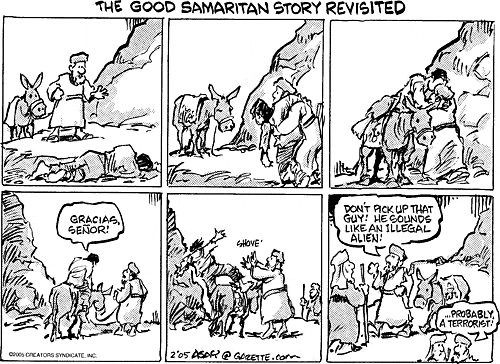
Those priding themselves on trying to "observe law" in the above story not only did not help the half-dead man, but when they saw him they actually passed by on the other side of the road. Considering their positions as Priest and Levite, they considered the man who lay dying on the side of the road to be unclean, as not only did they not want to help (touch) him, they went to the other side of the road to avoid any possible contact with him. They were more concerned for their own “clean-ness” than they were for the very life of the man bleeding, obviously needing aid, lying at the side of the road. Who did Jesus say to imitate? The consummate Law Keepers, a Priest and a Levite? No. He instructed the expert in the law to imitate the unclean man, a Samaritan.


Why was IT so significant for Jesus to speak in parables regarding the usage of Samaritans? Or why the lawyer in the story couldn't even say "Samaritan" when ASKED who in the story did good? For much of what went down indeed dealt with the issues of ethnicity/cultural heritages---and the Jews forgetting what it was they were called to be to others, as well as looking down upon others when they had no right to do so, Deuteronomy 9:4-6/ Deuteronomy 9 Romans 3:28-30 / Romans 3. Cultural barriers (and for that matter, the old sin of prejudice/racism) wasn't a new issue that just came up in the 1700's-1960's (during the time of Slavery to the CIVIL Rights time)....and if we were to be honest for a moment, regarding the issue, I think that we are often moreso like that Lawyer and the others in that parable than we’d want to believe. We treat the TOPIC as an topic for discussion like the Lawyer did with the wounded man, or we act like the priest and treat the man as a topic to avoid or an object of curiousity and go about our buisness for the “Lord” like the Levite……rarely acting like the Samaratin and acting out of love---and still seeing others as too "dirty" to deal with. This is seen across the wall in the Body of Christ when certain groups we avoid quickly...


TheGoodSamaritanStoryRevisited.gif

…For it’s much more easier to talk about the Lord within the realm of our OWN CULTURES than outside of it....and forgetting that we're all connected


responsibility.jpg


On the parable of the GOOD Samaritan issue, the lawyer raised his question---and in response,Jesus told him, “Go and do likewise.”

If we were to be honest for a moment, regarding the AIDS issue, I think that we are often moreso like that Lawyer and the others in that parable than we’d want to believe. We treat the AIDS Topic as an topic for discussion like the Lawyer did with the wounded man, or we act like the priest and treat the man as a topic to avoid or an object of curiousity and go about our buisness for the “Lord” like the Levite……rarely acting like the Samaratin and acting out of love. And like the Lawyer/Levite and Priest in the story, we all tend to act first out of our prejudices and build our theology from there. For example, there was a deep hatred that existed between the Jews and the Samaritans.....and Jesus had to address that squarely..


It’s a perfect example of the change and the freedom in behavior Jesus was ushering into the world with the New Covenant forged in His blood. No longer was one to be bound by the restrictions of the Law, which, in the hands of humans could not be possibly be met by any stretch anyway, because Jesus met the requirements of the Law on our behalf (Romans 7:4-6) .

Under the New Covenant, the Law of Christ, the believer is now free to love their neighbor without restriction. We are able to bend down into the dirt of life and minister to those in need and love them with the love that comes from the very Holy Spirit of God.

Why? Because we are cleansed with the Blood of Christ, not merely covered by the blood of animals. Our state of redemption and “clean-ness” is permanent and irrevocable – incorruptable – enabling us to obey both parts of the commandments (instructions) of Jesus – Love God, Love others, whatever the circumstance.

John, Yeshua's favorite disciple, has a lot to say about keeping the commandments and his conclusion is
1John 5:2–3 By this we know that we love the children of God, when we love God and observe His
commandments. For this is the love of God, that we keep His commandments; and His commandments are not burdensome.
__________________
Amen..

Thankully, John clarified what those commandments were in the New Covenant, as John sought to sum them up into the simple reality of LOVING your neighbor ( 1 John 4:20-21 , 1 John 3:22-24, )

2 John 1:6
And this is love: that we walk in obedience to his commands. As you have heard from the beginning, his command is that you walk in love.
2 John 1:5-7/ 2 John 1

James, the brother of Jesus, noted the same exact concept when it came to demonstrating one's heart for the Lord by their deeds---and his stance was that the ULTIMATE expression of devotion to the Lord was whether or not one truly loved their neighbor ( James 2:8 ), prior to any kind of discussion on faith/works...and even his stance of works/faith went directly in line with what Paul noted.

For some good articles on the issue, one can go here:


Matthew 5:17-20
New International Version (NIV)
The Fulfillment of the Law

17 “Do not think that I have come to abolish the Law or the Prophets; I have not come to abolish them but to fulfill them. 18 For truly I tell you, until heaven and earth disappear, not the smallest letter, not the least stroke of a pen, will by any means disappear from the Law until everything is accomplished. 19 Therefore anyone [That means Jew or Gentile] who sets aside one of the least of these commands and teaches others accordingly will be called least in the kingdom of heaven, but whoever practices and teaches these commands will be called great in the kingdom of heaven. 20 For I tell you that unless your righteousness surpasses that of the Pharisees and the teachers of the law, you will certainly not enter the kingdom of heaven.

Yeshua declares our righteousness has to surpass that of the Pharisees and teachers of the law or we will not enter into the Kingdom of God. So not only must we learn about it, but we must learn it via the Holy Spirit to do it according to His Will and not by traditions because that is our only chance of surpassing that of the Pharisees' righteousness. We know that Yeshua's righteousness is top of the line and the example we are to follow.

What the Pharisees of his day had was that they were extracting and scrupulous in their attempts to follow their laws. So how could Jesus reasonably call us to a greater righteousness than theirs? The Pharisee's weakness was that they were content to obey the laws outwardly without allowing GOD To change them inwardly in their hearts---something the LAW could never do...and that was noted in Acts 13 when it came to Christ being noted as the one who gave justification. The quality of goodness must always be better than that of the Pharisees. The Lord noted how his listeners needed a different kind of righteousness altogether (i.e. love and obediance), not just an intense version of the Pharisees righteousness (legal compliance) or looking unto the Law first as opposed to the one it pointed to.

John 5:39

Testimonies About Jesus

31 “If I testify about myself, my testimony is not true. 32 There is another who testifies in my favor, and I know that his testimony about me is true.


33 “You have sent to John and he has testified to the truth. 34 Not that I accept human testimony; but I mention it that you may be saved. 35 John was a lamp that burned and gave light, and you chose for a time to enjoy his light.
36 “I have testimony weightier than that of John. For the works that the Father has given me to finish—the very works that I am doing—testify that the Father has sent me. 37 And the Father who sent me has himself testified concerning me. You have never heard his voice nor seen his form, 38 nor does his word dwell in you, for you do not believe the one he sent. 39 You study[c] the Scriptures diligently because you think that in them you have eternal life. These are the very Scriptures that testify about me, 40 yet you refuse to come to me to have life.
 
Last edited:
Upvote 0

visionary

Your God is my God... Ruth said, so say I.
Site Supporter
Mar 25, 2004
56,978
8,072
✟542,711.44
Gender
Female
Faith
Messianic
Easy G (G²);59065603 said:
Indeed--and when Paul stated that, he actually went further in expressing to the Gentiles he worked with how what was expected was simple walking in love.

Galatians 5:6
For in Christ Jesus neither circumcision nor uncircumcision has any value. The only thing that counts is faith expressing itself through love.
Galatians 5:5-7 /Galatians 5
Yeshua echoed the SAME thoughts in Luke 10:25-39 when it came to the parable of the Good Samaritan, with the subject of whether or not love was shown as the ultimate focus.
Romans 13:9
The commandments, “You shall not commit adultery,” “You shall not murder,” “You shall not steal,” “You shall not covet,” and whatever other command there may be, are summed up in this one command: “Love your neighbor as yourself.”

The Ten commandments are LOVE.. Showing love to God and man.
 
Upvote 0

Gxg (G²)

Pilgrim/Monastic on the Road to God (Psalm 84:1-7)
Site Supporter
Jan 25, 2009
19,769
1,429
Good Ol' South...
Visit site
✟211,037.00
Faith
Oriental Orthodox
Marital Status
Private
Politics
US-Others
Romans 13:9
The commandments, “You shall not commit adultery,” “You shall not murder,” “You shall not steal,” “You shall not covet,” and whatever other command there may be, are summed up in this one command: “Love your neighbor as yourself.”

The Ten commandments are LOVE.. Showing love to God and man.
Indeed. Not murdering someone is loving, just as not committing adultery/destroying the lives of others via sexual immorality is beyond being disrespectful to others. And with the other commandments, the same thing goes. Of course, that's something not in conflict with the entire issue of Gentiles not having to study Torah. For Paul noted in Romans 2 how those within the Law become a law to themselves/live out the things already stated in the Mosaic Law. It's why in cultures where there is no knowledge of the 10 commandments, people still understand that murder is wrong and that one should not steal. It is something the Lord ensured all men would know on a basis level, just as Geneis 9 notes alongside Romans 1 with all men being without excuse. The heart of the Law is what the Lord was always about as opposed to the Letter.

Yeshua showed that as well when it came to pointing to the spirit of the Law on things like the Sabbath. Paul himself kept Shabbat--but, as is often discussed here on the boards, he didn't do so for the sake of obligation. Rather, he did so for celebration/remembrance of his Jewish inheritance.....and he often noted how his doing so with the Law wasn't a means of trying to earn approval from God since that was already found in the person of Christ. With Christ, who fulfilled all of the Law, its interesting to see how often he made clear that any interpretation of keeping Shabbat which resulted in life being neglected was not truly a representation of the heart of it. ( Matthew 12:11-13 / Matthew 12 , Mark 3:3-5 / Mark 3 , Luke 6:8-10 / Luke 6, Luke 14:1-3 (/ Luke 14 , Luke 13:10-17, etc ). He actually got livid with many when it came to saying that survival itself was not important on the Sabbath--with others literally in need of physical help and yet getting nothing...or being condemned for seeking it out when in dire situations.

As the Word states:
Matthew 12 /Matthew 12:7

Lord of the Sabbath

1At that time Jesus went through the grainfields on the Sabbath. His disciples were hungry and began to pick some heads of grain and eat them. 2When the Pharisees saw this, they said to him, "Look! Your disciples are doing what is unlawful on the Sabbath."

3He answered, "Haven't you read what David did when he and his companions were hungry? 4He entered the house of God, and he and his companions ate the consecrated bread—which was not lawful for them to do, but only for the priests. 5 Or haven’t you read in the Law that the priests on Sabbath duty in the temple desecrate the Sabbath and yet are innocent? 6 I tell you that something greater than the temple is here. 7 If you had known what these words mean, ‘I desire mercy, not sacrifice,’[a] you would not have condemned the innocent. 8 For the Son of Man is Lord of the Sabbath.”


9 Going on from that place, he went into their synagogue, 10 and a man with a shriveled hand was there. Looking for a reason to bring charges against Jesus, they asked him, “Is it lawful to heal on the Sabbath?”

11 He said to them, “If any of you has a sheep and it falls into a pit on the Sabbath, will you not take hold of it and lift it out? 12 How much more valuable is a person than a sheep! Therefore it is lawful to do good on the Sabbath.”

13 Then he said to the man, “Stretch out your hand.” So he stretched it out and it was completely restored, just as sound as the other. 14 But the Pharisees went out and plotted how they might kill Jesus.

Mark 2:22-24


As seen in Matthew 12:1-6 and Mark 2:22-24, Jesus was accused of violating the Sabbath by eating grain from the fields..and he then brought up the situation of David. Concerning David’s situation, Leviticus 24:5 makes clear that only cohanim were allowed to eat the bread of the Presence set aside for display before the ark in the House of God (tabernacle). 1 Samuel 21:5 recounts how King David and the priest Achimelekh violated this mitzvah of the WRITTEN Torah---which the P'rushim would accept as more authoritative than a rule in the Oral Torah. Jesus made clear that to do good/save life is God’s greater law (Leviticus 19:18, Matthew 12:1-8, Luke 6:1-5, Matthew 12:9-14, Luke 13:10-17, Luke 14:1-6, etc). As both Paul and Jesus have often noted, the Lord is our Sabbath--and in Christ, the interpretation of the Sabbath is not so much about the Day as it is the INTENT. If one chooses to have a Sabbath on a day other than Saturday--be it by choice or by limitation in options--the New Covenant does not give the impression that believer is to be condemned in any kind of way. Paul tried to note this in depth in Romans 14 when it came to others noting how other days were considered by some to be more holy than others.

For some good reviews, one can go here:

The same principle has also applied for a number of things within the OT when it comes to Christ giving the proper interpretation of the Law and showing new realms of how it applies, as well as how it no longer may be applicable in the same manner. For contrary to what Numbers 15 noted with those working on the Sabbath being stonned, the Lord did not suffer that punishment....
 
Last edited:
Upvote 0

Gxg (G²)

Pilgrim/Monastic on the Road to God (Psalm 84:1-7)
Site Supporter
Jan 25, 2009
19,769
1,429
Good Ol' South...
Visit site
✟211,037.00
Faith
Oriental Orthodox
Marital Status
Private
Politics
US-Others
Pretty wild bunch..

And to think I questioned it being odd at times when daring to believe what often happens online is akin to an electronic version of things I saw on the streets with gang culture and differing camps battling for turf, attacking even those on their own side if there's any attempt at agreement with the other. Bloods vs Crips Bible style.... .:cool:
 
Upvote 0

MarkRohfrietsch

Unapologetic Apologist
Site Supporter
Dec 8, 2007
31,126
5,957
✟1,046,940.00
Country
Canada
Gender
Male
Faith
Lutheran
Marital Status
Married
Easy G (G²);59059495 said:
Perhaps it's just me---but I think one would have be careful in what you noted since there are Christians (numerous ones) that do not believe the Church had it all right....and even within that, the other Christian denomination forums have that as well. The same goes for here, seeing how many have seen Messianic Judaism as an expression of Christianity even though it's distinct in its outlook---and as it is all done under "Christian Forums", it wouldn't make sense to say that those in the Messianic Forum are not "Christian."

Additionally, in regards to the Catholic/Anglican point you raised, there are many Messianic Believers who are Catholic (i.e. Hebrew Catholics) and others involved in liturgical circles within Christendom (i.e Anglican, Orthodox, etc)---and they've all been here for a good bit and sometimes more so due to the season. They're just as Messianic as others due to their practicing their Jewish heritage and yet believing in Yeshua--and that's why they came here. Thus, speaking in terms of "we" in the sense of not including them into the Messianic camp would be not fully accurate.


Moreover, as there are differing ideas behind the concept of the Eucharist, it can come off demeaning in trying to say all of those who are Catholic or Anglican just want to sacrifice Christ over/over again. For more, one can investigate the article entitled Sacrifice of the Mass: Do Catholics Re-crucify Christ or [SIZE=-1]The Eucharist in Scripture[/SIZE][SIZE=-1] by Marty Barrack[/SIZE]. There's also an excellent book on the issue entitled Jesus and the Jewish Roots of the Eucharist: Unlocking the Secrets of the Last Supper by Brant Pitre (as seen here).Also, if you've ever heard of the ministry series known as "Common Ground", it may give some good info for others to consider. During the interview, the Non-Catholic Pastor Steve Andrews asks Fr. John Riccardo about the accusation made by Non-Catholics that they Re-Sacrifice Christ during the Mass. What follows is a great explanation of what Catholics truly believe...and it's well worth it, especially if you want to have a correct understanding of what the Catholic Church believes and teaches - regardless if you are Catholic or not.

Thanks for the lesson Easy, but I was brought up in a Step family that was Catholic (and Italian in fact) so I don't need to be taught what they believe (which means I have witnessed many discussions on what they believe and have also attended Mass).

Also we have discussed numerous times in this forum since I've been here (over 10 years) that there is a difference between Hebrew Christians and Messianics. In fact we used to have a Hebrew Catholics here that almost destroyed this forum. They finally had to ban him.

When you are taught the one way and only one way is the right way, you then have to believe everyone else is wrong, there's no getting around it.

If you grew up knowing Catholicism how come you think they re-crucify Jesus over and over? That's not Catholic (or Anglican- and for you to equate the two is really off the mark)

Anyway..regarding the other posts: easy is right. One Law doctrine is not Messianic - according to the Messianics.

A little late in the thread to offer some clarification, but here goes...

The idea that the Mass is a "re-sacrifice" is a reformed protestant creation used to add fuel to the fire when arguing against the doctrine of the "real presence" of Christ's body and blood in the Eucharist. Their idea of re-sacrifice comes from an out of context misunderstanding of the use of the words "sacrifice and sacrificial" where they take in light the Old Testement to mean an act done by us to gain merit; more on that a bit later;). Those of us who hold this doctrine (Orthodox, RC, Lutherans, and most Anglicans) view the Eucharist as a means of Grace given and commanded by Christ himself.

There are two aspects of all Liturgical worship. Sacrificial, which has nothing to do with offering something to gain merit; rather it means simply and only "what we do". The second is Sacramental; which pertains to what God does for us.

Sacrificial acts include, but are not limited to: Prayer, singing of hymns, giving of ourselves such as attending service, giving to the Lord's work (money, time, talents and abilities; not just within the Church, but in our every day lives; works of all sorts which proceed from our faith, and which we know gain us no merit or justification) and keeping God's laws.

Sacramental acts, as I stated above are all about what God does for us: Receiving the Eucharist, Baptism, Confession and Absolution, the reading of Scripture (including reading or chanting of the Psalms), blessings and benedictions etc.

Sometimes, both Sacrimental and Sacrificial acts happen at the same time, a few examples would be; In the Eucharist, our receiving of the bread and wine is a "sacrificial act on our part" but Christ's body and blood, the forgiveness of sins, and the grace bestowed on us by God are purely Sacrimental; going to be baptized, or presenting one's child for baptism are Sacrificial acts; the forgiveness of sins and the Grace which God bestows are Sacramental; Confession of sin is sacrificial, Absolution is Sacramental...

In traditional Liturgical Churches that retain the use of an ad orientum Alter it's easy to discern the nature of the acts within the context of the Liturgy; when the Pastor is facing the Altar (facing the "east" end of the Church with the Congregation) the acts are Sacrificial; when he is facing the Congregation, the acts are Sacramental.

All that being said, things are not quite so cut and dried in RC theology; where it is taught that these Sacramental Acts are an obligation; one must go to confession in order to receive the Eucharist; one must do penance to merit God's forgiveness conveyed in the Absolution; one may earn extra merit by purchasing Masses for various reasons, going on pilgrimages, earning indulgences (yes, one can still be granted a Plenary Indulgence); one can even earn extra merit for others, living and dead, by prayer and by purchasing special Masses; extra Masses are still sold for the repose of the Souls of departed friends and relatives in Funeral Homes every day (having worked in the Funeral Business for many years I can attest that this is still common practice).

In effect the RCC, while teaching and believing that faith alone can save, still have this extra tier of works based cooperation in one's own salvation. In effect they have replaced the legalism of the Pharisees with one of their own making.

I post this only for clarification, not to cause debate:).


Easy G (G²);59065741 said:
Pretty wild bunch..

And to think I questioned it being odd at times when daring to believe what often happens online is akin to an electronic version of things I saw on the streets with gang culture and differing camps battling for turf, attacking even those on their own side if there's any attempt at agreement with the other. Bloods vs Crips Bible style.... .:cool:

Wild indeed; a theology of dissension for the sake of dissension:doh:.

In all honesty, I understand you guys here far better than I ever will the majority of reformed protestants:thumbsup:.
 
Upvote 0

Gxg (G²)

Pilgrim/Monastic on the Road to God (Psalm 84:1-7)
Site Supporter
Jan 25, 2009
19,769
1,429
Good Ol' South...
Visit site
✟211,037.00
Faith
Oriental Orthodox
Marital Status
Private
Politics
US-Others
Wild indeed; a theology of dissension for the sake of dissension:doh:.

In all honesty, I understand you guys here far better than I ever will the majority of reformed protestants:thumbsup:.

Thankfully, for many who are Reformed protestants, they are not the same in their thinking. And saying that is something I'm glad to have discovered myself after doing years of battle with others in a highschool that was predomiantely Reformed/very aggressive toward others not accepting what they think. For those I was friends with (teachers included), we had alot of GOOD exchanges and mutual sharing to where both were impacted. But dissension for its own sake was something I never really cared for...

Always is odd whenever you may be in a group you don't even feel like you can relate to and end up having more in common with a family you feel you don't even know as well---and yet connects with ya. Have it all the time on some things :)
 
Upvote 0

MarkRohfrietsch

Unapologetic Apologist
Site Supporter
Dec 8, 2007
31,126
5,957
✟1,046,940.00
Country
Canada
Gender
Male
Faith
Lutheran
Marital Status
Married
Easy G (G²);59081278 said:
Thankfully, for many who are Reformed protestants, they are not the same in their thinking. And saying that is something I'm glad to have discovered myself after doing years of battle with others in a highschool that was predomiantely Reformed/very aggressive toward others not accepting what they think. For those I was friends with (teachers included), we had alot of GOOD exchanges and mutual sharing to where both were impacted. But dissension for its own sake was something I never really cared for...

Always is odd whenever you may be in a group you don't even feel like you can relate to and end up having more in common with a family you feel you don't even know as well---and yet connects with ya. Have it all the time on some things :)

Your experience mirrors my own! Bless you!

Just to add another personal observation...

Those who are steadfast, secure and comfortable in their faith are often the most open to discussion and sharing; those who argue, bash, flame and goad others are often times much less secure and comfortable, and seem they have a need to keep reaffirming what they believe to themselves; it's as though they see the faith of others as a threat to their own.

My 2 cents.
 
  • Like
Reactions: visionary
Upvote 0

Lulav

Y'shua is His Name
Aug 24, 2007
34,149
7,245
✟509,998.00
Country
United States
Gender
Female
Faith
Unorthodox
Marital Status
Married
I appreciate your 2c Mark, and welcome it, but there is another alternative I can think of, especially regarding this forum. While your assessment of the other denominations holds true, In MJ, being that it is such a young movement and no set rules to agree on, this often happens. Also being that those who come to this have been searching, the 'arguments' usually stem from trying to find their way. Now if in any of the other forums, of course a strong defense is needed as we do mostly agree here that the Sabbath is still the seventh day, starting at sundown, and not Sunday.

I think in this forum we generally come to learn and share, but (and you will not see this in the Staff forums much) we try and handle those who come in and tell us we are wrong, but some, actually most that disregard the forum rule are already coming in an antagonistic way and we get a bit tired of being told how wrong we are, how we have lost our salvation, etc........................

I wish that all could be together to discuss maturely so we can share and learn together as one, but alas I don't think that will happen until Messiah comes back and sets everyone straight.
 
Upvote 0

Gxg (G²)

Pilgrim/Monastic on the Road to God (Psalm 84:1-7)
Site Supporter
Jan 25, 2009
19,769
1,429
Good Ol' South...
Visit site
✟211,037.00
Faith
Oriental Orthodox
Marital Status
Private
Politics
US-Others
Your experience mirrors my own! Bless you!.
Small world after all:):D


Just to add another personal observation...


Those who are steadfast, secure and comfortable in their faith are often the most open to discussion and sharing; those who argue, bash, flame and goad others are often times much less secure and comfortable, and seem they have a need to keep reaffirming what they believe to themselves; it's as though they see the faith of others as a threat to their own.

My 2 cents
For one saying it was just your 2 cents, I thought it was worth dollars:);) But I feel you on what you noted. If you're comfortable in what you believe, you don't have to bash/flame someone else who differs---and likewise, you don't have to do a campaign on the issue/do a "witch hunt" either. People are people, though...
 
Upvote 0

MarkRohfrietsch

Unapologetic Apologist
Site Supporter
Dec 8, 2007
31,126
5,957
✟1,046,940.00
Country
Canada
Gender
Male
Faith
Lutheran
Marital Status
Married
I think in this forum we generally come to learn and share, but (and you will not see this in the Staff forums much) we try and handle those who come in and tell us we are wrong, but some, actually most that disregard the forum rule are already coming in an antagonistic way and we get a bit tired of being told how wrong we are, how we have lost our salvation, etc........................

I wish that all could be together to discuss maturely so we can share and learn together as one, but alas I don't think that will happen until Messiah comes back and sets everyone straight.

I know that when our Lord returns... I'll be out of a job here;); Praise His Holy Name!:clap::clap::clap:

Easy G (G²);59358090 said:
Small world after all:):D


For one saying it was just your 2 cents, I thought it was worth dollars:);) But I feel you on what you noted. If you're comfortable in what you believe, you don't have to bash/flame someone else who differs---and likewise, you don't have to do a campaign on the issue/do a "witch hunt" either. People are people, though...

Indeed!

Martin Luther said that we must recall our baptism, and daily repent so that we may "drown the old Adam daily".

May we all be blessed as we celebrate the incarnation of our Lord Jesus, and be mindful that this celebration points to the unending celebration in the new Jerusalem with all the company of Heaven when He returns!

God bless all!:liturgy:
 
Upvote 0

Redheadedstepchild

Child of God
Site Supporter
Jun 3, 2007
38,443
1,566
2 weeks from everywhere
✟114,214.00
Faith
Methodist
Marital Status
Politics
US-Others
Bumping for a clarification on tag usage.

The SoF says this:

Note about the MJ-only tag and its use:
A tag to identify "MJ-only threads" was designed to help MJ's answer or contribute replies to discussions for them or addressed to them alone. Please respect the MJ tag and enter those threads only if you are MJ, ie. attending an MJ congregation or practicing MJ at home

So, if you identify as MJ you may post in threads with the MJ only tag. As always with the congregational forums, we will not require a specific icon. The content of the posts must follow these rules:

Do not teach or debate in any Congregational Forum unless you are truly a member and share its core beliefs and teachings. Questions and fellowship are allowed, proselytizing is not.

Respect and become familiar with each forum's Statement of Purpose. Start threads that are relevant to that forum's stated purpose; submit replies that are relevant to the topic of discussion. Off Topic posts will be moved or removed.
 
Upvote 0

visionary

Your God is my God... Ruth said, so say I.
Site Supporter
Mar 25, 2004
56,978
8,072
✟542,711.44
Gender
Female
Faith
Messianic
Your experience mirrors my own! Bless you!

Just to add another personal observation...

Those who are steadfast, secure and comfortable in their faith are often the most open to discussion and sharing; those who argue, bash, flame and goad others are often times much less secure and comfortable, and seem they have a need to keep reaffirming what they believe to themselves; it's as though they see the faith of others as a threat to their own.

My 2 cents.
Yep.. that is my observation too.:thumbsup:
 
Upvote 0