
• Starting today August 7th, 2024, in order to post in the Married Couples, Courting Couples, or Singles forums, you will not be allowed to post if you have your Marital status designated as private. Announcements will be made in the respective forums as well but please note that if yours is currently listed as Private, you will need to submit a ticket in the Support Area to have yours changed.

  • CF has always been a site that welcomes people from different backgrounds and beliefs to participate in discussion and even debate. That is the nature of its ministry. In view of recent events emotions are running very high. We need to remind people of some basic principles in debating on this site. We need to be civil when we express differences in opinion. No personal attacks. Avoid you, your statements. Don't characterize an entire political party with comparisons to Fascism or Communism or other extreme movements that committed atrocities. CF is not the place for broad brush or blanket statements about groups and political parties. Put the broad brushes and blankets away when you come to CF, better yet, put them in the incinerator. Debate had no place for them. We need to remember that people that commit acts of violence represent themselves or a small extreme faction.

Why evolution doesn't work.

Micaiah

Well-Known Member
Dec 29, 2002
2,444
37
62
Western Australia
Visit site
✟2,837.00
Faith
Christian
The following was made with reference to the first post.

1 and 3 are definitively busted. 2LTD only applies to closed systems; no closed systems are in evidence. 1 is silly; even a few signposts along the route suggest a route, even if we could debate exactly what the route was.

Does the second law apply to open systems. The following person think it does.

Speaking of the general applicability of the second law to both closed and open systems in general, Harvard scientist Dr. John Ross (not a creationist) affirms:

“...there are no known violations of the second law of thermodynamics. Ordinarily the second law is stated for isolated [closed] systems, but the second law applies equally well to open systems ... there is somehow associated with the field of far-from equilibrium phenomena the notion that the second law of thermodynamics fails for such systems. It is important to make sure that this error does not perpetuate itself.”
[Dr. John Ross, Harvard scientist (evolutionist), Chemical and Engineering News, vol. 58, July 7, 1980, p. 40]

Others consider the law to be a live and well and in operation on our earth.

To help ensure an adequate understanding of what the second law means, consider the following, also from Isaac Asimov:


“Another way of stating the second law then is: ‘The universe is constantly getting more disorderly!’ Viewed that way, we can see the second law all about us. We have to work hard to straighten a room, but left to itself it becomes a mess again very quickly and very easily. Even if we never enter it, it becomes dusty and musty. How difficult to maintain houses, and machinery, and our bodies in perfect working order: how easy to let them deteriorate. In fact, all we have to do is nothing, and everything deteriorates, collapses, breaks down, wears out, all by itself -- and that is what the second law is all about.”
[Smithsonian Institute Journal, June 1970, p. 6]
 
Upvote 0
Originally posted by chris_norwood
Okay, let's do that. Where would you say that the energy to get the whole shebang going came from?

The big bang took no energy nor generated any energy. The net amount of energy in the universe is still zero, because the positive energy that we usually think about is opposed by negative energy found in kinetic of galaxies and/or dark matter. I'm no physist, but this is the explaination I've been told.

If you go back far enough, the second law does seem to hinder the arguments of evolutioninsts and atheists.

Sorry, but you should have written "physicists" instead of "evolutionists and atheists."


And concerning RufusAtticus:

You definitely make some excellent arguments.

Why thank you.

But take for instance the Foraminifera example you used. After supposedly 66 million years of evolution, you can see the gradual change of a one plankton into... yes, ladies and gentlemen, a plankton.

But a different plankton. I guess you must have no problem with the evolution of man and chimps from our common ape ancestor since all that happened was an ape evolving into an ape. In fact, I don't see how you can have a problem with any of human evolution, since we are still memebers of the ape kind, primate kind, mammal kind, amniote kind, tetrapod kind, boney skeleton kind, veterbrate kind, cordate kind, deutrostomia kind, bilatera kind, animal kind, eukaryote kind, and biota kind. Yeap nothing but lateral evolution.

There are obviously some differences in the shape and maybe even the way the "newer" plankton lived, but all that this supports is lateral evolution (adaptation within an organism without truly changing the nature of that organism). After that much time, shouldn't the plankton have become something more than just a plankton?

Why? In that time the decendents of your ancestors haven't become more than just a mammal.

I have some scientific background (a BS in chemistry/biochemistry with quite a bit of emphasis on Molecular Biology and genetics), and as far as I know and have encountered, there is no real evidence of anything greater than lateral evolution.

That's because like most biochem majors you were not required to take a course on Evolutionary Biology. However, my background is squarely in molecular genetics (BS Genetics, AB Classics) and my current studies are in population genetics, and I did have to take classes in evolutionary biology to earn my degree.

To believe that a little single-celled organism became some simple worm, which became a fish, which became a lizard, which then eventually became a mammal and then a human is a process that simply has no evidence to support it.

Uhha . . . Please read the following link and get back to us.

Transitional Vertebrate Fossil FAQ


Ultimately, a hypothesis must still be made based on scant evidence and a whole lot of assumptions.

Good thing evolution is a scientific theory and not a hypothesis.

Chris, I notice that you are keen on the idea of immutable kinds. I have a standing challenge to have a formal debate with a creationist on the reality of immutable kinds. Another board that I participate on has a forum dedicated to formal debates. I've been iching to participate in one. All the creationists that I have ever challeged have disappeared with out taking me up on it. Are you willing?
 
Upvote 0

Micaiah

Well-Known Member
Dec 29, 2002
2,444
37
62
Western Australia
Visit site
✟2,837.00
Faith
Christian
How about you give your explanation, and define the term. I don't mind either way. I'm probably unaware of the difference at this point.

I make the point that for evolution to be proven, we would expect to see examples today of genetic change that represent how man evolved from a cell. Once that is demonstrated, the next question is where did the cell come from.
 
Upvote 0
Originally posted by Micaiah
Do you have any examples of mutations that result in an increase in the complexity of the original life form. To me that is the evidence required to support evolution from a single cell to a human.

Not a single mutation is needed. Hint: It only takes nine months to go from a single cell to a fully breathing human.

Now if you are wondering about information theory here is my take on the subject, based on what I send to a 15-yro a while back. I really need to update it.

INFORMATION
Individuals don't evolve. Populations do. So in linking information theory to evolution, you must consider the information in the population, which you do not do. Biologically, information can refer to different things. Pseudogenes, contain information about evolutionary history but not information that can be selected for. In the context of this discussion, it would be better for us to consider the genetic information underlying traits, with an interest in adaptable traits. It is difficult to determine a way to measure the amount of this information, but one possibility is the size of the proteome. This is the number of unique proteins produced in the population and includes all loci and alleles. Whenever a mutation produces a novel allele, it adds information to the population. In other words, there is a new trait for selection to act upon. Here are two examples of the effects of information in a population.

Jeff knows something about Gina: "Gina is neat." Thus he has information about Gina. Before he leaves town, Jeff replicates this information by telling it to two people, Nick and Randy. Because neither of them pays attention, they don’t replicate the information exactly. Nick thinks "Gina is sweat," and Randy thinks "Gina is near." We can measure the about of information about Gina by the number of non-redundant attributes people ascribe to her. Here, the amount of information about Gina has doubled: from "neat" to "sweat and near." Clearly when we remember that it is the population that’s important to evolution, it is obvious how mutations can add information for selection to act upon.

Take this example retrieved from LocusLink [1], the only difference occurs in the 7th codon (6th amino acid because the first one, 'm,' gets cut off). The letters refer to amino acids [2].
Code:
Human Beta-hemoglobin (HBB)
  1 mvhltpeeks avtalwgkvn vdevggealg rllvvypwtq rffesfgdls tpdavmgnpk
 61 vkahgkkvlg afsdglahld nlkgtfatls elhcdklhvd penfrllgnv lvcvlahhfg
121 keftppvqaa yqkvvagvan alahkyh


HBB-S
  1 mvhltpveks avtalwgkvn vdevggealg rllvvypwtq rffesfgdls tpdavmgnpk
 61 vkahgkkvlg afsdglahld nlkgtfatls elhcdklhvd penfrllgnv lvcvlahhfg
121 keftppvqaa yqkvvagvan alahkyh


HBB-C
  1 mvhltpkeks avtalwgkvn vdevggealg rllvvypwtq rffesfgdls tpdavmgnpk
 61 vkahgkkvlg afsdglahld nlkgtfatls elhcdklhvd penfrllgnv lvcvlahhfg
121 keftppvqaa yqkvvagvan alahkyh

Each allele does not encode the same information since each one produces a distinctly different product. A single point mutation has enough effect on the information contained in the genome that it can determine whether an individual dies from malaria or not. In the presence of malaria, HBB-S is maintained because of heterozygote advantage. However, HBB-C also offers resistance to malaria, but the most fit genotype is the homozygote.[3] It is expected to become the most common allele in parts of Africa if the environment stays the same. These mutations have clearly added new information to the population. Selection then acts on this new information, changing the make up of the population. Thus, evolution happens.

It is important to realize that evolution occurs even if information is lost. It also occurs when information is gain or without any change in the amount of information at all. Thus no-new-information arguments do not actually address evolutionary theory. By focusing on individuals and not populations, no-new-information claims never even get close to disproving evolution. In fact, the actual claim, when applied to biology, is that the information capacity of an individual's genome cannot increase. However, this claim is false because there are known types of mutations that can increase the length of the genome and thus its capacity to hold information. Ernst Mayr discusses this origin of new genes in his latest book.

“Bacteria and even the oldest eukaryotes (protists) have a rather small genome. . . . This raises the question: By what process is a new gene produced? This occurs, most frequently, by the doubling of an existing gene and its insertion in the chromosome in tandem next to the parental gene. In due time the new gene may adopt a new function and the ancestral gene with its traditional function will then be referred to as the orthologous gene. It is through orthologous genes that the phylogeny of genes is traced. The derived gene, coexisting with the ancestral gene, is called paralogous. Evolutionary diversification is, to a large extent, effected by the production of paralogous genes. The doubling sometimes affects not merely a single gene, but a whole chromosome set or even an entire genome.” [4]

1. http://www.ncbi.nlm.nih.gov/LocusLink/
2. http://www.chem.qmul.ac.uk/iupac/AminoAcid/AA1n2.html
3. Modiano D. et al. (2001) Haemoglobin C protects against clinical plasmodium falciparum malaria. Nature: 414 pp 305-308
4. Mayr E. (2001) What Evolution Is. Basic Books.
 
Upvote 0

Risen Tree

previously Rising Tree
Nov 20, 2002
6,988
328
Georgia
✟33,382.00
Faith
Atheist
Marital Status
In Relationship
Politics
US-Democrat
I head out to run and errand and look at all the new posts in this thread.

Orihalcon: You are only referring to one measure of order/disorder--the thermodynamic property of entropy.  You'll need to take a step outside the box to understand my argument in which I never once cited the 2nd Law.

ocean: Refer to the first post in this thread.  My logic is not at all circular.

Corey: Due to its sheer complexity, the 2nd Law has multiple interpretations even within its thermodynamic realm.  And even then, any good Thermodynamics textbook will tell you that the implications of entropy go far, far beyond delta-Q calculations.

If your dice are not loaded (i.e., fair & random dice), repetitive throws should approximate the theoretical distributions of each test. If they are loaded in some way (i.e., nonrandom), then the distribution of totals from your throws will shift one way or the other.

That's correct, but I don't see how it applies to this debate.

I refuted your point with a hypothesis testing example. It doesn't matter if you were talking about it or not. The Central Limit Theorem states that a plot of the mean of random samples from a population will follow a distribution around population mean...this is true for even Uniform Distributions.

What the heck are you talking about? :scratch:  Corey I think you're so eager to bash my arguments that you're missing my point.  I know full and well how a hypothesis test works and I was NOT dealing with that aspect of statistics per se.  Now you said:

Nonrandom means that not all outcomes are equally likely.

which is not correct.

The Central Limit Theorem states that a plot of the mean of random samples from a population will follow a distribution around population mean...this is true for even Uniform Distributions.

You have to summate the distributions to get the CLT working.  It essentially states that a sum of iid distributions can be approximated by the Normal distribution.  This doesn't necessarily apply to a lone distribution.  With some distributions, such as the Gamma or the Weibull, one might be able to get away with it, but with others, such as the Exponential or Uniform, approximating stand-alone distributions with the CLT is highly innacurate.

Now you can further question my credentials on statistics, or we can take this tangent even further.... :rolleyes:

Rufus, where are you getting your evidence?  Most of what I saw in that post was a bunch of rather lengthy assumptions.  As for the fossil theory, are you one of those who believes that we have established complete missing links from the fossil record?  If so, you are mistaken, WE HAVEN'T FOUND ANY YET.  Now, to further bury the idea that we have missing links in the fossil record, consider that evolution from one species to another could take anywhere from a few thousand to a few trillion steps.  Now if Darwin's theory is correct, the fossil record should contain somewhere between 99.9% to 99.99999999% missing links.  Unfortunately, that number currently holds at a steady 0%.  At present, it is nothing but an assumption to claim that the missing links are in the fossil record.  It is a scientific statement to say that missing links are missing.

No real process can happen that violates the second law of thermodynamics.

2nd Law = principle of life.  Already discussed.

Biological systems are in concordance with this because they use energy from their environment to survive and reproduce.

The introduction of a massive form of energy tends to cause more chaos, not reduce it.  High sources of energy are inherently dangerous to life.  This is another fundamental principle that can be applied in areas well detached from physical science. 

This has absolutely nothing to do with evolution.
The Law of Biogenesis pretty much screws evolution before it can even get started.  Barring the arrival of aliens, which I already discussed on the first page, evolution cannot occur if life does not occur.  But science tells us that life cannot arise from non-life.  It just isn't possible.

Religious Belief

Bah, is that your only refutation?  I think that's a clue right there. :D  C'mon man, if anything I said in there is scientifically inaccurate, let's hear the principle that refutes it.  No Darwinian theory--I want to hear legitimate science.

biologists often explain how evolution is not random because of selection.

For the last time, no.  Mutations are the random aspect in the evolutionary process.  By the way, natural selection is not something that occurs overnight; it takes a long time to get a new gene to spread across the gene pool.  Oh, and don't forget that there is always a chance that the new gene won't survive at all, even if it is beneficial.

Rising Tree...
Please feel free to comment in my thread: Biblical Stories that Support Evolutionary Science...

OK, I'll check it out.

You made that statement... now back it up.

If it's not, then how come most public classrooms are forbidden from having discussions such as these when the topic of evolution comes up?  Legitimate science states that theories should be discussed, debated, and possibly refuted, until they become law.  What better way to train young minds to think for themselves than to allow them to debate the merits of one of the fundamental concepts of the universe--the origin of life.  But you know what?  They won't let them do that.  They're spoon-fed evolution as if it were an irrefutable fact.  Now even if I were an evolutionist who accepted all its evidence, if I were honest, I would have to admit that there are still some holes that have yet to be closed.  The fact that both sides of the issue are not presented in the classroom is a dead giveaway that this is a political agenda.

I had a look at your link on the Paluxy man tracks. I watches a video the other night on the Paluxy man tracks, with discussions by those who have been to the site. They say that the tracks are (were) so disctinct you could see the prints of the toes. Some tracks were evidently made by someone wearing moccasins, and they were able to see prints of the thread used to sew the moccasins together. There is are big differences in the way people are representing the facts.

Thanks, Micaiah.  I am not at all surprised to hear this.  When I get the chance, I'd like to take a look at the alleged refutations of the Paluxy River prints and see if it's factual or assumption-riddled.

The scientist stated those investigating could see the prints of the epidermus in the tracks, and the stitching of moccasins worn by those who made the tracks. It would be hard to interpret these as parts of dinosaur tracks.

must...study...this

The latter are much more likely to understand the 2nd law of thermodynamics then the former, as the latter will have likely studied at least basic physics. Anyone trying to use the 2nd law of thermodynamics this way obviously has never studied it at all.

Trust me, I've studied physics in college--four semesters of it, to be specific, including an entire course on Thermodynamics.

This entire argument makes creationists looks like fools because it only flaunts your ignorance.

Don't take this personally, but I'm getting sick of hearing this.  I know what the 2nd Law is and the underlying principle behind it.  Do you? 

I'll stop there.  My posts are getting waaay too long.
 
 
Upvote 0

chickenman

evil unamerican
May 8, 2002
1,376
7
43
Visit site
✟24,874.00
Rufus, where are you getting your evidence? Most of what I saw in that post was a bunch of rather lengthy assumptions. As for the fossil theory, are you one of those who believes that we have established complete missing links from the fossil record? If so, you are mistaken, WE HAVEN'T FOUND ANY YET. Now, to further bury the idea that we have missing links in the fossil record, consider that evolution from one species to another could take anywhere from a few thousand to a few trillion steps. Now if Darwin's theory is correct, the fossil record should contain somewhere between 99.9% to 99.99999999% missing links. Unfortunately, that number currently holds at a steady 0%. At present, it is nothing but an assumption to claim that the missing links are in the fossil record. It is a scientific statement to say that missing links are missing.

woah, stick to statistics - any fossil which doesn't represent a terminal branch of the tree of life is transitional

The Law of Biogenesis pretty much screws evolution before it can even get started. Barring the arrival of aliens, which I already discussed on the first page, evolution cannot occur if life does not occur. But science tells us that life cannot arise from non-life. It just isn't possible.

science tells us nothing of the sort - thats why scientists are researching the origins of life - if science had concluded that it was impossible for non-life -> life they wouldn't be bothering - this is your conclusion, not scientist's

For the last time, no. Mutations are the random aspect in the evolutionary process. By the way, natural selection is not something that occurs overnight; it takes a long time to get a new gene to spread across the gene pool. Oh, and don't forget that there is always a chance that the new gene won't survive at all, even if it is beneficial.

selection is an ongoing process

The introduction of a massive form of energy tends to cause more chaos, not reduce it. High sources of energy are inherently dangerous to life. This is another fundamental principle that can be applied in areas well detached from physical science.

look up photosynthesis - it perfectly explains how energy input can be coupled to increasing molecular complexity
 
Upvote 0
Originally posted by Micaiah
The growth of a person from the womb doesn't prove the theory of evolution. As you say

"Individuals don't evolve. Populations do."

I never said that it proved TOE, it just disproves the argument that mutations are needed to go from single cell to breathing human.
 
Upvote 0
How about you give your explanation, and define the term. I don't mind either way. I'm probably unaware of the difference at this point.

I assume that when you asked to be shown an example of a muation that increases information, that you meant something by that. That is why I asked for your definition of "information." Information can mean lots of things - mathematically, and in terms of common usage. By some definitions of "information," the answer to your question would be "I cannot show you such an example, yet the theory of evolution does not expect or require the addition of "information" through mutation alone." By another definition of "information," the answer would be: "look at this research done on mutations in the immune system: they clearly increase information by your definition."

I have to say, though, that Rufus gave a good demonstration of how "information" as it can be directly related to biological systems, can indeed increase through mutation. You may be just satisfied to accept his answer, if the idea of "information" he used was the one you had in mind when you asked.
 
Upvote 0

Micaiah

Well-Known Member
Dec 29, 2002
2,444
37
62
Western Australia
Visit site
✟2,837.00
Faith
Christian
RufusAtticus,

The following article from on the sickle cell disease is interesting. Some of the points made are that this is not an example of a gene becoming more complex. For man to evolve (not grow) from a cell, the gene needs to become more complex.

Sickle-cell disease
Sickle cell anaemia is caused by an inherited defect in the instructions which code for the production of haemoglobin, the oxygen-carrying pigment in red blood cells. You will only develop the full-blown serious disease if both of your parents have the defective gene. If you inherit the defect from only one parent, the healthy gene from the other one will largely enable you to escape the effects of this serious condition.

However, this means you are capable of transmitting the defective gene to you offspring, and it also happens that such carriers arc less likely to develop malaria, which is often fatal. Being a carrier of sickle cell disease without suffering it (heterozygosity is the technical term) is far more common in those areas of the world which are high-risk malaria areas, especially Africa.

This is good evidence that natural selection plays a part in maintaining a higher frequency of this carrier state. If you are resistant to malaria, you are more likely to survive to pass on your genes. Nevertheless, it is a defect, not an increase in complexity or an improvement in function which is being selected for, and having more carriers in the population means that there will be more people suffering from this terrible disease. Demonstrating natural selection does not demonstrate that 'upward evolution' is a fact, yet many schoolchildren are taught this as a ‘proof’ of evolution.
 
Upvote 0
So, what is the definition you have of information. Obviously, "information" of new instructions for a new trait that yields new advantages under certain environmental conditions (as in the case of Sickle Cell anemia) is not what you meant. Tell us what you did want an example of!
 
Upvote 0
Originally posted by Rising Tree
Rufus, where are you getting your evidence?

A little human endeavor called science.

Most of what I saw in that post was a bunch of rather lengthy assumptions.

Such as?

As for the fossil theory, are you one of those who believes that we have established complete missing links from the fossil record? If so, you are mistaken, WE HAVEN'T FOUND ANY YET.

Of course we haven't found any missing links because once a missing link is discovered it becomes a found link. Almost every fossil we have is a found link, because that which is not terminal is transitional.

Now, to further bury the idea that we have missing links in the fossil record, consider that evolution from one species to another could take anywhere from a few thousand to a few trillion steps.

And if a sexual species consists of millions of individuals, that could only take 1000 generations, which is rather low on the expectations of biologists. Now if you want evidence of speciation, I suggest that you read the following scientific paper, Byrne K, Nichols RA. Culex pipiens in London Underground tunnels: differentiation between surface and subterranean populations. Heredity. 1999 Jan;82 ( Pt 1):7-15.. I can send it to you if need be. Now this paper demonstrates that the mosquitoes that inhabit the London underground are reproductively isolated from the parent, above ground species, and show distinct genetic differentiation. That, my friend, is the hallmark of speciation, and it has occurred in less than 100 years. Here is a table listing the macroevolutionary differences of the populations.

ByrneNichols1999_T1.JPG


Now if Darwin's theory is correct, the fossil record should contain somewhere between 99.9% to 99.99999999% missing links. Unfortunately, that number currently holds at a steady 0%.

Actually, the fossil record (which amounts to the sum of discovered fossils) should contain no missing links which by definition haven't been discovered. Is it no surprise that it does not contain that which it cannot.

It is a scientific statement to say that missing links are missing.

Which amazes me why you expect "missing" things to not be missing.

2nd Law = principle of life. Already discussed.

Nope, it is a principle of the universe, as described by the definition from my undergrad physics book which I provided in my post. If you noticed what I emphasized, "plus the surroundings," then it becomes obvious how biological process, including evolution, operate in concordance with it.

The introduction of a massive form of energy tends to cause more chaos, not reduce it. High sources of energy are inherently dangerous to life. This is another fundamental principle that can be applied in areas well detached from physical science.

Tell that to all the plants which use the light emitted from the sun to generate sugars.

The Law of Biogenesis pretty much screws evolution before it can even get started. Barring the arrival of aliens, which I already discussed on the first page, evolution cannot occur if life does not occur. But science tells us that life cannot arise from non-life. It just isn't possible.

Okay, one more time. The origin of life and the origin of the diversity of life are two separate subjects. You are shooting yourself in the foot by trying to argue against a natural origin of life which that is not part of evolutionary theory. If you want people to take you seriously, you at least know what you are arguing against. By the way, how does the "law" of biogenesis screw anything? It only applies to "spontaneous generation." It does not refer to abiogenesis. Using the same argument, we can say that Newton's Laws of Motion refute Einstein's Relativity. However, that ignores the fact that science marches on, and Einstein supersedes Newton. Likewise, abiogenesis supersedes biogenesis. Yes cells now come from previous cells, but that has nothing to do with where the first cell came from, otherwise you could claim that the first cell came from God, since every cell must come from a previous cell.

Bah, is that your only refutation?

I wasn’t refuting ICR’s beliefs since they were not science (hint: anything that involves supernatural intervention is not science) and we are discussing science here. If you want to debate beliefs go to the apologetics forum.

C'mon man, if anything I said in there is scientifically inaccurate, let's hear the principle that refutes it.

Spoken like a man who wouldn’t know science if he read it on a message board. Hint: I already gave you what you want.

No Darwinian theory--I want to hear legitimate science.

Spoken like a man who has never taken a college evolutionary biology class. If it is not legitimate science, why is it the foundation of all modern biology?
For the last time, no. Mutations are the random aspect in the evolutionary process. By the way, natural selection is not something that occurs overnight; it takes a long time to get a new gene to spread across the gene pool. Oh, and don't forget that there is always a chance that the new gene won't survive at all, even if it is beneficial.

Did you even read the rest of my post on the subject? Where did I once say that Mutation is not random? In fact, I very must stated that evolution is random, but biased. Actually selection operates every second of every minute of every hour of every day. It only takes one generation to feel its effects. It’s rate of spread is tied closely to how beneficial it is, but that doesn’t matter since evolution has occurred over countless generations, and in the course of a single species lifetime it can go through millions of generation. And yes, many beneficial mutations are lost because of drift, but many are not lost. Your comments do nothing to refute evolution, and the fact that you think they do shows a profound lack of knowledge about the subject.

Edit: Changed the table to a more managable version. Thanx, Jerry.
 
Upvote 0

Micaiah

Well-Known Member
Dec 29, 2002
2,444
37
62
Western Australia
Visit site
✟2,837.00
Faith
Christian
If you think that this is a good example of a mutation that could have given resulted in man - fine. Consider the parts of a person - their hair, eyes, brain etc. The DNA has the necessary information required to make up all of these parts. Compare that with the DNA of a single celled bacteria. My understanding is they are quite different.
I don't accept that your example gives a sensible explanation of how the DNA for the human body parts came into existence.
 
Upvote 0
Originally posted by Micaiah
Some of the points made are that this is not an example of a gene becoming more complex. For man to evolve (not grow) from a cell, the gene needs to become more complex.

Why? You keep asserting that "a gene" (?) needs to be more complex for humans to have evolved from a single cell. But why is this a necessity since it is possible for the transition to happen without mutation. Your entire question, of course, ignores the fact that there were many viable states in our evolutionary history between "free living single cell" and "human." Heck, some of them are even reflected in our gestation.

This is good evidence that natural selection plays a part in maintaining a higher frequency of this carrier state. If you are resistant to malaria, you are more likely to survive to pass on your genes. Nevertheless, it is a defect, not an increase in complexity or an improvement in function which is being selected for, and having more carriers in the population means that there will be more people suffering from this terrible disease.

All mutations are techniquely "defects," yet in some instances the defect is better than the original and gets promoted. However, your AiG link doesn't address the HBB-C allele which has no drawbacks. It appears to be under positive directional selection, instead of overdominance like the HBB-S allele.
 
Upvote 0
Originally posted by Micaiah
If you think that this is a good example of a mutation that could have given resulted in man - fine. Consider the parts of a person - their hair, eyes, brain etc. The DNA has the necessary information required to make up all of these parts. Compare that with the DNA of a single celled bacteria. My understanding is they are quite different.

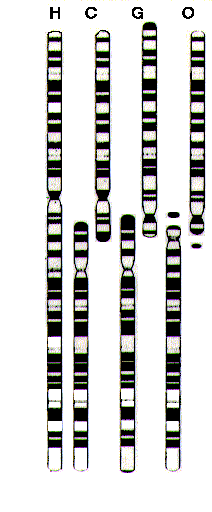
Well it depends on what genes you are looking at. Some genes are highly conserved, others are not. But rememer, we didn't evolve from modern bacteria, but rather from ~2.5 billion year old bacteria. If you want a closer look to the orgin of mankind, you need to be comparing us to the great apes. Take the following comparason of our chromosome 2 to chimp, gorilla, and orangutan chromosomes.
hum_ape_chrom_2.gif

What does it say to you?

I don't accept that your example gives a sensible explanation of how the DNA for the human body parts came into existence.

Of course not, DNA is the product of complex biochemical pathways for the synthesis of nucleic acids and the forming of polymers. Human DNA comes about the same way as Magnolia DNA: semi-consevative replication.
 
Upvote 0

Risen Tree

previously Rising Tree
Nov 20, 2002
6,988
328
Georgia
✟33,382.00
Faith
Atheist
Marital Status
In Relationship
Politics
US-Democrat
look up photosynthesis - it perfectly explains how energy input can be coupled to increasing molecular complexity

Oh it can happen, but note that the process is not spontaneous without the intervention from the sunlight.  As a general rule, however, the random introduction of energy into a system tends to cause chaos, not order.

woah, stick to statistics - any fossil which doesn't represent a terminal branch of the tree of life is transitional

That's an assumption.  Just because a lower form of life exists does not automatically mean that it is a stairstep on the evolutionary ladder.

Of course we haven't found any <I>missing</I> links because once a missing link is discovered it becomes a <I>found</I> link.

OK.&nbsp; Then show me a complete, unabridged evolutionary pathway of evolution.

Here is a table listing the macroevolutionary differences of the populations.

Unless the world's record for mutations has occurred with these mosquitoes, this is MICROevolution.&nbsp; The natural selection that is occurring here is not introducing any new genes to the gene pool; it is simply adapting the mosquitoes to their environments.&nbsp; Many cases of this have been recorded where the races/subspecies eventually mate with each other again, reuniting the gene pool.&nbsp; This fluctuation of the genes is normal and happens all the time.

Actually, the fossil record (which amounts to the sum of discovered fossils) should contain no missing links which by definition haven't been discovered. Is it no surprise that it does not contain that which it cannot.

Here come the semantic wars. :rolleyes:&nbsp; Missing links are the pathways by which we should see macroevolution from one species into another.&nbsp; They are called missing links because they do not exist.&nbsp; Now if scientists can find these links, then we can discuss the consistency of evolution with the fossil record.&nbsp; At present, however, it is a clash.

Nope, it is a principle of the universe, as described by the definition from my undergrad physics book which I provided in my post.

Exactly, and life is a part of the universe.

By the way, how does the "law" of biogenesis screw anything? It only applies to "spontaneous generation." It does not refer to abiogenesis.

See, there we go.&nbsp; You're attempting to refute a law based on an assumption.&nbsp; Again, that will not work.&nbsp; I encourage you to step outside the box and see which POV actually uses science and not politics.

I wasn’t refuting ICR’s beliefs since they were not science (hint: anything that involves supernatural intervention is not science)

Read back through the thread; it was very much directed at me.&nbsp; The second comment is an assumption.

I already gave you what you want.

It must have gone straight over my head. :rolleyes:&nbsp; The only "evidence" you gave against my theory of creation was that it was religious.&nbsp; What is your evidence against creation?

Spoken like a man who has never taken a college evolutionary biology class. If it is not legitimate science, why is it the foundation of all modern biology?

There are three general fields of science that exist today:&nbsp; Junk science, lab science, and origin science.&nbsp; Junk science is the notion that the planet is going to blow up in a few decades unless we start "thinking green" and stop polluting.&nbsp; Lab science is the methodical, step-by-step process of hypothesis testing and drawing conclusions.&nbsp; Origin science is the attempt to vindicate the theory of evolution based on the assumption that life as we know it evolved.&nbsp; The three fields of study are highly unrelated, and I leave it as an exercise to the reader to determine which science is the true science.

Did you even read the rest of my post on the subject? Where did I once say that Mutation is not random? In fact, I very must stated that evolution is random, but biased. Actually selection operates every second of every minute of every hour of every day. It only takes one generation to feel its effects. It’s rate of spread is tied closely to how beneficial it is, but that doesn’t matter since evolution has occurred over countless generations, and in the course of a single species lifetime it can go through millions of generation. And yes, many beneficial mutations are lost because of drift, but many are not lost. Your comments do nothing to refute evolution, and the fact that you think they do shows a profound lack of knowledge about the subject.

lol

Forget about natural selection for a moment.&nbsp; The weak link in the evolutionary process is not natural selection, but mutations.&nbsp; Mutations are highly irregular and random, and the odds of producing a specific mutation AND that mutation being beneficial AND that mutation surviving the initial stages of propagation are very low.&nbsp; And don't even mention the odds of getting a few billion or so helpful mutations to occur within a SINGLE phase of evolution.&nbsp; And what about the millions of such processes of evolution that have to occur?&nbsp; The odds against this happening are simply impossible.&nbsp;

What does it say to you?

The "I smell a rat here" warning light has just gone off.&nbsp;:p&nbsp; Does anyone remember the pictures of human embryos and the gills they contain?&nbsp; Later research showed that the "gills" were actually the early stages of the thyroid and parathyroid glands!
 
Upvote 0

seebs

God Made Me A Skeptic
Apr 9, 2002
31,917
1,530
20
Saint Paul, MN
Visit site
✟70,235.00
Faith
Seeker
Marital Status
Married
Politics
US-Republican
I will be a lot more interested when I've seen someone who has actually studied information theory making the "no new information" argument; for now, I think it's just lack of clear understanding of what "information" is.
 
Upvote 0
Originally posted by Rising Tree:
OK. Then show me a complete, unabridged evolutionary pathway of evolution.

00prescott1.gif
-->
yaleball-tiny.gif
-->
00bushawol.gif


Unless the world's record for mutations has occurred with these mosquitoes, this is MICROevolution.

It is the evolution of one species from another, which is what you were previously saying didn't happen. Now you rely on faulty definitions of microevolution and macroevolution to shift your goal post. You can read my sig for the actual definations used in biology. We are discussing science, so lets make sure we stick with using scientific terminology correctly.

The natural selection that is occurring here is not introducing any new genes to the gene pool

And you know this how? When was the last time you studied London Subway Mosquitoes? Sorry, but hand waving won't get you out of this one.

it is simply adapting the mosquitoes to their environments.

Well if simple adaptation can change a mosquitoes breeding site, host preference, feeding, egg preference, and life cycle, then ape ancestor to man is rather trivial.

Many cases of this have been recorded where the races/subspecies eventually mate with each other again, reuniting the gene pool.

Not in this case, the populations are reproductively isolated, they won't successfully interbreed. Or did you miss that when I mentioned it earlier? You really should take the time to read the paper before you try to disprove its research. I can email you a copy if you need it.

Here come the semantic wars. Missing links are the pathways by which we should see macroevolution from one species into another. They are called missing links because they do not exist. Now if scientists can find these links, then we can discuss the consistency of evolution with the fossil record. At present, however, it is a clash.

So missing links are pathways that do not exist. Therefore, pathways that do exist are not missing links. Why do you insist that missing links must exist if by definition they cannot?

Exactly, and life is a part of the universe.

And thus does not violate 2Lot.

See, there we go. You're attempting to refute a law based on an assumption. Again, that will not work.

What is the assumption? You are asserting that I am using an assumption. Well what is it? How is it an assumption?

I encourage you to step outside the box and see which POV actually uses science and not politics.

My vote for irony of the year.

Read back through the thread; it was very much directed at me. The second comment is an assumption.

So it is an assumption to say that science does not involve the supernatural. Right. . . . So demon possession is a scientific explanation for disease. Thor is a scientific explanation of lightning. The devil beating his wife is a scientific explanation of why the sun shines when it rains. Santa Claus is a scientific explanation of why there are presents under the tree on Christmas Morning. Methinks, that you need a refresher course on the scientific method.

The only "evidence" you gave against my theory of creation was that it was religious. What is your evidence against creation?

First propose a scientific theory. Then we can debate on the evidence for it.

There are three general fields of science that exist today: Junk science, lab science, and origin science.

Really? Can you find a single university with departments or divisions of "junk science," "lab science," and "origin science?"

Junk science is the notion that the planet is going to blow up in a few decades unless we start "thinking green" and stop polluting.

Reference please, with specific links to scientific journals that are at the forefront of "Junk Science."

Lab science is the methodical, step-by-step process of hypothesis testing and drawing conclusions.

Okay, I challenge you to find a single lab in evolutionary biology that does not practice this.

Origin science is the attempt to vindicate the theory of evolution based on the assumption that life as we know it evolved.

There you go again. Throwing around the word "assumption" with out any support. How about you take a college level course on evolutionary biology and get back to us? If evolution was so unscientific, why is it the foundation of modern biology?

Forget about natural selection for a moment.

For what reason? It is the central design process of evolution.

The weak link in the evolutionary process is not natural selection, but mutations. Mutations are highly irregular and random, and the odds of producing a specific mutation AND that mutation being beneficial AND that mutation surviving the initial stages of propagation are very low.

Yes beneficial mutations are rare compared to other ones. But so what? They're not non existent. Most species have millions of individuals. That is over a million chances each generation for any beneficial mutation to occur. Couple that with thousands of generations during the lifetime of a species and you have billions of chances for beneficial mutations to arise. The typical mutation rate of a gene is on the order of 1e-5 to 1e-6 mutations per gene per generation. So it is not surprising at all for beneficial mutations to crop up and be promoted in the population. This kind of stuff is covered in Introductory Genetics.

And don't even mention the odds of getting a few billion or so helpful mutations to occur within a SINGLE phase of evolution. And what about the millions of such processes of evolution that have to occur? The odds against this happening are simply impossible.

What does that have to do with anything? There is no mutation threshold for evolution. It can happen with one mutation. It can happen with millions. Furthermore, evolution is a continuous process that occurs from generation to generation. It is not a role playing game where you get to "level up" to the next stage. Please educate yourself on basic biology.

The "I smell a rat here" warning light has just gone off. Does anyone remember the pictures of human embryos and the gills they contain? Later research showed that the "gills" were actually the early stages of the thyroid and parathyroid glands!

Well it should be easy for you to confirm or refute. Just go through the scientific literature on human and ape chromosome banding patterns. If that doesn't work, you can generate you own by taking samples and following the standard guidlines of cytology. We'll be waiting for your results.
 
Upvote 0