• Starting today August 7th, 2024, in order to post in the Married Couples, Courting Couples, or Singles forums, you will not be allowed to post if you have your Marital status designated as private. Announcements will be made in the respective forums as well but please note that if yours is currently listed as Private, you will need to submit a ticket in the Support Area to have yours changed.

  • CF has always been a site that welcomes people from different backgrounds and beliefs to participate in discussion and even debate. That is the nature of its ministry. In view of recent events emotions are running very high. We need to remind people of some basic principles in debating on this site. We need to be civil when we express differences in opinion. No personal attacks. Avoid you, your statements. Don't characterize an entire political party with comparisons to Fascism or Communism or other extreme movements that committed atrocities. CF is not the place for broad brush or blanket statements about groups and political parties. Put the broad brushes and blankets away when you come to CF, better yet, put them in the incinerator. Debate had no place for them. We need to remember that people that commit acts of violence represent themselves or a small extreme faction.

The Quiet Thread

mark kennedy

Natura non facit saltum
Site Supporter
Mar 16, 2004
22,030
7,265
63
Indianapolis, IN
✟617,130.00
Gender
Male
Faith
Calvinist
Marital Status
Single
Politics
US-Democrat
HRE said:
Genererally, posts that go in the Quiet Thread need to engage in a brief trial period on the actual forums.

The point of this thread is for the topics that usually receive no answers because they are so...irrefutable.

For a topic to receive no answers, that chance must first be given.

I have posted most of this in the public forums like the evolution of the human brain and Genetics and natural selection. However, I posted a copy of the first one to Genetics and natural selection and got nothing in the way of a substantive response, much less a technical discussion. However, if you like I'll post a copy of the entire discussion there and see what happens.
 
Upvote 0

Deamiter

I just follow Christ.
Nov 10, 2003
5,226
347
Visit site
✟40,025.00
Faith
Christian
Marital Status
Married
HRE said:
Genererally, posts that go in the Quiet Thread need to engage in a brief trial period on the actual forums.

The point of this thread is for the topics that usually receive no answers because they are so...irrefutable.

For a topic to receive no answers, that chance must first be given.

Presumably you're referring to how evolution is irrefutable, and creationism is not?

Having scanned the two posts (didn't have time to go over them in detail) they look all right to me. I certainly disagree with the conclusions, and I believe personally that they can be refuted, but they seem strongly written and not outrageous!

I agree that posts in the quiet thread need to be well thought-out and more detailed than can be addressed easily in a single thread. At the same time, I don't agree with the implication that only evolutionist posts will be allowed here. If Mark felt that his articles were refuted, he wouldn't be posting them! He's certainly been around long enough, and has discussed natural selection enough to have a good feel of what he feels has been addressed and where evolutionary theory is lacking!

I'll take spamming posts out of the quiet thread, but I won't be judging posts on the basis of scientific accuracy. I have an opinion of course, but this forum isn't trying to promote evolution any more than it's pushing creationism (though we routinely get accused of doing both).
 
Upvote 0

mark kennedy

Natura non facit saltum
Site Supporter
Mar 16, 2004
22,030
7,265
63
Indianapolis, IN
✟617,130.00
Gender
Male
Faith
Calvinist
Marital Status
Single
Politics
US-Democrat
HRE said:
No, it was just that I had never seen these articles in the main forum section at all...which is usually where it is determined if the argument holds merit or not.

That's all.

The first part was buried in the natural selection and genetics thread while the second one, actually more of the same was from the formal debate.
 
Upvote 0

grmorton

Senior Member
Sep 19, 2004
1,241
83
76
Spring TX formerly Beijing, China
Visit site
✟31,783.00
Faith
Non-Denom
Marital Status
Married
Why was the flood so dry?


For those like Dad, who can't stay on topic, please don't reply. I want to see some discussion of the issues raised below. I will post some today and the rest over the next couple of days. this forum doesn't like pictures being linked in. OK YECs, why don't your leaders ever publish these kinds of pictures in your Creationist magazines? Are they hiding something from you?


Everyone knows what happens when a lake dries out. The mud dries and cracks form. We find such things in the global flood.One of the things that is very difficult for the global flood advocates to explain is why, during a global, wet water catastrophe, there are so many places in the world which experienced drought. These areas dried up and left mudcracks as evidence of the drying throughout the geologic column. Everyone is familiar with mudcracks and the fact that they take several days to several weeks of drought to dry out the sediments sufficiently to form. When we find such things in the fossil record, young-earth creationists often claim that they are synaeresis cracks, which are dewatering structures. This is a false claim as synaeresis cracks are easily distinguishable from genuine desiccation cracks. Consider what the experts say.

Simpson and Eriksson note that synaeresis cracks are discontinuous:

"Discontinuous dikelets are considered to be characteristic of synaeresis cracks that are of no
paleoenvironmental value (Donovan and Foster 1972; Anderton 1976; Soegaard and Eriksson 1985). Alternatively, the
discontinuity of the dikelets could be due to limited exposure in the tidal cycle that prevented muds from drying completely (cf. Allen 1983)." (Simpson and Eriksson, 1990, p. 94)


Reineck and Singh note that the cross-section of the crack is different in synaeresis cracks (dewatering):

"Such subaqueous shrinkage cracks differ from subaerial desiccation cracks in that they are not so well developed, the cracks are rather narrow, and they do not possess well developed V-shapes in transverse sections. In general, subaqueous shrinkage cracks are less regular in form and often incomplete." (Reineck and Singh, 1980, p. 60)

The young-earth creationist, Steve Austin, implies that all desiccation cracks are synaeresis cracks. He writes:


"Thick sedimentary rock sequences containing shrinkage cracks are frequently claimed to have required repeated wetting and drying of the sediment surface, thereby requiring a lot of time in what would normally appear to be a rapidly deposited sedimentary sequence. Plummer and Gostin urge caution when interpreting 'mudcracks' in rocks as evidence of drying.

'Shrinkage cracks can form not only at the sediment-air interface by desiccation processes but also at the sediment-water interface or substratally by synaeresis processes.' (page 1147)" (Austin, 1984, p. 272-273)

But what Austin doesn't tell his readers is that Plummer and Gostin note that synaeresis cracks are easily distinguishable from desiccation cracks. Desiccation cracks exist on more than one layer, i.e. have more than one generation; synaeresis cracks are one time events. They write:

"Desiccation mudcracks are generally continuous, polygonal, and often of several generations with v- or u-shaped cross-sections that are infilled from above. Synaeresis cracks, on the other hand, are generally discontinuous, spindle, or sinuous in shape and of one generation only, with v-or u-shaped cross-sections that are infilled from either above or below." (Plummer and Gostin, 1981, p. 1153)

The picture below shows what it is like to have more than one generation:

crackgeneration.gif


Clemmy notes that synaeresis cracks are randomly oriented and incomplete:

"Randomly oriented incomplete cracks, often having a characteristic bird's foot shape and formed during subaqueous
dewatering (possibly aided by salinity changes; Donovan & Foster, 1972) are termed synaeresis cracks. ...
○"Whilst they are not unique to lake sediments, syneresis cracks are particularly abundant in ancient lacustrine formations
(Devonian-Arcadian basin, Triassic - Lockatong Formation, Eocene - Green river Formation)."(Clemmey, 1978, p. 264)


I am going to show a comparison of the most complete set of synaeresis cracks I have seen, which were made in a laboratory under carefully controlled conditions. Even so, one can clearly see the difference between these synaeresis cracks (in which the crack doesn't cause a separation of the two sides of the crack). The synaeresis crack is more like a fold or wrinkle than like a desiccation crack shown below it.

synaeresisCracksTW.jpg


Here is a modern example of a desiccation cracks. Here you see the clear break in the 2 sides of the crack. It isn't merely a fold as above:

mudcracks.gif
http://www.hill.anorak.org.uk/pics/mudcracks.gif


The synaeresis cracks were generated by flocculating (rapidly depositing shale) and thus it is a phenomenon of shale, not of limestone which will become important below.

I note these differences up front so that no one can claim that the cracks I will show below are synaeresis in origin. One more piece of background information before looking at various age desiccation cracks. The geologic column is in the order as follows:

Tertiary
Cretaceous
Jurassic
Triassic
Permian
Pennsylvanian
Mississippian
Devonian
Silurian
Ordovician
Cambrian
Precambrian


Thus when we find Cambrian desiccation, it lies in rocks beneath the rest. And when we find Miocene cracks, they are above most of the rocks being beneath only the Recent, Pleistocene and Pliocene. One must remember that whatever one thinks about the geologic column, the order represents a relative time line--e.g. the Cambrian was deposited earlier than the Ordovician etc.

The global flood was supposed to have covered the entire earth with water and deposited the entire geologic column, according to most flood advocates. A moderate thickness of sedimentary rock of 15,000 feet would require the average deposition of 41 feet of sediment per day for 365 days to account for the strata. That is almost 2 feet per hour. Under these conditions, we should not expect to find lots and lots of desiccation cracks in the geologic column. The plain fact is, desiccation cracks are quite abundant in the column. Given that desiccation cracks can be found in each and every geologic period, the earth was never covered with water because it would be impossible for the sediments to dry out beneath thousands of feet of water. Lets start with a set of desiccation cracks with an unknown age. This is from Peru and is along one of the roads.

D0004.JPG


The thing that is fascinating about this is that the layer used to be flat when the mud was soft and when it was drying out. The drying would have taken some days. This alone would argue against the 2 feet per hour of flood deposition. But after the cracks were formed and the rock dried out, the next layer of sediment came and deposited inside the cracks filling them with a slightly different material. (once again, more time). Then the rock was lithified (more time) and eventually the rock was upraised to a vertical position in the Andes. The entire sequence of events requires more time than the global flood advocates allow.

Drought in the Cambrian

Archibald Geikie, as long ago as 1903 noted that the Cambrian was full of desiccation cracks.:

"The rocks of the Cambrian system present considerable uniformity of lithological character over the globe. They consist of grey and reddish grits or greywackes, quartzites, and conglomerates, with shales, slates, phyllites, or schists, and sometimes thick masses of limestone. Their false bedding, ripple-marks, and sun-cracks indicate deposit in shallow water and occasional exposure of littoral surfaces to desiccation." (Geikie, 1903, p. 909.

Occasionally the drying out in the Cambrian became so great that salt was deposited.
CambrianSaltPseudomorphsTW.jpg


The salt crystals formed in the sediments beneath the sandstone, then dissolved and the sand filled in the crystals leaving the form of the crystal only now molded in sand. This is a true drought in the Cambrian.
 
Upvote 0

grmorton

Senior Member
Sep 19, 2004
1,241
83
76
Spring TX formerly Beijing, China
Visit site
✟31,783.00
Faith
Non-Denom
Marital Status
Married
Here is the next installment. YECs, why do your leaders never publish this
information? What are your creationist magazines hiding from you?


Drought in the Ordovician.

DesciccationCracksOrdovicianTW.jpg


This is from the Ordovician of the Ozarks. Once again, another drought affected the
global flood, drying out the earth's surface while it was all wet! Yeah sure.


Ordovician mudcracks are found elsewhere as well:

"Sedimentary structures suggestive of deposition in a predominantly intertidal
environment, possibly supratidal in parts, are common in the Gap Creek Formation.
They include desiccation cracks, algal laminae, intraclastic beds, small scale cross-
bedding, fossil trails, erosional truncation, scour-and-fill, abundant vertical burrows,
and some horizontal burrows." (McTavish and Legg, 1976, p.461)


Drought Cracks in the Silurian

DesciccationCracksSilurianTW.jpg


One can see the multiple generations of desiccation cracks on the upraised slab at the
top right of the above outcrop. This is something that synaeresis can not do. And this is
a limestone, not a shale where synaeresis cracks form.

Drought in the Devonian

Another drought occurred during the Noahic flood in the Devonian. Here are some
desiccation cracks from that age.
DesciccationCracksDevonianTW.jpg


Drought in the Mississippian

As we move up the geologic column the global flood
once again finds itself without water and the land
drying out. Here is a Mississippian example:


DesciccationCracksMississippianTW.jpg


Like the case in Peru, this rock shows a similar
sequence. Mud deposited (takes some time); mud dries
out (takes a few days); cracks infilled with more
material (takes some time); mud lithified (takes
some time); then uplifted to a vertical position
(takes some time). These sequences argue against the
view that 41 feet of sediment each and every day was
being deposited on these rocks.


Drought in the Pennsylvanian

The Pennsylvanian Minnelusa formation which contains
three features which are incompatible with the
flood. First there is a desiccated dolomite with
desiccation cracks. Secondly, there are two
anhydrite layers with a peculiar "chicken-wire"
structure (Achauer, 1982, p. 195). Thirdly, the
sands are cross-bedded in a fashion identical to
modern desert dunes! The importance of these three
features is that desiccation is not likely in a
world wide flood, and "chicken-wire" anhydrite only
forms above 35 degree C. and near the water table.
(Hsu, 1972,p. 30). This type of anhydrite is
deposited in the Persian Gulf area today. Fossils
include brachiopods, cephalopods, gastropods, fish
teeth, crinoids pelecypods. None of the Minnelusa
beds are likely to be deposited under flood waters.


With all these droughts, one wonders where the
global flood was!


Drought in the Permian

In western Pennsylvania, the Permian was a time of
drought, as it was over much of the world. Salt was
deposited in Kansas, West Texas, as well as in
Europe. Dean notes


"By contrast, the evaporites in the Permian
Zechstein basin are more than 600 m thick, with a
total volume of more than 2 X 10^9 Km^3 and a
NaCl:CaSO4 of about 5:1 (Borcher and Muir,
1964)." (Dean, 1978, p. 81)


In Texas the Castile formation was deposited. King
relates that 928.5 x 10^15 cubic
feet of water had to have been evaporated during
this time (King, 1947, p. 475) The
young-earther should note that complete evaporation
is hard to accomplish when the world is covered with
water.

Below is a desiccation crack from the Permian. It is
from an excellent web page http://www.geology.pitt.edu/GeoSites/site%20WASHE%206-1new.htm
which tells about other items indicating drought.
sams%20club%202.jpg

 
Upvote 0

grmorton

Senior Member
Sep 19, 2004
1,241
83
76
Spring TX formerly Beijing, China
Visit site
✟31,783.00
Faith
Non-Denom
Marital Status
Married
Here is the next installment of the droughts.

Drought in the Triassic


The Triassic also was a time of worldwide drought. Red beds, salt (Zechstein of Europe). And once again, in the middle of a global flood, we find the world running out of water and everything drying out. Here is a Triassic desiccation crack.

desciccationCracksTriassSloanCanyonFmNewMexicoTW.jpg


During the formation of this rock, the 41 feet of deposition per day ceased so that a dinosaur could take a stroll on the mudcracked and drying rocks. Doesn't look like a global flood to me, but several of my YEC friends claim that if I only had the right framework I could interpret this as due to a global flood. Unfortunately, they never seem to give me their explanation for these features.

Drought in the Jurassic

Below is from St. George, Utah. The Jurassic there holds dinosaur tracks but they also, like the Triassic above, have multiple layers of desiccation cracks. Once again, there must have been several months when the flood waters and sedimentation ceased to have any effect. Once again, the global flood was stopped by a drought.

SIA0322.jpg


You can learn more about this site at http://scienceviews.com/dinosaurs/dinotracks.html

Here is a dino track and on the left you can see the desiccation cracks:

SIA0273.jpg


Drought in the Cretaceous

The Cretaceous example comes from South Texas where on a field trip along Pipe Creek. There are 6 ledges along the creek, each having a carbonate hardground with burrows and desiccation cracks filled with evaporitic minerals.

hardgr3.jpg


The celstite is an evaporitic mineral which fills the desiccation crack. Once again, the Cretaceous seems to be short on water for the global flood. And the six ledges with all of this clearly shows that 41 feet per day were not being deposited here. There is about 15,000 feet of sediment below these rocks and used to be a lot of sediment above them prior to the erosion which has dumps lots of this sediment out in the Gulf of Mexico.

Drought in the Tertiary

From France:

"Periodically, desiccation of the basin produced mud-cracked horizons locally with bird and mammal footprints. At the end of this arid period, an extensive development of algal mats covered the whole area of the basin." (Truc, 1978, p. 189-190)

And here is a picture of mudcracks from the Eocene of the Tertiary from the Green River formation, which YECs often claim is due to a global flood. At least parts of that deposit were lacking waters of the global flood.:

DesciccationCracksEoceneGreenRiverTW.jpg


What we have seen here is that the entire geologic column lacks evidence of a global flood. The world was drying out during the time the YECs claim that the world was underwater. Global flood advocates will most assuredly not have a rational explanation for all these desiccation cracks up and down the entire column. And this is why no one pays any attention to YEC in the geological sciences. They can't explain anything.
 
Upvote 0

Lucretius

Senior Veteran
Feb 5, 2005
4,382
206
38
✟5,541.00
Faith
Atheist
Marital Status
Single
Politics
US-Democrat
“The moon is drifting slowly away from the Earth. If it is getting further away, then at one time it was much closer. The Inverse Square Law in physics states that if the moon was half the distance away, its gravitational effect on our tides would be quadrupled. One third the distance and it would be 9 times stronger. We would all drown twice a day. 1.2 billion (1,200 million) years ago, the moon would have been touching the Earth.” — http://www.allaboutcreation.org/age-of-the-earth-c.htm

In attempting to find evidence for a young universe, Creationists seem to mention the drifting of the moon away from the Earth. A friend of mine recently gave me a paper on ‘evidence against evolution’, and among his arguments was this one. My plan is to address it in an order easily understood, and as to leave no doubt of its fallacy. I also will include some basics on the orbit of the moon learned through my research.

The Orbit of the Moon

The moon is approximately 384,400km away from the Earth, and is almost perfectly circular, being tilted slightly (5°). It takes 27 days to orbit around the Earth. The moon does not orbit around the center of the earth. Instead, it revolves around something known as a barycenter, which lies inside the Earth’s crust but not the middle. Why? Both the Earth and the moon have gravitational pull. The Earth’s gravitational pull is much greater however, than that of the moon’s. So, the barycenter’s position can be described as the Earth’s gravitational pull on the moon to it’s center minus the moon’s gravitational pull on the Earth (Love 2005.) Wikipedia places the barycenter for the Earth-moon relationship at 4,671km from the center of the Earth. The moon, as stated in the claim, is drifting away from the Earth. I’ve seen Creationists put figures as high as 5.8cm/yr though (DeYoung 2004.) but the real figure is 3.8cm/yr or 1.5in/yr. The reason for the drift is simply that the Earth’s rotation is slightly faster than the orbit of the moon’s, and so when the moon exerts it’s gravitational pull on the tides, the Earth’s rotation carries this ahead of where the moon placed it. The Earth slows down a bit because of this tide displacement, allowing the moon to drift away from us.

The Inverse Square Law?

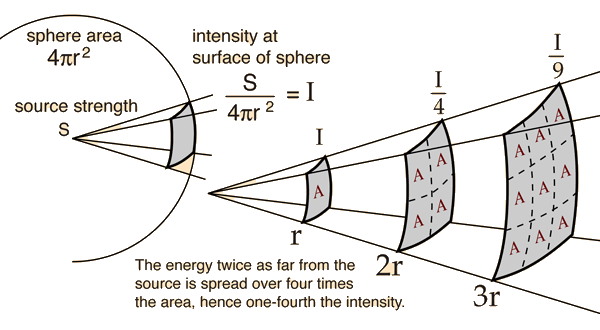
The Inverse Square Law is a physical law that basically states objects that can radiate their influence will do so according to this law. Mathematically described, intensity is equal to radius divided by area of sphere.

isq.gif


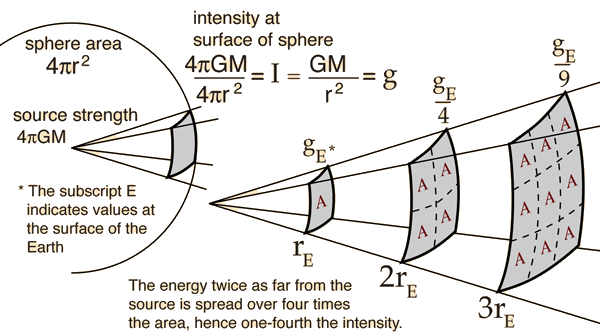
In regard to gravity, the equations do not change much, the figure looks very similar as well:

isqg.gif


Now it is time for some calculations: G = Gravitational Constant, M = mass of the Earth. I think we all know what r means. For an example, let’s use the formula to find out the acceleration on moon’s surface caused by it’s gravitational field.
R = 1,738, and M = 7.347673x10^22. The equation that follows is:

582474-0.png


The answer I receive is: 1.62246789m/s/s. This makes sense because the Earth’s gravitational pull (9.81m/s/s) is approximately six times stronger than that of the moon. What is the moons effect on the Earth’s surface then? The moon is 384,403km away from Earth, which means it is going to have 221 times less gravitational effect on the Earth. Unfortunately for the argument the Creationists present, the Inverse Square Law is not a method for calculation of tidal movement. If it were, the numbers one would get from the equations would state that the Earth’s tide should move about one centimeter vertically per day due to the moon’s pull. The law is good for finding power of the gravitational field of an object, but for tidal movement it is not of value.

The mathematical formula needed for finding the estimate tide size is as follows: (Johnson 2002.)

582737-0.png


Once again I plug in values:

582737-1.png


What does this number mean? It represents the distortion the moons acceleration puts on our Earth’s acceleration. How much is it? About 1/900,000,000 of that of the Earth’s. Now, since we do not have water at the center of the Earth, this measurement is going to be distorted as well (the measurement we got referred to the Earth's center, not where the water is.) The Earth is about 6,400,000m thick, so we take our distortion rate and divide it by that amount and get 2/3rds of a meter. This is the height of the tide. Due to the shape of the Earth and whatnot, the height is somewhat less than this, the site I found puts it at around 20”.

So, after all the fancy mathematics all we have found is the bulge of the Earth’s tides that the moon causes on us today. Still, with 3.8cm/yr as the drift rate, the tide does seem like it would be very high. We can use it to tell us past tides as well. If I place the moon 100,000 km closer to Earth, it will effect the tides such that the bulge is 66". How long ago would the moon be this close assuming a constant rate of drift? 2,631,578,950 years ago. Using a more lenient drift rate like 2.5cm/yr (as you shall see the drift rate is not constant) would put this type of tidal action at 4 billion years ago.

Oops, the moon hasn’t always been drifting by 3.8cm.

The current rate of moon drift does not accurately reflect the moon’s previous drift. Why is the rate of drift not constant? The accumulation of momentum transferred from tides to the moons rotation is responsible for this. The further away from Earth the moon gets, the less it is going to be held back, because the gravitational attraction between the two objects will be lessening. The momentum transferred from the tides to the moon will be letting the moon travel faster and faster until it ultimately flies out of orbit and into space. How can scientists know what the rate is? Layers of sediment. The thin layers of sediment scientists look at (called sedimentary cyclic rhythmites) show scientists the ebb and flow of the tide, and from this the length of the day can be inferred, and from this, the drift of the moon can be inferred (Williams 2000.) George E. Williams in the journal Reviews of Geophysics places the rate of drift during the Proterozoic (2450-620MYA) around 1.24cm/yr and 2.17cm/yr during the Neoprotozoic (~620MYA). So then, how does this effect our calculations? The numbers already show that the moon is drifting away not at a steady rate, but faster and faster. The numbers supplied by Mr. Williams show that for the 1.8 billion years of the Proterozoic Era, the moon’s yearly drift changed by 1.9cm. In only 620 million years (From the Neoprotozoic age to now) the moon’s drift changed by 1.63cm. The drift rate increased threefold!

This is critical. Unfortunately, it makes calculation very, VERY tedious. Too tedious, in fact, for me. I’m by no means a mathematical wizard, but one can see that the moon’s drift rate gets asymptotically smaller as one delves farther and farther into the history of the Earth-moon system. If one wants to see this for himself, take 38440300000cm (the moon' distance from the Earth) and divide it by 3.8cm/yr. The result? 10,115,868,400 years. That's right. If the drift rate was constant, the moon would outdate the Solar System before it ran into Earth (which makes no sense). The moon has always been a safe enough distance away from the Earth so that tides were not so huge as to drown every living species that didn’t breathe water.

!

For some of you who want to nitpick: please do. I’ve checked the math to the best of my ability, but I wouldn’t doubt if it was wrong. If anyone sees an error within this please let me know so I can correct it A.S.A.P. Thanks.
EDIT: I finally found out why I was getting strange values for some formulae. Remember kids, always make sure your units aren't being mixed.

Bibliography

http://www.synapses.co.uk/astro/moon1.html
http://ncsdweb.ncsd.k12.wy.us/planetarium/synchronous.html
http://mb-soft.com/public/tides.html
http://hyperphysics.phy-astr.gsu.edu/hbase/forces/isq.html
http://adsabs.harvard.edu/cgi-bin/nph-bib_query?bibcode=2000RvGeo..38...37W&db_key=PHY
 
Upvote 0

grmorton

Senior Member
Sep 19, 2004
1,241
83
76
Spring TX formerly Beijing, China
Visit site
✟31,783.00
Faith
Non-Denom
Marital Status
Married
Lucretius said:
The Earth is about 64,000,000m thick, so we take our distortion rate and divide it by that amount and get 2/3rds of a meter.

Unless I and everyone else is terribly mistaken, the earth's radius is only 6,378 Km, or 6,378,000 m thick, approximately 6.4 million meters, not the 64 million meters you have. You might want to fix this.
 
Upvote 0

Pete Harcoff

PeteAce - In memory of WinAce
Jun 30, 2002
8,304
72
✟9,884.00
Faith
Other Religion
Beneficial mutation rates not a problem

To start, estimates on beneficial mutation rates are almost non-existent. Even estimates on mutation rates in general are sketchy, so I would caution against drawing any rigorous conclusions from this data. That said, based on the numbers I could dig up, mutations are not a problem for evolution.

The only hard numbers I could find on beneficial mutations were from the paper Fitness effects of advantageous mutations in evolving Escherichia coli populations. The authors estimate the number of beneficial mutations in an E.coli population to be 4x10^-9 per cell and generation. It should also be noted that the authors consider this to be a conservative estimate. So what does this mean? Well, I took an estimate of the number of total mutations in E.coli from the paper Rates of Spontaneous Mutation at 0.0025 per cell and generation. Based on these rates, 1 in every 625000 mutations is beneficial. This may sound like beneficial mutations are ridiculously rare, but keep in mind that E.coli populations are huge (supposedly an individual human poops out between 100 billion and 10 trillion E.coli every single day). Just like winning the lottery may be rare, if enough people play, someone will win.

But let's put this into another context: human evolution. From the same Rates of Spontaneous Mutation paper, the estimated mutation rate for humans is 1.6 mutations per effective genome per sexual generation. Note, I highlighted "effective genome". This is due to the fact that many more mutations occur in humans (typical estimates are over 100), but most are in non-protein coding DNA. But in the E.Coli genome, almost the entire genome is considered the "effective genome". Therefore, for the purposes of this comparison I'm going to compare rates in effective genome only. I should also point out that 1.6 mutations is one of the lower estimates I've seen (some estimates are over 4 per human per generation).

Assuming the same ratio of beneficial mutations to total mutations, this means the rate of beneficial mutations in humans is 2.56x10^-6. How does this affect human evolution? Consider the scenario of human versus chimp evolution. Humans and chimps are estimated to have diverged anywhere from 5 to 10 million years ago. I'm going to go with the lower end of 5 million. If I assume 5 million years of evolution, an average generation time of 20 years, and a stable population size of 100 000 individuals, this means that during that time 64000 beneficial mutations could occur in the human population.

So what does that mean? Well, the estimated difference between human and chimp genomes is typically less than 2% (though one study put the difference between critical genes at only 0.6%). I'll assume 2% in this scenario. Based on the estimated size of the protein-coding portion of the human genome (45 million base pairs; or 30 000 genes @ ~1500 base pairs per gene), we need a difference of 900 000 base pairs. But the chimp line is also evolving, so in the human population we only need to account for half of the difference or 450 000 base pairs.

I also calculated a rough estimate based on the paper DNA sequence and comparative analysis of chimpanzee chromosome 22 and arrived at a 168000 mutation difference in coding DNA between humans and chimps.

Could these mutations account for the difference? Sure, especially given that the 64000 mutations is only based on strictly beneficial mutations and lower end time frame of 5 million years. This doesn't take into account fixation of neutral or even possibly deleterious mutations which could account for many more differences between humans and chimps. Plus, the 64000 mutations is based on a relatively conservative estimate of both beneficial mutation rates and effective mutation rates in humans. Conceivably, there could numbers of beneficial mutations that are magnitudes higher.

So are mutations a problem for evolution? Based on limited and conservative data, the answer is no.
 
Upvote 0

grmorton

Senior Member
Sep 19, 2004
1,241
83
76
Spring TX formerly Beijing, China
Visit site
✟31,783.00
Faith
Non-Denom
Marital Status
Married

There are thousands of correlations between vastly different areas of knowledge and natural systems which are seen in the geologic record which make the concept of a global flood simply untenable. This is one of them.


One of the observations of modern science is that there is an inverse relationship between the number of stomata in leaves and the CO2 content of the atmosphere. The higher the CO2 content, the fewer stomata on the plants. For those who don't know, stomata are tiny openings into the leaves which allow air to pass into and out of the leaf.


“From a study of herbarium material, Woodward (1987) demonstrated that a number of forest tree species have responded to the anthropogenically induced CO2 rise since preindustrial times, with a 40% mean reduction in stomatal density. This stomatal density response to atmospheric CO2 concentration has since been confirmed from Quaternary leaf macrofossil analysis and controlled environment experiments.” Jennifer C. McElwain and William G. Chaloner, “Stomatal Density and Index of Fossil Plants Track Atmospheric Carbon Dioxide in the Palaeozoic,” Annals of Botany, 76(1995):389-395, p. 389


This information has been used to reconstruct past atmospheres:


"The end-Cretaceous mass extinctions, 65 million years ago, profoundly influenced the course of biotic evolution. These extinctions coincided with a major extraterrestrial impact event and massive volcanism in India. Determining the relative importance of each event as a driver of environmental and biotic change across the Cretaceous-Tertiary boundary (KTB) crucially depends on constraining the mass of CO2 injected into the atmospheric carbon reservoir. Using the inverse relationship between atmospheric CO2 and the stomatal index of land plant leaves, we reconstruct Late Cretaceous-Early Tertiary atmospheric CO2 concentration (pCO2) levels with special emphasis on providing a pCO2 estimate directly above the KTB. Our record shows stable Late Cretaceous/Early Tertiary background pCO2 levels of 350-500 ppm by volume, but with a marked increase to at least 2,300 ppm by volume within 10,000 years of the KTB. Numerical simulations with a global biogeochemical carbon cycle model indicate that CO2 outgassing during the eruption of the Deccan Trap basalts fails to fully account for the inferred pCO2 increase. Instead, we calculate that the postboundary pCO2 rise is most consistent with the instantaneous transfer of 4,600 Gt C from the lithic to the atmospheric reservoir by a large extraterrestrial bolide impact. A resultant climatic forcing of +12 W·m2 would have been sufficient to warm the Earth's surface by 7.5°C, in the absence of counter forcing by sulfate aerosols. This finding reinforces previous evidence for major climatic warming after the KTB impact and implies that severe and abrupt global warming during the earliest Paleocene was an important factor in biotic extinction at the KTB."
D. J. Beerling, B. H. Lomax, D. L. Royer, G. R. Upchurch, Jr., and L. R. Kump

An atmospheric pCO2 reconstruction across the Cretaceous-Tertiary boundary from leaf megafossils PNAS 99: 7836-7840.


Now, why would we expect the global flood to sort leaves according to their stomata counts AND at the same time have the geological column have huge quanitities of basalt in the form of the Deccan traps? CAn some YEC please explain this? And can you explain why the YEC leaders don't ever tell you this kind of detail?


But it doesn't stop here. Lower down in the geologic column we find that an oceanic anoxic event (OAE) is also correlated with a change in the stomatal density on the leaves of plants. The oceanic anoxic events are the times when the oceanic global circulation system stopped. It turned the oceans into huge carbon sinks (traps) in which billions of tons of organic carbon was buried in the oceans. These organic rich rocks became the source rocks for much of the world's petroleum.


“The marine sedimentary record exhibits evidence for episodes of enhanced organic carbon burial known as 'oceanic anoxic events' (OAEs). They are characterized by carbon-isotope excursions in marine and terrestrial reservoirs and mass extinction of marine faunas. Causal mechanisms for the enhancement of organic carbon burial during OAEs are still debated, but it is thought that such events should draw down significant quantities of atmospheric carbon dioxide. In the case of the Toarcian OAE ( 183 million years ago), a short-lived negative carbon-isotope excursion in oceanic and terrestrial reservoirs has been interpreted to indicate raised atmospheric carbon dioxide caused by oxidation of methane catastrophically released from either marine gas hydrates or magma-intruded organic-rich rocks. Here we test these two leading hypotheses for a negative carbon isotopic excursion marking the initiation of the Toarcian OAE using a high-resolution atmospheric carbon dioxide record obtained from fossil leaf stomatal frequency. We find that coincident with the negative carbon-isotope excursion carbon dioxide is first drawn down by 350 +\-100 p.p.m.v. and then abruptly elevated by 1,200 +/- 400 p.p.m.v, and infer a global cooling and greenhouse warming of 2.5+/- 0.1 °C and 6.5 +/-1 °C, respectively. The pattern and magnitude of carbon dioxide change are difficult to reconcile with catastrophic input of isotopically light methane from hydrates as the cause of the negative isotopic signal. Our carbon dioxide record better supports a magma-intrusion hypothesis, and suggests that injection of isotopically light carbon from the release of thermogenic methane occurred owing to the intrusion of Gondwana coals by Toarcian-aged Karoo-Ferrar dolerites." Jennifer C. McElwain, Jessica Wade-Murphy and Stephen P. Hesselbo, “Changes in Carbon Dioxide During an Oceanic Anoxic Event Linked to Intrusion into Gondwana Coals,” Nature, 435(2005):479


Now, what we have in the record is a correlation between the intrusion of volcanic rocks into previously deposited coal (causing the coal to give off copious quantities of methane, which then caused a stomatal density decline in the plants all over the world, and the formation of an Oceanic Anoxic event which would use up and bury the vast quantities of CO2 eventually created by the combustion of the methane given off by the heated coal.


Why would this happen in the middle of a global flood? How could the flood waters KNOW that because volcanic rocks were being intruded into coal it was time to let the appropriate leaves with the appropriate stomatal densities be buried now? How on earth could the flood waters do such a thing?


The geologists among the YECs, like Tas Walker, Andrew Snelling, Steve Austin and Kurt Wise, KNOW that these issues are out there, but they NEVER tell their followers that these problems exist. Why? Could it be that they don't have answers and are afraid to tell their readers of these problems for fear that they would lose their jobs at the creationist organizations? Just a thought.
 
Upvote 0

grmorton

Senior Member
Sep 19, 2004
1,241
83
76
Spring TX formerly Beijing, China
Visit site
✟31,783.00
Faith
Non-Denom
Marital Status
Married
Precambrian Unconformity--what the YEC leaders don't talk about


Note added to Quiet Thread: I really didn't want to have to put this here but no YEC would reply


Most young-earthers beleive that the flood started at the Cambrian Precambrian boundary and that the earth was a tranquil place during the 1600 years between the creation and the flood. But, seismic data from around the world shows this to be anything but true. Below is a seismic section from Australia which show a major unconformity which starts about 1/2 second into the seismic record(the top of the green). Below that is demonstrably 1 seconds worth of sediment below the unconformity. Now, this is geophysical jargon. One second on a seismic line means that the seismic sound wave takes one second to go down through the sediment and back up again. The thickness of the sedimentary pile can be calculated by knowing the speed of sound. This is determined when the seismic is processed. The LUngkarta 1 well drilled to 1770 m deep and it passed the unconformity at about 530 m. So the well drilled 1240 meters ( 4070 feet) of section. The seismic section shows about 6000 feet of sediment.

After the 6000 feet of sediment was deposited, we have thrusting and contortion of the sediment. Then we see the erosional surface (bottom of the green). There was a period of erosion PRIOR to when the green (the Precambrian Wahlgu formation) was deposited on it. On the right of the picture you can see that approximatelly 4000 feet has been eroded beneath the Table Hill volcanics. There must have been time for 4000 feet of erosion--all this BEFORE the flood actually started. AFter this comes the red formation which is early paleozoic in age. These are the Table Hill Volcanics. Note that the sediment above the table Hill Volcanics is flatlying and undeformed. NO further tectonic movement occurred here and the sediments deposited by the flood are no more than 500 m.

Now, here is the problem for the advocates of a global flood is this. We have to have more sediment deposited BEFORE the flood than is deposited DURING the flood. We have to have all the tectonic activity occur BEFORE the flood and none AFTER or DURING. There has to be a long time to remove a few thousand feet of sediment by erosion.

The YEC leaders never tell their gullible followers about this. And the YEC leaders will never come to a forum like this to explain to the faithful (who have faith in them rather than in God) why I am wrong. They never show pictures like this in Creation magazine. Why? The thing that troubled me when I was a YEC was how little such data is ever discussed by these so-called YEC geologic experts. I challenge any of the big name creationists to come here and explain this to their followers. Where is Austin? Where is Snelling? Where is Walker? Please explain this data.
 
  • Like
Reactions: theFijian
Upvote 0

random_guy

Senior Veteran
Jan 30, 2005
2,528
148
✟3,457.00
Faith
Christian
I've been reading the forums for a while, and it amazes me that so few people understand basic probability, and yet they continue to use it in an attempt to disprove evolution. I decided to write this post to explain why the argument that evolution is impossible and improbable is a bad argument and hopefully clear up some misconceptions. I tried to keep it math-light, and if you have any questions, or if you spot any mistakes, please let me know. I'm on summer break now, so my brain is officially mush until next semester.

This argument only address the fallacy of evolution being impossible because it only has 10^-100000000000 chance of occurring according to some random guy (not me).

Basic Probability Information:
Suppose we are rolling a dice and we are interested in what number is rolled. This is called an experiment. We will not be able to predict the outcome of this experiment, but we do know all the possible outcomes. The set of all possible outcomes is called the sample space (S). For this experiment, S = {1,2,3,4,5,6}. Any subset of the S is called an event (E).

A probability of an event (or P(E)) must follow three conditions.
(i) 0 <= P(E) <= 1 (there is a 0 to 100% chance of something occurring)
(ii) P(S) = 1 (there is 100% chance of something in the sample space occurring)
(iii) Probability of the union of mutually exclusive events is equal to the sum of the probability of each event. (Example: P(1 or 4) = P(1) + P(4))

To determine the probability of an event, if all events are equally likely, the basic formula for P(E) = size(E)/size(S). Basically, how many ways can event E occur divided by the size of the sample space.

In our example, if we want to determine the probability of rolling a 4 on a fair dice, we take the number of ways to roll a four (1) and divide it by the sample space (6) P(4) = 1/6.

E can also be more than one outcome. Let's find the probability of rolling a number between 2-4, E=[2,4]. Remember that (iii) states you can add the probabilities of the individual events. P(E) = P(2) + P(3) + P(4) = 3/6.

More Probability Information:
Our example of rolling a dice is a discrete example. The sample space is countable. We'll now move to the continuous example. All the rules of i-iii still apply.

To determine the probability of an event in a continuous sample space, you need a probability density function (pdf). While this sounds scary, it's just a function, f(x), that represents the probability of something occurring. Here's an example of a pdf.

pdfExample.jpg


For example, let's find the probability of E=(.5 < x < .6). Remember in the discrete case, we just summed up all the values between 2 and 4? Well, the same basic idea applies here. However, there's an infinite amount of points between a and b!

pdfExampleInfinite.JPG


Well, this is where calculus comes to the rescue. The probability of an event is defined as the area underneath the pdf of that event. As you forgot, to find the area underneath a curve, you take the integral of the function of the curve between your points.

pdfExampleInfiniteCalc.JPG


Our experiment will now be the arrival time of a bus. Let's assume the bus always arrives between 1:00 and 2:00 and it has equal probability to arrive at any time inbetween. Our sample space is [0 hour, 1 hour]. This means the bus can arrive right away, any time before an hour, or at the very end of the hour.

uniformPDF1.JPG


The line is our PDF. It's basically

f(x) = 1, 0<x<1.
f(x) = 0, else where.

(more on next post....)
 
Upvote 0

random_guy

Senior Veteran
Jan 30, 2005
2,528
148
✟3,457.00
Faith
Christian
If we want to find the probability that the bus arrives between 1:15-1:30 (E=[.25-.50]), the probability would look like this:

busexample18ho.jpg


The probability of the bus arriving between those two times is 25%.


The Impossibility of the Bus:

Suppose that we're running late, and we rush to the bus station. Right when we arrive, the bus arrives. Let's let the time be 1:45. What's the probability of this event occurring?

busExample2.JPG
busexample26cx.jpg


Uh oh. What just happened? There's 0% chance of the bus arriving at 1:45? What about the chance of the bus arriving at 1:46? 0%. 1:12? 0%. When you see that bus arrive, it had a 0% chance of arriving at this time. How is this possible?

Does God intervene to make the bus beat all odds and show up? There's better odds of me turning into an atheist, becoming President, while dating Natalie Portman than there are of that bus showing up at that time.

odds.JPG


What's going on here?

Flaws of the Bus:
The problem with entire bus probability is that there's an infinite number of possible times that the bus can show up. The odds of it landing on that exact one is technically impossible. However, the bus has to arrive at some time. If you want to find a probability of any value, you must examine a set from that sample space. For example, if I asked, what's the probability that the bus shows up between 1:15 and 1:15 and 1 second, then I would get a valid answer (~.003%).

Flaws of the Impossibility Argument:
Now, you might counter that the impossibility argument doesn't have an infinite solution set, it's countable. However, the same flaws apply. There are a huge number of outcomes in the sample space, but the argument is asking the probability that an exact one occurred. Of course that number is going to be small. However, the argument doesn't examine what other similar outcomes can occur if the event is changed by a bit.

After that outcome did occur, did it really beat all odds? Or was it like the bus example, where something has to occur. Remember, a bus has 0% chance of ever showing up at a specific time, but the bus will eventually show up. Just like an argument of a specific protein being impossible to form required for some specific advantage, perhaps some protein will show up giving some advantage, it just happened to be this certain protein that did.

Conclusion:
Before you argue that something is impossible, remember to stop and think about three things:
1) What is the sample space? If it is large, the probability of a specific event will be small.
2) What is the event? If the event is a specific event, the probability will be very small. Are there other events
that can lead to the same outcome? Are there other events that can lead to similar outcomes? Have you even thought about other events?
3) What are the possible outcomes? If you are focusing on one specific outcome, the probability will be very small. Have you considered other outcomes?

Take this things in mind before you argue about probability. Again, this post did not mention other flaws with the impossibility argument such as non-uniform probability, errors in determining that probabilities, etc. If you have any questions, please feel free to PM me.
 
Upvote 0

jnhofzinser

if the Son sets you free, you will be free indeed
Jun 17, 2005
517
16
✟2,501.00
Faith
Christian
Marital Status
Married
It is of great interest to examine the process of mutation fixation in the context of the evolution of Homo sapiens. The current thinking is that a chimpanzee/human common ancestor (CHCA) existed roughly six million years ago, and from this creature, both Pan Troglodyte (chimpanzee) and Homo sapiens (human) have evolved in the interim.

At no time in the history of science have we had such an opportunity to examine this hypothesis. In recent weeks, the sequencing of the chimpanzee genome has been completed. We can now compare human and chimp genomes and investigate the divergence between them. We can also now use this divergence to estimate the parameters required over the last six million years to affect that divergence.

In particular, I propose to estimate the chance of beneficial mutation and the selective advantage of a single such mutation. That is, given the required divergence, and the allotted time-frame, one can determine the required strength (selective advantage) and frequency (probability of occurrence) of beneficial mutations.

At the same time, we have the opportunity to validate these estimates on the historic population of Homo sapiens. That is, we can use what we know about the evolution of humankind in the last two thousand years to legitimize the estimates we obtain. Based on a stable pre-historic population size of one hundred thousand, we observe that the number of mutations experienced by that population in six million years is roughly the same as the number of mutations experienced by the historic human population in the last two thousand years (see http://www.census.gov/ipc/www/worldhis.html). In the first case, the population is compressed in size and expanded in time. In the second, it is compressed in time and expanded in size. Note that the same number of mutations does not indicate the same degree of evolution. Evolution requires the “fixation” of those mutations, and it likely requires the accumulation of numerous mutations (i.e., sequential mutation-on-top-of-mutation).

In this post, I will propose a very simple simulation of evolution. The parameters used to regulate the simulation will either be chosen to reflect the latest thinking on the problem at hand, or they will be adjusted to consider “best-case” (i.e., fastest evolution) and “worst-case” (i.e., slowest evolution) scenarios.

The parameters of interest are:

· Required time-frame “T” (taken to be 6My [http://www.eden.rutgers.edu/~holt/Chimparticle.doc ]). While some articles indicate a time-frame as long as 10My, there are enough that limit the time-frame to six or seven that this cannot be construed to be a particularly conservative estimate.
· Stable pre-historic population “N” (taken to be 100,000). In general, a smaller population increases the speed of mutation fixation, while the larger increases the chance of mutation origination. We will consider this issue briefly below.
· Required number of beneficial mutations “K” (taken to be 168k). This is the number Pete Harcoff estimated elsewhere. (please see the Appendix).
· Chance of a beneficial mutation “p” (in the range of 1e-3 to 2.5e-6). For reference, Pete Harcoff estimated a value of 2.56e-6 as a chance of a beneficial mutation.
· Typical selective advantage of a beneficial mutation “s” (in the range of 1.02 to 10.0). This represents the ratio of expected offspring from mutated and non-mutated organisms respectively. Note that the selective advantage of x accumulated mutations will be taken to be s^x. With this particularly generous assumption, using the value of s=2.0 results in organisms having an accumulation of 10 mutations bearing more than one thousand times more offspring than their non-mutated ancestors! Note that the value 1.02 represents the (calculable) selective advantage for heterozygous Cystic Fibrosis, and is in keeping with the value used in [http://www.pnas.org/cgi/content/full/98/3/1113 ]. A value as high as 1.3 has been suggested elsewhere. Very high values of “s” (i.e., anything over 1.3, frankly) represent “hopeful monster” mutations.

For the purposes of the simulation, we consider asexual reproduction. For a selective advantage of s=2.0, and a population size of n=100,000, the plot below shows that sexual reproduction slows the mutation fixation rate.

Here, “a-r” indicates asexual reproduction and “s-r” indicates sexual reproduction. The blue line indicates the fixation of a dominant allele providing a “double” selective advantage (i.e. s=4.0) for homozygous mutants, while the red line indicates the fixation of a dominant allele providing a “single” selective advantage (i.e., equal between heterozygous and homozygous mutants). Clearly, the choice to consider asexual reproduction for efficiency and clarity represent a generous bias to the results obtained.
fix9ul.png

Now let’s consider the simulation itself. For sake of simplicity, a genotype is represented as a whole number, denoting the number of (beneficial) mutations accumulated in an organism. The population is represented by a hash-map (“Bag” in Smalltalk), where the keys are the genotypes and the values are the population of that genotype. Initially, the population is represented by the simple hash-map: $pop{0}=N. In the “mutation” code ["
Code:
" mangles the following]:[/size][/font]
 
[font=Times New Roman][size=3]<code>[/size][/font]
[size=3][font=Times New Roman]mut := [:pop :p | | z | z := pop copy. [/font][/size]
[size=3][font=Times New Roman]z valuesAndCountsDo:[:g :c | c>0 ifTrue:[| bx r x d f | [/font][/size]
[size=3][font=Times New Roman]r := rng next. x := p*c. bx := 0. d := x asDouble negated exp. f := d.[/font][/size]
[size=3][font=Times New Roman][bx<=c and:[f<r]] whileTrue:[bx := bx + 1. d := d*x/bx. f := f + d].[/font][/size]
[size=3][font=Times New Roman]bx>0 ifTrue:[pop remove: g withOccurrences: bx. [/font][/size]
[size=3][font=Times New Roman]pop add: g+1 withOccurrences: bx.]]]]. [/font][/size]
[font=Times New Roman][size=3]</code>, [/size][/font]
[font=Times New Roman][size=3]we see that for each genotype, a number “bx” organisms mutate, increasing their “genotype number” by one. Given that mutations occur as Bernoulli trials, the distribution of beneficial mutations is Binomial. Further, since we have the chance of a beneficial mutation, p, much less than one, we can approximate the distribution using a Poisson distribution:[/size][/font]
 
[font=Times New Roman][size=3]P(n) = m^n e^(-m)/n![/size][/font]
 
[font=Times New Roman][size=3]where m=pN, the Poisson mean. The Poisson relation P(n)/P(n-1)=m/n makes “walking up” the cumulative distribution to find an appropriate value for Monte Carlo simulation (i.e, where we hit the random number “r”) particularly convenient.[/size][/font]
 
[font=Times New Roman][size=3]The “reproduction” code:[/size][/font]
[font=Times New Roman][size=3]<code>[/size][/font]
[font=Times New Roman][size=3]rep := [:pop :s | | z | z := pop copy. [/size][/font]
[size=3][font=Times New Roman]z valuesAndCountsDo:[:g :c | | k |[/font][/size]
[size=3][font=Times New Roman]k := (s raisedTo: g)*c.[/font][/size]
[size=3][font=Times New Roman]pop add: g withOccurrences: (k-c) ceiling]]. [/font][/size]
[font=Times New Roman][size=3]</code>
simply increases each genotype by (s^x-1).[/size][/font]
 
 
[font=Times New Roman][size=3]Finally, the “population normalization” code:[/size][/font]
[font=Times New Roman][size=3]<code>[/size][/font]
[font=Times New Roman][size=3]n[/size][/font][font=Times New Roman][size=3]orm := [:pop :n | | z | z := pop copy.[/size][/font]
[size=3][font=Times New Roman]z valuesAndCountsDo:[:g :c | [/font][/size]
[size=3][font=Times New Roman]p removeAllOccurrencesOf: g ifAbsent:[]. [/font][/size]
[size=3][font=Times New Roman]c>0 ifTrue:[pop add: g withOccurrences: (n*c/z size) floor+1]]]. [/font][/size]
[font=Times New Roman][size=3]</code> simply reduces the overall population to N, while maintaining genotypic proportions in that population.[/size][/font]
 
[font=Times New Roman][size=3]A “generation” is represented by mutation-reproduction-normalization.[/size][/font]
 
[size=3][font=Times New Roman]Each simulation was run one thousand times, and histograms were constructed of genotype-number. In this way, we can estimate both the expected number of fixed mutations in the given time-frame and the standard deviation of that number. [/font][/size]
 
[font=Times New Roman][size=3]Here are some results, given conservative (p=2.5e-6; s=1.02) and generous (p=1e-4; s=2) parameters:[/size][/font]
 
[img]http://img220.imageshack.us/img220/1986/fig10cx.png[/img][img]http://img220.imageshack.us/img220/815/fig26xb.png[/img]
[font=Times New Roman][size=3]That is, using conservative numbers, we would expect around sixteen hundred beneficial mutations to fix in six million years in a population of one hundred thousand. Using generous parameter values, this number could increase to as much as forty thousand. Note also that the standard deviation of these results is quite tight. Even with the generous parameters, our goal of 168k fixed mutations is roughly 130,000 standard deviations from our expectation. In order to reach the goal of 168k, it is necessary to stretch the parameters well into the realm of “hopeful monsters”: p=0.001 and s=10.[/size][/font]
 
[font=Times New Roman][size=3]Let’s consider the implications of these “hopeful monster” parameters to the population genetics of the last two thousand years. Given p=1e-3, we would expect at least 100,000 beneficial mutations to occur in each generation in the Common Era. Further, given s=10 and a population of one hundred million, these mutations would fix within roughly eight generations (nominally 160 years). In consequence, if these parametric values are approaching reality, when “modern man” discovers a tribe of “primitive man” (i.e., genetically isolated for an extended period) we would expect to find an observable selective advantage between the two groups. For example, if a tribe of “primitive man” were isolated for as much as one thousand years, we would expect each modern man to yield one million more offspring than each primitive man. Clearly, the parametric model is weak when “hopeful monsters” are considered. However, such limits are necessary to achieve the nominally necessary number of beneficial mutations between the CHCA and humankind.[/size][/font]
 
[font=Times New Roman][size=3]Discussion[/size][/font]
 
[font=Times New Roman][size=3]On the one hand, we have insufficient time for evolution to act, and on the other hand, we have hopeful monsters. There are two escapes from the present conundrum:[/size][/font]
 
[font=Times New Roman][size=3]1.[/size] [size=3]Establish that fewer beneficial mutations are necessary.[/size][/font]
[font=Times New Roman][size=3]2.[/size] [size=3]Establish that beneficial mutations can fix faster than estimated here.[/size][/font]
[font=Times New Roman][size=3](or a combination of the two). Unfortunately, as discussed in the Appendix, the evidence indicates that more, rather than fewer beneficial mutations are required to effect human evolution. As Bruce Lahn puts it:[/size][/font]
 
[font=Times New Roman][size=3][quote=”Bruce Lahn”] Humans evolved their cognitive abilities not due to a few accidental mutations, but rather from an enormous number of mutations acquired through exceptionally intense selection favoring more complex cognitive abilities. Human evolution is, in fact, a privileged process because it involves a large number of mutations in a large number of genes…. To accomplish so much in so little evolutionary time…requires a selective process that is perhaps categorically different from the typical processes of acquiring new biological traits.[/quote][/size][/font][font=Times New Roman][size=3]Alternatively, one could attempt to increase the rate of mutation fixation. In particular, there is some thought that successive isolation of sub-populations and re-integration of those populations could accelerate the origination-and-fixation of mutations in keeping with the theory of punctuated equilibrium. While this is no doubt the case, it is unclear how to parameterize its effects here. Moreover, it would be highly unlikely for a systematic adjustment in the stable population to yield significantly increased rates of mutation fixation. For example, a histogram for a population of one thousand is shown here. Note that the overall mutation origination-and-fixation rate is significantly lower than that for the higher population with the same parameters. In fact, having tried a number of options, I can safely say that one would be hard-pressed to demonstrate that an unplanned succession of sub-population isolation and re-integration could increase the overall rate of mutation origination-and-fixation. [/size][/font]
 
[font=Times New Roman][size=3][img]http://img220.imageshack.us/img220/4903/fig30uc.png[/img] [/size][/font]
 
[font=Times New Roman][size=3]Conclusion[/size][/font]
 
[size=3][font=Times New Roman]Using simple mathematics and Monte Carlo simulation, it has been demonstrated that the presumed mechanism of evolution, namely random mutation and natural selection, is insufficient as a cause for the observed genomic divergence between chimpanzee and humankind. In particular, astronomic levels of selective advantage are necessary to achieve the ballpark of observed divergence. Moreover, observations from human history clearly disallow the introduction of selective advantages of the necessary magnitude.[/font][/size]
 
[font=Times New Roman][size=3]An alternative conclusion might be that the simulation is flawed. However, in this event, demonstration of the flaw should be a simple matter indeed, as the amount of code needed to perform the simulations in question is less than half a page in length.[/size][/font]


[/size]
 
Upvote 0

jnhofzinser

if the Son sets you free, you will be free indeed
Jun 17, 2005
517
16
✟2,501.00
Faith
Christian
Marital Status
Married
Above, Pete Harcoff estimated that the number of beneficial mutations required to effect the evolution of a human being from a “chimp/human common ancestor” (CHCA) was 168k.


Let’s call out some of the assumptions necessary for this estimate.
  • Only the “protein-coding” elements of DNA are of interest. This cuts the number of necessary beneficial mutations by about a factor of one hundred. Interestingly, there is current thought that “non-protein-coding” DNA is critical to evolution. [http://darwin.bio.uci.edu/~faculty/villarreal/new1/erv-placental.html ]
  • Humans need only account for one-half the divergence between humans and chimps, as chimpanzees have also been evolving. This is in spite of the fact that it is almost universally acknowledged that the CHCA was “chimp-like.” And that we know of vertebrate organisms that have not evolved significantly in the last 65 million years. [http://en.wikipedia.org/wiki/Coelacanth ]
  • Insertions and deletions are almost entirely ignored. With a mean-indel length of no more than 10bp [DNA sequence and comparative analysis of chimpanzee chromosome 22 http://www.nature.com/cgi-taf/DynaPage.taf?file=/nature/journal/v429/n6990/full/nature02564_fs.html ] and the fact that indels account for almost twice as much divergence as point substitutions, it would seem fair to permit indels to require at least 20% of the number of mutations required for point substitutions. That this is a lower bound is clear from the observation that many indels almost certainly require more than one mutation to account for the divergence they represent. [http://www.christianforums.com/t1889328 ]
It is clear, at very least, that the choice of a 168k number is by no means a conservative estimate. However, let us adopt it in any event, as a generous estimate.

foghorn1mk.png
 
Upvote 0

raphael_aa

Wild eyed liberal
Nov 25, 2004
1,228
132
70
✟24,552.00
Faith
Christian
Marital Status
Married
The Misuse of Scripture in the Creation/Evolution Debate


Creationists are often very vocal in their espoused dedication to scripture. Many claim that scripture clearly (and only) supports their view in a literal interpretation. For people who claim so much respect for the Bible it is interesting to see them either plainly misinterpret, misapply or misunderstand scripture.


In this post, I will examine three common scripture quotes routinely trotted out against those (Christians included) who accept evolution.


1 Timothy 6:20, 21 KJV

O Timothy, keep that which is committed to thy trust, avoiding profane and vain babblings, and oppositions of science falsely so called: 21Which some professing have erred concerning the faith. Grace be with thee. Amen.


This quote is trotted out by some who think it is expressly aimed at evolution. There are a number of troubles with this position.


Firstly, this expression only occurs in the KJV. The word translated as ‘science’ here in fact really means ‘knowledge’. The NIV translates it more accurately


20Timothy, guard what has been entrusted to your care. Turn away from godless chatter and the opposing ideas of what is falsely called knowledge, 21which some have professed and in so doing have wandered from the faith


More than this, the knowledge that Paul is writing about to Timothy is most likely the Gnostic concept of knowledge, with which the early church was doing constant battle. To apply it to evolution misses the mark completely.

Further, if we’re going to rip it from its context why can’t we apply it to creationism itself? It seems to fit more closely. Creationists often claim that creationism is a science and should be taught in science classes but it does not meet the definition of science and its adherents regularly retreat to a spiritual high ground by claiming authority of scripture, or special revelation to really ‘see’ creationism. If anything is ‘science, falsely so called’ it is creationism.


1 Corinthians 3:19

For the wisdom of this world is foolishness in God's sight. As it is written: "He catches the wise in their craftiness"


Here, we are often offered this scripture which some creationists take to mean that people who are experts in a particular field of knowledge (like evolution) must be the ‘wise’ this scripture is talking about. Further in similar scriptures, they cast themselves in the role of the ‘foolish’ who God uses to confound the wise.

One problem with this interpretation is that creationists apparently do not consistently apply this verse in the same way. One presumes they visit doctors and get TV repairmen to fix their TV’s without shouting at them that because they actually know something they are really foolish in God’s sight. Too often this kind of thinking boils down to a sanctification of ignorance and a distrust of education.

Further, who is really claiming the most absurd pretension at wisdom here: those who study and become knowledgeable in their field and reach a reasonable conclusion or those who claim they know MORE than the experts with little or no education? Sounds like just the kind of hubris that God may have something against.


2 Timothy 3:16,1716All Scripture is God-breathed and is useful for teaching, rebuking, correcting and training in righteousness, 17so that the man of God may be thoroughly equipped for every good work


Here we have an old favourite. This scripture is frequently cited to ‘prove’ the inerrancy of the Bible. But does it really say that?

  • Remember this was a letter written by Paul to a fellow pastor. It was written before the New Testament was compiled and most probably applies to the Old Testament only.
  • What does God-breathed mean? What did the phrase mean to the author? There is a good deal of interesting theology around the notion of inspiration and the default position is by no means a dictation model where the will and experience of the author are overwhelmed by God. How do we know? Because in his letters Paul tries to distinguish between his own thoughts and those of God. How accurate was he in his judgement? We do not know.
  • If Biblical inerrancy is such a cornerstone of Christianity, why is this verse only a passing note late in a personal letter? Why didn’t Paul make much more of it?
  • Finally, consider what the function of scripture is: ‘that the man of God may be thoroughly equipped for every good work.’ This says nothing about history or science (both of which are constructs of much later eras.) No, scripture is aimed at making Christians better people. It is aimed at developing character rather than giving answers to external problems
 
Upvote 0

mark kennedy

Natura non facit saltum
Site Supporter
Mar 16, 2004
22,030
7,265
63
Indianapolis, IN
✟617,130.00
Gender
Male
Faith
Calvinist
Marital Status
Single
Politics
US-Democrat
After weeks of debate one point of contention seems irrefutable. The mutation rate for chimpanzee and humans, particularly with regards to brain evolution, is impossible to reconcile to modern genomics. I have discussed this for weeks and even had the rare opportunity to discuss the Initial Sequence of the Chimpanzee Genome with one of the authors. This is exciting research but for whatever reason, it gets almost no attention in this forum. I think that is a shame. The biggest problem with apes evolving into human beings is the human brain tripled in size and developed increased density and funtion. I have yet to see a resonable explanation for how this is even possible and yet it must be presumed or you are not being scientific, I'm not buying it.

I bring you yet another renunciation of the much celebrated, never demonstrated, often pontificated, single common ancestor model...but seriously folks. Let us ponder the the most signifigant questions confronting the single common ancestor model in our day. What makes us human? (Nature 437, 69-87 ) What is the genetic basis for the threefold expansion of the human brain in 2 1/2 million years?(Genetics, Vol. 165, 2063-2070) What is the genetic and evolutionary background of phenotypic traits that set humans apart from our closest evolutionary relatives, the chimpanzees?(Genome Research 14:1462-1473)

One of the problems with the evolutionary expansion of the human brain from that of an ape is the size, weight and complexity. The human brian would have had to triple in size, starting 2 1/2 million years ago and ending 200 to 400 thousand years ago. The brain weight would have had to grow by 250% while the body only grows by 20%. The average brain weight would have to go from 400-450g, 2 1/2 MY ago to 1350–1450 g 0.2–0.4 MY.

"It is generally believed that the brain expansion set the stage for the emergence of human language and other high-order cognitive functions and that it was caused by adaptive selection (DECAN 1992 ), yet the genetic basis of the expansion remains elusive."

Evolution of the Human ASPM Gene, a Major Determinant of Brain Size, Genetics, Vol. 165, 2063-2070, December 2003

Jianzhi Zhang tried to determine if positive selection of amino acid substitutions that left the reading frame open are detectable in the ASPM gene. He instead found strong purifying selection and concluded that the postive selection of the ASPM gene took place time between 6–7 and 0.1 MY ago (0.5 x 10,000 generations x 20 years/generation). Researchers have determined that the gene is still evolving but I wonder how a congenital developmental defect characterized by severely reduced brain size could be an advantage.

Overall genetic differences create a problem since the size of the genetic differences is growing. Type 'DNA simularities between humans and chimpanzees' into a google search engine and you will find estimates close to 99%. Growing evidence has determined that these estimates are just plain wrong. The divergance has been found to include indels of considerable length, in the comparision of the Chimpanzee Chromosome 22 and its counterpart Human Chromosome 21 found that 83% of chimpanzee chromosome 22 proteins are different from their human counterparts.

"Sakaki said their analysis found about 68,000 insertions or deletions. "That is almost one insertion/deletion every 470 bases," he said. In addition, a small proportion of genes showed a relatively higher rate of evolution than most other genes. "We haven't known what proportion of the genes shows adaptive evolution. This study shows it to be about 2 to 3%," he said."

Chimps are not like humans Whole-chromosome comparison reveals much greater genetic differences than expected

More recently, the Chimpanzee Genome project published their highly anticipated Initial sequence of the chimpanzee genome and comparison with the human genome, Nature 437, 69-87 (1 September 2005). What they found was the the differences between the chimpanzee and human genomes have a 35 million nucleotide difference with five million insertion/deletion events, and various chromosomal rearrangements. This would include a 3 million bp divergance in the function part of the genome effecting vital functions.Even by conservative estimates the fixation of single base substitutions, insertions, deletions and polymorphisms (including chromosomal rearrangements) would have to average anywhere from 3 to 7 bp differences, fixed in the respective geneomes, per year for humans to evolve from apes. The most important of these would be the human brain with the most important changes occuring in the cerebral cortex.

Consumed with incredulity I started to wonder how the genes effecting brian function were related to the presumed common ancestor of Man and Chimpanzee. What I found was astonishing and I don't mean the differences between chimpanzees and humans, which are considerable. The differences within their respective species and, even more supprising, from one individule to another are far larger then I realized. In fact, 22% of the genes that showed differences between humans and chimpanzees where due to differences between individules within their respective species.


What follows is from Regional Patterns of Gene Expression in Human and Chimpanzee Brains . Apparently the transcriptomes differ more between individules then between regions. In comparing human and chimpanzee genes differ by 10% in at least one region with the majority being shared in all others. I will make every attemp not to exaggerate the differences nor dismiss the simularities. I, like most people interested in the theory of evolution, am interested in the genetic basis of evolution.

"The draft sequence of the chimpanzee genome will allow most nucleotide differences between the two species to be listed. However, to interpret these differences in terms of function, an important step is to know how gene expression has changed between humans and chimpanzees. Because several important phenotypic differences that distinguish humans and apes are associated with cerebral activity, it is of particular interest to investigate the gene expression patterns in brains of humans and chimpanzees."​

brain.jpg

Figure 1 Location of areas sampled from the human cerebral cortex.​

The cerebral cortex in involved in many complex brain functions including memory, attention, perceptual awareness, "thinking", language and consciousness.

"In the cerebral cortex, the biggest difference in gene expression is between the primary visual cortex and the anterior cingulate cortex in both humans and chimpanzees, where 193 and 227 genes differ in expression in humans and chimpanzees, respectively."


The primary visual cortex has been observed to have distinct differences between chimpanzees and other primates considered to be related to humans. The human nonphosphorylated neurofilaments (NPNF) is denser with embedded cell bodies, were intermingled with lightly stained territories, giving the layer a mesh-like appearance. (Cerebral Cortex, Vol. 12, No. 7, 671-691, July 2002)

In other regions the differences are close to nonexistant.

"Only one gene out of the 4998 genes with detectable expression differs in expression between Broca's area and the left prefrontal cortex in all three humans analyzed and none in chimpanzees."

Figure 3 Number of genes exhibiting expression patterns specific to brain regions in humans and chimpanzees.

In all the differences amount to:

"406 differentially expressed genes for which the chimpanzee DNA sequence is known, 207 are more highly expressed in humans and 199 in chimpanzees."

What is the explanation that is most often used to explain the level of divergance in genes affecting the brain? Welcome to the wonderfull world of duplications. Chromosomes 1, 2, 4, 5, 9, 12, 15, 16, 17, and 18, are known sites of signifigant differences between chimpanzees and humans. Instead of differences modern researchers simply insert the word selection instead of admitting the coding regions have distict structural differences. In the conclusion they assume that these chromosomal rearrangements led to speciation because they lead to lower recombination in the heterokaryotypes.

"Gene expression differences between humans and chimpanzees are furthermore associated with regions of segmental duplications in the human genome Table 5 . This association is seen for genes that show higher expression levels in humans than in chimpanzees, whereas there is no statistically significant association with genes that are more highly expressed in chimpanzees."

They are still propagating the idea that we are 99% identical to the chimpanzee and this is not only wrong, it is shamefull. If there is going to be a substantive discussion of what shapes the diversity alleles in populations over time the actual differences should be accounted for. Here is a fairly typical statement of fact that has been proven wrong conclusivly. Submitted as a post script for your general interest and amusement.

"Humans are 99.9% alike genetically, and that 0.1% makes all the difference in terms of appearance, personality, and susceptibility to disease. That 0.1% promises to shed light on the evolutionary forces that control genetic variation as well as the genetic origins of human disease."

A DNA Recombination “Hotspot” in Humans Is Missing in Chimps

We are talking about what makes us human and the genetic basis of our supposed shared common ancestory with chimpanzees. Will they and those who made these erroneous statement in the past now revise their statements? If they do the recombination rate and segmental gene duplications just got harder to demonstrate, four to five times harder in fact. In the case of human genes expressed in the brain as compared to the chimpanzee its more like ten.

Looking genome wide there are about 35 million single nucleotide that are different plus about 5 million indels (insertion/deletion=indel). I have stretched this all the way to ten million years and did some really basic math. 40 million nucleotide differences accumulated over a ten million year period. 40,000,000 divided by 10,000,000 gives you 4 nucleotides established genome wide per year for ten million years. This simply does not happen in nature and something infinitly more important. Evolutionists have been telling us that we are virtually identical to apes and the fact is that we are vastly different. For every 400 nucleotides in the human genome as compared to the chimpanzee genome there is one difference by even the most conservative estimate.

The real question for evolutionary biology is did they accumulate 4 nucleotides a year are have sudden spikes in the mutation rate? Obviously mainstream science has abandoned the concept of apes and humans being fully formed 6-10 thousand years ago. So we can just forget about the idea being entertained by evolutionary biologists. So as the research continues when they are looking for the genetic basis for such a dramatic change in an evolving genome the question arises, how did they get there.

Do me a favor, don't just say evolution. Evolution is a theory that investigates the change of alleles in populations over time. There is no such thing as evolution as a natural cause of adaptation, evolution is the effect. In other words evolution is the change being observed, not the reason that the change happened. The same thing with natural selection, until a change is actually made natural selection cannot act. When the change produces a beneficial trait then it is preserved simply because it inhances survivablity.

The first question is what makes us human and remember saying goddidit is not an option, that would be psuedo science. Don't get me wrong I am a young earth creationist and I think evolutionary biology is chasing the wind here, I just want to know what the genetic basis is for human evolution. I warn you though, if you say evolution or natural selection you are wrong, those are methodologies and effects respectivly. Call it psuedo science or an argument from incredulity if you will, my explanation for these differences is that 'In the Begining God'.

Grace and peace,
Mark

 
Upvote 0

Lucretius

Senior Veteran
Feb 5, 2005
4,382
206
38
✟5,541.00
Faith
Atheist
Marital Status
Single
Politics
US-Democrat
Stretching Logic and General Relativity: Gravitational Time Dilation and a Young Earth

This attempt at explaining the age of the universe, known to be about 13 billion years, was unknown to me until recently. Instead of the usual claims that God created light in-transit, with the appearance of age, or even that the speed of light (referred to hereafter simply as c, was faster beforehand, this argument tries to use General Relativity and a theoretical concept called a white hole in an attempt to use gravitational time dilation as an explanation for why the universe appears billions of years old. The white-hole model, originally proposed by Creationist Russell Humphreys, is clever, but nonetheless based on some very unreasonable assumptions — for instance, that the Earth is the center of the universe and that it is sitting in a very warped region of spacetime.

What I will attempt to demonstrate in this article is not only that Humphrey’s assumptions are unreasonable, but that his conclusions are wrong as well, and stem from a misunderstanding of physics.

What is gravitational time dilation?

The concept of gravitational time dilation is one that took into account gravity, but was otherwise simply an extension of Special Relativity time dilation. So, the question is: what is time dilation? The idea that space and time were not absolute in and of themselves is a basic principle of Relativity. These both depended on the observer. Take for example, the problem of the surviving muon. Observations of these from ground observatories taking into account the muon’s half-life found that a tiny fraction of the muon’s should actually reach the ground, but instead about one-eighth of them did. That is, the muon should have gone through more half-lives (about 23), reducing the chance of it surviving, than it actually did. The reason for this is time dilation. The muon particle travels at a speed of is about .99c and so special relativistic effects must be taken into account. Time for some math:

picture98jp.png


We need to find something called the time dilation factor, which is signified by the Greek gamma. The equation for it looks like this (numbers are added.) .99 is the speed of the muon and 1 is the speed of light (in terms of c.) This gives a gamma of 7.08. What does this mean? The muon looks like it lives seven times longer than it really does. The reason for this is because the muon does not really have to travel 30,000 meters from the upper atmosphere to the Earth in it’s own point of view. In fact, it only has to travel about 4000 meters (the equation for the contraction being rest length divided by gamma.) If one then does a simple distance/speed to find time, and then divides by the half-life of a muon they find that the number of times the muon actually experiences a half-life is significantly less than the previous calculation.

Gravitational time dilation, as mentioned previously, simply applies the notion of time dilation to gravitational fields. An obvious example of where this plays a part is in a black hole. As an observer sees an object get closer and closer to that gravitational field, the time for that object to reach the event horizon gets asymptotically larger until the object in question freezes in place (to the observer from the outside) and then dims to blackness due to the lengthening wavelength of the light reaching the observer.

There are methods of calculating the time dilation involved with black holes, which is dependent on the circumference of their event horizon as well as the circumference of the orbiting observer. This is quantitatively expressed by
b4bfe9c99d91163922202d867531b3f8.png


Let’s do an example problem, for which the time dilation can be reversed in the situation of a white hole (mathematically this works, because the white hole is the hypothetical opposite of a black hole, thus, while objects in a black hole take longer and longer to fall in to an outside observer, objects leaving a white hole take longer and longer to escape to an inside observer.)

picture111wb.png


In this equation, the numerator is the time observed by people outside of the black hole. The fraction you see is the circumference of the event horizon divided by the circumference of the orbit of the observer. If one does the calculation, one finds that a day to an orbiting observer is really 14,142 days for someone outside of the system! This means, each day that goes by is 38 years for anyone outside of the system. A week inside this orbit and everyone you knew would have been long dead. However, if these numbers were to be given to a black hole, would it provide sufficient time for the Earth to be mistakenly dated billions of years old when it was only 6,000? The answer, at this orbit at least, is yes. Because 1 day is 38 years, we find that in 6000 years of “true time”, over 30 billion years have passed. Problems with this will be discussed in the next section.


Big Problems with White Holes

How does this apply to white holes and Humphrey’s Creation model? As mentioned above, Humphrey believes that matter passing out of the white hole will have a time dilation opposite that of a black hole. That is, any object being spewed out would undergo time dilation, and so an observer inside the white hole would see things in an accelerated manner. There are problems with this idea. First of all, white holes cannot exist. They violate the Second Law of Thermodynamics due to the fact that they are the purported ends of black holes and so spew out matter, but seem to totally hide the entropy that their original black hole swallowed up. That is, the universe would have decreasing entropy, something that violates the Second Law which states that entropy in a closed system cannot decrease. Another problem is that white holes only stem from relativistic equations. There is no evidence that they exist in the physical universe. According to the Second Law, they cannot exist as they are described now.

However, for the sake of Humphrey’s argument let’s assume for a moment that a white hole does exist. How would it work? Any object that spews matter outwards would have to have positive gravitational energy. This is because gravitational energy is normally negative (objects attract other objects, and extremely massive objects will collapse into smaller objects due to gravity, e.g. black holes). For a white hole to be repulsive then, it would need a positive gravitational energy, and, if one takes into account the fact that massive bodies create negative gravitational fields, it becomes implied that bodies with negative mass create positive gravitational fields. Particles with negative mass have not been observed, and so this only hurts the notion of a white hole. Another problem arises when one tries to reconcile Humphrey’s claim that we are at the center of where that white hole was (so that the time dilation works) and the fact that material spewed out of a white hole would all accumulate somewhere around the white hole, eventually aggregating into a mass so large that it would collapse and form a black hole. This implies that the Earth, in Humphrey’s model, should not exist, because it is at the center of a black hole.

Why would we observe accelerated aging?

The question comes to mind — why would the Earth view the accelerated aging? We would have to somehow have the energy to sit right in the middle of the white hole, while ALL other matter somehow was forced out. This is a physical impossibility. The matter that formed the Earth is the same as every other planet, galaxy, and star in our universe. How come we are exempt from being spewed out of the white hole while others are not? What evidence does Humphrey give to defend his position that the Earth is in some sort of gravitational “spacetime dip” and that everything else is above us? He writes “As Isaiah 55:9 says: “For the heavens are higher than the Earth…”(3) Other than the mention of a Biblical passage, he provides no mechanism for how the Earth could have avoided the push from the positive gravitational gravity out of the white hole. We must assume we went along with the rest of the matter out of the white hole which means are our clocks ran no different than any other clocks’. Time dilation does not allow for a 6,000 year old Earth. Going back up to our equation for the black hole time dilation, we assumed the Earth could actually orbit within .0001km of a black holes event horizon for 6,000 years. This is also impossible. Let’s forget about being fried by the incredible temperature for a moment and calculate the tidal forces exerted by a black hole on the Earth were we to orbit as close as we calculated for.

picture101dz.png


The above equation was used to find tidal forces, where I assumed both R and r (R being distance to object, and r being distance from center of axis) were the same.

How much tidal force is exerted on our Earth? 8.6x10^51 N worth. The Earth could not hold up to this for any length of time, let alone 6,000 years.

Of course, in Bruce Malone’s article (4) he says that the Earth was actually the “last thing to come out of the white hole”. This also is a physical impossibility (I assume Malone implies the Earth came out in one piece.) Any object under the strength of such an immense gravitational field, be it positive or negative, would still undergo tremendous tidal forces, causing anything larger than the tiniest of particles to be ripped to shreds. Only when out of the white hole could anything hope to accumulate.
 
Upvote 0