Darwin was as well trained as most naturalists of his day
http://en.wikipedia.org/wiki/Charles_Darwin's_education
but I base my acceptance of evolution on data and analysis done by thousands of scientists since then.
Meanwhile Kent Hovind is such a charlatan the even AiG rejects many of his arguments.
A WARNING FROM ANSWERS IN GENESIS
a little more on Hovind
Kent Hovind - Wikipedia, the free encyclopedia
Replied to but not refuted. In fact the creationwiki page refutes itself.
Here is a quote your link with a little emphasis added
Look at the diagram I attached to my last post. These layers of trees grew succesively each layer growing on top of the buried layer below it. Perhaps you would like to explain how they are
rooted in the layer they appear to grow in if they were deposited by a global flood.
These deposits contain layers of fossil soils called paleosols that could not have formed in a global flood.
Soils and Paleosols - SkepticWiki
http://www.uoguelph.ca/~pmartini/in_prepa/M_G_SMITH_I_P_MARTINI_micro.htm
The reason that some trees are rooted in sandstones, some in shale and some in coal is that the depositional environment changed during the thousands of years the forests were growing one atop the other.
FLOODPLAIN DEPOSITS AND PALEOSOL PROFILES OF THE LATE CARBONIFEROUS
Here is quote from Bill Birkeland on the EvC forum I linked to above
The paper I referenced from Geology Today also discusses the evidence of repeated forest fires during the deposition of the Joggins forest.
Perhaps you could tell us how multiple forest fires burned during a global flood.
This is from my previous post:
Bill also addresses Holocene buried forests which could not have been formed by Noah's flood.
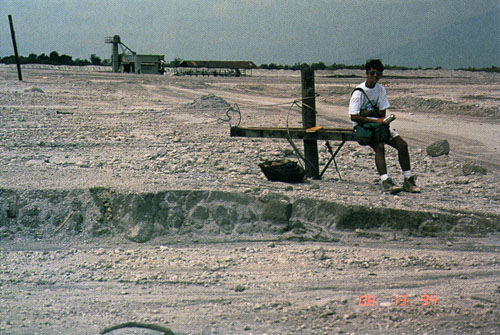
My favorite example of a polystrate tree is one that was found in a backhoe trench by archaeologists looking for archaeological sites in the Atchafayala Basin near Indian Bayou. The sediments enclosing this polystrate tree can clearly be demonstrated as having accumulated over the last 150 to 200 years. This makes the sediments enclosing this polystrate tree far too young to have been deposited by the Noachian Flood. As mentioned in a previous post, I discussed the details of this find in "Polystrate Telephone Pole and Bridge Observed in Philippines" at:
http://www.evcforum.net/cgi-bin/dm.cgi?action=page&f=7&t=105&p=8
http://www.evcforum.net/cgi-bin/dm.cgi?action=msg&f=7&t=105&m=8#8
In the cutbanks of the Mississippi River that expose its older natural levee and oxbow lakes deposits, a person, who wanted to look, could have found additional examples of such historic and Holocene polystrate trees. In 1846 while traveling along the Mississippi River, Charles Lyell saw innumerable examples of polystrate trees encased in recent floodplain deposits that were exposed in Mississippi River cutbanks. It was the amazing similarity of these buried polystrate trees, clearly enclosed in unquestionable fluvial deposits of the Mississippi River, with the Joggins polystrate trees that lead him to interpret the Joggins trees as having been buried upright in place. Polystrate trees have not only been found in the rock record, but also in the modern Mississippi floodplain deposits. This proves not only are they are possible, but also can be created by noncatastrophic processes common to large river systems. (NOTE: Lyell's observation of polystrate trees in exposed Mississippi River deposits is discussed by Leonard G. Wilson in his book "Lyell in America: Transatlantic Geology 1841-1853".)
The Joggins forests were buried in place in a similar fashion to what is happening in the Atchafayala basin today. The literature indicates that they are well rooted in fossil soils contrary to YEC claims and the fact that some were charred by forest fires between the time they grew and the time they were buried makes it pretty hard to image that they are global flood deposits.
The idea that a global flood somehow set forests up one atop the other and buried them with their roots in fossil soils is simply absurd