- Jan 17, 2005
- 44,905
- 1,259
- Country
- Canada
- Gender
- Male
- Faith
- Christian
- Marital Status
- Private
That doesn't address the issue. You can't use ratios that you claim are ages to tell us how much of something was there to start!!!First, by the fact that the K/Ar, U/Pb, and Rb/Sr methods all produce the same age from rocks within the same geologic layer.
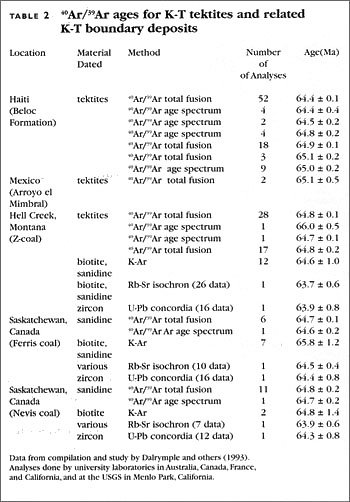
Nonsense. Just because you assign imaginary dates to isotopes and then stick those dates on known layers does not mean they are that old!"There are several important things to note about these results. First, the Cretaceous and Tertiary periods were defined by geologists in the early 1800s. The boundary between these periods (the K-T boundary) is marked by an abrupt change in fossils found in sedimentary rocks worldwide. Its exact location in the stratigraphic column at any locality has nothing to do with radiometric dating — it is located by careful study of the fossils and the rocks that contain them, and nothing more. Second, the radiometric age measurements, 187 of them, were made on 3 different minerals and on glass by 3 distinctly different dating methods (K-Ar and 40Ar/39Ar are technical variations that use the same parent-daughter decay scheme), each involving different elements with different half-lives. Furthermore, the dating was done in 6 different laboratories and the materials were collected from 5 different locations in the Western Hemisphere. And yet the results are the same within analytical error. If radiometric dating didn’t work then such beautifully consistent results would not be possible."
http://ncse.com/rncse/20/3/radiometric-dating-does-work
So now you descend into a strange broken record syndrome type of response and avoid the question you were asked, in fact that you yourself CLAIMED!It is consilience between independent evidence that demonstrates a same state past which includes how Rb and Sr behave in rocks. If you want to learn how isochrons work and why the y-intercept represents the amount of Sr that the rock started with, there are many references for you to look at:
http://hyperphysics.phy-astr.gsu.edu/hbase/nuclear/rbsrstep.html
https://en.wikipedia.org/wiki/Rubidium-strontium_dating
Lest we forget, here is YOU talking..
"Did you miss part where they can determine the number of daughter atoms produced by decay?"
Now get to it.
Upvote
0