

- Jan 17, 2005
- 44,905
- 1,259
- Country
- Canada
- Gender
- Male
- Faith
- Christian
- Marital Status
- Private
Your pic has ages in it....gong!Let's review, shall we?
If there was a same state past, then we would expect to see the same patterns of ratios from the past as we see in the present. Those patterns are predicted from the measured decay rates of the isotopes under question. For example, if the decay of isotope A into B is twice as fast as that of the decay of isotope C into D, then you would expect to find that the ratio of B/A is twice that of D/C on a logarithmic scale. This is like looking at the pattern of a suspect's DNA and then comparing it to DNA found at a crime scene. If the patterns match, then it is evidence for a same state past. For the decay of K into Ar and the decay of U into Pb, this is what the graph looks like.
View attachment 169117
If a rock has a Pb/U ratio of 0.6 along the x axis, then rocks in that same geologic layer should have an Ar/K ratio of approximately 0.3. That is the relationship we should see if there was a same state past, and it is EXACTLY what we observe in the rocks as discussed here:
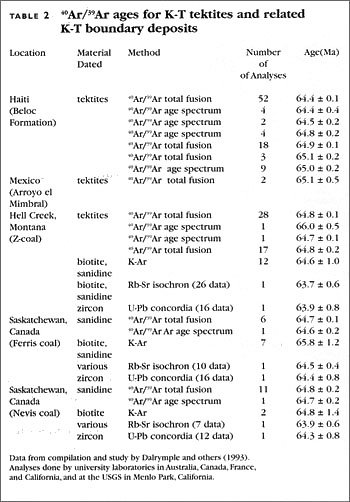
http://ncse.com/rncse/20/3/radiometric-dating-does-work
The U/Pb and K/Ar dates are the same meaning that they have the predicted ratios that we would see with a same state past.
Let's compare that to dad's different state past. As he has shown, all the same state past will do is put some random amount of daughter isotope into rocks. dad has been given every chance to show that there would be some sort of relationship between B/A and D/C as discussed above, but at every turn has made it painfully obvious that no such relationship should exist in a different state past. Therefore, a sample from a different state past could as well have these measured amounts of the 4 isotopes listed above.
Ar/K------Pb/U
0.4--------1.6
0.1-------0.8
0.7-------0.2
When we graph those data points on the graph, this is what they look like.
View attachment 169118
As anyone can see, dad's different state past would not produce the same data points as a same state past, and they don't match what we actually see in rocks.
Therefore, a same state past is supported and a different state past is falsified.
Upvote
0


