• Starting today August 7th, 2024, in order to post in the Married Couples, Courting Couples, or Singles forums, you will not be allowed to post if you have your Marital status designated as private. Announcements will be made in the respective forums as well but please note that if yours is currently listed as Private, you will need to submit a ticket in the Support Area to have yours changed.

  • CF has always been a site that welcomes people from different backgrounds and beliefs to participate in discussion and even debate. That is the nature of its ministry. In view of recent events emotions are running very high. We need to remind people of some basic principles in debating on this site. We need to be civil when we express differences in opinion. No personal attacks. Avoid you, your statements. Don't characterize an entire political party with comparisons to Fascism or Communism or other extreme movements that committed atrocities. CF is not the place for broad brush or blanket statements about groups and political parties. Put the broad brushes and blankets away when you come to CF, better yet, put them in the incinerator. Debate had no place for them. We need to remember that people that commit acts of violence represent themselves or a small extreme faction.
  • We hope the site problems here are now solved, however, if you still have any issues, please start a ticket in Contact Us

problems with macroevolution

sfs

Senior Member
Jun 30, 2003
10,868
7,884
66
Massachusetts
✟409,619.00
Country
United States
Gender
Male
Faith
Non-Denom
Marital Status
Married
Mitochondrial Eve has nothing to do with fossil DNA. (Note: your link probably doesn't point where you wanted it to.)

Based on DNA samples from present populations, probably combined with calculations about frequency of mutations.
That would be the age of mitochondrial Eve, not her existence. mtDNA Eve existed, or at least I've never heard of any model of human history in which she didn't exist.
 
Upvote 0

Steve Petersen

Senior Veteran
May 11, 2005
16,077
3,393
✟177,942.00
Faith
Deist
Politics
US-Libertarian
Mitochondrial Eve has nothing to do with fossil DNA. (Note: your link probably doesn't point where you wanted it to.)


That would be the age of mitochondrial Eve, not her existence. mtDNA Eve existed, or at least I've never heard of any model of human history in which she didn't exist.

Gotcha.

So how specifically do we know that primate fossils are ancestors of humans?
 
Upvote 0

Sanguis

Active Member
Nov 14, 2009
339
22
✟597.00
Faith
Atheist
Marital Status
In Relationship
Gotcha.

So how specifically do we know that primate fossils are ancestors of humans?

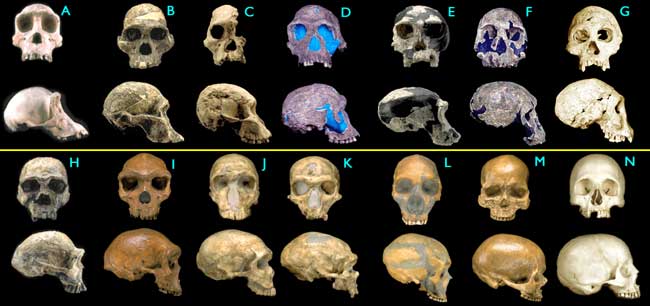
hominids2.jpg


Coupled with all the other independent lines of evidence, such as atavisms, or ERV markers, it doesn't leave much room for other possibilities.
 
Upvote 0

Split Rock

Conflation of Blathers
Nov 3, 2003
17,607
730
North Dakota
✟22,466.00
Faith
Agnostic
Marital Status
Single
Gotcha.

So how specifically do we know that primate fossils are ancestors of humans?

I think you are asking about specific fossil species, like A. afarensis... correct? This is a very good question. First, it is almost impossible to know if a fossil species is a direct ancestor. We can only determine if they are likely to be either a direct ancestor, of related to a direct ancestor. Second, the one true hallmark of a human ancestor is a bipedal gait. We know of no other primate that has this, and thus we infer that any ape that is found that had adaptations for a bipedal gait was related to us either directly or indirectly. Other traits include reduced size of teeth (especially canine) and jaws, as well as an enlarged cranium. Keep in mind that an increase in cranium size, however, was a fairly late adapatation. Thus the oldest relatives (like A. afarensis) had only slightly larger brains than non-human apes today, even though they had intermediate size jaws and a bipedal gait.
 
Upvote 0

Steve Petersen

Senior Veteran
May 11, 2005
16,077
3,393
✟177,942.00
Faith
Deist
Politics
US-Libertarian
I think you are asking about specific fossil species, like A. afarensis... correct? This is a very good question. First, it is almost impossible to know if a fossil species is a direct ancestor. We can only determine if they are likely to be either a direct ancestor, of related to a direct ancestor. Second, the one true hallmark of a human ancestor is a bipedal gait. We know of no other primate that has this, and thus we infer that any ape that is found that had adaptations for a bipedal gait was related to us either directly or indirectly. Other traits include reduced size of teeth (especially canine) and jaws, as well as an enlarged cranium. Keep in mind that an increase in cranium size, however, was a fairly late adapatation. Thus the oldest relatives (like A. afarensis) had only slightly larger brains than non-human apes today, even though they had intermediate size jaws and a bipedal gait.

There must be more than forensic theory.
 
Upvote 0

Split Rock

Conflation of Blathers
Nov 3, 2003
17,607
730
North Dakota
✟22,466.00
Faith
Agnostic
Marital Status
Single
There must be more than forensic theory.

I'm not sure what you are looking for. If a fossil species has features intermidate between humans and modern apes, is bipedal and is found in the appropriate strata, then it is considered a probable human ancestor. I guess you can call that "forensics," if you like. Are you asking about other evidence that supports the evolution of man, of just for evidence that supports a particular fossil species being ancestral to man?
 
Upvote 0

Hespera

Junior Member
Dec 16, 2008
7,237
201
usa
✟8,860.00
Faith
Buddhist
Marital Status
Private
Specifically, linking primate fossils to modern humans?

Point me in the right direction.

Start by looking in the direction of understanding that all living things are the product of evolution. Is there some particular reason to concentrate on people? On people as primates?

Some type of evidence other than is applicable to all other living things?
 
Upvote 0

Wiccan_Child

Contributor
Mar 21, 2005
19,419
673
Bristol, UK
✟46,731.00
Faith
Atheist
Marital Status
In Relationship
Politics
UK-Liberal-Democrats
Start by looking in the direction of understanding that all living things are the product of evolution. Is there some particular reason to concentrate on people? On people as primates?

Some type of evidence other than is applicable to all other living things?
It's a fair question. Scientists say that fossil X is a member of one of our ancestral species, but how do they conclude that?
 
Upvote 0

Steve Petersen

Senior Veteran
May 11, 2005
16,077
3,393
✟177,942.00
Faith
Deist
Politics
US-Libertarian
It's a fair question. Scientists say that fossil X is a member of one of our ancestral species, but how do they conclude that?

That's what I was wondering. If similarity is the only connection, isn't that rather tenuous?
 
Upvote 0

Split Rock

Conflation of Blathers
Nov 3, 2003
17,607
730
North Dakota
✟22,466.00
Faith
Agnostic
Marital Status
Single
That's what I was wondering. If similarity is the only connection, isn't that rather tenuous?

It isn't similarity so much as the mix of intermediate features. Also, as I said, there is the time period the fossil was buried, as well as the location. If the species is advanced enough, we can also recover stone tools, carbon from firepits, etc. Only hominids use these. Unless there is sufficient DNA to analyze (as with Neanderthal) I don't see what else one can use.
 
Upvote 0

Wiccan_Child

Contributor
Mar 21, 2005
19,419
673
Bristol, UK
✟46,731.00
Faith
Atheist
Marital Status
In Relationship
Politics
UK-Liberal-Democrats
That's what I was wondering. If similarity is the only connection, isn't that rather tenuous?
You'd be surprised. Similarities between bones is very unlikely to be a matter of chance, since every curve and groove is specific to its species. Comparative anatomy contains enough evidence to demonstrate evolution in and of itself.
But we have more evidence still: the geographic and geologic distribution of fossils, as well as their age, is all consistent with the hypothesis that they are an ancestor species.

If we found primate fossils in Archaen rock that were dated to be 3 billion years old, then that would be very troubling for evolution. But we never do. We only ever find primate fossils where they're expected to be found, and we only ever find them to be as old as we expect them to be.
 
Upvote 0

sfs

Senior Member
Jun 30, 2003
10,868
7,884
66
Massachusetts
✟409,619.00
Country
United States
Gender
Male
Faith
Non-Denom
Marital Status
Married
It's a fair question. Scientists say that fossil X is a member of one of our ancestral species, but how do they conclude that?
I think careful scientists avoid saying that. They will say a species is transitional between two groups, meaning it shows a mix of characteristics of the two, or that the species is somewhere on branch of the tree leading from the chimpanzee/human common ancestor to us, but not it is directly ancestral. Cladistic systematics, in fact, never identifies ancestral species, precisely because evolutionary relationships cannot be determined with certainty. In cladistics, all species, extinct and living, are leaf nodes on the tree.
 
Upvote 0

Wiccan_Child

Contributor
Mar 21, 2005
19,419
673
Bristol, UK
✟46,731.00
Faith
Atheist
Marital Status
In Relationship
Politics
UK-Liberal-Democrats
I think careful scientists avoid saying that. They will say a species is transitional between two groups, meaning it shows a mix of characteristics of the two, or that the species is somewhere on branch of the tree leading from the chimpanzee/human common ancestor to us, but not it is directly ancestral. Cladistic systematics, in fact, never identifies ancestral species, precisely because evolutionary relationships cannot be determined with certainty. In cladistics, all species, extinct and living, are leaf nodes on the tree.
Except, of course, those species which are actual ancestors. There is a species which is ancestral to all extant mammal species, after all.
 
Upvote 0

sfs

Senior Member
Jun 30, 2003
10,868
7,884
66
Massachusetts
✟409,619.00
Country
United States
Gender
Male
Faith
Non-Denom
Marital Status
Married
Except, of course, those species which are actual ancestors. There is a species which is ancestral to all extant mammal species, after all.
But we don't know which species were actual ancestors, and will never know whether a fossil we find represents one of those species. So named species never appear as internal nodes in cladistic trees.
 
Upvote 0

Hespera

Junior Member
Dec 16, 2008
7,237
201
usa
✟8,860.00
Faith
Buddhist
Marital Status
Private
You'd be surprised. Similarities between bones is very unlikely to be a matter of chance, since every curve and groove is specific to its species. Comparative anatomy contains enough evidence to demonstrate evolution in and of itself.
But we have more evidence still: the geographic and geologic distribution of fossils, as well as their age, is all consistent with the hypothesis that they are an ancestor species.

If we found primate fossils in Archaen rock that were dated to be 3 billion years old, then that would be very troubling for evolution. But we never do. We only ever find primate fossils where they're expected to be found, and we only ever find them to be as old as we expect them to be.


True about the structure of a bone being characteristic of a type of animal.

A paleontologist can tell you if the bone is deer, rhino, camel, cat etc like a car buff can spot a fender from a '52 buick at the junk yard.
 
Upvote 0

Split Rock

Conflation of Blathers
Nov 3, 2003
17,607
730
North Dakota
✟22,466.00
Faith
Agnostic
Marital Status
Single
That's what I was wondering. If similarity is the only connection, isn't that rather tenuous?

One other point I just came up with. Let's look at an ape fossil species that does not fit with being a human ancestor. It's actually one of the creationists' favorites.... yes, Piltdown Man. Piltdown Man was a human cranium matched with an orangutan's jaw. One reason it was successful as a fraud, was it matched the hypothesis most scientists in the field ascribed to: that man's brain evolved first, and that led to a reduction in jaw and teeth size. However, once other real fossil species were found, Piltdown Man didn't fit with them. As a result, most paleontologists sidelined Piltdown Man even before it was determined to be a fraud. What was wrong with it?
1. Other fossils showed that an enlargement of the cerebrum lagged behind other adaptations, such as a bipedal gait and a reduction in the size of the jaw.
2. Piltdown Man was found in Great Britain, whereas the other fossil species were all found in Africa or Asia.

So, Piltdown Man was found in the wrong location and with the wrong mix of adaptive features. If it was found today, it would not fit in with what we understand of human evolution, and would not be considered a possible human ancestor.
 
Upvote 0

laconicstudent

Well-Known Member
Sep 25, 2009
11,671
720
✟16,224.00
Faith
Christian Seeker
Marital Status
Private
Politics
US-Democrat
That's what I was wondering. If similarity is the only connection, isn't that rather tenuous?


No. I, for example, can tell the difference between a man and a woman based on the angle of the angle of the pubic symphysis in their pelvic bone.

We classify species based on genetics and morphology.... So I don't really see the point of this.
 
Upvote 0

Hespera

Junior Member
Dec 16, 2008
7,237
201
usa
✟8,860.00
Faith
Buddhist
Marital Status
Private
No. I, for example, can tell the difference between a man and a woman based on the angle of the angle of the pubic symphysis in their pelvic bone.

We classify species based on genetics and morphology.... So I don't really see the point of this.


The point is to falsify evolution. Others go out to try to square the circle, or invent perpetual motion machines.

A person who wanted to understand it would spend some time reading and thinking.
 
Upvote 0