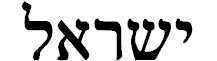
The Hebrew word that was translated "Vain".
[size=+1]STRONGS CONCORDANCE[/size]
[size=+1]7723 shav' (shawv);[/size]
[size=+1]or shav (shav); from the same as 7722 in the sense of desolating; evil (as destructive), literally (ruin) or morally (especially guile); figuratively idolatry (as false, subjective), uselessness (as deceptive, objective; also adverbially, in vain):[/size]
[size=+1]KJV-- false (-ly), lie, lying, vain, vanity.[/size]
[size=+1]=================================================================[/size]
[size=+1]OXFORD ENGLISH DICTIONARY[/size]
[size=+1]vain (____), a. and n. Forms: _. 4_5 vayn (4, 5_6 Sc., wayn), 4_6 vayne (5_6 wayne), 4_7 vaine (5 Sc. waine), 4, 6_ vain (4 wain). _. 4 vein, veen, 5 veine; 4_5 veyn (4 ueyn, 5 weyn), veyne (5 veyyne, feyne, Sc. weyne). _. 4 wan, 5, 6 Sc., wane, 5_6 Sc. vane (6 uane).[/size]
[size=+1][a. OF. vein, veyn, vain (F. vain):---L. vanus empty, void, idle, etc. (whence also It. and Sp. vano, Pg. vão).][/size]
[size=+1]I. 1. Devoid of real value, worth, or significance; idle, unprofitable, useless, worthless; of no effect, force, or power; fruitless, futile, unavailing.[/size]
[size=+1]_ b. Of material things: Useless, worthless. Obs.[/size]
[size=+1]_c. Trivial, unimportant. rare1.[/size]
[size=+1]2. Empty, vacant, void. Also const. of. Obs.[/size]
[size=+1]3. Of persons: Devoid of sense or wisdom; foolish, silly, thoughtless; of an idle or futile nature or disposition. Now rare or Obs.[/size]
[size=+1]4. Given to or indulging in personal vanity; having an excessively high opinion of one's own appearance, attainments, qualities, possessions, etc.; delighting in, or desirous of attracting, the admiration of others; conceited. Also absol.[/size]
[size=+1]II. 5. In the advb. phrase[/size]
[size=+1]in vain, to no effect or purpose; ineffectually, uselessly, vainly.[/size]
[size=+1]After L. in vanum, or OF. en vein (F. en vain, = It. in vano, Sp. en vano, Pg. em vão).[/size]
[size=+1]6. to take_in vain:[/size]
[size=+1]_ a. To disregard, to treat with contempt. Obs.[/size]
[size=+1]b. With name as object. To use or utter (the name of God) lightly, needlessly, or profanely; transf. to mention or speak of casually or idly.[/size]
[size=+1]====================[/size]
[size=+1]It amazes me how many "Commandment Keepers" gloss so smoothly over the Third Word of the Law they profess to keep. (not to mention the First!)[/size]
[size=+1]
TETRAGRAMMATON - Jewish Encyclopedia
[/size]
--------------------------------------------------------------------------------
The interesting article below is from:
http://www-oi.uchicago.edu/OI/ANE/ANE-DIGEST/CURRENT/v1998.n098
===============================
Date: Thu, 9 Apr 1998 20:35:25 +-200
From: Aayko Eyma <ayma@tip.nl>
Subject: AW: ane Jove
William Black[SMTP:balkh@hotmail.com] wrote:
[size=+1]>Is there any linguistic relation between the Roman god Jove and the name[/size]
[size=+1]of the Jewish deity?[/size]
[size=+1]***Perhaps your question was invoked by the late medieval form Jehova? - which however is based on wrong vocalisation.[/size][size=+1]Note that the V in that form stems from Latin, expressing the W sound, not our modern V sound, and the J expressing the Y sound, not the modern English J.[/size][size=+1]The Hebrew divine name YHWH, so with W, sounded like Yahweh.[/size][size=+1]In Greek the name was transliterated _iaoue_ (Clement of Alexandria) or even _iabe_ (Theodoret); as in Greek, 'ou' or 'b' came closest to w, and they could not render the Hebrew H in the middle of words either.[/size][size=+1]The short or poetic form of YHWH was Yahu, in Greek lettering transliterated as _iaO_.So any resemblance between Yahweh/Yahu and Jove (iovis) is not really big.[/size]
[size=+1]Q: Jupiter (= iov-+pater) of course is formed like Greek Zeus pater, Sanskrit Dyaus pita, i.e. IndoEuropean *Dieus ph2ter, but where does the first element (iov-, Jove) stems from? Does it tie in with the others (Dieus etc)? But why the disappearing act of the D(j)? Bit off topic I suppose, but I know some Classicists are lurking on ANE as well.[/size]
[size=+1]kind regards,[/size]
[size=+1]Aayko Eyma[/size]
====================================
[size=+2]THE NAME OF G-D[/size]
John Steed (Coffs Harbour)
[size=+1]I write in reply to the anonymous article The Name of God in the last issue. The author listed a number of texts preceded by the statement: After wrestling with these doubts in my mind, I decided to be guided by Gods Word, and sat down and searched the scriptures for some light on this subject. I did not find just one name but a number of names. I agree wholeheartedly that we should be guided by the Scriptures in this important matter. But unfortunately the author has been misled by the dishonesty of the translators who have substituted the word Lord for the Tetragrammaton. The word Lord bears no relationship to the meaning of the Tetragrammaton, it is not a translation but a blatant substitution on level with the replacement of the Sabbath with Sunday worship - check this for yourself. We must never forget that in English we have translations only, we must always check back to the real thing, the Hebrew, to find the truth.[/size]
[size=+1]If we examine these same texts with the Tetragrammaton restored and improved translation I am sure you will see a different conclusion.[/size]
[size=+1]EX. 3:14 I will be what I will be - Thus you shall say to the sons of Israel, I will be sent me to you.[/size]
[size=+1]The Hebrew phrase here translated as I will be what I will be is eyeh asher eyeh and it is a statement by the Heavenly Father about Himself. Yes, it is His personal name, but it is in the first person. It means, as the author of the article correctly points out, that He will fulfil ALL our needs, He will become whatever and whoever we need - Saviour, Healer, Provider, etc.[/size]
[size=+1]EX. 3:15 YHWH, Mighty One of your fathers, the Mighty One of Abraham, the Mighty One of Yitzchak, the Mighty One of Yaakov, has sent to you. This is My name forever and My remembrance to all generations.[/size]
[size=+1]YHWH, the Tetragrammaton, is the I will be statement in the third person and present tense - He is or The Existent One.[/size]
[size=+1]YHWH is the name by which we can call upon our Creator - it is used around 7,000 times in Scripture.[/size]
[size=+1]EX. 6:3 I appeared to Abraham, to Yitzchak, and to Yaakov, as El Shaddai (Mighty One All Powerful). And My name YHWH did I not reveal Myself to them?[/size]
[size=+1]This verse has been sorely mistranslated in the past. The Hebrew does not say that El Shaddai is a name, rather it is the role in which YHWH revealed Himself to the fathers.[/size]
[size=+1]EX. 34:14 For YHWH, whose name is jealous, is a jealous Mighty One.[/size]
[size=+1]This text does not mean that we are to call Him by the name Jealous. Rather it means that His name - YHWH - is a jealous name. How is it jealous? It means that He fills ALL our needs, it leaves NO ROOM for other mighty ones! Read the first command - EX. 20:3.[/size]
[size=+1]DE. 28:58 ....to fear this esteemed and awesome name, YHWH, your Mighty One.[/size]
[size=+1]PS. 68:4 Sing to the Mighty One, sing praises to His name. Raise up a highway for Him who rides through the deserts, by His name Yah and exult before Him.[/size]
[size=+1]Yah (YH) is simply an abbreviation of YHWH, it is used in verse, and in personal names (EliYah, IsaYah, etc.), though the more common abbreviation is Yahu (YHW) as in Yahushaphat (Jehoshaphat), Yahudah (Judah), etc.[/size]
[size=+1]IS. 47:4 Our Redeemer, YHWH of hosts is His name, the Set-apart One of Israel.[/size]
[size=+1]IS.57:15 For thus declares the high and exalted One who dwells forever, whose name is set-apart (holy).[/size]
[size=+1]Again this does not mean that we are to call Him Holy, rather that His name, YHWH, is holy (set-apart). Read the third command - EX. 20:7.[/size]
[size=+1]IS. 54:5 For your Maker is your husband, YHWH of hosts is His name, and Set-apart One of Israel is your Redeemer. He is called the Mighty One of all the earth.[/size]
[size=+1]All these verses point to our Heavenly Father having only one personal name. Yes He has many, many titles, which can be called names, but these are not the same as a personal name as they demonstrate particular roles that He fills at certain times. But His personal name demonstrates His all-encompassing character, and does so for all time.[/size]
[size=+1]I agree with the author, that being children, we like Yahushua can approach Him as Abba (Father), and indeed should do so. But this does not remove the fact that our Father has a name, a name which we can use to introduce Him to a world that is ignorant of Him. For it is only by His name YHWH that He is differentiated from the false mighty ones of the pagan world.[/size]
[size=+1]Yes, there is confusion as to how the Tetragrammaton is to be pronounced, but it is not true that it is without vowels, Josephus wrote that the name was composed of four vowels, yes vowels, not consonants! The three Hebrew letters that make up the name, Yod, He, and Waw (Vav), while they are used as consonants, actually function more often as long vowels. This means that these letters are self contained and can be pronounced without added vowel points (which only came along a few hundred years ago anyway). Clement testified that the name was pronounced Iaoue, but this was in Greek where there is no H sound.seoj We know from personal names in Scripture that the first three letters (YHW) are pronounced Yahu. Hence the most probable pronunciation is Yahueh (Yah-hoo-eh), though Yahu(h) (silent h), and Yahweh (Yah-weh, not Yah-way), are also possible. The important point is that the pronunciation must convey the correct meaning of He is- Yahueh or Yahu do that.[/size]
[size=+1]As mentioned earlier, the removal of the name was a sin comparable to that of the institution of Sunday worship. The third command says: You do not bring the name of YHWH your Mighty One to nought (nothing), for YHWH does not cleanse from guilt the one who brings His name to nought. Deut. 12:2-4 says Completely destroy all the places where the nations which you are dispossessing served their mighty ones...And you shall cut down the carved images of their mighty ones and shall destroy their name out of that place. Do not do so to YHWH your mighty One. The translators followed on from the lead of the Rabbis to replace the name of the Creator with the names of pagan deities in the Scriptures, removing the true name from peoples lips and memories. Their is no reason for us to continue in this sin. It is time to return to YHWH and restore His name to its rightful place.[/size]

 The Israelites following the murder of King Gedaliah fled to Egypt and YHWH pronounced a curse on them.