• Starting today August 7th, 2024, in order to post in the Married Couples, Courting Couples, or Singles forums, you will not be allowed to post if you have your Marital status designated as private. Announcements will be made in the respective forums as well but please note that if yours is currently listed as Private, you will need to submit a ticket in the Support Area to have yours changed.

  • CF has always been a site that welcomes people from different backgrounds and beliefs to participate in discussion and even debate. That is the nature of its ministry. In view of recent events emotions are running very high. We need to remind people of some basic principles in debating on this site. We need to be civil when we express differences in opinion. No personal attacks. Avoid you, your statements. Don't characterize an entire political party with comparisons to Fascism or Communism or other extreme movements that committed atrocities. CF is not the place for broad brush or blanket statements about groups and political parties. Put the broad brushes and blankets away when you come to CF, better yet, put them in the incinerator. Debate had no place for them. We need to remember that people that commit acts of violence represent themselves or a small extreme faction.
  • We hope the site problems here are now solved, however, if you still have any issues, please start a ticket in Contact Us

Dorothea

One of God's handmaidens
Jul 10, 2007
21,651
3,637
Colorado Springs, Colorado
✟274,013.00
Country
United States
Gender
Female
Faith
Eastern Orthodox
Marital Status
Single
Politics
US-Others
Where is the "there you have it" ?


We should all desire to understand the ways of God more and more..Bless you sister.
Thank you. I would appreciate if you would read what I posted as I have read your links. I did do much research and work to have a respectful and edifying discussion with you and others here.

What I can do is bring some of the info up front in smaller bulks, but I would still suggest you read the rest of the links.
 
Upvote 0

Dorothea

One of God's handmaidens
Jul 10, 2007
21,651
3,637
Colorado Springs, Colorado
✟274,013.00
Country
United States
Gender
Female
Faith
Eastern Orthodox
Marital Status
Single
Politics
US-Others
Ok, first thing: No images were in the temples in the OT, and none in the NT Churches. They weren't allowed and considered making graven images.

The answers:

The most obvious reason and the most widely cited by the iconoclasts themselves, though, was a strict and literal interpretation of the Second Commandment,9 which states (see Exodus 20:4-6 and Deuteronomy 5:8-10):
You shall not make for yourself an idol, whether in the form of anything that is in heaven above, or that is on the earth beneath, or that is in the water under the earth. You shall not bow down to them or worship them; for I the Lord your God am a jealous God, punishing children for the iniquity of parents, to the third and the fourth generation of those who reject me, but showing steadfast love to the thousandth generation of those who love me and keep my commandments.40
The strict and literal interpretation of these verses of Scripture lays at the heart of and has been the key point in all movements of Christian iconoclasm, including the the original iconoclasm of the Byzantines, that of the Protestant Reformers, and that of modern iconoclasts.

The immediate problem with such a strict and literal interpretation, however, is that Scripture itself does not interpret this as a prohibition of images in a strict and literal sense. Where the Second Commandment occurs in the book of Exodus, for instance, God says only a few chapters later (Exodus 26:1):
Moreover you shall make the tabernacle with ten curtains woven of fine linen thread, and blue and purple and scarlet yarn; with artistic designs of cherubim you shall weave them.
And in another verse previous to that, God even associates his own presence with images (Exodus 25:22):
And there I will meet with you, and I will speak with you from above the mercy seat, from between the two cherubim which are on the ark of the Testimony, of all things which I will give you in commandment to the children of Israel.
Clearly, Scripture can and does distinguish between an idol and an icon, just as the early Christians and Jews we encountered earlier did. Few, if any, Christians interpret the Sixth Commandment, which forbids murder, so strictly.41 Nearly all Christians accept that Scripture distinguishes here between murder and killing, forbidding the former while allowing for the latter in some limited circumstances; this is especially true in the light of later verses in which God directly orders the killing of certain groups and individuals.42Why, then, if Protestants can allow for a distinction here between murder and killing in the light of later verses, do they refuse to allow for a distinction between idols and icons in the Second Commandment in the light of later verses allowing for and even ordering the production of religious images? This inconsistency smacks of hypocrisy and is indicative of certain readers interpreting their own presuppositions into the text rather than allowing the text to speak for itself.

And the text of Scripture certainly does interpret itself on this matter. Speaking to the people and repeating much of the Second Commandment to them, the Prophet Moses explains why it is that they are forbidden to make an image of God (Deuteronomy 4:11, 15-18):
And the Lord spoke to you out of the midst of the fire. You heard the sound of the words, but saw no form; you only heard a voice. ... Take careful heed to yourselves, for you saw no form when the Lord spoke to you at Horeb out of the midst of the fire, lest you act corruptly and make for yourselves a carved image in the form of any figure: the likeness of male or female, the likeness of any animal that is on the earth or the likeness of any winged bird that flies in the air, the likeness of anything that creeps on the ground or the likeness of any fish that is in the water beneath the earth.
According to the Prophet Moses, then, the reason that the Hebrews were ordered not to make an image is because they saw no image. They were unable to make an image of God because God was as yet unseen and even unseeable, and therefore undepicted and undepictable. However, approximately 2000 years ago, a remarkable event occurred which changed all of this: the Incarnation; in the words of the Holy Apostle John (Gospel of John 1:14):
And the Word became flesh and dwelt among us, and we beheld His glory, the glory as of the only begotten of the Father, full of grace and truth.
God became man in the Person of Jesus Christ, born of the Virgin Mary. And, in becoming man, he took on all the properties of mankind, becoming like us in all things.43Amongst the properties common to humankind is to have form and to be depictable; Christ, therefore, took upon himself the ability to be depicted in an image. We are no longer in the situation of the Hebrews in the Book of Deuteronomy who had only “heard the sound of the words, but saw no form;” we have now “beheld His glory.”

The truth of the Incarnation is fatal to any attempt at Christian iconoclasm and, necessarily, iconoclasts have traditionally, and dangerously, downplayed or altogether ignored it and its implications. The father of Protestant iconoclasm, John Calvin, for instance, wrote against images as if he were totally unfamiliar with the Incarnation of the Lord:
Therefore it remains that only those things are to be sculptured or painted which the eyes are capable of seeing: let not God's majesty, which is far above the perception of the eyes, be debased through unseemly representations.44
St. John of Damascus (ca. 646-749), one of the most important defenders of the Holy Icons during the Byzantine controversy, noted this betrayal of the prime truth of Christianity amongst the iconoclasts of his day and rightly declared:
In times past, God, without body and form, could in no way be represented. But now, since God has appeared in flesh and lived among men, I can depict that which is visible of God. I do not venerate the matter, but I venerate the Creator of matter, who became matter for me, who condescended to live in matter, and who, through matter accomplished my salvation; and I do not cease to respect the matter through which my salvation is accomplished.45

A Defense of the Holy Icons @ Orthodox Answers

Pics of the archaeological find that murals and frescos of Christian art were on Jewish synagogues and Christian Church houses in the early 200s.

oode

And you'll have to find the others. I have worked hard and spent much time on these today.

 
Upvote 0

Dorothea

One of God's handmaidens
Jul 10, 2007
21,651
3,637
Colorado Springs, Colorado
✟274,013.00
Country
United States
Gender
Female
Faith
Eastern Orthodox
Marital Status
Single
Politics
US-Others
I'm gonna post this once again.

Why do Catholics use statues and Orthodox do not?
Hope this helps:

The icon is an artistic depiction of Christ, the Mother of God and the Saints. God the Father cannot be painted, because He has never been seen. God the Holy Spirit has appeared as a dove and as "tongues of fire." He may be shown in this way. God the Son became a man, and He may be painted in His human form.

Icons are more than sacred pictures. Everything about them is theological. For example, they are always flat, flat so that we who inhabit the physical world will understand that the world of the spirit where Christ, His Mother, the angels, the saints, and the departed dwell, is a world of mystery which cannot be penetrated by our five senses.

Customarily, Roman Catholicism has historically employed statues in its worship. The statues are life-like and three-dimensional. They seem to imitate the art of ancient Greece. Both arts are naturalistic. The Latins portray Christ, the Mother of God, the saints, even the angels, as if they were in a state of nature. This "naturalism" stems from the medieval idea that "grace perfects nature."

The person or persons are represented on the icon as deified. He or she is not a perfect human being, but much more: They are transfigured and glorified. They have a new and grace-filled humanity.

Important to remember is the Latin theory of grace: It is created by God for man. Orthodoxy teaches, as we recall, that grace is uncreated, and impacts all creation. It is a mysterious extension of the Divine Nature. Orthodox iconography reflects this truth, even as Roman Catholic statues reflect its idea of grace.

Again, icons are a necessary part of Orthodox piety. The Orthodox honor and kiss icons, a devotion which passes from the icon to the person or persons represented in them. Icons are not idols and the Orthodox do not worship them. Worship is reserved for God alone. The statues set up in Roman Catholic temples are not commonly venerated; they are visual aids and decorations.

ORTHODOXY AND ROMAN CATHOLICISM
 
Upvote 0

Dorothea

One of God's handmaidens
Jul 10, 2007
21,651
3,637
Colorado Springs, Colorado
✟274,013.00
Country
United States
Gender
Female
Faith
Eastern Orthodox
Marital Status
Single
Politics
US-Others
I think so, because we live by faith not by sight.

A blind person has absolutely no use for icons. I'm totally empathetic for them.
What about an illiterate or mentally challenged person?

We live as body, soul, and spirit all together, not just the spirit. That's not Christianity. We were given all the senses to use them in worshiping Him. The difference between Orthodox worship and Protestant worship is the Protestants worship in mind and inner heart (I'm talking about those devout who truly do worship God in not just the mind), and Orthodox worship through the senses and through bodily actions - actions that come forth from the heart.


What does a blind person see?
Thats what I see.

Peace and grace be to all of you.
I don't know, but we are not saved by understanding, but by His mercy.
 
Upvote 0
T

Thekla

Guest
I'm gonna post this once again.

Why do Catholics use statues and Orthodox do not?

I really cannot answer re: the RC.

The EO tend towards 2 dimensional (and some bas relief, too) in part because (per what I've read/heard) sculpture is "too naturalistic". We live in a fallen world; the purpose of iconography is not to represent realism, to describe the fallen world, but to lift the mind, heart, and soul upwards to God.

Wilhelm Worringer's dissertation (early 20th c., now considered a classic in Art History) Abstraction and Empathy noted two "strands" in all art throughout history; the naturalistic (realism) and the abstract. He noted that naturalistic art was dominant in cultures and eras where people felt a satisfaction with human accomplishment, control, and where the chief aim was satisfaction with life in the material. Those eras and cultures which produced abstract art evidenced a lesser interest in the "natural life", and heightened awareness of "striving beyond", of the spiritual if you will. Worringer found Byzantine iconography to belong to this latter category.


Iconography is highly stylized, symbolic, and its 'production' codified. The intent is not to present what is, but the promise of fulfillment in Christ. To this end, it represents not "realism" per se, but is unlike the realistic as what we see now is not our ultimate goal and purpose. It's catechetical role - the effect on the disposition, the soul, the heart - is to some extent found in two aspects: line and perspective.

Realistic art, and much abstract as well (especially in the modern era) is interested in the aesthetic of the whole piece, but also the beauty or aesthetic of "the line"; each stroke, each line should have a beauty. Yet in iconography, the lines themselves almost defy this aesthetic aspect (and can look clumsy, or clunky, often broken in odd places along the sweeping advance of the line). It is not the aesthetic of the visual which is the chief aim, but the spiritual represented to lift the viewer to the contemplation of the spiritual.

This second point is echoed in the use of perspective in iconography.
Realistic art (and sculpture is included) has a "vanishing point", thus describing space and depth. Typically, the vanishing point is imagined to be somewhere in the painting or picture (thus small objects are "far away", and large objects are perceived as being "close by" in space. In iconography, the vanishing point is not in the icon, but in the viewer - thus icons have a very flat or surface look. The size of objects within icons is often not descriptive of distance, but importance.

Sculptures, in having three dimensions, describe things as they are now - as we perceive what is "real" in our everyday lives. Iconography, in two dimensions, invite us away from the "real" of our mundane lives towards what is really real - not those things that will pass away, but towards the spiritual existence.

It should also be noted that those who "write icons" typically prepare for their task with a period of fasting and increased prayer.
 
  • Like
Reactions: Dorothea
Upvote 0

Philothei

Love never fails
Nov 4, 2006
44,893
3,220
Northeast, USA
✟83,209.00
Faith
Eastern Orthodox
Marital Status
Married
Some augustine opinions .
Here
Yeah it has been observed that Augustine was not too fond of iconography or religious sculpture-although the part you quoted is clearly against pagan idols or so it seemed to me- that does not mean that because one of two or whatever number of Fathers would oppose the idea of iconography that sets the standard for the Church. The councils have the authority rather than any individual Father.
 
  • Like
Reactions: Dorothea
Upvote 0

Ishraqiyun

Fanning the Divine Spark
Mar 22, 2011
4,882
169
Montsalvat
✟28,535.00
Faith
Marital Status
Single
Politics
US-Others
Of the opposing or differing icons of the Christ...Which one is the right one?

What do mean by right one? The one that most accurately represents his actual physical appearance? To me that's of minor importance. The purpose of an icon isn't to be a painted photograph giving you a physical description of the person being painted. It has symbolic meaning and is meant to speak to the heart. If it properly conveys it's intent or is psychologically / spiritually useful then it can be right for you.
 
Upvote 0
I

I die daily

Guest
I'm curious and would like to ask all the anti-icon Christians, when each and everytime they pray, their minds are all a dark void? Are there absolutely zero images coming into your thoughts to assist you in your worship to God? Now be completely honest here in your answers. Does not one image of Jesus as we see Him today, even appear in your minds? And if so, do you immediately cast it out as it represents an erroneous style of worship?
Kepha,
Anti-icon? that seems like a way to put a negative connotation to one who chooses to err on the safe side of what is written in sacred scripture.
For the sake of consistency to what I have read in this thread why not refer to the term iconoclast or iconodule (against or for?). Seems like there is an intent to enflame here. Enough about that, honestly I do not try to envision Christ in any manor and yes if one sets on my mind I do try to cast it out, how can we place our eyes/mind upon that height of His glory at the right hand of the Father?

Also, would you likewise condemn the woman for using Jesus cloak as a veneration tool where even Christ Himself felt His power absorbed through this earthly material? And remember, Christ was almost getting crushed by the crowd so alot of folks were touching Him. But she touched the end of His cloak, not out of worship, but connecting it with Him who She truly worshiped and believed would heal her as even Christ said, your faith has healed you leaving us no doubt.
Kepha,
Her faith in Jesus Christ healed her, not her veneration of His cloak.
 
Upvote 0

Philothei

Love never fails
Nov 4, 2006
44,893
3,220
Northeast, USA
✟83,209.00
Faith
Eastern Orthodox
Marital Status
Married
Kepha,
Anti-icon? that seems like a way to put a negative connotation to one who chooses to err on the safe side of what is written in sacred scripture.
For the sake of consistency to what I have read in this thread why not refer to the term iconoclast or iconodule (against or for?). Seems like there is an intent to enflame here. Enough about that, honestly I do not try to envision Christ in any manor and yes if one sets on my mind I do try to cast it out, how can we place our eyes/mind upon that height of His glory at the right hand of the Father?

Christ was equally man and God. Thinking of Him as a man or as a God ONLY calls for a "not wholistic" view on the person of Christ as a God-man. So of course when Christ is depicted in NOT the Divine we see in the image but we see the humanity of Him. Expecially in the Western expression that is the realistic art representation of Christ through sculpture and realistic art expression. In the East we do "include" the transfigured world of the saints in the representation. That is precisely that makes iconography special and unique : the stylized manner of presentation that is only kept for expressing that "off God's glory" and "the transcended" reality of "the life to come". The sacred art of iconography is not a mere depiction of Christ and the saints but a glimpse into God's realm. That is why it is minimalistic in nature as its emphasis in NOT in the human wolrd but the divine. The information depicted on the icon is a "lesson" itself in theology and the person that it represents. i.e. Christ is holding always the bible and blessing with the inscription "the One Who Is" on his halo. All this symbolizes not a mere human but the Son the second person who was incarnated. It does not show its humanity but also its divinity of what we know about Him. It is not a mere pic of Him but who He is in relation to the Kingdom. I think that tells us much more and it is waaaaay far away from a realistic painting where ONLY the humanity is represented. I would not call that iconolatry. Iconolatry would be to "worship" and Idol. Christ depected as such IS NOT. We do not worship but venerate the holy image of Christ as both God and man in His rightful glory that of the incrnated Logos of God.


Kepha,
Her faith in Jesus Christ healed her, not her veneration of His cloak.

No one is denying this but the Grace of God has to be in ALL things or then we are not saved... Sad to say it does take grace to pass around for us to be healed. We do not dispute that people get healing in other ways even by one word of our Lord that we see in the miracles (the roman officer comes to mind) but we also see that with Peter's apron etc:


so that even handkerchiefs and aprons that had touched him were taken to the sick, and their illnesses were cured and the evil spirits left them.

Acts 19:12

It is the same for icons too that they carry that because they carry the image of the saint and through their intercession miracles take place. God knows our need for something tangible in this case of Peter above is allowed for God's economy (salvation plan) is vast and no one leaves empty handed. The Greeks thirst for wisdom and the Jews of signs comes to mind so God conduscends to us in every way possible to teach us of His glory. Divine grace is given to us for our healing for our bodies, minds and spirits!
 
Upvote 0
G

GratiaCorpusChristi

Guest
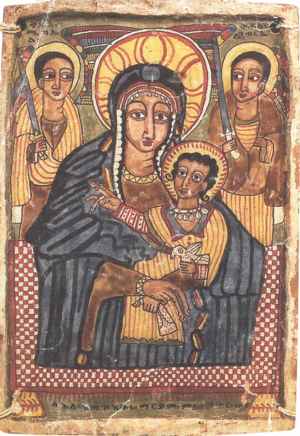
When I went to Ethiopia a few years back, I saw icons showing Jesus as a black man. Are you willing to defend that as an accurate image of Jesus?

Are they supposed to be accurate? Because if they are, then people in ancient times must have had freakishly large foreheads. I really don't think visual accuracy is the point.
 
  • Like
Reactions: Philothei
Upvote 0

Philothei

Love never fails
Nov 4, 2006
44,893
3,220
Northeast, USA
✟83,209.00
Faith
Eastern Orthodox
Marital Status
Married
The icon offers an external human expression of the holy transfigured state, of a body filled with the Holy Spirit. By omitting everything irrelevant to the spiritual figure, the figure becomes stylized, spiritualized, not unrealistic but supra-realistic. The icon figure is thereby set aside from all other forms of pictorial art.

Overview

Sure!! Christ is not only human but also Divine. He is the man of "sorrows" too who undertakes every man's calamities. So in a sense he is an African as much as He is an Asian or a Japanese. He undertook our "bodies" and became all things to all.
He was despised and rejected by men, a man of sorrows, and familiar with suffering. Like one from whom men hide their faces he was despised, and we esteemed him not.

Isaiah 53:3
1Cor 9:22
To the weak I became weak, to win the weak. I have become all things to all men so that by all possible means I might save some.
You make a dichotomy here Christ is for all!!!

Race did not matter as well as color of skin etc. for there is no Jew or Greek etc. So yeah we accept the icon of Christ as a man and God. Actually these icons are beautiful. So the Jews he was a Jew and to the Greeks a Greek why not an Ethiopian to the Ethiopians?
ethiopian_christ.jpg


After all historically Christ was a Jew further more what makes you think he was "light"? He was a semite; a Jew of course he was dark.
 
Upvote 0

JesusFreak78

Reformed Baptist
Feb 11, 2005
4,296
1,530
47
Minnesota, USA
✟42,855.00
Country
United States
Gender
Male
Faith
Baptist
Marital Status
Married
Politics
US-American-Solidarity
Are they supposed to be accurate? Because if they are, then people in ancient times must have had freakishly large foreheads. I really don't think visual accuracy is the point.

So is the point to show Jesus in your own image?
 
Upvote 0
I

I die daily

Guest
No one is denying this but the Grace of God has to be in ALL things or then we are not saved... Sad to say it does take grace to pass around for us to be healed. We do not dispute that people get healing in other ways even by one word of our Lord that we see in the miracles (the roman officer comes to mind) but we also see that with Peter's apron etc:


Acts 19:12

It is the same for icons too that they carry that because they carry the image of the saint and through their intercession miracles take place. God knows our need for something tangible in this case of Peter above is allowed for God's economy (salvation plan) is vast and no one leaves empty handed. The Greeks thirst for wisdom and the Jews of signs comes to mind so God conduscends to us in every way possible to teach us of His glory. Divine grace is given to us for our healing for our bodies, minds and spirits!
Philothei,
When you place an eye upon the icon of Christ do you walk away with a radiantly beaming face? a reflection of the glory of God?
If not it would seem that the artictic rendition would fall well short of the Colossian 1 description others have put forth on this thread.
 
Last edited:
Upvote 0

Tzaousios

Αυγουστινιανικός Χριστιανός
Dec 4, 2008
8,504
609
Comitatus in praesenti
Visit site
✟34,229.00
Gender
Male
Faith
Christian
Marital Status
Married
When I went to Ethiopia a few years back, I saw icons showing Jesus as a black man. Are you willing to defend that as an accurate image of Jesus?

This sounds like a strawman or red herring to me.

Is the depiction of Jesus as a black man the usual way that he is depicted in the Eastern Orthodox tradition? Does depicting him as a black man come down to the Eastern Orthodox as the canonical manner by which iconographers represent him? No, it is not; thus there is no reason to implicate them in wrongdoing by asking if they "are willing to defend it."
 
Upvote 0