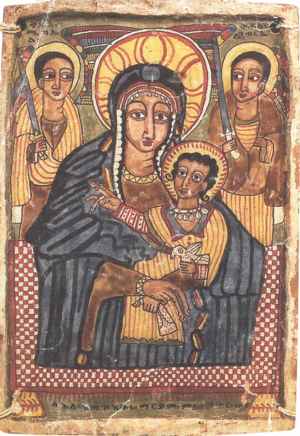
Ok, first thing: No images were in the temples in the OT, and none in the NT Churches. They weren't allowed and considered making graven images.
The answers:
The most obvious reason and the most widely cited by the iconoclasts themselves, though, was a strict and literal interpretation of the Second Commandment,9 which states (see Exodus 20:4-6 and Deuteronomy 5:8-10):
You shall not make for yourself an idol, whether in the form of anything that is in heaven above, or that is on the earth beneath, or that is in the water under the earth. You shall not bow down to them or worship them; for I the Lord your God am a jealous God, punishing children for the iniquity of parents, to the third and the fourth generation of those who reject me, but showing steadfast love to the thousandth generation of those who love me and keep my commandments.40
The strict and literal interpretation of these verses of Scripture lays at the heart of and has been the key point in all movements of Christian iconoclasm, including the the original iconoclasm of the Byzantines, that of the Protestant Reformers, and that of modern iconoclasts.
The immediate problem with such a strict and literal interpretation, however, is that Scripture itself does not interpret this as a prohibition of images in a strict and literal sense. Where the Second Commandment occurs in the book of Exodus, for instance, God says only a few chapters later (Exodus 26:1):
Moreover you shall make the tabernacle with ten curtains woven of fine linen thread, and blue and purple and scarlet yarn; with artistic designs of cherubim you shall weave them.
And in another verse previous to that, God even associates his own presence with images (Exodus 25:22):
And there I will meet with you, and I will speak with you from above the mercy seat, from between the two cherubim which are on the ark of the Testimony, of all things which I will give you in commandment to the children of Israel.
Clearly, Scripture can and does distinguish between an idol and an icon, just as the early Christians and Jews we encountered earlier did. Few, if any, Christians interpret the Sixth Commandment, which forbids murder, so strictly.41 Nearly all Christians accept that Scripture distinguishes here between murder and killing, forbidding the former while allowing for the latter in some limited circumstances; this is especially true in the light of later verses in which God directly orders the killing of certain groups and individuals.42Why, then, if Protestants can allow for a distinction here between murder and killing in the light of later verses, do they refuse to allow for a distinction between idols and icons in the Second Commandment in the light of later verses allowing for and even ordering the production of religious images? This inconsistency smacks of hypocrisy and is indicative of certain readers interpreting their own presuppositions into the text rather than allowing the text to speak for itself.
And the text of Scripture certainly does interpret itself on this matter. Speaking to the people and repeating much of the Second Commandment to them, the Prophet Moses explains why it is that they are forbidden to make an image of God (Deuteronomy 4:11, 15-18):
And the Lord spoke to you out of the midst of the fire. You heard the sound of the words, but saw no form; you only heard a voice. ... Take careful heed to yourselves, for you saw no form when the Lord spoke to you at Horeb out of the midst of the fire, lest you act corruptly and make for yourselves a carved image in the form of any figure: the likeness of male or female, the likeness of any animal that is on the earth or the likeness of any winged bird that flies in the air, the likeness of anything that creeps on the ground or the likeness of any fish that is in the water beneath the earth.
According to the Prophet Moses, then, the reason that the Hebrews were ordered not to make an image is because they saw no image. They were unable to make an image of God because God was as yet unseen and even unseeable, and therefore undepicted and undepictable. However, approximately 2000 years ago, a remarkable event occurred which changed all of this: the Incarnation; in the words of the Holy Apostle John (Gospel of John 1:14):
And the Word became flesh and dwelt among us, and we beheld His glory, the glory as of the only begotten of the Father, full of grace and truth.
God became man in the Person of Jesus Christ, born of the Virgin Mary. And, in becoming man, he took on all the properties of mankind, becoming like us in all things.43Amongst the properties common to humankind is to have form and to be depictable; Christ, therefore, took upon himself the ability to be depicted in an image. We are no longer in the situation of the Hebrews in the Book of Deuteronomy who had only “heard the sound of the words, but saw no form;” we have now “beheld His glory.”
The truth of the Incarnation is fatal to any attempt at Christian iconoclasm and, necessarily, iconoclasts have traditionally, and dangerously, downplayed or altogether ignored it and its implications. The father of Protestant iconoclasm, John Calvin, for instance, wrote against images as if he were totally unfamiliar with the Incarnation of the Lord:
Therefore it remains that only those things are to be sculptured or painted which the eyes are capable of seeing: let not God's majesty, which is far above the perception of the eyes, be debased through unseemly representations.44
St. John of Damascus (ca. 646-749), one of the most important defenders of the Holy Icons during the Byzantine controversy, noted this betrayal of the prime truth of Christianity amongst the iconoclasts of his day and rightly declared:
In times past, God, without body and form, could in no way be represented. But now, since God has appeared in flesh and lived among men, I can depict that which is visible of God. I do not venerate the matter, but I venerate the Creator of matter, who became matter for me, who condescended to live in matter, and who, through matter accomplished my salvation; and I do not cease to respect the matter through which my salvation is accomplished.45
A Defense of the Holy Icons @ Orthodox Answers
Pics of the archaeological find that murals and frescos of Christian art were on Jewish synagogues and Christian Church houses in the early 200s.
oode
And you'll have to find the others. I have worked hard and spent much time on these today.