• Starting today August 7th, 2024, in order to post in the Married Couples, Courting Couples, or Singles forums, you will not be allowed to post if you have your Marital status designated as private. Announcements will be made in the respective forums as well but please note that if yours is currently listed as Private, you will need to submit a ticket in the Support Area to have yours changed.

  • CF has always been a site that welcomes people from different backgrounds and beliefs to participate in discussion and even debate. That is the nature of its ministry. In view of recent events emotions are running very high. We need to remind people of some basic principles in debating on this site. We need to be civil when we express differences in opinion. No personal attacks. Avoid you, your statements. Don't characterize an entire political party with comparisons to Fascism or Communism or other extreme movements that committed atrocities. CF is not the place for broad brush or blanket statements about groups and political parties. Put the broad brushes and blankets away when you come to CF, better yet, put them in the incinerator. Debate had no place for them. We need to remember that people that commit acts of violence represent themselves or a small extreme faction.

LittleLambofJesus

Hebrews 2:14.... Pesky Devil, git!
Site Supporter
May 19, 2015
125,549
28,532
75
GOD's country of Texas
Visit site
✟1,237,330.00
Country
United States
Gender
Male
Faith
Christian
Marital Status
Single
Politics
US-Libertarian
Originally Posted by Der Alter[/quote
Here is a link to Ignaius' letter to the Smyrneans. Please show me where he anything about a catholic church? Hint it ain't there. Not everything that is posted on the internet is true.

Apostolic Fathers - Ignatius to the Smyrnaeans
Ignatius' Letter to the Smryneans (8:2):
"Wherever the bishop appears let the congregation be present;
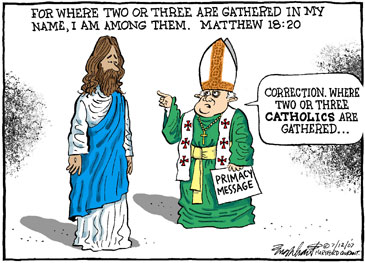
just as wherever Jesus Christ is, there is the Catholic Church."
Brings to mind this humorous cartoon :)


july122007.jpg


http://www.christianforums.com/t7325781-104/
Originally Posted by simonthezealot
The Pope, King of the world?

Ever read the Bull Unam Sanctum?
Check it out, especially the last part.
http://www.fordham.edu/halsall/source/b8-unam.html

Along those lines take a look also at this...Also...


.
 
Upvote 0

CherubRam

Well-Known Member
Dec 21, 2012
6,777
781
✟103,730.00
Country
United States
Gender
Male
Faith
Oneness
Marital Status
Private
Politics
US-Others
No it is not! There is no such Greek word as "katholike." The term katos holos occurs in the ECF, it means "according to the whole."

Here is a link to Ignaius' letter to the Smyrneans. Please show me where he anything about a catholic church? Hint it ain't there. Not everything that is posted on the internet is true.

Apostolic Fathers - Ignatius to the Smyrnaeans

The words "Catholic Church" is on page 261.
 
Upvote 0

CherubRam

Well-Known Member
Dec 21, 2012
6,777
781
✟103,730.00
Country
United States
Gender
Male
Faith
Oneness
Marital Status
Private
Politics
US-Others
Hades is the Greek god of the underworld.

Hades ( /ˈheɪdiːz/; from Greek ᾍδης (older form Ἀϝίδης), Hadēs, originally Ἅιδης, Haidēs or Άΐδης, Aidēs (Doric Ἀΐδας Aidas), meaning "the unseen") was the ancient Greek god of the underworld. The genitive ᾍδου, Haidou, was an elision to denote locality: "[the house/dominion] of Hades". Eventually, the nominative came to designate the abode of the dead.

In Greek mythology, Hades is the oldest male child of Cronus and Rhea. According to myth, he and his brothers Zeus and Poseidon defeated the Titans and claimed rulership over the cosmos, ruling the underworld, air, and sea, respectively; the solid earth, long the province of Gaia, was available to all three concurrently.

Hades was also called "Plouton" (Greek: Πλούτων, gen.: Πλούτωνος, meaning "Rich One"), a name which the Romans Latinized as Pluto. The Romans would associate Hades/Pluto with their own chthonic gods, Dis Pater and Orcus. The corresponding Etruscan god was Aita. Symbols associated with him are the Helm of Darkness, the bident and the three-headed dog, Cerberus.


Matthew 11:23
And you, Capernaum, will you be lifted to the heavens? No, you will go down to Hades. For if the miracles that were performed in you had been performed in Sodom, it would have remained to this day.

Matthew 16:18
And I tell you that you are Peter, and on this rock I will build my church, and the gates of Hades will not overcome it.

Luke 10:15
And you, Capernaum, will you be lifted to the heavens? No, you will go down to Hades.

Luke 16:23
In Hades, where he was in torment, he looked up and saw Abraham far away, with Lazarus by his side.

Revelation 1:18
I am the Living One; I was dead, and now look, I am alive for ever and ever! And I hold the keys of death and Hades.

Revelation 6:8
I looked, and there before me was a pale horse! Its rider was named Death, and Hades was following close behind him. They were given power over a fourth of the earth to kill by sword, famine and plague, and by the wild beasts of the earth.

Revelation 20:13
The sea gave up the dead that were in it, and death and Hades gave up the dead that were in them, and each person was judged according to what they had done.

Revelation 20:14
Then death and Hades were thrown into the lake of fire. The lake of fire is the second death.

Most likely the word "grave" was replaced with the word "Hades."
 
Upvote 0

Der Alte

This is me about 1 yr. old. when FDR was president
Site Supporter
Aug 21, 2003
29,128
6,154
EST
✟1,151,726.00
Country
United States
Gender
Male
Faith
Baptist
Marital Status
Married
Politics
US-Others
Nobody wants to touch this tar baby. ^_^

Nothing to touch! What does the Greek word Katholike' mean. Whoever might have used that word didn't make up a word, start using it and expect people to understand what he meant. Hint I already gave the meaning.
 
Upvote 0
Dec 8, 2012
469
40
✟30,785.00
Faith
Christian
Marital Status
Private
Jesus spoke almost exclusively in figurative language (FL). It is the bane of the literalist to install primarily literal interpretations on figurative (spiritual; esoteric; metaphoric; allegorical) meaning/language, which to be understood correctly requires that symbolic and literal elements be distinguished and properly joined into an interpretive whole.

Note: I copied/pasted DA's post into Word for my convenience in responding. In posting back, this appears to have removed DA's original formatting. No change was intended, and the text of DA's entire post is presented below, only minus his original formatting.

PART ONE

[1] Matthew 3:12 Whose fan is in his hand, and he will throughly purge his floor, and gather his wheat into the garner; but he will burn up the chaff with unquenchable fire.
FL. that there is something burned is obvious. Note the number of times in what follows that the FL of Jesus uses in His words either a collection of elements or a collection of elements pertaining to a whole. Mat 3:12 bears a striking resemblence to the parable of the wheat and tares. In 3:12, there are good elements (wheat) and bad elements (chaff) from a whole (threshing floor).

[2] Matthew 5:13 Ye are the salt of the earth: but if the salt have lost his savour, wherewith shall it be salted? it is thenceforth good for nothing, but to be cast out, and to be trodden under foot of men.
This FL verse at most speaks to moral culpability; despite the fact there is no mention of eternal punishment, hellfire folks throw this and many like it into their bag. More often than not, those who attempt to drown their opponents in verbiage do so because they haven't the rational skills to properly argue their position.

[3] Matthew 5:20 For I say unto you, That except your righteousness1 shall exceed the righteousness of the scribes and Pharisees, ye shall in no case enter into the kingdom of heaven.
This is ambiguous. Jesus could be speaking of a temporal state. And, as is true of much of the eternal tormentist's proof texting, this verse is completely silent re the concept of individuals suffering eternal hell.

1 Psalm 14:2 The LORD looked down from heaven upon the children of men, to see if there were any that did understand, and seek God.
3 They are all gone aside, they are all together become filthy: there is none that doeth good, no, not one
These verses describe human fallenness and says nothing about hell of any variety. Notice how verses like these are buried into the "drown you in text" list. Using excessive proof texting looks like the poster knows what he's talking about....until closer inspection shows that he's thrown in everything he can find under the sun, in an apparent effort to impress his friends and confuse his opponents. Once sorted through, there's very little of substance in the entire post.

Isaiah 53:6 All we like sheep have gone astray; we have turned every one to his own way; and the LORD hath laid on him the iniquity of us all.
Same as above. Nothing about hell here.

Romans 3:10 As it is written, There is none righteous, no, not one:
Nothing about hell here.

[4] Matthew 5:29 And if thy right eye offend thee, pluck it out, and cast it from thee: for it is profitable for thee that one of thy members should perish, and not that thy whole body should be cast into hell.
30 And if thy right hand offend thee, cut if off, and cast it from thee: for it is profitable for thee that one of thy members should perish, and not that thy whole body should be cast into hell.
Again, the insertion of the literalist's desire to defend God's wish to torture humans eternally by stifling metaphoric language. Doing so misses the meaning completely. As pointed out earlier, look at the structure of Jesus' FL--the reference of parts pertaining to a whole. The literalist in his zeal to make the Bible fit his doctrine completely misses one of the most revealing metaphors taught about the truth of hell's purpose in the Bible: the separation of bad parts from a whole. Reread the above passage carefully.

[5]Matt 7:13 Enter ye in at the strait gate: for wide is the gate, and broad is the way, that leadeth to destruction, and many there be which go in thereat:
14 Because strait is the gate, and narrow is the way, which leadeth unto life, [i.e. Kingdom of heaven, vs. 21] and few there be that find it.
Destruction of what? There is no support for the concept of individuals spending an eternity in hell in these passages, but this doesn't stop the literalist from including it in his text-barrage. It sounds as though there are few parts which “find” or make it to the narrow way, but many “parts” are met with destruction. Again, that persistent pattern….

[6] Matt 7: 21 Not every one that saith unto me, Lord, Lord, shall enter into the kingdom of heaven; but he that doeth the will of my Father which is in heaven.
22 Many will say2 to me in that day, Lord, Lord, have we not prophesied in thy name? and in thy name have cast out devils? and in thy name done many wonderful works
23 And then will I profess unto them, I never knew you: depart from me, ye that work iniquity.
Again, FL leading to an obvious reference to moral responsibility, but no reference to individuals spending an eternity in hellfire.

[7] Matthew 8:12 But the children of the kingdom shall be cast out into outer darkness: there shall be weeping and gnashing of teeth.
Same as above.

[8] Matt 10:33 But whosoever shall deny me before men, him will I also deny before my Father which is in heaven.
Same as above.

[9] Matt 13:39 The enemy that sowed them is the devil; the harvest is the end of the world; and the reapers are the angels.
40 As therefore the tares are gathered and burned in the fire; so shall it be in the end of this world.
41 The Son of man shall send forth his angels, and they shall gather out of his kingdom all things that offend, and them which do iniquity;
42 And shall cast them into a furnace of fire: there shall be wailing and gnashing of teeth.
Yet again in the FL of Jesus is the separation of bad components (tares) and good components (wheat) from a whole (field). Starting to see a pattern here? You won't if you're a dogmatic literalist who's bought into the eternal torment of whole people and teach it to the exclusion of all evidence to the contrary. The pattern was established by God in the first book of the Bible:
Christian Universalism Part 4: Genesis 18, God's Pattern for Saving All. - YouTube

[10] Mat 13:49 So shall it be at the end of the world: the angels shall come forth, and sever the wicked from among the just,
50 And shall cast them into the furnace of fire: there shall be wailing and gnashing of teeth.
The metaphor of Godly fire as a retributive process is obvious and granted. No contest. Of interest is that there is no mention of eternal torment, just that the wicked will be severed from the unjust. Ezek 21:2-5 says the same exact thing about "all flesh". So, in the highly metaphoric language of the Bible, we can determine that God decrees punishment on humanity which bears a resemblance to sword, fire and other forms of destruction. There's sufficient warrant to establish this. It is necessarily missed completely by the hardcore literalist intent only on defending a doctrine that there is in this FL a separation or severing of wicked from just. Another reference to some work performed within a whole.

The multitude of passages which speak to this feature of Scripture leads to the notion of a disunited spirit or soul...
Christian Universalism Part 3: The FragmentedSoul - YouTube
 
Upvote 0
Dec 8, 2012
469
40
✟30,785.00
Faith
Christian
Marital Status
Private
PART TWO

[11] Matthew 18:3 And said, Verily [αμην/amen] I say unto you, Except ye be converted3, and become as little children, ye shall not enter into the kingdom of heaven.
18:4 Whosoever therefore shall humble himself as this little child, the same is greatest in the kingdom of heaven.
Okay, so we must be converted and become like children. Doesn't it make sense that if there are bad parts which act as a deterrent to an adult to become like a little child in the sense intended here, God needs only to remove that deterrent to restore the individual to the desired state? Childlike faith is something all humans possess very early in life. We lose it by being corrupted. When the corruption is removed, the original state prevails.

[12] Matthew 18:8 Wherefore if thy hand or thy foot offend thee, cut them off, and cast them from thee: it is better for thee to enter into life halt or maimed, rather than having two hands or two feet to be cast into everlasting [αιωνιον/aiónion] fire.
Truth test: if it can be shown that God’s pure Truth essence is a roaring fire to unrighteous elements within the human soul, then the “eternal fire” of Mat 18:8 and anywhere else found in the Bible can be seen as a reference to the natural opposition between God and man, not a reference to eternal torment of humans. (See the Psa 14 verses above and compare this idea closely with all the verses posted.)

18:9 And if thine eye offend thee, pluck it out, and cast it from thee: it is better for thee to enter into life with one eye, rather than having two eyes to be cast into hell fire.
See comments on Mark 9:43-48, below.
Another example of text barrage…this example was used in its Mat 5:29-30 sister quote above and is repeated here, obviously to “beef up” the whole passage flooding scheme, and is apparently used a third time when we’re advised to access comments on Mark 9:43-48, a third passage of the same teaching.

[13] Matthew 21:43 Therefore say I unto you, The kingdom of God shall be taken from you, and given to a nation bringing forth the fruits thereof.
Nothing here about humans suffering eternally in hell.

[14] Matt 22:2 The kingdom of heaven is like unto a certain king, which made a marriage for his son,
3 And sent forth his servants to call them that were bidden to the wedding: and they would not come. * * *
7 But when the king heard thereof, he was wroth: and he sent forth his armies, and destroyed those murderers, and burned up their city.
8 Then saith he to his servants, The wedding is ready, but they which were bidden were not worthy.
9 Go ye therefore into the highways, and as many as ye shall find, bid to the marriage.
* * *
12 And he saith unto him, Friend, how camest thou in hither not having a wedding garment? And he was speechless.
13 Then said the king to the servants, Bind him hand and foot, and take him away, and cast him into outer darkness; there shall be weeping and gnashing of teeth.
14 For many are called, but few are chosen.
Nothing here about eternal suffering in hell, but the passages do provide yet another of the many examples in Scripture of a separation of good from bad elements.

[15] Matt 23:13 But woe unto you, scribes and Pharisees, hypocrites! for ye shut up the kingdom of heaven against men: for ye neither go in [the kingdom of heaven] yourselves, neither suffer ye them that are entering to go in. […]
Same as above. Nothing whatever to do with an eternal hell.

15 Woe unto you, scribes and Pharisees, hypocrites! for ye compass sea and land to make one proselyte, and when he is made, ye make him twofold more the child of hell than yourselves.
Same. No hell to be found here.

[16] Matt 25:11 Afterward came also the other virgins, saying, Lord, Lord, open to us.
12 But he answered and said, Verily, [αμην/amen] I say unto you, I know you not.
Same. No hell.

[17] Matt 25:41 Then shall he say also unto them on the left hand, Depart from me, ye cursed, into everlasting [αιωνιον/aiónion] fire, prepared for the devil and his angels:
[…]
46 And these shall go away into everlasting [αιωνιον/aiónion] punishment: but the righteous into life eternal [αιωνιον/aiónion].
In this passage Jesus calls the sinners, unrepentant, wicked, etc. “cursed.”
This is the ONLY place in the Bible the term “everlasting punishment”, which has been covered re Barclay’s observation in another post.

The real clincher is that when the allegoric structure—the use of literal elements formed to denote a higher, spiritual principle—is applied to yet another example of Lord’s use of FL as good (sheep) and bad (goat) parts in a whole (nations; v. 32) within each human rather than representing whole human beings, the real miracle of God’s salvation of all is clearly seen and eternal punishment immediately becomes the corrective action while actually maintaining some shred of the literal. E.g., the punishment (destruction) of the goat parts of every human is decreed by God to be eternal…perfection is applied to the one in whom all bad stuff has been eternally destroyed.

This interpretation is the only one which does not vioate God’s perfect justice, as explained in the link to the Gen 18 video provided earlier.

10,000 eons times, 10,000 eons times, 10,000 eons from now, will God’s unchanging word, Jesus, still say, “Depart from me, ye cursed, into everlasting fire, everlasting punishment?”
Rev 14:11 And the smoke of their torment ascendeth up for ever and ever: [εις αιωνας αιωνων/eis aionas aionon] and they have no rest day nor night, who worship the beast and his image, and whosoever receiveth the mark of his name.
Same consistent concepts apply here which have already been presented above: the smoke (that which has been destroyed and burned out of the human soul) ascends (departs) forever. Cleansing complete. Soul restored.
Christian Universalism Part 6: The Purification of Godly Fire - YouTube

[18] Mark 9:43 And if thy hand offend thee, cut it off: it is better for thee to enter into life maimed, than having two hands to go into hell, into the fire that never shall be quenched:
44 Where their worm dieth not, and the fire is not quenched.
45 And if thy foot offend thee, cut it off: it is better for thee to enter halt into life, than having two feet to be cast into hell, into the fire that never shall be quenched:
46 Where their worm dieth not, and the fire is not quenched.
47 And if thine eye offend thee, pluck it out: it is better for thee to enter into the kingdom of God with one eye, than having two eyes to be cast into hell fire:
48 Where their worm dieth not, and the fire is not quenched.
If the unrighteous, in “hades,” eventually leave or perish, the worm would no longer be theirs or any concern to them. Why would Jesus warn his followers about worms, that do not die, three times, if it did not concern to them? Was Jesus concerned about the biology of worms, or the eternal souls of his followers?
First, the worm thing is not in the ancient manuscripts and is generally conceded to have been added much later, probably by a zealous monk as an embellishment to the actual text. Second, the literalist—using this same teaching for the third time in his post (text barrage)—again, or rather still, completely misses the figurative elements in Jesus’ use of FL.
 
Upvote 0
Dec 8, 2012
469
40
✟30,785.00
Faith
Christian
Marital Status
Private
Part Three

If those in hell eventually leave or perish, the unquenched fire did not concern them. Why did Jesus warn his followers about unquenched fire, three times, if it did not concern them?
[19] Mark 10:15 Verily I say unto you, Whosoever shall not receive the kingdom of God as a little child, he shall not enter therein.
When a person dies rejecting, cursing, blaspheming, God and does not receive the Kingdom, Jesus said they shall not enter in. For universalism to be true either Jesus is a liar, or these words must change to, shall enter in.” When does that change occur?
Good example of the traditionalist forcing his doctrine on the Scriptures. There is no leaving hell because it’s an experience, not a place. Jesus warns us all about the unquenchable fire because those who reject Him will face its terrible purification without mercy, albeit in God’s greatest expression of love, for He will not lose a single one the Son draws to Him in His having been lifted up (Jn 12:32) And those portions of us which reject Him will be brought to the light of His fire and eliminated (1Cor 3:11-15). Hence, the change occurs when all the false elements are destroyed from the individual soul, restoring the person to right relationship with her Maker.

Universalism is true, and Jesus is no liar, but you continually force your doctrine learned by literal rote on His symbolic meaning, thus removing from them--for the sake of your doctrine--their power and the highest order of their truth.

There is no second chance to receive the Kingdom, after death.
Heb 9:27 “And as it is appointed unto men once to die, but after this the judgment:”
What? This is completely taken out of context as part of the text barrage.

[20] Luke 9:62 And Jesus said unto him, No man, having put his hand to the plough, and looking back, is fit for the kingdom of God.
Where’s the hell you champion? Not here.

[21] Luke 12:45 But and if that servant say in his heart, My lord delayeth his coming; and shall begin to beat the menservants and maidens, and to eat and drink, and to be drunken;
46 The lord of that servant will come in a day when he looketh not for him, and at an hour when he is not aware, and will cut him in sunder, and will appoint him his portion with the unbelievers.
What is the portion of the unbelievers? αιωνιον/aiónion punishment, see Matt 13:49,50; 18:3, 8; 22:14; 25:12; 25:41-46; Mark 9:43-48; 10:15; Luke 13:23-24; 16:26; 18:17; John 3:3, 5, and notes.
See how DA forces doctrine on the Scriptures? He takes a FL passage with no connection to the eternal punishment and imposes it onto his favorite punishment verse. We've already been across that bridge.

Luke 13:23, below. Jesus said, “many shall not be able,” to enter the kingdom. Universalists claim that everyone will enter. Is Jesus a liar? Some time in the future will this verse change to say, “Everyone shall be able to enter?” When does that change occur?
Because the FL of Jesus was never intended for understanding by a literalist audience, the answer to this question is lost on him. Answer: In time, the Godly fire which sanctifies the believer effects the change in time. In the unbeliever, the same Godly fire—which serves exactly the same purpose of destroying the false elements which prevent the unbeliever from union with God—effects this change, either at the instant of physical death (if you want to be philosophically accurate), which from the perspective of the person who finds herself in the purifying lake of Truth [fire] can be a small eternity, or after she passes and suffers same on the eternity side of things, if you aren't concerned with metaphysical propriety.

If follows that not entering the kingdom is a temporal decree. Only by properly joining metaphoric and literal meanings can one learn where to properly place the meaning [literal or symbolic] of God’s word. Once understood, the context becomes unambiguous.

[22] Luke 13: 23 Then said one unto him, Lord, are there few that be saved? And he said unto them,
24 Strive to enter in at the strait gate: for many, I say unto you, will seek to enter in, and shall not be able.
Same as above. Saved in what sense? Where does it say anything about suffering eternally in hell. I've explained the temporal/eternal distinction of salvation to you before, which satisfies the above by noting that some find their eternal salvation in this life (satisfying Jesus' response above) while the remainder face harsher purification at the end of their life or in eternity itself in the lake of God's essence, which is a roaring lake of fire to the kindling of false elements within the human soul.

[23] Luke 13:27 But he shall say, I tell you, I know you not whence ye are; depart from me, all ye workers of iniquity.
28 There shall be weeping and gnashing of teeth, when ye shall see Abraham, and Isaac, and Jacob, and all the prophets, in the kingdom of God, and you yourselves thrust out. [of the kingdom of God.]
Same as above. No mention of individuals suffering in an eternal hell here.

[24] Luke 16:22 [. . .] the rich man also died, and was buried;
23 And in hell he lift up his eyes, being in torments, and seeth Abraham afar off, and Lazarus in his bosom.
24 And he cried and said, Father Abraham, have mercy on me, and send Lazarus, that he may dip the tip of his finger in water, and cool my tongue; for I am tormented in this flame.
25 But [Jesus said] Abraham said, Son, remember that thou in thy lifetime receivedst thy good things, and likewise Lazarus evil things: but now he is comforted, and thou art tormented.
26 And beside all this, between us and you there is a great gulf fixed: so that they which would pass from hence to you cannot; neither can they pass to us4, that would come from thence.
4 Note, those in “hades,” the place of torment, cannot leave. 10,000 eons times, 10,000 eons times, 10,000 eons from now God’s unchanging word will still say, “neither can they pass to us.”
Let's use intellectual honesty here. The rich man is not told he must remain there forever, only that there is a gulf between him and the place where no torment exists. You force eternal separation on a verse which clearly does not teach it.

Scoffers argue it is only a parable, if so, what is the point of the parable?
When someone tries to tell you, you just call them scoffers and move on to the next point.

In every legitimate parable, Jesus uses common, every day, events to illustrate or clarify, often unclear, spiritual truth.
Ya think? Sorry, couldn’t resist the sarcasm, since your rote literalism is designed precisely to deny this truth by choosing which FL passages you will allow to abide by its structure. Thus the corruption of the literal, that it holds God’s word hostage and limits God to say only what literalism allows it to say.

The only common, every day, events in this story are Lazarus begging and the rich man living high. Everything else occurs after the death of Lazarus and the rich man. What spiritual truth, for the living, is Jesus clarifying, or illustrating, by talking about things that happen after death, that his audience had never experienced?

In all the legitimate parables Jesus uses nonspecific persons, “a certain man,” “a certain king,” etc. In the thousands of years of history, someone said or did the things Jesus mentioned. Somebody, somewhere, lost sheep and coins, and found them, sowed seed, etc.

But Abraham is a specific, historical, person. If Abraham did not actually, in fact, speak to the rich man, in hades, and, literally, say the words, in blue, that Jesus quotes, Jesus is a liar.
27 Then he said, I pray thee therefore, father, that thou wouldest send him to my father's house:
28 For I have five brethren; that he may testify unto them, lest they also come into this place of torment.
29 [Jesus said] Abraham saith unto him, They have Moses and the prophets; let them hear them.
[…]
31 And he [Abraham] said unto him, [the rich man] If they hear not Moses and the prophets, neither will they be persuaded, though one rose from the dead.
These are manmade rules, not spiritual truth. Remember the control thing? Behold the beast. I could concede such a view if there existed any legitimate reason for placing it there. What basis is there for such a rule? It seems to me you're just trying to add some admittedly needed weight to your arguments by sticking in some sort of contrived linguistic rule to cement your position. Unless you can come up with a reasonable basis for this, it should be assigned to empty posturing.

[25] Luke 18:17 Verily I say unto you, Whosoever shall not receive the kingdom of God as a little child shall in no wise enter therein.
When a person dies rejecting, cursing, blaspheming, God, and does not receive the Kingdom, Jesus said they shall not enter in. For universalism to be true, either Jesus is a liar, or these words must change to, shall enter in.” When does this verse change?
It doesn't need to change. You're misreading it. Jesus isn't making a demand, He's showing us the standard he intends to impose upon all whom He decreed He will draw (Jn 12:32) The whole "when a person dies...etc" used above is not in the Bible, it's your doctrine being wrongly presented as truth. I understand that you believe this stuff, but the downfall of the harsh literalist is his inability to see that his beliefs, though they certainly hold truth, are not identical to truth itself.

[26] John 3:3 Jesus answered and said unto him, Verily, verily, [αμην αμην/amen amen] I say unto thee, Except a man be born again,5 he cannot see the kingdom of God.
No mention of individuals suffering in an eternal hell here or of this being an eternal set of circumstances.

[27] John 3:5 Jesus answered, Verily, verily, [αμην αμην/amen amen] I say unto thee, Except a man be born of water and of the Spirit]5, he cannot enter into the kingdom of God.
5 Note, is there any scripture, anywhere, showing anyone, ever, being born again, born of water, and the spirit, after death? When does this verse change to “Even if a man is not born of water, and of the Spirit, he can still enter into the kingdom of God?”
No mention of individuals suffering in an eternal hell here. Also, argument from silence, a conclusion based on the absence of statements in historical documents, rather than their presence. Carries no weight.

[28] John 15:6 If a man abide not in me, he is cast forth as a branch, and is withered; and men gather them, and cast them into the fire, and they are burned.
When does Jesus say they are taken out of the fire? How long are they burned in the fire?
No mention of individuals suffering in an eternal hell here. Answer to your question is, they're burned until all the bad stuff is annihilated.

See Matt 13:49,50; 18:3, 8; 22:14; 25:12; 25:41-46; Mark 9:43-48; 10:15; Luke 13:23-24; 16:26; 18:17; John 3:3, 5, and notes.

Note in the most well known and loved passage in the N.T. Jesus did not say everyone was saved already. But he said they are condemned already.
John 3:17 For God sent not his Son into the world to condemn the world; but that the world through him might be saved.
18 He that believeth on him is not condemned: but he that believeth not is condemned already, because he hath not believed in the name of the only begotten Son of God.
Now read Jesus' FL in the same sense He intended it: Those portions of the essence of an individual which prevent him from belief are already condemned. This, unlike the literalist doctrine of eternal suffering of individuals, is part of a consistent, coherent, congruous and harmonious interpretation of Scripture which resolves the tensions imposed by literalism.

 
Upvote 0

CherubRam

Well-Known Member
Dec 21, 2012
6,777
781
✟103,730.00
Country
United States
Gender
Male
Faith
Oneness
Marital Status
Private
Politics
US-Others
The Serpent says: "You will not surly die..." And that is what you agree to and believe. God says: "You will surly die" And that is what I agree to and believe.

Believing in Hell supports what the Serpent says and makes God a liar. The word "sheol" translates as "grave," it absolutely, positively does not mean "hell."
 
Upvote 0

Der Alte

This is me about 1 yr. old. when FDR was president
Site Supporter
Aug 21, 2003
29,128
6,154
EST
✟1,151,726.00
Country
United States
Gender
Male
Faith
Baptist
Marital Status
Married
Politics
US-Others
Most likely the word "grave" was replaced with the word "Hades."

The Hebrew word Sheol is translated as "Hades" in the LXX. While Hades can mean grave, the first century Jews that Jesus taught and debated with believed in a place of eternal, unending, everlasting punishment for the unrighteous, they called it both Gehinnom/Gehenna and Sheol. When Jesus taught about "Eternal punishment, Mt 25:46""the fire of hell where the fire is not quenched and the worm does not die, Mk 9:43-48" and "cast into a fiery furnace where there will be wailing and gnashing of teeth,” Mt 13:42, 50, that supported and validated the existing view of eternal hell. Jesus was born into and grew to maturity in that culture. He knew what His countrymen, the Jews, believed about hell. If the Jews were wrong Jesus would have corrected them. He did not correct them, thus their teaching on hell was correct.

The historical evidence for the above is in my [post=5877433]Post #4[/post] in this thread.
 
Upvote 0

Der Alte

This is me about 1 yr. old. when FDR was president
Site Supporter
Aug 21, 2003
29,128
6,154
EST
✟1,151,726.00
Country
United States
Gender
Male
Faith
Baptist
Marital Status
Married
Politics
US-Others
Believing in Hell supports what the Serpent says and makes God a liar. The word "sheol" translates as "grave," it absolutely, positively does not mean "hell."

That is a blatanly false teaching of contentious, unscriptural, later, theologicalal systems teach but that is not what the 1st century Jews believed. See my post #4, this thread.
 
Upvote 0

LittleLambofJesus

Hebrews 2:14.... Pesky Devil, git!
Site Supporter
May 19, 2015
125,549
28,532
75
GOD's country of Texas
Visit site
✟1,237,330.00
Country
United States
Gender
Male
Faith
Christian
Marital Status
Single
Politics
US-Libertarian
Believing in Hell supports what the Serpent says and makes God a liar. The word "sheol" translates as "grave," it absolutely, positively does not mean "hell."
:)

http://www.christianforums.com/t7426735/
There is no hell.

http://www.christianforums.com/t7323024-91/#post49849834

Original OP:

GuardianShua
user_offline.gif


Male.gif
Non-Trinitarian-Messianic.gif


There is no hell. The words in scripture were not correctly translated into English. The joining of the Pagan religion about hell is a Catholic invention.See Holman Bible Dictionary at: Hell - Holman Bible Dictionary - Bible Dictionary - StudyLight.org

*snip*

The Hebrew word “Sheol” Should have been translated as “grave”.
The Angle Saxon word “hel” meaning to bury. It is more than a mistranslation it a premeditated deliberate assault on scripture to introduce the Teutonic pagan word...............


Gehenna is the garbage dump outside the city of Jerusalem.

It is true that our bodies return to the dust, and our spirits go to live with the Father. But what about the condemed? Do they also (go or return) to live with our Father. Or are they cut off from the living? It is true that God will bring the condemed back to life, as a part of their punishment. The word "fire" and other words like it, are often used parabolically to mean judgement. We do not worship a God who is without mercy or who tortures people for all eternity.......

The concept of Hell is part of the Pagan religion. In the K.J.V. of the Old Testament the Hebrew word sheol means "grave." Also other words are not translated, but the interpretation "Hell" is given. Thats why in the N.I.V. you dont see the word Hell in the Old testament. The reason you see the word Hell in the new testament, is because it was introduced into scripture by the Catholic Church. However, there is death of the body and spirit. Our bodies are mortal, and our spirits are mortal. And if God never called us back into being, we would never live again.
The INTERPRETATION "hades or gehenna" is in the K.J.V. You will not find the word "hades" in the N.I.V. Old Testament, however you will find the word "hades" in the N.I.V. New Testament as an INTERPRETATION for "grave."


.
 
Upvote 0

CherubRam

Well-Known Member
Dec 21, 2012
6,777
781
✟103,730.00
Country
United States
Gender
Male
Faith
Oneness
Marital Status
Private
Politics
US-Others
The Hebrew word Sheol is translated as "Hades" in the LXX. While Hades can mean grave, the first century Jews that Jesus taught and debated with believed in a place of eternal, unending, everlasting punishment for the unrighteous, they called it both Gehinnom/Gehenna and Sheol. When Jesus taught about "Eternal punishment, Mt 25:46""the fire of hell where the fire is not quenched and the worm does not die, Mk 9:43-48" and "cast into a fiery furnace where there will be wailing and gnashing of teeth,” Mt 13:42, 50, that supported and validated the existing view of eternal hell. Jesus was born into and grew to maturity in that culture. He knew what His countrymen, the Jews, believed about hell. If the Jews were wrong Jesus would have corrected them. He did not correct them, thus their teaching on hell was correct.

The historical evidence for the above is in my [post=5877433]Post #4[/post] in this thread.
You do not seem to know the difference between an interpretation and a translation. You also fail to understand that Christ came speaking in parables.

2 Clem 5:4 Jesus said unto Peter, Let not the lambs fear the wolves after they are dead; and ye also, fear ye not them that kill you and are not able to do anything to you; but fear Him that after ye are dead hath power over soul and body, to cast them into the Gehenna of fire.

Gehenna is parabolic for eternal destruction. Gehenna: Mentioned twelve or thirteen times in the bible. Gehenna: Referring to the Valley of Hinnom, or Gehenna which is the city dump outside the walls of Jerusalem; it then was a place of constant burning of refuge. Only Pagan Jews believe in Hell, Orthodox Jews do not. The word "grave" does not translate as "Hell." Believing in Hell supports what the Serpent says and makes God a liar.
 
Upvote 0

Der Alte

This is me about 1 yr. old. when FDR was president
Site Supporter
Aug 21, 2003
29,128
6,154
EST
✟1,151,726.00
Country
United States
Gender
Male
Faith
Baptist
Marital Status
Married
Politics
US-Others
Nothing to touch! What does the Greek word Katholike' mean. Whoever might have used that word didn't make up a word, start using it and expect people to understand what he meant. Hint I already gave the meaning.

Now this is a "tar baby" that those who rail against the Trinity are afraid to touch. So I will answer my own question. As I said there was no Catholic Church with a Pope at its head in Rome until 1075.

The word catholic (with lowercase c; derived via Late Latin catholicus, from the Greek adjective καθολικός (katholikos), meaning "universal") comes from the Greek phrase καθόλου (katholou), meaning "on the whole", "according to the whole" or "in general", and is a combination of the Greek words κατά meaning "about" and ὅλος meaning "whole".

Oxford Dictionaries

This is the earliest occurrence in Christian literature of the phrase 'the Catholic Church' (ἡ καθολικὴ ἐκκλησία). The original sense of the word is 'universal'. Thus Justin Martyr (Dial. 82) speaks of the 'universal or general resurrection', using the words ἡ καθολικὴ ἀνάστασις. Similarly here the Church universal is contrasted with the particular Church of Smyrna. Ignatius means by the Catholic Church 'the aggregate of all the Christian congregations' (Swete, Apostles Creed, p. 76). So too the letter of the Church of Smyrna is addressed to all the congregations of the Holy Catholic Church in every place. And this primitive sense of 'universal' the word has never lost, although in the latter part of the second century it began to receive the secondary sense of 'orthodox' as opposed to 'heretical'.

[J.H. Srawley, The Epistles of St. Ignatius, Bishop of Antioch, vol. II,] pp. 41-42​
 
Upvote 0

CherubRam

Well-Known Member
Dec 21, 2012
6,777
781
✟103,730.00
Country
United States
Gender
Male
Faith
Oneness
Marital Status
Private
Politics
US-Others
That is a blatanly false teaching of contentious, unscriptural, later, theologicalal systems teach but that is not what the 1st century Jews believed. See my post #4, this thread.

Do you want to believe that Yahuah will torture living being for all eternity with out mercy?
 
Upvote 0

Der Alte

This is me about 1 yr. old. when FDR was president
Site Supporter
Aug 21, 2003
29,128
6,154
EST
✟1,151,726.00
Country
United States
Gender
Male
Faith
Baptist
Marital Status
Married
Politics
US-Others
http://www.christianforums.com/t7426735/
There is no hell.

Original OP:

GuardianShua

There is no hell. The words in scripture were not correctly translated into English. The joining of the Pagan religion about hell is a Catholic invention.See Holman Bible Dictionary at: Hell - Holman Bible Dictionary - Bible Dictionary - StudyLight.org

Nonsense! One can post as many quotes from modern universalists and other false beliefs they want to but nothing can refute the historical evidence I have presented from the Jewish Encyclopedia and the Talmud in post #4.

The Hebrew word “Sheol” Should have been translated as “grave”.
The Angle Saxon word “hel” meaning to bury. It is more than a mistranslation it a premeditated deliberate assault on scripture to introduce the Teutonic pagan word...............

Nonsense, nonsense and more nonsense. See historical evidence in post #4. Nothing can refute that.

Gehenna is the garbage dump outside the city of Jerusalem.

This is a popular fiction that the Hell No! crowd endlessly perpetuates, endlessly copy/pasting it over and over, but it is totally false. None of them would dare actually research this lest they learn the truth and have to admit they have been spreading blatantly false information.

The traditional explanation that a burning rubbish heap in the Valley of Hinnom south of Jerusalem gave rise to the idea of a fiery Gehenna of judgment is attributed to Rabbi David Kimhi's commentary on Psalm 27:13 (ca. A.D. 1200). He maintained that in this loathsome valley fires were kept burning perpetually to consume the filth and cadavers thrown into it. However, Strack and Billerbeck state that there is neither archaeological nor literary evidence in support of this claim, in either the earlier intertestamental or the later rabbinic sources (Hermann L. Strack and Paul Billerbeck, Kommentar zum Neuen Testament aus Talmud and Midrasch, 5 vols. [Munich: Beck, 1922-56], 4:2:1030). Also a more recent author holds a similar view (Lloyd R. Bailey, "Gehenna: The Topography of Hell," Biblical Archeologist 49 [1986]: 189.

Source, Bibliotheca Sacra / July–September 1992

Scharen: Gehenna in the Synoptics Pt. 1

Note there is no “archaeological nor literary evidence in support of this claim, [that Gehenna was ever used as a garbage dump] in either the earlier intertestamental or the later rabbinic sources” If Gehenna was ever used as a garbage dump there should be broken pottery, tools, utensils, bones, etc. but there is no such evidence.

“Gehenna is presented as diametrically opposed to ‘life’: it is better to enter life than to go to Gehenna. . .It is common practice, both in scholarly and less technical works, to associate the description of Gehenna with the supposedly contemporary garbage dump in the valley of Hinnom. This association often leads scholars to emphasize the destructive aspects of the judgment here depicted: fire burns until the object is completely consumed. Two particular problems may be noted in connection with this approach. First, there is no convincing evidence in the primary sources for the existence of a fiery rubbish dump in this location (in any case, a thorough investigation would be appreciated). Secondly, the significant background to this passage more probably lies in Jesus’ allusion to Isaiah 66:24.” (“The Duration of Divine Judgment in the New Testament” in The Reader Must Understand edited by K. Brower and M. W. Ellion, p. 223, emphasis mine)

G. R. Beasley-Murray in Jesus and the Kingdom of God:
“Ge-Hinnom (Aramaic Ge-hinnam, hence the Greek Geenna), ‘The Valley of Hinnom,’ lay south of Jerusalem, immediately outside its walls. The notion, still referred to by some commentators, that the city’s rubbish was burned in this valley, has no further basis than a statement by the Jewish scholar Kimchi (sic) made about A.D. 1200; it is not attested in any ancient source.” (p. 376n.92)

The Burning Garbage Dump of Gehenna is a myth - Archaeology, Biblical History & Textual Criticism - Bible Truth Discussion Forum

The concept of Hell is part of the Pagan religion. In the K.J.V. of the Old Testament the Hebrew word sheol means "grave." Also other words are not translated, but the interpretation "Hell" is given. Thats why in the N.I.V. you dont see the word Hell in the Old testament. The reason you see the word Hell in the new testament, is because it was introduced into scripture by the Catholic Church. However, there is death of the body and spirit. Our bodies are mortal, and our spirits are mortal. And if God never called us back into being, we would never live again.
The INTERPRETATION "hades or gehenna" is in the K.J.V. You will not find the word "hades" in the N.I.V. Old Testament, however you will find the word "hades" in the N.I.V. New Testament as an INTERPRETATION for "grave."

Irrelevant! See historical evidence in post #4.
test
 
Upvote 0

he-man

he-man
Oct 28, 2010
8,891
301
usa
✟105,748.00
Country
United States
Gender
Male
Faith
Non-Denom
Marital Status
Private
Do you want to believe that Yahuah will torture living being for all eternity with out mercy?
HELL
6913. keh’-ber; or (fem.)kib-raw’; from 6912; a sepulchre:— burying place, grave, sepulchre. See 6900. 1
6900. keb-oo-raw’; or keb-oo-raw’; fem. pass. part. of 6912; sepulture; (concr.) a sepulchre:— burial, burying place, grave, sepulchre.2
7585.sheh-ole’; or sheh-ole’; from 7592; hades or the world of the dead (as if a subterranean retreat), incl. its accessories and inmates:— grave, hell, pit.3
hah´-dace; from [FONT=Symbol, serif][/FONT] (as neg. particle) and [FONT=Symbol, serif][/FONT]; prop. unseen, i.e. “Hades” or the place (state) of departed souls:— grave, hell.4
gheh´-en-nah; of Heb. or. [1516 and 2011]; valley of (the son of) Hinnom; ge-henna (or Ge-Hinnom), a valley of Jerusalem, used (fig.) as a name for the place (or state) of everlasting punishment: This is the second death.— hell.5
a remembrance, i.e. cenotaph (place of interment):— grave, sepulchre, tomb.6

Psalm 31:17
17 Let me not be ashamed, O LORD; for I have called upon thee: let the wicked be ashamed, and let them be silent in the grave. 8

Psalm 49:20
20 Man that is in honour, and understandeth not, is like the beasts that perish. 9

Psalm 6:5
5 For in death there is no remembrance of thee: in the grave who shall give thee thanks?10

1 Corinthians 15:55
55 O death, where is thy sting? O grave, where is thy victory? 11

Psalm 88:10-11
10 Wilt thou shew wonders to the dead? shall the dead arise and praise thee? Selah. 11 Shall thy lovingkindness be declared in the grave? or thy faithfulness? 12

Psalm 89:48
48 What man is he that liveth, and shall not see death? shall he deliver his soul from the hand of the grave? Selah. 13

Ecclesiastes 9:10
10 Whatsoever thy hand findeth to do, do it with thy might; for there is no work, nor device, nor knowledge, nor wisdom, in the grave, whither thou goest. 14

Isaiah 14:4
4 That thou shalt take up this proverb against the king of Babylon, and say, How hath the oppressor ceased! the golden city ceased! 15

Isaiah 14:12-19
12 How art thou fallen from heaven, O Lucifer, son of the morning! how art thou cut down to the ground, which didst weaken the nations! 13 For thou hast said in thine heart, I will ascend into heaven, I will exalt my throne above the stars of God: I will sit also upon the mount of the congregation, in the sides of the north:

14 I will ascend above the heights of the clouds; I will be like the most High. 15 Yet thou shalt be brought down to hell, to the sides of the pit.

16 They that see thee shall narrowly look upon thee, and consider thee, saying, Is this the man that made the earth to tremble, that did shake kingdoms; 17 That made the world as a wilderness, and destroyed the cities thereof; that opened not the house of his prisoners? 18 All the kings of the nations, even all of them, lie in glory, every one in his own house.

19 But thou art cast out of thy grave like an abominable branch, and as the raiment of those that are slain, thrust through with a sword, that go down to the stones of the pit; as a carcase trodden under feet. 16

Isaiah 38:18-19
18 For the grave cannot praise thee, death can not celebrate thee: they that go down into the pit cannot hope for thy truth. 19 The living, the living, he shall praise thee, as I do this day: the father to the children shall make known thy truth. 17

1 Samuel 2:10
10 The adversaries of the LORD shall be broken to pieces; out of heaven shall he thunder upon them: the LORD shall judge the ends of the earth; and he shall give strength unto his king, and exalt the horn of his anointed.18

1 Kings 2:9-10
9 Now therefore hold him not guiltless: for thou art a wise man, and knowest what thou oughtest to do unto him; but his hoar head bring thou down to the grave with blood. 10 So David slept with his fathers, and was buried in the city of David. 11 And the days that David reigned over Israel were forty years: seven years reigned he in Hebron, and thirty and three years reigned he in Jerusalem.19

1 Kings 13:30-31
30 And he laid his carcase in his own grave; and they mourned over him, saying, Alas, my brother! 31 And it came to pass, after he had buried him, that he spake to his sons, saying, When I am dead, then bury me in the sepulchre wherein the man of God is buried; lay my bones beside his bones: 20

2 Kings 22:20
20 Behold therefore, I will gather thee unto thy fathers, and thou shalt be gathered into thy grave in peace; and thine eyes shall not see all the evil which I will bring upon this place. And they brought the king word again.21

Revelation 20:13-15
13 And the sea gave up the dead which were in it; and death and hell delivered up the dead which were in them: and they were judged every man according to their works. 14 And death and hell were cast into the lake of fire. This is the second death. 15 And whosoever was not found written in the book of life was cast into the lake of fire.
This is the second death.
1James Strong, New Strong’s dictionary of Hebrew and Greek words [computer file], electronic ed., Logos Library System, (Nashville: Thomas Nelson) 1997, c1996.
 
Upvote 0

Der Alte

This is me about 1 yr. old. when FDR was president
Site Supporter
Aug 21, 2003
29,128
6,154
EST
✟1,151,726.00
Country
United States
Gender
Male
Faith
Baptist
Marital Status
Married
Politics
US-Others
Jesus spoke almost exclusively in figurative language (FL). It is the bane of the literalist to install primarily literal interpretations on figurative (spiritual; esoteric; metaphoric; allegorical) meaning/language, which to be understood correctly requires that symbolic and literal elements be distinguished and properly joined into an interpretive whole.

Common cop-out. Anything that refutes or disproves someone's false teaching simply blow it off as figurative language. There is an old maxim about translating scripture, If the plain sense makes good sense it is nonsense to look for any other sense. All further responses claiming figurative language will be deleted without comment.

Unsupported figurative argument deleted.

Unsupported figurative argument deleted.

This is ambiguous. Jesus could be speaking of a temporal state. ....

Supposition is not a counter argument.

Diatribe with no substance deleted.

Unsupported figurative argument deleted.

Unsupported diatribe deleted.

Unsuppported figutrative argument deleted.

Unsuppported figurative argument deleted.

The multitude of passages which speak to this feature of Scripture leads to the notion of a disunited spirit or soul...]

No, zero, none evidence. I don't chase URLs Post your evidence here.
 
Upvote 0

he-man

he-man
Oct 28, 2010
8,891
301
usa
✟105,748.00
Country
United States
Gender
Male
Faith
Non-Denom
Marital Status
Private
Common cop-out. Anything that refutes or disproves someone's false teaching simply blow it off as figurative language. There is an old maxim about translating scripture, If the plain sense makes good sense it is nonsense to look for any other sense. All further responses claiming figurative language will be deleted without comment.

Unsupported figurative argument deleted.

Unsupported figurative argument deleted.


Supposition is not a counter argument.

Diatribe with no substance deleted.

Unsupported figurative argument deleted.

Unsupported diatribe deleted.

Unsuppported figutrative argument deleted.

Unsuppported figurative argument deleted.


No, zero, none evidence. I don't chase URLs Post your evidence here.
Unsuppported figurative argument deleted! No, zero, none evidence. I don't chase URLs Post your evidence hereNo, zero, none evidence. I don't chase URLs Post your evidence here!
 
Upvote 0