A friend of mine wrote this. I don't have time to go over it now, but I thought some of you might. It's too long for one post so see part A & B.
Evolution is called a science, yet many refute this claim, saying evolution has no true scientific foundations whatsoever. The people who make this claim are by and large creationists, and many who refute the theory of evolution are, in fact, scientists with degrees. This is quite unknown to the general populace, who are taught evolution all through school and are led to believe this is a thoroughly substantiated science. The creationist camp is quite bothered that such a flimsy theory is given so much weight in school, whereas such a plausible theory as the science of creation is given no exposure to students whatsoever. Furthermore, students fail tests if they refuse to answer evolution questions with an accepted evolution theory answer rather than a scientifically-observed answer. Creation scientists feel creationism should be given equal time for students to be able to make educated choices. Is evolution a flimsy theory, or does it actually stand up to scrutiny based on known
The evolution doctrine begins with the Big Bang theory, which states that all matter was originally compressed into one small point in space. The size of this point varies with the theorist, from a giant star to a pea-sized object and even to an atom-sized object or even smaller. Some have even theorized this object had virtually no mass at all. This is tantamount to saying all matter came from nothing. Already this sounds a bit illogical. This compressed object at some point blew up, rapidly expanding and creating all atomic matter. It spread across the universe like one great nebula, swirling as gravity acted upon each particle. This swirling mass took on the basic structure of galaxies, forming stars with nebulous material around them from which planets were formed. The heavier atoms attracted by the more intense gravity at the center of the solar system turned into the inner rocky planets while the lighter, gassy atoms further from this source of gravity formed into the gas gi
Einstein theorised that sources of intense gravity would bend light. This theory has been proven with the observation of "lensing". This occurs when a star is directly behind an intense source of gravity, like another star. The gravity of the object will bend the light of the star behind it creating a double image of that star, one above and one below the source of gravity. This observation proved that an intense enough source of gravity would deny the escape of light from the source, in other words a "black hole". The reason this information hurts evolution is because all matter had to come from the initial explosion. Since all matter was in this point, the gravity would have been trillions of times stronger than a black hole and light could not escape it. Therefore if light could escape it neither could matter because another law shows that matter cannot exceed the speed of light, and matter would have to attain multiples of the speed of light to escape. This is an incred Immediately preceding the big bang all of space would be at absolute zero including the "matter" about to explode. At absolute zero, all motion ceases, and no energy exists. If this is the case, how can something with no heat, and therefore no energy (and apparently no mass) explode, create heat, raise the average temperature of the universe three degrees and create all mass? It was first thought that intense gravity would cause a big bang but it is now known that such an object would only collapse and continue collapsing! It makes you wonder why the Big Bang theory still stands.
Even if there was a big bang two more observed laws act upon the matter. What would exist would be matter chaos, which would be quickly followed by heat death. Both these terms are used to describe what happens when matter is scattered completely, and energy becomes unavailable for use. The formation of solar systems is really a problem too. Theory states that the heavier atoms formed closer to the sources of gravity forming the rocky planets, and the lighter elements further away formed the gassy giants. If this is the case why is the sun composed of almost entirely helium and hydrogen atoms; the lightest atoms in existence? The big bang theory does not stand up to scrutiny and must be discarded. Another, suitable, theory is needed which encompasses all the observed laws. The next aspect of evolution to look at is the origin of life.
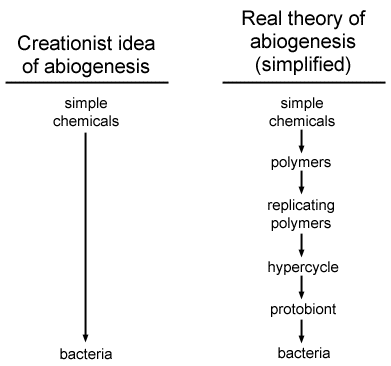
There are three main types of evolution* that theorise on the start of life but basically the theory goes as follows: approximately 4 billion years ago in the primordial soup on the primitive earth, chance atoms and molecules formed and linked, forming proteins and amino acids, the substance of life. About 3.9 billion years ago primitive genes, or RNA and DNA about 100 links long formed, which had the ability to reproduce themselves. About a hundred thousand years later the cell formed around these genes creating bacteria. Through minute changes these bacteria changed into various forms of single and multi-celled organisms. These became more complex, developing calcium structures for bones and shells, or hair-like appendages for propulsion. Eventually, through many stages, varieties of fish formed and some that came upon land developed strong fins to navigate on land. The fins eventually formed into legs or wings, and their bodies developed fur and warm blood to adapt to the harsh
Doctor Henry Morris refers to Marcel J. E. Golay’s studies when he states that the minimum number of parts a machine needs to be able to reach into a bin of parts and assemble a fully functioning replica of the machine that built it, is 1500 parts or bits of information to complete the task (Morris {1988?}P64)(1). This I500 bits also happens to be the " Amount of structure contained in the simplest large protein molecule which, when immersed in a bath of nutrients, can induce the assembly of those nutrients into another large protein molecule like itself and then separate itself from it" (IBID.)(2). If the minimum complexity needed for a creature to reproduce itself is 1500 parts, why do evolutionists propose the first genes had only 100 parts? No such creature has ever been found. Granted this is extremely small, but we’ve found an abundance of 1500 part organisms, so why haven’t any 1000 part creatures been found? It is because ether they don’t exist, or if they ever did exist t
Let’s assume now, that by some as yet unexplained incredible sequence of events, an entire cell complete with all it necessary parts in perfect working order just appeared on the primitive earth. What would we have? It would be a very interesting configuration of atomic particles and structures, a strangely complicated shape in an orderless world. A blob of uniquely constructed elemental material contrasting strangely against its random backdrop. It would now decompose, quickly deteriorate until all trace of it disappeared, and we would be right back where we started! Why? Because it is missing the essential ingredient: life. Heat would decompose it faster, electricity would destroy it and radiation would ruin an already perfect structure. No reasonable theory exists to explain the occurrence of life. Evolutionists presume the cell spontaneously came to life, and incredibly in regards to dead people, they suggest that not enough corpses have been watched to say with absolute certa So now this first spontaneous cell must also be alive with no satisfactory explanation for its existence, for the mechanism of evolution to go to work on it. Evolution methods are said to work by three possible ways: natural selection (choosing the best mates); survival of the fittest (the weeding out of the weak or deformed); or beneficial mutations (through radiation); or all three. If we can show that none of these methods will create a new species from our 1500 part virus, then evolution is not a valid theory.
Believe it or not, natural selection is now being abandoned by many evolutionists as a cause of evolution, because all this process does is insure that those which go on to propagate the species are merely the ‘fittest’. It does nothing to explain how they became fit in the first place. Natural selection only serves to strengthen a species. An analogy might be like using glasses to make an image sharper and take away the ‘fuzzy edges’. If natural selection were a method for altering a species, then survival of the weak and the misfit would be very dominant in nature, because it is presumed that such is what new species arose from. Evolutionists now reluctantly conclude this is a safeguard built into every species designed to maintain genetic stability, exactly the opposite of what they are looking for.
Some have toted that a new species has occurred through survival of the fittest with the Peppered moth of England, including National Geographic. (Sisson Mar. 1980 pg. 400,401)(6) Around 1830 the white peppered moth began to disappear because the coal from the industrial revolution was soiling the trees making the white variety easy prey for birds. Thus the black and gray sort remained. This is not a true new species because the black can still mate with the white. Also since the cleaning of the air from all the coal soot, the trees have cleaned up allowing the white type to return in large numbers once again. Saying this white variety of peppered moth is a new species is like suggesting that if lions liked to catch and eat only blond or light haired or even light skinned humans that what would remain would be a new species of human. This is really absurd. All humans can mate with all other humans regardless of tones, just as all peppered moths can. And once lions were eliminated The only ways to change DNA molecules are to cut, add to, or radiate causing mutation. Scientists have found surprisingly that adding or cutting length to DNA does nothing to create new species. Every part of the molecules length is needed to make the same species, and just clipping it wont make a eel into a duck but just a nonreproducing mass of DNA, and adding to the DNA only produces cancerous cells. In fact scientist are baffled as to how DNA actually changed length. The only possibility I can think of is if a virus attached to a so mutated gene that by some fluke they worked. But this stretches even the evolutionists’ mind. Back to our perfectly formed virus.
Believe it or not, the fact that our 1500-part creature is a virus really bugs evolutionists. Why? Because every last virus is completely parasitic! They cannot reproduce unless they have a host cell to attach themselves to, and then when they do they kill the cell! Even if the virus was first it couldn’t reproduce until a more complex cell came along. Scientist argue whether a virus is even alive and describe viruses as chromosomes on the loose. Radiating a virus is no good because changing a single link destroys them. The fact that a 1500 (to as many as 730,000)-part virus cannot possibly procreate, makes it look pretty bleak for the evolutionists fictional 100-part creature. The next least complicated cell on the ladder is the bacteria, with a minimum 1,100,000 links with approximately 75 million atoms arranged in precise order, and this is to come into existence through chance. To go into the odds would be a moot point for one huge reason. The evolutionist doesn’t even want it The third simplest lifeform is the fungi that are not simple at all; they are about 47,000 times more complicated than the virus. In fact some fungi are more complex than man! In fact if man were to evolve to the next highest order based on the complexity of the cell we would become a rose, frog, or a protozoa! Not only does the evolution theory deteriorate upon scrutiny, we also uncover deliberate deception. Take the further quote for example from The Encyclopædia of Science and Technology which suggests simpler organisms have less DNA.
"There are about 2´10-16g of DNA in a bactieriophage, as compared to about 10-14 g in the bacterium escherichia coli and about 3´10-12 g in rat liver cells. Whereas mammalian cells contain about 2-3´109nucleotide pairs of DNA. Amphibian cells vary widely, ranging from less 2´109 to about 1.5´1011nucleotide pairs." (Author, 1971? Vol. 2 p.299)(8)
You may have noticed that they changed the scale of reference from grams of DNA to the actual number DNA nucleotide pairs. This is done purely to deceive because 10-16 appears to be much smaller than 109~11. To really understand the statement we are forced to convert. There are approximately 1021 nucleotide pairs in one gram of DNA Thus mammalian cells contain 2-3x10-12 grams of DNA, or virtually identical to the rat liver cells they describe! They try to suggest that as organisms advance along their evolutionary scale their DNA gets more advanced. This couldn’t be farther from the truth. (See diagram.) To my surprise some protozoa are staggeringly complex having a thousand times more DNA than man!
EVOLUTION ASSESSMENT
Evolution is called a science, yet many refute this claim, saying evolution has no true scientific foundations whatsoever. The people who make this claim are by and large creationists, and many who refute the theory of evolution are, in fact, scientists with degrees. This is quite unknown to the general populace, who are taught evolution all through school and are led to believe this is a thoroughly substantiated science. The creationist camp is quite bothered that such a flimsy theory is given so much weight in school, whereas such a plausible theory as the science of creation is given no exposure to students whatsoever. Furthermore, students fail tests if they refuse to answer evolution questions with an accepted evolution theory answer rather than a scientifically-observed answer. Creation scientists feel creationism should be given equal time for students to be able to make educated choices. Is evolution a flimsy theory, or does it actually stand up to scrutiny based on known
The evolution doctrine begins with the Big Bang theory, which states that all matter was originally compressed into one small point in space. The size of this point varies with the theorist, from a giant star to a pea-sized object and even to an atom-sized object or even smaller. Some have even theorized this object had virtually no mass at all. This is tantamount to saying all matter came from nothing. Already this sounds a bit illogical. This compressed object at some point blew up, rapidly expanding and creating all atomic matter. It spread across the universe like one great nebula, swirling as gravity acted upon each particle. This swirling mass took on the basic structure of galaxies, forming stars with nebulous material around them from which planets were formed. The heavier atoms attracted by the more intense gravity at the center of the solar system turned into the inner rocky planets while the lighter, gassy atoms further from this source of gravity formed into the gas gi
Einstein theorised that sources of intense gravity would bend light. This theory has been proven with the observation of "lensing". This occurs when a star is directly behind an intense source of gravity, like another star. The gravity of the object will bend the light of the star behind it creating a double image of that star, one above and one below the source of gravity. This observation proved that an intense enough source of gravity would deny the escape of light from the source, in other words a "black hole". The reason this information hurts evolution is because all matter had to come from the initial explosion. Since all matter was in this point, the gravity would have been trillions of times stronger than a black hole and light could not escape it. Therefore if light could escape it neither could matter because another law shows that matter cannot exceed the speed of light, and matter would have to attain multiples of the speed of light to escape. This is an incred Immediately preceding the big bang all of space would be at absolute zero including the "matter" about to explode. At absolute zero, all motion ceases, and no energy exists. If this is the case, how can something with no heat, and therefore no energy (and apparently no mass) explode, create heat, raise the average temperature of the universe three degrees and create all mass? It was first thought that intense gravity would cause a big bang but it is now known that such an object would only collapse and continue collapsing! It makes you wonder why the Big Bang theory still stands.
Even if there was a big bang two more observed laws act upon the matter. What would exist would be matter chaos, which would be quickly followed by heat death. Both these terms are used to describe what happens when matter is scattered completely, and energy becomes unavailable for use. The formation of solar systems is really a problem too. Theory states that the heavier atoms formed closer to the sources of gravity forming the rocky planets, and the lighter elements further away formed the gassy giants. If this is the case why is the sun composed of almost entirely helium and hydrogen atoms; the lightest atoms in existence? The big bang theory does not stand up to scrutiny and must be discarded. Another, suitable, theory is needed which encompasses all the observed laws. The next aspect of evolution to look at is the origin of life.
There are three main types of evolution* that theorise on the start of life but basically the theory goes as follows: approximately 4 billion years ago in the primordial soup on the primitive earth, chance atoms and molecules formed and linked, forming proteins and amino acids, the substance of life. About 3.9 billion years ago primitive genes, or RNA and DNA about 100 links long formed, which had the ability to reproduce themselves. About a hundred thousand years later the cell formed around these genes creating bacteria. Through minute changes these bacteria changed into various forms of single and multi-celled organisms. These became more complex, developing calcium structures for bones and shells, or hair-like appendages for propulsion. Eventually, through many stages, varieties of fish formed and some that came upon land developed strong fins to navigate on land. The fins eventually formed into legs or wings, and their bodies developed fur and warm blood to adapt to the harsh
Doctor Henry Morris refers to Marcel J. E. Golay’s studies when he states that the minimum number of parts a machine needs to be able to reach into a bin of parts and assemble a fully functioning replica of the machine that built it, is 1500 parts or bits of information to complete the task (Morris {1988?}P64)(1). This I500 bits also happens to be the " Amount of structure contained in the simplest large protein molecule which, when immersed in a bath of nutrients, can induce the assembly of those nutrients into another large protein molecule like itself and then separate itself from it" (IBID.)(2). If the minimum complexity needed for a creature to reproduce itself is 1500 parts, why do evolutionists propose the first genes had only 100 parts? No such creature has ever been found. Granted this is extremely small, but we’ve found an abundance of 1500 part organisms, so why haven’t any 1000 part creatures been found? It is because ether they don’t exist, or if they ever did exist t
Let’s assume now, that by some as yet unexplained incredible sequence of events, an entire cell complete with all it necessary parts in perfect working order just appeared on the primitive earth. What would we have? It would be a very interesting configuration of atomic particles and structures, a strangely complicated shape in an orderless world. A blob of uniquely constructed elemental material contrasting strangely against its random backdrop. It would now decompose, quickly deteriorate until all trace of it disappeared, and we would be right back where we started! Why? Because it is missing the essential ingredient: life. Heat would decompose it faster, electricity would destroy it and radiation would ruin an already perfect structure. No reasonable theory exists to explain the occurrence of life. Evolutionists presume the cell spontaneously came to life, and incredibly in regards to dead people, they suggest that not enough corpses have been watched to say with absolute certa So now this first spontaneous cell must also be alive with no satisfactory explanation for its existence, for the mechanism of evolution to go to work on it. Evolution methods are said to work by three possible ways: natural selection (choosing the best mates); survival of the fittest (the weeding out of the weak or deformed); or beneficial mutations (through radiation); or all three. If we can show that none of these methods will create a new species from our 1500 part virus, then evolution is not a valid theory.
Believe it or not, natural selection is now being abandoned by many evolutionists as a cause of evolution, because all this process does is insure that those which go on to propagate the species are merely the ‘fittest’. It does nothing to explain how they became fit in the first place. Natural selection only serves to strengthen a species. An analogy might be like using glasses to make an image sharper and take away the ‘fuzzy edges’. If natural selection were a method for altering a species, then survival of the weak and the misfit would be very dominant in nature, because it is presumed that such is what new species arose from. Evolutionists now reluctantly conclude this is a safeguard built into every species designed to maintain genetic stability, exactly the opposite of what they are looking for.
Some have toted that a new species has occurred through survival of the fittest with the Peppered moth of England, including National Geographic. (Sisson Mar. 1980 pg. 400,401)(6) Around 1830 the white peppered moth began to disappear because the coal from the industrial revolution was soiling the trees making the white variety easy prey for birds. Thus the black and gray sort remained. This is not a true new species because the black can still mate with the white. Also since the cleaning of the air from all the coal soot, the trees have cleaned up allowing the white type to return in large numbers once again. Saying this white variety of peppered moth is a new species is like suggesting that if lions liked to catch and eat only blond or light haired or even light skinned humans that what would remain would be a new species of human. This is really absurd. All humans can mate with all other humans regardless of tones, just as all peppered moths can. And once lions were eliminated The only ways to change DNA molecules are to cut, add to, or radiate causing mutation. Scientists have found surprisingly that adding or cutting length to DNA does nothing to create new species. Every part of the molecules length is needed to make the same species, and just clipping it wont make a eel into a duck but just a nonreproducing mass of DNA, and adding to the DNA only produces cancerous cells. In fact scientist are baffled as to how DNA actually changed length. The only possibility I can think of is if a virus attached to a so mutated gene that by some fluke they worked. But this stretches even the evolutionists’ mind. Back to our perfectly formed virus.
Believe it or not, the fact that our 1500-part creature is a virus really bugs evolutionists. Why? Because every last virus is completely parasitic! They cannot reproduce unless they have a host cell to attach themselves to, and then when they do they kill the cell! Even if the virus was first it couldn’t reproduce until a more complex cell came along. Scientist argue whether a virus is even alive and describe viruses as chromosomes on the loose. Radiating a virus is no good because changing a single link destroys them. The fact that a 1500 (to as many as 730,000)-part virus cannot possibly procreate, makes it look pretty bleak for the evolutionists fictional 100-part creature. The next least complicated cell on the ladder is the bacteria, with a minimum 1,100,000 links with approximately 75 million atoms arranged in precise order, and this is to come into existence through chance. To go into the odds would be a moot point for one huge reason. The evolutionist doesn’t even want it The third simplest lifeform is the fungi that are not simple at all; they are about 47,000 times more complicated than the virus. In fact some fungi are more complex than man! In fact if man were to evolve to the next highest order based on the complexity of the cell we would become a rose, frog, or a protozoa! Not only does the evolution theory deteriorate upon scrutiny, we also uncover deliberate deception. Take the further quote for example from The Encyclopædia of Science and Technology which suggests simpler organisms have less DNA.
"There are about 2´10-16g of DNA in a bactieriophage, as compared to about 10-14 g in the bacterium escherichia coli and about 3´10-12 g in rat liver cells. Whereas mammalian cells contain about 2-3´109nucleotide pairs of DNA. Amphibian cells vary widely, ranging from less 2´109 to about 1.5´1011nucleotide pairs." (Author, 1971? Vol. 2 p.299)(8)
You may have noticed that they changed the scale of reference from grams of DNA to the actual number DNA nucleotide pairs. This is done purely to deceive because 10-16 appears to be much smaller than 109~11. To really understand the statement we are forced to convert. There are approximately 1021 nucleotide pairs in one gram of DNA Thus mammalian cells contain 2-3x10-12 grams of DNA, or virtually identical to the rat liver cells they describe! They try to suggest that as organisms advance along their evolutionary scale their DNA gets more advanced. This couldn’t be farther from the truth. (See diagram.) To my surprise some protozoa are staggeringly complex having a thousand times more DNA than man!