william jay schroeder said:
please explain nested hierarchy.
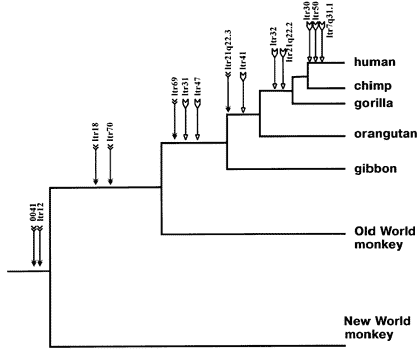
A nested hierarchy is groups, within groups, within groups. For instance all apes are primates, are eutheria (placental mammals), are mammals, are therapsids, are synapsids, are amniotes, are tetrapods, are craniata, are vertebrates, are chordates, are deuterostomia, are bilaterals, are metazoans, are eukaryotes. The nested tree of life comes from the science of taxonomy, as originally conceived by Carl Linnaeus. Another way to look at a nested hierarchy is as a branching tree.
william jay schroeder said:
a fossil record or fossil records. is this as fact on one fossil remain or many with out the gaps. I dont see how you can say a relation by fossils when there is such big gaps in them.
All existing speces can be fit within the nested hierarchy of life. In addition, all extinct species for which we have fossils also fit within this tree, sometimes forming whole new branches that have left no modern descendents. If we were to find fossil species that appeared well before their apparent ancestors, or that could not be classified into the nested hierarchy, then evolution would have a serious challenge.
There are places in the tree where there is very little information. Sometimes, as with Romer's gap and the evolution of birds, these gaps are filled. Sometimes they remain scarce. However, no fossils ever contradict this nested hierarchy, nor are they found out of time.
william jay schroeder said:
Or with just one or two close looking fossils and say all animals evolved see here is the proof with these two fossils,
No, it is the fit of the entire fossil record within the nested hierarchy of species, not any two specific fossils.
william jay schroeder said:
which seem to be a transitional. One fully formed dino and one fully formed bird, i dont know if you believe that dinos evolved into birds or not
It is the best supported hypothesis for the evolution of birds, yes. Especially given all the recent feathered dinosaurs being found, even a basal tyrannosauroid.
william jay schroeder said:
but if you do how did plants reproduce or have there seeds spread around. Birds are fairly important for most plants and or trees for reproduction as well as insects and other animals.
Prior to using birds as vectors for seed dispersal, plants used other mechanisms, such as wind, or insects. This is called coevolution, were an initially weak relationship strengthens over time as both species evolve to become soley dependent on the other.
william jay schroeder said:
other animals have to exsist with another or neither exsist insects to decay matter or waste and such birds to control the spead or growth of insects. As in the food chain of animals tree we all learn in school. if one chain is missing what happens to all the rest above it and below it.
Such a complex interrelationship has evolved over time from more simple relationships. The original self replicators would have been chemotrophs, relying only on chemical reactions, such as photosynthesis, to power their metabolism.