2nd February 2003 at 11:21 PM webboffin said this in Post #64
Good now we are finally getting somewhere at last. Carrying on from post #63. Is evolution so rapid that a primate could evolve distinctly to a human (what I believe as scientifically guessed) in 2 million years which is a very short amount of time? And what sort of neuro-genetic similarities do apes have that they can relate to humans, such as behaviour; language skills, religion; socialising and technical skills? What is the future expected evolutional path for humans going by past fossil evidences?
To take your questions in order.
Evolution
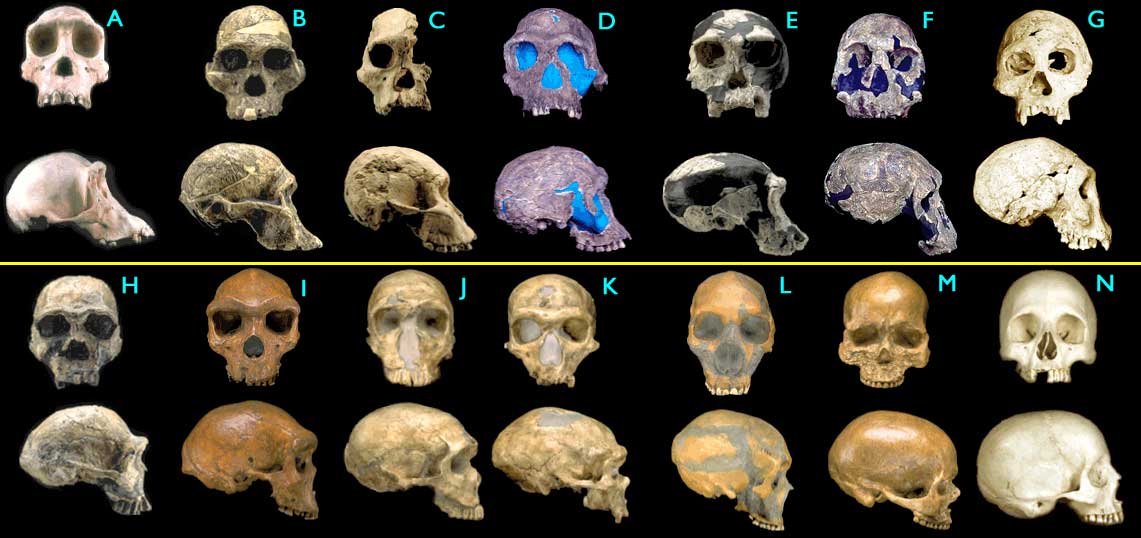
can be rapid enough to go from the common ancestor of chimps and humans to humans in 2 million years. However, by 2 million years ago you already have the genus Australopithecus which is quite a ways along the transition of primate to H. sapiens. The genetic and fossil evidence say that the last common ancestor of humans and the other great apes was 6-8 million years ago.
Apes have quite a bit of intelligence, culture, morality, etc. The adaptations that separate us from the other great apes seem to be: bipedality, a larger brain with increased intelligence, better language skills, and the ability to make tools to make tools.
If you want to research the similarities of apes and humans, these are some sources. All should be in your public library.
8. MD Hauser, Games primates play. Discover 19: 48-57, Sept. 1998. Discusses behavior among primates. Humans not so unique.
9. E Linden, Can animals think? Time 154: 57-60, Sept 6, 1999.
10. MD Hauser, Morals, apes, and us. Discover 21: 50-55, Feb. 2000.Summarizes some studies in monkeys to determine if they have "moral" behavior.
12. DS Woodruff and NG Jablonski and G Chaplin, Chimp cultural diversity. Science 285: 836-837, Aug. 6, 1999. Social tolerance evolved among hominids.
12a. A Whiten C Boesch, The cultures of chimpanzees. Scientific American 284: 60-67, Jan. 2001. Another "unique" feature of humans turns out not to be unique.
Now, one adaptation we have is increased language ability. One of the mutations that result in that has been found:
31. Molecular evolution of FOXP2, a gene involved in speech and language. Wolfgang Enard, Molly Przeworski, Simon E. Fisher, Cecilia S. L. Lai, Victor Wiebe, Takashi Kitano, Anthony P. Monaco, Svante Pääbo Nature 418, 869 - 872 (22 Aug 2002)
Future evolutionary paths can't be predicted because they depend on the environment, and that is too complex and chaotic to be predicted. If humans followed the pattern of other species, there would be allopatric speciation of humans as the separate populations adapted to isolated environments. The beginning of that can be seen in genetic adaptations of Himalayan and Andean highlanders to living at high altitudes and the !Kung to living in the Kalahari desert. Reproductive isolation has happened somewhat with the !Kung.
However, modern transportation could and probably will stop that by having different populations interbreed and thus having gene flow. Also, our technology lessens the influence of the environment because we change our environment by technology.
Bottom line: no predictions.





 ) possible for the theory to fail one of them. IOW, no matter how many rocks we drop to "authenticate" gravity, there are still an infinite number of rocks yet to drop, and it is possible that one of them could fall up.


