Okay, there was controversy with the Java man fossils and why you are all acting like there hasn't been I don't understand.
Eugène Dubois
Photograph Illustration Eugène Dubois came into the world at an appropriate time, given the mission he chose in life. He was born in 1858, in between the discovery of the first recognized Neanderthal fossil and Darwin's publication of On the Origin of Species. Dubois vowed to prove Darwin right by finding "the missing link" between apes and humans. In 1892, he succeeded, yet the years before and the decades after were anything but easy.
His first paper discussed the structure of the larynx and suggested that the mammalian larynx evolved from gill cartilage of fishes. Shortly afterwards, Dubois turned his attention away from voice boxes and toward early humans, convinced that fossils would provide the best evidence of evolution. He concluded that he would have a good chance of finding transitional fossils in the Dutch East Indies, and set sail with his new family. Most people thought the Dutchman crazy, especially since the move entailed giving up a university position and assuming duties as a military doctor in a disease-ridden climate.
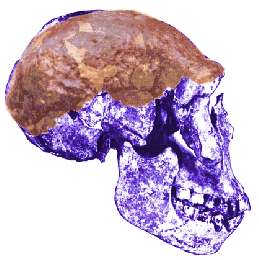
Dubois started fossil hunting in Sumatra, but later moved to Java where he had better luck. After five years, he had evidence he considered sufficient to declare a new genus and species: Pithecanthropus erectus, or Java Man. The evidence consisted of a skullcap, from which he estimated a cranial capacity larger than an ape's but smaller than a human's; a tooth; and the left femur of an erect biped that had sustained, but recovered from, a serious leg injury.
Dubois paid a steep price for his find. He and his wife lost a child to tropical fever, and Dubois himself narrowly escaped death more than once, from malaria, tigers, and collapsing cave walls. Upon returning home, he took an unprestigious university appointment, and concluded that his greatest achievement would always be finding Java Man. So he was cruelly disappointed when, though some scientists greeted his finds enthusiastically, others dismissed them as ape remains, primitive human remains, or a jumble of fossils from separate individuals. (The last claim gained credence decades later when Dubois found an additional left femur in his collections, something he had overlooked. It contradicted his long-held belief that the fossils had certainly come from a single individual. In fact, some paleoanthropologists now suspect that the femur Dubois used to describe Java Man actually belonged to an anatomically modern human.) Even the scientists who supported his arguments left him suspicious; the anatomist Gustav Schwalbe used a cast of the skullcap to write an expanded monograph that dwarfed the paper by Dubois. Considering the effort he had expended to collect the fossils, he felt perhaps with justification that describing them was his exclusive right. Afterwards, the disillusioned Dubois periodically refused other scientists access to the fossils. A resulting (and inaccurate) rumor claimed Dubois was keeping the fossils hidden under pressure from the Catholic church.
His personal life offered him little solace. As a young man, he had been smitten by a very bright young woman, but when he learned she did not return his affections, he married a more vivacious if less clever girl. His wife took no interest in his work, and he eventually judged her shallow and unworthy. Not that Dubois was an ideal husband. On their return trip from Java to Europe, the ship was caught in such a violent storm that the captain ordered all the passengers into lifeboats. Dubois apparently informed his wife that, should something happen to their lifeboat, she would be responsible for saving their three children; he would be preoccupied with saving the Java Man fossils in the suitcase he'd strapped to his chest.
Despite flashes of productivity, Dubois descended into a bitter malaise in his later years. He rejected the implications of new finds in paleoanthropology, and he developed a reputation for using then discarding devoted assistants. Yet even though he was seldom personable, Dubois was brilliant. In addition to identifying Java Man, he deduced a predictable relationship between brain size and body size in different types of animals. This finding enjoyed little attention until decades after his death, becoming the forerunner of new research fields in biology.
I could have presented more but I felt this was less biased in account.