
- May 15, 2020
- 1,344
- 388
- Country
- United States
- Gender
- Male
- Faith
- Christian
- Marital Status
- Private
Brownian motion can never be in a straight line and is modelled by the Langevin equation.
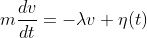
The first term in the right hand side of the equation is the resistance of a particle of mass m to the molecules in the medium and is proportional to the velocity of the particle v.
The proportionality constant λ is a damping coefficient.
The second term based on statistical mechanics is referred to as the noise term and represents the collisions of the air or liquid molecules with the particle.
The kinetic energy of the colliding molecules has a Gaussian distribution.
For motion to be in a straight line the general equation is;

where α is a constant.
Consider the case when there are no collisions on the particle (the second term is zero) and the force acting on the particle is purely resistance.
Solving the equation gives;

v₀ is the initial velocity and is clearly not a straight line.
One doesn’t even have to consider the noise term;

to show that straight line motion is impossible.
I'd love it if this could be established for a real world case, but your noise term is synthetic. I could pick anything, white noise, pink noise, etc. I'd be more interested in knowing if this holds when real forces are considered.
Upvote
0


