• Starting today August 7th, 2024, in order to post in the Married Couples, Courting Couples, or Singles forums, you will not be allowed to post if you have your Marital status designated as private. Announcements will be made in the respective forums as well but please note that if yours is currently listed as Private, you will need to submit a ticket in the Support Area to have yours changed.

  • CF has always been a site that welcomes people from different backgrounds and beliefs to participate in discussion and even debate. That is the nature of its ministry. In view of recent events emotions are running very high. We need to remind people of some basic principles in debating on this site. We need to be civil when we express differences in opinion. No personal attacks. Avoid you, your statements. Don't characterize an entire political party with comparisons to Fascism or Communism or other extreme movements that committed atrocities. CF is not the place for broad brush or blanket statements about groups and political parties. Put the broad brushes and blankets away when you come to CF, better yet, put them in the incinerator. Debate had no place for them. We need to remember that people that commit acts of violence represent themselves or a small extreme faction.

Who believes this to be true: The Torah is not for Gentiles

I believe the Torah is NOT for Gentiles

  • yes Torah is not for Gentiles

  • no Torah is for anyone


Results are only viewable after voting.
Status
Not open for further replies.

Lulav

Y'shua is His Name
Aug 24, 2007
34,149
7,245
✟509,998.00
Country
United States
Gender
Female
Faith
Unorthodox
Marital Status
Married
do you still believe that after seeing this poll of fol;ks here ? I think we are all feeling the same, the way we apply Torah to our lives may differ but we are all on the same page that Torah is for everyone:thumbsup:

so enough with the trying to define Torah for each other's groups:D;):p and getting it wrong....let each person have their own convictions about Torah and dont try to lable them one way or another


just know that most here believe Torah has a place in everyone lives and leave it at that:) we are not all going to agree on everything detail but we do agree on a basic point:groupray:
that's fine but you should be aware that some of the squeakiest wheels who want to redo this forum have not voted but would not be, by their own posts, ones to agree it is for everyone.

Im not going to define it as its ment to be vague to give a simple Basic answer yes or no, we spend toooo much time drawing conclusions about each other in here and I think we need to look at a larger picture and not sweat out each other sooo much:)
 
Upvote 0

Gxg (G²)

Pilgrim/Monastic on the Road to God (Psalm 84:1-7)
Site Supporter
Jan 25, 2009
19,769
1,429
Good Ol' South...
Visit site
✟211,037.00
Faith
Oriental Orthodox
Marital Status
Private
Politics
US-Others
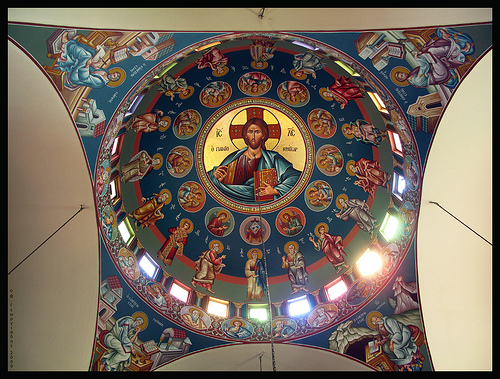
Thekla, a dear friend of mine, had an EO Icon of the Pantocrater...pretty kewl! :)
Originally Posted by Thekla The four Gospel writers are the icons on the pendentives supporting the dome which has the icon of Jesus Christ Pantocrater; this is a visual demonstration of Christ as ruler of all, and the importance of the Gospels (and Holy Scripture) in the EO.

4530644494_5f800d9a1c.jpg

Beautiful.

Outside of the fact that Thekla is a wonderful/brilliant individual and I'm glad you referenced her--especially on the subject of Icons which are more than Biblical (as discussed here, here and here /#25)--I wanted to say that it is truly a Beautiful picture demonstrating Christ as the center of all existence and all people of influence having to submit themselves unto Him:) As Philippians 4 notes when it makes clear that every knee will bow/tongue confess that He is LORD of ALL.....
Romans 14:11
It is written: “‘As surely as I live,’ says the Lord, ‘every knee will bow before me; every tongue will acknowledge God.’”
Philippians 2:6
God exalted him to the highest place and gave him the name that is above every name, 10 that at the name of Jesus every knee should bow,
in heaven and on earth and under the earth,
11 and every tongue acknowledge that Jesus Christ is Lord,
to the glory of God the Father.

In many ways, what the Icon picture shows is in regards to the subject of the OP and asking what Torah is for. For when it comes to the Torah, what matters is the character of Christ..and as the Word says, all things are meant to point to Him since He is the End of the Law:
Romans 10:4

4 Christ is the culmination of the law so that there may be righteousness for everyone who believes.


Christ is the aim of the law. He is the purpose of the Law. God’s grace didn’t suddenly appear out of nowhere when Jesus burst onto the scene, as it appeared multiple points in His Word the entire time. God is a God of grace and mercy from day one..and Grace appears in the Bible before the Law is ever uttered. In Christ, the law gained its full meaning in His death. We can understand the Law fully because Christ died to explain it to us. The word “perfected” in 1 John 4:17 is teleioō and is the same word family as the word translated “end” in Romans 10:4. Thus, Christ didn’t bring an “end” to the law as in the sense of canceling it out or finishing it off. Christ brought the law to its goal: LOVE.

For more, go here.


As said best elsewhere:
There is much confusion rampant today regarding Christ and the Law of Moses. The expression "law of Moses" is found in the scriptures (Lk. 24: 44). Smith's Bible Dictionary makes the following observation relative to law (nomos):
"The word is properly used, in Scripture as elsewhere, to express a definite commandment laid down by any recognized authority; but when the word is used with the article, and without any words of limitation, it refers to the expressed will to God, and in nine cases out of ten to the Mosaic law, or to the Pentateuch of which it forms the chief portion….The sense of the word, however, extends its scope and assumes a more abstracts character in the writings of St. Paul. Nomos , when used by him with the article, still refers in general to the law of Moses; but when used without the article, so as to embrace any manifestation of 'law,' it includes all powers which act on the will of man by compulsion, or by the pressure of external motives, whether their commands be or be not expressed in definite forms…. It should also be noticed that the title 'the Law' is occasionally used loosely to refer to the whole of the Old Testament, as in John 10: 34 referring to Psalms 82: 6 in John 15: 25 referring to Psalms 35: 17 and in I Corinthians 14: 21 referring to Isaiah 28: 11, 12."
Hence, the expression "the law" or "the law of Moses" is used in the New Testament in keeping with Jewish use to denote the Pentateuch (first five books of the Bible), but also to include the Psalms and the books of prophecy (Lk. 24: 44; Jn. 10: 34; I Cor. 14: 21).

Christ was prophesied in the law. Moses prophesied of a "prophet from among their brethren" being raised up and that he would be like unto Moses (Deut. 18: 18). The apostle Peter showed this prophecy was fulfilled in Christ (Acts 3: 22, 23). The Hebrew scriptures prophesied of Jesus' birth, life, and death (Micah 5: 2; Isa. 53: 1-12). Jesus said of the Hebrew scriptures, "…they are they which testify of me" (Jn. 5: 39).

Christ lived and died under the law. "But when the fullness of the time was come," Paul wrote, "God sent forth his Son, made of a woman, made under the law, to redeem them that were under the law…" (Gal. 4: 4, 5). The fact Jesus was born when he was did not accidentally happen. God had planned Jesus' birth and introduction to the world (Dan. 2).

Christ recognized the authority of the law. Jesus respected the Law of Moses. Why one asked Jesus "what shall I do to inherit eternal life" Jesus replied, "What is written in the law? How readest thou?" (Lk. 10: 25, 26). When the man correctly answered by alluding to the Ten Commandments, Jesus said "Thou hast answered right: this do, and thou shalt live" (vs. 27, 28). Jesus recognized the resident authority of the Hebrew scriptures when he quoted them to defeat the Tempter (Matt. 4, 7, 10, Deut. 8: 3; Ps. 91: 11, 12; Deut. 6: 16).

Christ perfectly kept the Law of Moses. Jesus himself claimed to have been obedient to the law under which he lived, the Law of Moses (Jn. 8: 29, 55). In fact, the Jews were unable to convict Jesus of any transgression of the law (Jn. 8: 46). It is affirmed in the New Testament that Jesus "did no sin" and "was without sin" (I Pet. 2: 22; Heb. 4: 15). Jesus is the only "man" who ever sinlessly kept the law.

Christ taught others to keep the law. As seen, Jesus recognized the authority of the law in his life and taught others to keep the law (Lk. 10: 25-28). Jesus instructed his disciples to obey the law (Matt. 23: 2, 3). Christ defended the law and severely condemned those who perverted the Hebrew scripture (Mk. 7: 7-13; Matt. 23: 16-22).


Christ is the end of the law. Paul wrote thus of Christ and the law: "For Christ is the end of the law for righteousness to every one that believeth" (Rom. 10: 4). The word "end" is from the Greek telos. Vine remarks on telos in this fashion,

"Noun, telos: signifies (a) "the limit," either at which a person or thing ceases to be what he or it was up to that point, or at which previous activities were ceased, 2 Cor. 3:13; 1 Pet. 4:7; (b) "the final issue or result" of a state or process, e.g., Luke 1:33; in Rom. 10:4, Christ is described as "the end of the Law unto righteousness to everyone that believeth;" this is best explained by Gal. 3:23-26; cp. Jas. 5: 11…" (W. E. Vine's Expository Dictionary of New Testament Words).

Christ did not simply do away with the law, he ended or fulfilled it. Jesus is the substance of the shadows, the antitype of the types, and the very epitome of all the moral enunciations of the law. Jesus said, "Think not that I am come to destroy the law, or the prophets: I am not come to destroy, but to fulfill" (Matt. 5: 17). Notice the next verse, "For verily I say unto you, Till heaven and earth pass, one jot or one tittle shall in no wise pass from the law, till all be fulfilled" (vs. 18). Jesus fulfilled the law and inaugurated his system or testament (Lk. 24: 44, 47). Christ's system is not without law, but the onerous system of Moses was nailed to Jesus' cross (Gal. 6: 2, Col. 2: 14, see addendum). Jesus' apostles are "able ministers of the new testament" (2 Cor. 3: 6). The Law of Moses could not impart life (2 Cor. 3: 7-18). The law was only a "schoolmaster to bring us (Jew, dm) unto Christ, that we might be justified by faith" (Gal. 3: 24). "But after that faith is come," Paul continued, "we are no longer under a schoolmaster" (vs. 25).

Paul warned regarding any who would attempt justification by the Law of Moses. Hear him: "Christ is become of no effect unto you, whosoever of you are justified by the law; ye are fallen from grace" (Gal. 5: 4). One cannot be saved by a system of meritorious works that seek to earn salvation and by grace at the same time (Rom. 11: 6). John said, "For the law was given by Moses, but grace and truth came by Jesus Christ" (Jn. 1: 17).


In conclusion, Christ sustained a unique position to the Law of Moses. He promoted it and flawlessly kept its precepts. Of greater importance: Christ was the end of the law in that he fulfilled it. Jesus became the ultimate and perpetual sacrifice for the sins of the world (Heb. 7-9). Jesus has all authority in heaven and earth and we are to hear him (Matt. 28: 18; 17: 5). Jesus is to be heard over Moses and Elias (law and prophets, Matt. 17: 4, 5). "For this man was counted worthy of more glory than Moses…And Moses verily was faithful in all his house, as a servant…But Christ as a son over his own house; whose house are we…," argued the writer of Hebrews (Heb. 3: 3, 5, 6).


Also, as said best by another:
Romans 10:5-8
5 For Moses writes about the righteousness which is of the law, "The man who does those things shall live by them" 6 But the righteousness of faith speaks in this way, "Do not say in your heart, 'Who will ascend into heaven?' "(that is, to bring Christ down from above) 7 or, " 'Who will descend into the abyss?' " (that is, to bring Christ up from the dead). 8 But what does it say? "The word is near you, in your mouth and in your heart"(that is, the word of faith which we preach)
Paul, as is frequently his habit, turns to a specific Old Testament passage to support his thesis that the Jews had headed the wrong direction. He turns to Moses and quotes from Leviticus, then from a sequence of verses from Deuteronomy. The Leviticus passage is similar to several New Testament statements on the force of the law. Either you kept the entire law, or, you failed (James 2:10). The Jews, by binding themselves to the law, were bound to the consequences of breaking the law. And, since the Jews broke the law as is clear from Jesus pronouncements as to the true meaning of the law, the Jews would not find righteousness.

The three successive quotes from Deuteronomy set the stage for a clear understanding of justification by faith. Paul wants his Jewish brethren to understand they have always possessed the true answer for finding God -- they just failed to follow it. To bring Christ down from above would be to repeat things already accomplished. Jesus has already been to the Cross. There is no need to re-offer the sacrifice to appease God. But, by continuing to follow the law and seek righteousness by works, the Jews are, effectively, still offering sacrifices when none are needed, required or desired. Paul is attempting to make it clear God demonstrated His grace to the Jews in establishing a relationship with them initially.

In these verses Paul attempts to display two sets of train tracks that run parallel to each other. One is the Law. The other is Grace. Both came from God, but grace is an express track and the train runs straight to salvation. The other is the local track. Its sole purpose is to point people to grace, but the track ends at the station. It does not continue on to salvation. Having discovered grace by the law, the believer must change tracks, must place his faith and trust in Christ, in order to be saved.

What makes this somewhat difficult is that in these verses Paul is pitting Moses against himself. Moses writes about the negative side of righteousness in Leviticus, and then writes about the positive side of righteousness in Deuteronomy. These parallels become the proof of grace and faith as men’s sole path to salvation. To attempt and recreate the path is something men cannot accomplish, for God has already created the path Himself. The implications of Moses’ teachings is that the man who attempts to “ascend” or “descend” is a state of unbelief. Jesus has done these things, so to attempt to recreate them is to not believe in the Works of Christ.
 
Last edited:
Upvote 0

Tishri1

Well-Known Member
Site Supporter
Feb 28, 2004
59,894
4,323
Southern California
✟369,734.00
Gender
Female
Faith
Messianic
Marital Status
Married
I was thinking the same thing. This thread has become a free for all instead of what i think it was meant to be, a poll for the MJ forum members.


To post an icon in a Torah thread is.............................................

To many adjectives to list. :doh:
yeh it has:thumbsup: but the poll doesn't lie....trhata what I was trying to find out

*thats


sorry my keyboard is busted hence the awesome typos:p
 
Upvote 0

Gxg (G²)

Pilgrim/Monastic on the Road to God (Psalm 84:1-7)
Site Supporter
Jan 25, 2009
19,769
1,429
Good Ol' South...
Visit site
✟211,037.00
Faith
Oriental Orthodox
Marital Status
Private
Politics
US-Others
Both orthodox Judaism and orthodox Christianity have essentially the same position on the Torah.
The position being one of distinction when it comes to certain rules/their purpose and their application being limited--never intended for all.

And in regards to what orthodox Christianity makes clear, there's the reality that for both Jew and Gentile a new kind of righteousness has appeared for ALL
G
Romans 3:10-28


10 As it is written:
“There is no one righteous, not even one;
11 there is no one who understands;
there is no one who seeks God.
12 All have turned away,
they have together become worthless;
there is no one who does good,
not even one.”[a]
13 “Their throats are open graves;
their tongues practice deceit.”[b]
“The poison of vipers is on their lips.”[c]
14 “Their mouths are full of cursing and bitterness.”[d]
15 “Their feet are swift to shed blood;
16 ruin and misery mark their ways,
17 and the way of peace they do not know.”[e]
18 “There is no fear of God before their eyes.”[f]
19 Now we know that whatever the law says, it says to those who are under the law, so that every mouth may be silenced and the whole world held accountable to God. 20 Therefore no one will be declared righteous in God’s sight by the works of the law; rather, through the law we become conscious of our sin. Righteousness Through Faith

21 But now apart from the law the righteousness of God has been made known, to which the Law and the Prophets testify. 22 This righteousness is given through faith in[g] Jesus Christ to all who believe. There is no difference between Jew and Gentile, 23 for all have sinned and fall short of the glory of God, 24 and all are justified freely by his grace through the redemption that came by Christ Jesus. 25 God presented Christ as a sacrifice of atonement,[h] through the shedding of his blood—to be received by faith. He did this to demonstrate his righteousness, because in his forbearance he had left the sins committed beforehand unpunished— 26 he did it to demonstrate his righteousness at the present time, so as to be just and the one who justifies those who have faith in Jesus.

27 Where, then, is boasting? It is excluded. Because of what law? The law that requires works? No, because of the law that requires faith. 28 For we maintain that a person is justified by faith apart from the works of the law.
This verse says that if there were such a thing as the “court of heaven”, that the law & prophets would have stood up as witnesses, pointed their fingers to us who put our faith in Jesus and said: “This person is righteous!” And in many ways, when examining what Hebrews 7 and Genesis 14 describe with the character with the Priest/King of Salem (short for Jerusalem) and how Melkelzidek was righteous even before anything of the Mosaic Law occurred, the reality is that righteousness was available for all outside of the Mosaic Code. What was available in the time of Abraham was "Torah" just as much as the Mosaic Code was Torah. For there were differing laws given at differing times/periods--and the same has occurred in Christ
Acts 13:39
Through him everyone who believes is set free from every sin, a justification you were not able to obtain under the law of Moses.
Romans 4:25
He was delivered over to death for our sins and was raised to life for our justification.
Romans 4:24-25


For another scripture:
1 John 3:23
And this is His commandment: that we should believe on the name of His Son Jesus Christ and love one another, as He gave us commandment
Jesus’ disciples also asked what are the works that they should do:
John 6:28
Then they said to Him, “What shall we do, that we may work the works of God?” 29 Jesus answered and said to them, “This is the work of God, that you believe in Him whom He sent.”


Romans 10:4 always comes to mind for me whenever the OT is discussed. For in regards to what Paul noted, Paul’s declaration that “Christ is the end of the Law” appears to me to suggest “goal” or “purpose” rather than “THE END.” The interpretation of telos=fini is an Old Perspective understanding. As one commentator noted, “The context suggests that Paul means both, but with an emphasis on goal.” He draws a connection to Romans 8:3-4, which indicates that only through Christ can the “righteous requirements of the law…be fully met.” This understanding to me squares best with Jesus’ statement, “Do not think that I have come to abolish the Law or the Prophets; I have not come to abolish them but to fulfill them” (Mt. 5:17).

The law is still good in and of itself. However, it is no longer a means for salvation/justification. The implications are that Jews and Gentiles alike are included in this new covenant through faith. “Christ is the purpose or goal of the law” is a new perspective view on the law that solves many things and I think that this reading of Matt 5:17-20 makes a lot of sense in that Jesus is stating that HE is the goal of the law. The purpose of the law is to be Christ like. Since no one is able, it must be Him and through Him. Now the law is still there for good purpose, and as we have seen the purpose of the law, we now must recognize that in the character of Christ--who emphasised a life of LOVE as being sufficient (Luke 10:25-39).

If we take ‘end’ to mean “GOAL or PURPOSE”, this would reflect the New Testament Perspective which flows from the basis of God in covenant with God’s people and the law isn’t the means of salvation but rather the presence of salvation…an indicator that God is with God’s people. With this reading, we would then read things like Matthew 5:17-20 as Jesus coming to be the goal or the purpose of the law – a transition point perhaps in how it was read and obeyed - but not the end of it all. The implications for this view are that it redefines for us what place the law does have in our lives as we seek to be in right relationship with God. He draws a connection to Romans 8:3-4, which indicates that only through Christ can the “righteous requirements of the law…be fully met.” This understanding, again, squares best (IMHO) with Jesus’ statement, “Do not think that I have come to abolish the Law or the Prophets; I have not come to abolish them but to fulfill them” (Mt. 5:17).


Romans 9:31 says that the righteousness that Israel sought could not be obtained because they were seeking it through the law. Paul also affirms this in another one of his writings seen in the passage Galatians 3:11, “Now it is evident that no one is justified before God by the law; for ‘The one who is righteous will live by faith.’” Matthew speaks of righteousness in that the righteousness of the disciples must exceed that of the scribes and Pharisees (exceed strict obedience to the law as a means of attaining that right relationship). The term appears again in the passage in Romans 10:4, “Christ is the end of the law so that there may be righteousness for everyone who believes.” Putting all these pieces together, it seems best to say that the Jews sought righteousness, a right relation with God, through the law. Paul states this didn’t work but in Christ’s coming, it was then available to all who would confess and believe (10:9). In Romans 10:5-8, he seems to be saying that righteousness by the law was up to a person’s actions (which were never adequate) but righteousness by faith was something only Christ could do and which was available to all – Jew and Greek.

It is as Romans 3:21-23 describes with the new righteousness found APART from the Law (Mosaic Law, that is)--for what occurred was essentially the creation of a another kind of Torah/Law, just as it was the case that differing versions of Torah existed/developed in differing eras/times with the Lord's people.

If the function of the Mosaic law was simply to meet the requirements for salvation then "telos" could very well mean the law is no longer necessary in view of Christ who made our salvation possible. If the law is referring to a covenantal righteousness then the New Perspective would say that God provides us with a right relationship through the death and resurrection of Jesus. Thus the end goal of the law is met in Jesus. The law is no longer the measuring stick for the believer. This is because the believer is now in right relations with God and can make the guidance of the Spirit the new measuring stick. Following the Holy Spirit as the guide elevates the believer to a level of righteousness that surpasses the limited requirements of the law. (Matthew 5:20) In Romans 10:4 Paul makes it clear that we remain in right covenantal standing by remaining in Jesus who has become the “end” of the law.

A Jew might have read Jeremiah 31:33 and saw a day coming when the law in it’s present form would be succeeded by a new age when God would guide through the heart of the believer. I think Romans 10:4 is best read in light of this passage.

In teaching with this text I would start with a discussion on the context. The Jews were trying to meat the requirements of the law on their own (and this would apply to both the Old and New Perspectives). Here Paul is saying that it is God’s work and faithfulness rather than our own that is meeting the requirements of the Law. Where does our faith lie? In our ability to be faithful or God’s faithfulness? This is the good news that we are able to proclaim to the Gentiles as Paul goes on to say, “How beautiful are the feet of those who bring good news!” (Romans 10:15)


For one good source of review, one can go to Jesus, Christians and the Law and the work of Dr.Arnold Frutembaum of "Ariel Ministries" in his work entitled THE LAW OF MOSES AND THE LAW OF MESSIAH. Also, one may consider investigating here for good discussion/debate at Jesus and Paul
 
Last edited:
Upvote 0

Gxg (G²)

Pilgrim/Monastic on the Road to God (Psalm 84:1-7)
Site Supporter
Jan 25, 2009
19,769
1,429
Good Ol' South...
Visit site
✟211,037.00
Faith
Oriental Orthodox
Marital Status
Private
Politics
US-Others
Last edited:
Upvote 0

Avodat

Contending for Biblical truth
Jul 2, 2011
4,188
315
✟28,927.00
Faith
Other Religion
Marital Status
Private
Seeking Him - your dilemma comes about because your questions roll a number of divergent views into one sentence. You will never get a clear answer on this basis as you have discovered. You need to pursue the component parts, not the whole, then you may see what everyone is saying and you can form your own opinion.
 
Last edited:
Upvote 0

yedida

Ruth Messianic, joining Israel, Na'aseh v'nishma!
Oct 6, 2010
9,779
1,461
Elyria, OH
✟40,205.00
Faith
Marital Status
In Relationship
Well dear, if it's not in full force, God can't be writing, can he? It either is, or it isn't here. And if you're saying that it is not here, then you're saying there has been no remission. Clearly this verse shows the New Covenant has begun, because the wordage is quite clear, redemed from the sins of the first Covenant, showing how, because the death occured, while showing the Covenantal change. SH.

Hebrews 9:15 Therefore he is the mediator of a new covenant, so that those who are called may receive the promised eternal inheritance, since a death has occurred that redeems them from the transgressions committed under the first covenant.

Well dear, I said the same thing, different words.
 
Upvote 0

yedida

Ruth Messianic, joining Israel, Na'aseh v'nishma!
Oct 6, 2010
9,779
1,461
Elyria, OH
✟40,205.00
Faith
Marital Status
In Relationship
that's fine but you should be aware that some of the squeakiest wheels who want to redo this forum have not voted but would not be, by their own posts, ones to agree it is for everyone.

I was getting ready to post the exact same thing. There are some unusually quiet where the poll is concerned, but not any other time or place!
 
Upvote 0

yedida

Ruth Messianic, joining Israel, Na'aseh v'nishma!
Oct 6, 2010
9,779
1,461
Elyria, OH
✟40,205.00
Faith
Marital Status
In Relationship
yeh it has:thumbsup: but the poll doesn't lie....trhata what I was trying to find out

*thats


sorry my keyboard is busted hence the awesome typos:p

This one doesn't lie, but it's not telling the full story. Some who are very vocal have been extremely unusually quiet on the poll (ie, their names are missing).
 
Upvote 0

Avodat

Contending for Biblical truth
Jul 2, 2011
4,188
315
✟28,927.00
Faith
Other Religion
Marital Status
Private
This one doesn't lie, but it's not telling the full story. Some who are very vocal have been extremely unusually quiet on the poll (ie, their names are missing).

May be because if they ticked the first box they would face a barrage of posts? We've posted plenty just agreeing together that it is well, sort of, maybe, in parts, or not at all (or any other variation of answer you can find on the thread).
 
Upvote 0

visionary

Your God is my God... Ruth said, so say I.
Site Supporter
Mar 25, 2004
56,978
8,072
✟542,711.44
Gender
Female
Faith
Messianic
We are all one in Messiah.

Therefore, we should all follow one law.


This is shown in Torah:

How are we going to try and emulate Yeshuah, if we don't follow Torah?

That is just ludicrous.

Did He not say " . . . Therefore anyone who sets aside one of the least of these commands and teaches others accordingly will be called least in the kingdom of heaven, but whoever practices and teaches these commands will be called great in the kingdom of heaven?"

I will choose to follow what YHWH says over what man says.
Amen... enough of this.. this piece is for Jew, and this piece left over the Gentiles can have.
 
Upvote 0

Yahudim

Y'shua HaMoshiach Messianic
Site Supporter
Sep 30, 2004
3,993
622
Deep in the Heart of Texas
✟182,948.00
Country
United States
Gender
Male
Faith
Messianic
Marital Status
Married
Politics
US-Others
Shalom All, :wave:

I just got around to reading this thread, so if I am the squeaky wheel to which some referred, please be advised that I have indeed voted. You may also note that my vote came down on the side of the 80% that concluded Torah is for gentile believers too. My reasoning is simple. If we are adopted under the covenant of Israel then we are obligated to the terms of the covenant of Israel. That is different than being obligated to the traditions and customs of the Rabbis and I believe that this is what Paul was teaching.

Please also note, that I have some concerns that I think should be addressed if we are going to exercise any intellectual honesty regarding this somewhat informal poll. :thumbsup:

I am completely perplexed by the reticence and reluctance of some members that fly the Messianic scroll, to define or acknowledge what Torah observance means to the majority of Messianics here. :confused: This is the meat of the matter, isn't it? Because when I read the posts of some contributors here, it is clear that Torah observance means something entirely different to them than it does to me. For me, this is a red flag warning that we are not effective ly communicating! What is the value of a poll, when those being polled cannot agree on the definition of the poll's most basic premise?

Wait! Forgive me. I presume that when you asked if Torah is for this group or that, you actually mean Torah observance, right? This is the understanding from which I am proceeding. If I am in error, please alert me to my mistake. To me Torah observance really means observing and obeying Torah in the context it was given.

When I read Torah and I read the teachings of Y'shua concerning Torah, I find a consistent theme of obedience to Torah in a very literal sense. When I read the epistles in the context of the many definitions of the word 'Torah', I find references to what could be construed as Torah in one place and 'Oral Torah' (or traditions, customs, ceremonial observances, precedents set by a biet dins, etc.) in the very next breath. When I read some contributions to this thread, I get the distinct impression that some feel that Torah is not to be taken literally or obeyed in those terms.

The translated scriptures about 'the Law', when interpreted by the writings of the 'church fathers', can have an entirely different, even completely opposite meaning when interpreted from the Hebraic context OR the context of Rabbinical Orthodoxy. This makes the concept of 'obedience' a very different matter depending on who is speaking and who is listening. :doh: Since this is SUPPOSED to be a Messianic forum, don't you think the majority opinion of Messianics concerning Torah observance should have some bearing in these deliberations?

If we are being intellectually honest, most (note the generalization) Messianic believers view Torah observance through a competely different lens than our Christian brothers and sisters. So why wouldn't we want to acknowledge that simple truth and explore the ramification of that revelation for the purpose of defining Messianic forum rules? Seems like a no brainer to me.

Is Ice Cream for you? Please vote YES or NO. I would vote YES, but with the understanding that it means something entirely different to me now, as an adult, than it did when I was a child and certainly before I became so lactose intolerant... ;) So if I am shopping for Ice Cream to be served at a small adult gathering, I am not going to take my grandchild's entire 5th grade class to help me choose brands, flavors, types and amounts. ^_^

Concerning whether the law has been written on our hearts yet: If it has then everyone in this discussion has had different scriptures tattooed on their tickers. I personally think that the verses in question will come to fruition about the time we not longer, "see as though through a glass darkly". It will come to pass when we, 'know even as we are known." Far as I can tell, that hasn't happened yet either. But I agree with the poster that said, it's a work in progress. Might be a firstfruits thing...

Blessings to All,
Phillip
 
Last edited:
Upvote 0

yedida

Ruth Messianic, joining Israel, Na'aseh v'nishma!
Oct 6, 2010
9,779
1,461
Elyria, OH
✟40,205.00
Faith
Marital Status
In Relationship
Shalom All, :wave:

I just got around to reading this thread, so if I am the squeaky wheel to which some referred, please be advised that I have indeed voted. You may also note that my vote came down on the side of the 80% that concluded Torah is for gentile believers too. My reasoning is simple. If we are adopted under the covenant of Israel then we are obligated to the terms of the covenant of Israel. That is different than being obligated to the traditions and customs of the Rabbis and I believe that this is what Paul was teaching.

Please also note, that I have some concerns that I think should be addressed if we are going to exercise any intellectual honesty regarding this somewhat informal poll. :thumbsup:

I am completely perplexed by the reticence and reluctance of some members that fly the Messianic scroll, to define or acknowledge what Torah observance means to the majority of Messianics here. :confused: This is the meat of the matter, isn't it? Because when I read the posts of some contributors here, it is clear that Torah observance means something entirely different to them than it does to me. For me, this is a red flag warning that we are not effective ly communicating! What is the value of a poll, when those being polled cannot agree on the definition of the poll's most basic premise?

Wait! Forgive me. I presume that when you asked if Torah is for this group or that, you actually mean Torah observance, right? This is the understanding from which I am proceeding. If I am in error, please alert me to my mistake. To me Torah observance really means observing and obeying Torah in the context it was given.

When I read Torah and I read the teachings of Y'shua concerning Torah, I find a consistent theme of obedience to Torah in a very literal sense. When I read the epistles in the context of the many definitions of the word 'Torah', I find references to what could be construed as Torah in one place and 'Oral Torah' (or traditions, customs, ceremonial observances, precedents set by a biet dins, etc.) in the very next breath. When I read some contributions to this thread, I get the distinct impression that some feel that Torah is not to be taken literally or obeyed in those terms.

The translated scriptures about 'the Law', when interpreted by the writings of the 'church fathers', can have an entirely different, even completely opposite meaning when interpreted from the Hebraic context OR the context of Rabbinical Orthodoxy. This makes the concept of 'obedience' a very different matter depending on who is speaking and who is listening. :doh: Since this is SUPPOSED to be a Messianic forum, don't you think the majority opinion of Messianics concerning Torah observance should have some bearing in these deliberations?

If we are being intellectually honest, most (note the generalization) Messianic believers view Torah observance through a competely different lens than our Christian brothers and sisters. So why wouldn't we want to acknowledge that simple truth and explore the ramification of that revelation for the purpose of defining Messianic forum rules? Seems like a no brainer to me.

Is Ice Cream for you? Please vote YES or NO. I would vote YES, but with the understanding that it means something entirely different to me now, as an adult, than it did when I was a child and certainly before I became so lactose intolerant... ;) So if I am shopping for Ice Cream to be served at a small adult gathering, I am not going to take my grandchild's entire 5th grade class to help me choose brands, flavors, types and amounts. ^_^

Concerning whether the law has been written on our hearts yet: If it has then everyone in this discussion has had different scriptures tattooed on their tickers. I personally think that the verses in question will come to fruition about the time we not longer, "see as though through a glass darkly". It will come to pass when we, 'know even as we are known." Far as I can tell, that hasn't happened yet either. But I agree with the poster that said, it's a work in progress. Might be a firstfruits thing...

Blessings to All,
Phillip

I thought most of us had, over and over again, in many different ways said what we believe Torah observance is. It is a matter of obedience, a matter of what is doable as opposed to what cannot and shouldn't be done, it's not a matter of picking and choosing as some accuse - there are some things that cannot be observed or if it's something that actually can be obeyed, it's not always a generic "for-all" command.
To get the train rolling, the plane in the air, we should all agree that
1 - we observe and honor the 7th Day Sabbath
2 - we meet with Avinu on His appointed Holy Days
3 - all are the road somewhere with the command to observe His dietary laws
4 - regardless of what it "seems" someone else may be saying. Words attributed to Adonai (thus saith, for I the Lord have spoken, etc) and words attributed to Yeshua override any and all others if there is any question involved as to the validity of another passage that may be causing concern.
There's more, but this is a good starting ground, I think.
 
Upvote 0

Yahudim

Y'shua HaMoshiach Messianic
Site Supporter
Sep 30, 2004
3,993
622
Deep in the Heart of Texas
✟182,948.00
Country
United States
Gender
Male
Faith
Messianic
Marital Status
Married
Politics
US-Others
I thought most of us had, over and over again, in many different ways said what we believe Torah observance is. It is a matter of obedience, a matter of what is doable as opposed to what cannot and shouldn't be done, it's not a matter of picking and choosing as some accuse - there are some things that cannot be observed or if it's something that actually can be obeyed, it's not always a generic "for-all" command.
To get the train rolling, the plane in the air, we should all agree that
1 - we observe and honor the 7th Day Sabbath
2 - we meet with Avinu on His appointed Holy Days
3 - all are the road somewhere with the command to observe His dietary laws
4 - regardless of what it "seems" someone else may be saying. Words attributed to Adonai (thus saith, for I the Lord have spoken, etc) and words attributed to Yeshua override any and all others if there is any question involved as to the validity of another passage that may be causing concern.
There's more, but this is a good starting ground, I think.
I agree yedida! I think Lulav already mentioned:
  • Sabbath and Holy Days
  • Niddah
  • Kosher
...as the three biggies in terms of Messianic and what was mentioned in Acts. It was my intent to get it nailed down even further. We are all at different points on the path of understanding what literal Torah obedience means for us as Messianic individuals and families. Just to acknowledge that most Messianics try to literally obey Torah rather than take some symbolic significance from it is huge! For me that would be a good start.

I agree that Sabbath and Holy Days, Niddah and Kosher observance are pretty universal in Messianic circles. The only point I was trying to make is that it's the literal, plain meaning of the text (p'sht) interpretation of Torah that gets us to that point in the first place. That's all I meant.

Do you think that other believers should decide for Messianics what being Torah observant means?
 
Upvote 0

Gxg (G²)

Pilgrim/Monastic on the Road to God (Psalm 84:1-7)
Site Supporter
Jan 25, 2009
19,769
1,429
Good Ol' South...
Visit site
✟211,037.00
Faith
Oriental Orthodox
Marital Status
Private
Politics
US-Others
Clearly this verse shows the New Covenant has begun, because the wordage is quite clear, redemed from the sins of the first Covenant, showing how, because the death occured, while showing the Covenantal change. SH.

Hebrews 9:15 Therefore he is the mediator of a new covenant, so that those who are called may receive the promised eternal inheritance, since a death has occurred that redeems them from the transgressions committed under the first covenant.


The New Covenant can be declared/initiated even though aspects of it may not come up until certain points....just as one can declare they're going to buy a house and they get the deed/contract signed, making the home legally theirs, but the house is still in need of many things (i.e. furniture, decorating, organization of who lives in what rooms, etc). All of those things will occur later, even though it is declared/considered to have occurred--but they take place in stages.

We've already experienced one stage of the plan when it comes to the Lord initiating His cleansing of our souls through the Power of His Shed Blood ALONE:
John 1:29
29 The next day John saw Jesus coming towards him and exclaimed, "Look, that is the Lamb of God who is to take away the sin of the world!
Romans 8:3 CJB For what the Torah could not do by itself, because it lacked the power to make the old nature cooperate, God did by sending his own Son as a human being with a nature like our own sinful one [but without sin]. God did this in order to deal with sin, and in so doing he executed the punishment against sin in human nature,
Hebrews 9:28 ESV so Christ, having been offered once to bear the sins of many, will appear a second time, not to deal with sin but to save those who are eagerly waiting for him.
His first coming dealt with sin--with it being declared by Christ " it is finished." His second coming does not deal with sin, but with redemption, being forever in the presence of God, collectively......and when He returns the world will see redemption in all ways. But until then, we've already experienced His Holy Spirit being placed inside of us (As apart of the New Covenant) to seal us ( Ephesians 1:13 ESV, Ephesians 4:30 ESV )

What has been made clear, if reading through the Book of Hebrews and other texts, is that the New Covenant has been initiated and we are no longer bound to walk fully in the Mosaic Covenant since that specific Covenant could never offer what Yeshua alone can bring in the New Deal He gives. He fulfilled the Law in order to make room for New Law to be initiated, honoring the OT in what it pointed to while taking others to Himself (As the Destination) and leading them into something beautiful....like driving an old car that has much value since it helps with many things (i.e. transportation primarily) and yet getting out of that one in order to walk into another NEW Car that has much of the same schematics as an older program except new parts are included that allow one to go much further than what the Older Car enabled them to do.


As said before, I've always tended to see the Law of Moses through the eyes of Christ in the same way one would see the laws of the U.S if going to D.C. For there've been many developments within our nation's history.....and some things that've progressed. Whereas some things that changed NEEDED to do so due to their not being just (as with laws concerning slavery, for popular example), not all things that changed were a sign of something negative occurring previously. For something progressing doesn't mean what used to occur before is somehow bad. To say such would be no more logical than saying that the artwork or artifacts in a Museum such as Smithsonian National Musuem in Washington D.C are somehow "bad" because we don't use them as often anymore. They retain their status of "good" and are still appreciated as the foundation for other developments---but they are not what we still seek to operate in.

It's the same way with other things in life that others experience....and it can alter. For just as a change from something before doesn't mean that it was "bad" in the past, something being good from the past doesn't mean that it is automatically good in the present or that its always applicable to every setting. I'm reminded of curfews...as a 7:00pm curfew being beneficial for children at a certain age doesn't mean that it stops being considered as "good" when more freedoms are given for the children as they grow older. Some things remain constant, such as the fact that being responsible (the purpose behind curfew) and learning boundaries....even though a child looks back acknowleding the previous curfew was beneficial/can be learned from while the new/extended freedoms are ALSO good. But if the child is required to walk in the same way as they were when they were truly a child, then it'd be destructive---and you'd end up having grown up children in the house who are not able to function on their own even when they're being told by the parents to be "adults" while still being placed under things which were given for a season.

I'm reminded of what occurred with the religious leaders trying to trap Jesus by discussing the laws of Moses in regards to divorce ( Deuteronomy 24:2-4 / Deuteronomy 24 )---as they were focused on what Moses gave in the law and the Lord brought them back to the focus of how things were MEANT to be....and why laws were given ( Matthew 19:7-9 / Matthew 19, Mark 10:4-6/ Mark 10 ) Where they had actually glorifed one aspect of what Moses said, the Lord made clear that a specific law was never given because the Lord wanted others to walk in that for all time...but rather, it was given since the people were corrupt/wouldn't honor him and a system had to be given to restrain the damage that could be done to others when marriage wasn't upheld.

The same thing goes for laws made about polygamy, as the Law stated that a man could take another wife as long as he still provided for his first wife (Exo.21:10). And for others who had multiple wives:

  • Jacob married Leah and Rachel (Gen.29:23-30; 31:17; 32:22) and then he married Leah and Rachel's handmaids, Zilbah and Bilhahand (Genesis 30:1-24; 37:2)
  • Judge Gideon had many wives and a concubine (Judges 8:30-31)
  • Elkanah married Hannah and Peninnah (1 Sam.1:2)
  • David married Abigail and Ahinoam (1 Sam.25:42-43; 30:18), then later took more wives (2 Sam.5:13) at Jerusalem (1 Chron.14:3)
  • In 2 Sam.12:7-8, God gave David these multiple wives as a blessing, just as anointing him as king over Israel, protecting him from Saul, and giving him the house of Israel and Judah were also blessings from Him
  • Ashur married Helah and Naarah (1 Chron.4:5)
  • Shaharaim married Hushim and Baara (1 Chron.8:8)
  • Abijah had 14 wives (2 Chron.13:21)
  • Jehoiada the priest had 2 wives (2 Chron.24:3).
Many other examples besides that....but it is not necessarily the case that polygamay was something that ALL were to assume they were to support simply because Moses said something about it in the law---as the Lord Jesus again made clear that God's original intention was for ONE man and ONE Woman to become one.

For anyone to say that the Mosaic code is to be adhered to and yet say it was okay to marry multiple women in our time when in a Messianic Fellowship.....that'd be a bit bizzare when we have more revelation than they did previously. And if the person was not dealt with in the fellowship because he was at least "focusing on the law of Moses", that'd be akin to saying that owning slaves today is permissible because many of the founding Fathers who made the Constitution also had them. .....and many of those individuals focused on the Mosaic Code on slavery, although they perverted alot of stuff (as discussed here and here and here).

Of course, with polygamy, there are some Jewish camps that would not have an issue with it...such as the Indian Jews apart of Bene Israel. The Jews there are said to be descendants of the survivors of an ancient shipwreck. An excellent book on the issue is known as "Burnt Bread and Chutney"...and as the author explains in the preface, the Bene Israel “evolved quite uniquely, without many of the holidays, rituals, and rabbinic rulings introduced meanwhile in the general Jewish Diaspora. …They adopted the local language, Marathi, and manners of dress like the sari, along with some of the other Indian customs; they… mostly kept to themselves. They maintained the few ancient Jewish rituals which could be passed on.” At the same time, they absorbed Indian influences in prayer melodies and rituals, fasting, pilgrimages, and caste-like ways....who in some parts are known for still practicing polygamy still as did many of the patriarchs (Abraham, Jacob, etc) and David did---thus angering others there. One can go here for more (as well as here). Additionally, one can go here for more on the subject...but that is another story.


All of that is said to indicate how many things in the Mosaic Law were never given to be done for all time, as many of them were done due to restraint for people who neither had his Spirit...or the same kind of relationship that we have today---and with the Lord Yeshua, who came and gave clarity on what was meant in the Law, as well as alluding on what was yet to come with differing Laws (updates) for new people, that is something that can never be forgotten.

Hebrews 7:11
[ Jesus Like Melchizedek ] If perfection could have been attainedthrough the Levitical priesthood (for on the basis of it the law was given to the people), why was there still need for another priest to come—one in the order of Melchizedek, not in the order of Aaron? For when the priesthood is changed, the law must be changed also. 13 He of whom these things are said belonged to a different tribe, and no one from that tribe has ever served at the altar.


Verse 11 of Hebrews makes clear that "if it had been possible to reach the goal....", that is, being renconciled with God and able to be eternally in his prescence, as Yeshua is now. In order for sinful human beings to reach this goal, they must indeed be perfect by having their sins forgiven by God. The author shows later that this can never come about through the Levitical priesthood---but it can come through Yeshua's priesthood..

And on the issue, people forget how there was once accusations by the Jews that Jesus came to change the customs of Moses--as seen in Acts 6:13-15 Acts 6 --though the Tanak itself records at least one change in the Torah, the addition of the festival of Purim....and also that a prominent Jewish tradition speaks of a change in the Torah when the Messiah comes. The logical necessity for such a transformation is demonsrated by verses 11-14

In Hebrews 7...and the scriptural basis for the transformation is found in Psalm 110:4, quoted in Hebrews 5:6, Hebrews 6:20 and Hebrews 7:17. The context makes clear that no change or transformation in the Torah is envisioned other than in connection with the priesthood and the sacrificial system. The issue is one of retention of the basic structure of Torah, as Christ said when he made clear He came to FULFILL the Law/it's requirements.


For those who are teachers of the Law/Torah, there must be an understanding of the new dynamics that we have available in the Kingdom---and that doing so, as Matthew 13 describes, is indeed like bringing out old treasures into new things as well.

The Word makes plain that the weakness of the Old Covenant was that it is a ministry of death (2 Corinthians 3:18 )..whereas the New Covenant has better promises (Hebrews 9:5 ), is a more glorious covenant (2 Corinthians 3:18 ) and it is kept by faith rather than our own works. It is a blessing to have the Torah/see it revealed from the OT into the NT...the NEW Torah, seeing that its an extension of the older one/remixed contract...in which we're now privileged to understand both the "new" revelation from Jesus and how it fulfills the "old" promises in the OT.....for when it comes to the distinction between Regressive and Progressive Revelation, as said best elsewhere, “The New Testament is in the Old Testament concealed. ..The Old Testament is in the New Testament revealed”....God is awesome..
John 1:17
For the law was given through Moses; grace and truth came through Jesus Christ.

Romans 8:1

Life Through the Spirit

3For what the law was powerless to do in that it was weakened by the sinful nature,] God did by sending his own Son in the likeness of sinful man to be a sin offering.[]

Galatians 6:2
Carry each other's burdens, and in this way you will fulfill the law of Christ.

Philippians 3:8-10
What is more, I consider everything a loss compared to the surpassing greatness of knowing Christ Jesus my Lord, for whose sake I have lost all things. I consider them rubbish, that I may gain Christ 9and be found in him, not having a righteousness of my own that comes from the law, but that which is through faith in Christ—the righteousness that comes from God and is by faith.


What the Torah describes is the reality of priorities as opposed to abolishment on all things in the NEW Covenant

And the scriptures seem to give many other examples of such..as it relates to a reestablishment of priorities.

 
Last edited:
Upvote 0

Yahudim

Y'shua HaMoshiach Messianic
Site Supporter
Sep 30, 2004
3,993
622
Deep in the Heart of Texas
✟182,948.00
Country
United States
Gender
Male
Faith
Messianic
Marital Status
Married
Politics
US-Others
Shalom G,

I don't think any of us would argue that there has been changes made in the requirements of Torah. Exodus alone is rife with them. The revolutionary teachings and ministry of Messiah are certainly great examples too. But there is much more to Torah observance than marriage or sin offerings. And despite your obvious omissions, there is much that was NOT changed in Torah and that IS required of all believers, whether born or grafted into the covenant of Israel.

The 'Kingdom of Heaven' is an often misunderstood concept. A Kingdom has a King. It has subjects. It has a defining document. It has laws. I would not want to be the 'least' in the Kingdom. As I understand the parable, those that are least are the ones that are cast into the outer darkness where there is wailing and gnashing of teeth. That's my take on it anyway.

Be Well,
 
Upvote 0

Gxg (G²)

Pilgrim/Monastic on the Road to God (Psalm 84:1-7)
Site Supporter
Jan 25, 2009
19,769
1,429
Good Ol' South...
Visit site
✟211,037.00
Faith
Oriental Orthodox
Marital Status
Private
Politics
US-Others
Shalom G,

I don't think any of us would argue that there has been changes made in the requirements of Torah. Exodus alone is rife with them. The revolutionary teachings and ministry of Messiah are certainly great examples too. But there is much more to Torah observance than marriage or sin offerings.
Shalom, T :)

To be clear, no one said that Torah observance was solely a matter of marriage or sin offerings. As mentioned, those things were stated as a means of example of where changes obviously occur with Torah---and the larger issue of how there have always been differing versions of "Torah" throughout the ages that the Lord has given to His people depending on the age they're in. Additionally, in regards to the phrase "I don't think any of us", IMHO, clarity would be necessary since there are plenty who've come on the boards here (and elsewhere) vehemently denying that any changes in the requirements of Torah ever occurred--all of which went to differing Messianic Fellowships (or claimed to be Messianic). Giving reference on that is not an issue, if asked---but I say that in light of how it's not as if there's one specific train of thought that defines all within this forum...and if you/others are different, cool. To those saying no changes have ever occurred, it's to that which many address.

And despite your obvious omissions, there is much that was NOT changed in Torah and that IS required of all believers, whether born or grafted into the covenant of Israel.
Concerning the "obvious omissions" statement, if I wanted to be exhaustive on the issue, it would not be a problem. However, as there's only space/time for so much addressment and much of it has occurred collectively over time on differing discussions, only some specific examples were brought up here. Thus, IMHO, you may be looking/reading more into things than what's warranted....and NEVER did I say at any point that much of Torah was NOT changed. I've already stated earlier that much of Torah was applied to Gentile/Jews altogether...but if you missed that, it's not a problem directing back to the postings I made which said such plainly. For places of reference outside of this discussion, one can go here to the thread entitled Does God yet have a plan through the Law? (or here in #28, #64, #67 and #91 ). Other places to go for more in-depth discussion would be seen here here, here, here , here, here, here , here , here, here , here, here , here, here, here, here , here , here , here and #25 , #36 /#39 , #50/#64 /#78 , #156 and #160


The 'Kingdom of Heaven' is an often misunderstood concept. A Kingdom has a King. It has subjects. It has a defining document. It has laws. I would not want to be the 'least' in the Kingdom.
All of that is agreed upon---and for those saying that the Law has no importance or relevance, it is sad that they'll be the least. One cannot understand what sin is apart from the Law anyway, as the apostles often noted. However, what often gets mixed up is noting where Laws which had importance are given differing application within differing eras.....and thus, others have more focus than some did in a previous period. That is not doing away with the Law, as much as it is about understanding the place/value of it properly. Some of the laws given were specificallly given to the Israelites/designated to be SOLEY for them rather than an indication of what would be for all in every era---and when considering the situations of others in times apart from that, be it Noah or Abraham and many others post Mosaic code, that is something which has to be remembered (IMHO). Messianics such as Dan Juster have often spoken out on those issues in very astute ways...

And as said best by other Messianics:
Originally Posted by MessianicShmuely
Just like there are varying types of Non-Messianic Jews from Reconstructionist to Reform to Orthodox there too are various types of Messianics.

Originally Posted by simchat_torah
I would say that all Messianics consider themselves Torah observant (at least to some degree).
Originally Posted by simchat_torah

Orthodox Messianics, on the other hand, believe they follow some set code of halacha. However, the problem is that there is no governing body (Beit Din) in MJ'ism, and every "Orthodox" Mesianic I've met does a "pick and choose" approach to Halacha.


Others such as Contra have noted this on a myriad of occassions when in conflict with others (seen in #242 / #254 and the thread entitled What it's all about....we hope. ) and other Messianic Jews have noted the same .


As I understand the parable, those that are least are the ones that are cast into the outer darkness where there is wailing and gnashing of teeth. That's my take on it anyway.
I can definately see the relevance in that..
Shalom :)
 
Last edited:
Upvote 0

yedida

Ruth Messianic, joining Israel, Na'aseh v'nishma!
Oct 6, 2010
9,779
1,461
Elyria, OH
✟40,205.00
Faith
Marital Status
In Relationship
Shalom G,

I don't think any of us would argue that there has been changes made in the requirements of Torah. Exodus alone is rife with them. The revolutionary teachings and ministry of Messiah are certainly great examples too. But there is much more to Torah observance than marriage or sin offerings. And despite your obvious omissions, there is much that was NOT changed in Torah and that IS required of all believers, whether born or grafted into the covenant of Israel.

The 'Kingdom of Heaven' is an often misunderstood concept. A Kingdom has a King. It has subjects. It has a defining document. It has laws. I would not want to be the 'least' in the Kingdom. As I understand the parable, those that are least are the ones that are cast into the outer darkness where there is wailing and gnashing of teeth. That's my take on it anyway.

Be Well,

Same here, but we are in the process of re-vamping our subforums and are trying to define just what this, that and the other is; pretty much trying to define the point of the least that would still be acceptable to be considered a Messianic here in this forum. does that make any sense?
 
Upvote 0

Avodat

Contending for Biblical truth
Jul 2, 2011
4,188
315
✟28,927.00
Faith
Other Religion
Marital Status
Private
Same here, but we are in the process of re-vamping our subforums and are trying to define just what this, that and the other is; pretty much trying to define the point of the least that would still be acceptable to be considered a Messianic here in this forum. does that make any sense?


Be careful, if that is what you are trying to do. It was just that idea that led to Heber being attacked so much that he left the forum! I watched what was happening, from outside. It is interesting to see those who attacked him most, now taking part in just the same exercise, though! All previous objections to this sort of question appear to have evaporated!
 
Upvote 0
Status
Not open for further replies.