
-
Starting today August 7th, 2024, in order to post in the Married Couples, Courting Couples, or Singles forums, you will not be allowed to post if you have your Marital status designated as private. Announcements will be made in the respective forums as well but please note that if yours is currently listed as Private, you will need to submit a ticket in the Support Area to have yours changed.
-
CF has always been a site that welcomes people from different backgrounds and beliefs to participate in discussion and even debate. That is the nature of its ministry. In view of recent events emotions are running very high. We need to remind people of some basic principles in debating on this site. We need to be civil when we express differences in opinion. No personal attacks. Avoid you, your statements. Don't characterize an entire political party with comparisons to Fascism or Communism or other extreme movements that committed atrocities. CF is not the place for broad brush or blanket statements about groups and political parties. Put the broad brushes and blankets away when you come to CF, better yet, put them in the incinerator. Debate had no place for them. We need to remember that people that commit acts of violence represent themselves or a small extreme faction.
You are using an out of date browser. It may not display this or other websites correctly.
You should upgrade or use an alternative browser.
You should upgrade or use an alternative browser.
Rapture
- Thread starter DD2008
- Start date


- May 15, 2005
- 11,935
- 1,498
- Country
- United States
- Gender
- Male
- Faith
- Christian
- Marital Status
- Married
- Politics
- CA-Conservatives
Why do you believe that 1 Thess refers to a pretribulational rapture of the Church?
There are many reasons we believe this. Two of the strongest of them are given here:
First, Jesus said;
“I go to prepare a place for you. And if I go and prepare a place for you, I will come again and receive you to Myself; that where I am, there you may be also.” (John 14:2-3)
But Enoch said;
“Behold, the Lord comes with ten thousands of His saints, to execute judgment on all, to convict all who are ungodly among them of all their ungodly deeds which they have committed in an ungodly way, and of all the harsh things which ungodly sinners have spoken against Him.” (Jude 14-15)
In the first passage above the Lord says “I will come again and receive you to Myself.” In the second one, “the Lord comes with ten thousands of His saints, to execute judgment on all.”
Nor is Jude 14-15 the only place where we read this. We also read in Colossians 3:4 "When Christ who is our life appears, then you also will appear with Him in glory." We also read in 1 Thessalonians 3:13 "so that He may establish your hearts blameless in holiness before our God and Father at the coming of our Lord Jesus Christ with all His saints." And Zechariah 14:15 says, "Then you shall flee through My mountain valley, For the mountain valley shall reach to azal. Yes, you shall flee As you fled from the earthquake In the days of Uzziah king of Judah. Thus the Lord my God will come, And all the saints with You."
It is obvious that His coming and receiving us to Himself has to take place before His coming with us. The words used by the Holy Spirit do not allow any other conclusion. But how long before “the Lord comes with ten thousands of His saints” will He “come... and receive” us to Himself?
The answer to this question begins in a passage on the coming of “the man of sin.” The Holy Spirit said “And now you know what is restraining, that he may be revealed in his own time. For the mystery of lawlessness is already at work; only He who now restrains will do so until He is taken out of the way. And then the lawless one will be revealed, whom the Lord will consume with the breath of His mouth and destroy with the brightness of His coming.” (2 Thessalonians 2:6-8) In this scripture the Holy Spirit said “you know what is restraining.” He did not say “you should know,” or “you ought to know.” He said “you know.” This makes it plain that he was speaking of Himself. No other possible restrainer could be so obvious he did not need to be named.
We are told that “He who now restrains will do so until He is taken out of the way.” How can this be, when Jesus said, “I will pray the Father, and He will give you another Helper, that He may abide with you forever—the Spirit of truth, whom the world cannot receive, because it neither sees Him nor knows Him; but you know Him, for He dwells with you and will be in you.” (John 14:16-17) One scripture tells us “the Spirit of truth”is given “that He may abide with you forever.” The other says that He will be “taken out of the way.” How can one who will “abide with you forever” be “taken out of the way?”
We read in 1 Thessalonians 4:16-17 that “the Lord Himself will descend from heaven with a shout, with the voice of an archangel, and with the trumpet of God. And the dead in Christ will rise first. Then we who are alive and remain shall be caught up together with them in the clouds to meet the Lord in the air. And thus we shall always be with the Lord.” The Holy Spirit, “the Spirit of truth,”is truly given “that He may abide with you forever.” But Jesus, “the Lord Himself,” will also “descend from heaven” and catch us up “to meet the Lord in the air. And thus we shall always be with the Lord.”
This event, which is commonly called the rapture, has to be the time when the Holy Spirit is “taken out of the way.” This is because both the Holy Spirit and the saints of God will be removed from this earth, yet they will be together forever. It is therefore plain that they will be removed at the same time. But it is only after that happens that “the lawless one will be revealed.” For we remember that “the mystery of lawlessness is already at work; only He who now restrains will do so until He is taken out of the way. And then the lawless one will be revealed.” (2 Thessalonians 2:6-8) Many think scripture does not clearly teach a pre-tribulation rapture, but that is not correct. This scripture clearly teaches that the Holy Spirit will be “taken out of the way” before the Antichrist, “the lawless one,” will be revealed.
As a side note, we must notice here that some want to interpret the restrainer as the church, rather than the Holy Spirit. This would strain the text, because it calls the restrainer “he.”But even if it were correct, it would only strengthen the conclusion above. For “the lawless one will be revealed” after the restrainer “is taken out of the way.” If the restrainer were the church, this would be an explicit statement of the pre-tribulation rapture.
While a single plain teaching of scripture is enough to prove a point, this is not the only way the scriptures teach the pre-tribulation rapture.
A second reason is given in Revelation 1:11, the apostle John was told, “What you see, write in a book and send it to the seven churches which are in Asia: to Ephesus, to Smyrna, to Pergamos, to Thyatira, to Sardis, to Philadelphia, and to Laodicea.” Then, in chapters 2 and 3, individual messages are given for each of the seven churches. In Revelation 3:10 the faithful saints in Philadelphia are promised, “Because you have kept My command to persevere, I also will keep you from the hour of trial which shall come upon the whole world, to test those who dwell on the earth.” The Greek word translated from in this passage is ek, (word number 1537 in Strong’s Greek dictionary). Its normal meaning is from in the sense of away from or out of. Our English word and prefix ex is derived from this Greek word through its Latin form ex.
(A very few modern translations render this Greek word differently in this verse, but almost all maintain or strengthen the sense of the New King James Version, which we are using.) The significance of this promise is made plain by its contrast with a warning given to sinners in Thyatira. “I will cast her into a sickbed, and those who commit adultery with her into great tribulation, unless they repent of their deeds.” (Revelation 2:22) In these parallel passages certain sinners are warned that they will be cast “into great tribulation” and certain saints are promised to be “kept from the hour of trial.” Each of these statements is significant in itself, but their contrast is also significant. Sinners will be cast into the tribulation and saints will be kept out of it.
Last edited:
Upvote
0

Hi DD:
You are touching on a Topic that the typical professing Christian has DEAD WRONG. The truth is so very different from the errant interpretations of those blinded by Denominationalism (Roman Catholicism, Greek Orthodoxy and Protestantism) that I have serious doubt that most of you will even begin to understand my commentary on this Rapture Topic. Paul's teaching to the Thessalonians on our mystery translation to immortality (1Cor. 15:51-53) not only includes a 'pre' Tribulation gathering to the Lord (1Thes. 4:13-17), but our mystery gathering to the Lord takes place some 1000 years 'before' the Tribulation even begins!
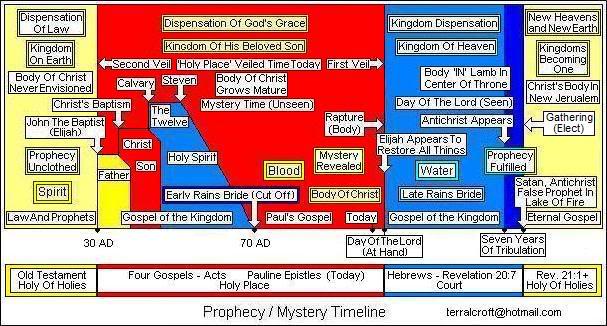
Find "Today" on the Prophecy/Mystery Timeline to realize we are living at the 'end' of the current "2000 Year Mystery Time" (in red) just prior to the start of the "1000 Year Day of the Lord" (in blue). That means we are living within the 2000 Year Time that the OT Prophets were 'not' given to see:
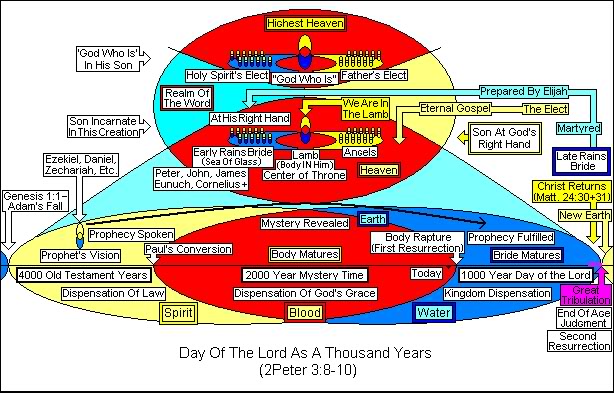
Daniel, Zechariah and Ezekiel see very clearly into the upcoming 1000 Year Day of the Lord, but they see 'nothing' inside this 2000 Year Mystery Time where God is calling members to Christ's Body (Church #2). John the Baptist, Christ and the Twelve all preached the "Gospel of the Kingdom" (Gospel #1) 2000 years ago 'and' Elijah is about to appear and begin the process of restoring 'all things' (Matt. 17:10-11) as the "prophet" of Acts 3:22-23; which includes the "Tabernacle of David" (Acts 15:16-18) shown in this diagram:
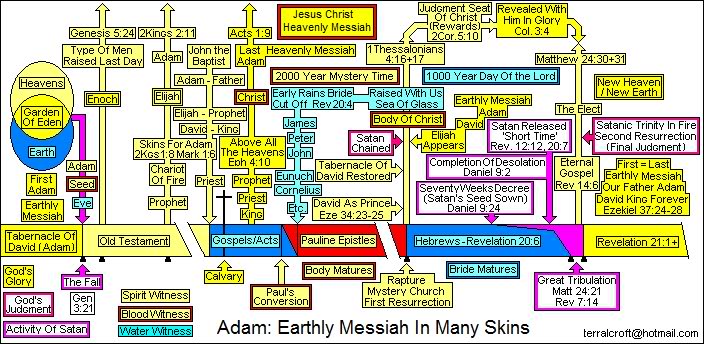
The 'Tabernacle of David' is actually the 'Tabernacle of Adam,' who just happens to be another 'skin' (Gen. 3:21) for Elijah (2Kings 1:8) and John the Baptist (Mark 1:6) and Abraham, David 'and' the coming "prophet." Elijah/David/Abraham (Adam) is coming to restore all things, which includes the hearts of the fathers to children (innocence of the garden) and the hearts of the children to their fathers (to immortality), lest this godless world inherit the 'curse' (Mal. 4:5-6). Paul teaches the Thessalonians that our mystery rapture coincides with the 'start' of the 1000 Year Day of the Lord, saying,
In Christ Jesus,
Terral
Why do you believe that 1 Thess refers to a pretribulational rapture of the Church?
You are touching on a Topic that the typical professing Christian has DEAD WRONG. The truth is so very different from the errant interpretations of those blinded by Denominationalism (Roman Catholicism, Greek Orthodoxy and Protestantism) that I have serious doubt that most of you will even begin to understand my commentary on this Rapture Topic. Paul's teaching to the Thessalonians on our mystery translation to immortality (1Cor. 15:51-53) not only includes a 'pre' Tribulation gathering to the Lord (1Thes. 4:13-17), but our mystery gathering to the Lord takes place some 1000 years 'before' the Tribulation even begins!
Find "Today" on the Prophecy/Mystery Timeline to realize we are living at the 'end' of the current "2000 Year Mystery Time" (in red) just prior to the start of the "1000 Year Day of the Lord" (in blue). That means we are living within the 2000 Year Time that the OT Prophets were 'not' given to see:
Daniel, Zechariah and Ezekiel see very clearly into the upcoming 1000 Year Day of the Lord, but they see 'nothing' inside this 2000 Year Mystery Time where God is calling members to Christ's Body (Church #2). John the Baptist, Christ and the Twelve all preached the "Gospel of the Kingdom" (Gospel #1) 2000 years ago 'and' Elijah is about to appear and begin the process of restoring 'all things' (Matt. 17:10-11) as the "prophet" of Acts 3:22-23; which includes the "Tabernacle of David" (Acts 15:16-18) shown in this diagram:
The 'Tabernacle of David' is actually the 'Tabernacle of Adam,' who just happens to be another 'skin' (Gen. 3:21) for Elijah (2Kings 1:8) and John the Baptist (Mark 1:6) and Abraham, David 'and' the coming "prophet." Elijah/David/Abraham (Adam) is coming to restore all things, which includes the hearts of the fathers to children (innocence of the garden) and the hearts of the children to their fathers (to immortality), lest this godless world inherit the 'curse' (Mal. 4:5-6). Paul teaches the Thessalonians that our mystery rapture coincides with the 'start' of the 1000 Year Day of the Lord, saying,
These Thessalonians were led astray by talk that the Day of the Lord had already started, which created the need for Paul's Second Epistle to the Thessalonians, saying:"Now as to the (A)times and the epochs (Acts 1:6-8), brethren, you (B)have no need of anything to be written to you. For you yourselves know full well that (C)the Day of the Lord will COME (D)just like a thief in the night." 1Thes. 5:1-2.
Again, Paul is connecting 'our gathering to Him' to the START (coming) of the 1000 Year Day of the Lord that still has yet to begin! We know there is no 'tribulation' for the members of Christ's Body, because Paul already told these Thessalonians to work with their hands and to live a quite life (1Thes. 4:10-12). The common mistake of most professing Christians is to connect our mystery gathering to the events of Matthew 24, when those things take place at the END of the Age still more than 1000 years in the future ..."Now we request you, (A)brethren, with regard to the (B)coming of our Lord Jesus Christ and our (C)gathering together to Him (1Thes. 4:15-17), that you not be quickly shaken from your composure or be disturbed either by a (D)spirit or a (E)message or a (F)letter as if from us, to the effect that (G)the Day of the Lord (H)HAS COME." 2Thes. 2:1-2.
In Christ Jesus,
Terral
Last edited:
Upvote
0
- May 15, 2005
- 11,935
- 1,498
- Country
- United States
- Gender
- Male
- Faith
- Christian
- Marital Status
- Married
- Politics
- CA-Conservatives
A scriptural precedent
Note: some of this was included in my first answer.
There were many prophecies that foretold the first coming of Jesus. These prophecies included not only where He would be born, but even when He would come. But the vast bulk of the Biblical scholars of Jesus’ day totally missed most of these prophecies. They missed them because they concentrated only on passages that spoke of Him as the glorious conquering Messiah, such as, “Gird Your sword upon Your thigh, O Mighty One, With Your glory and Your majesty. And in Your majesty ride prosperously because of truth, humility, and righteousness; And Your right hand shall teach You awesome things. Your arrows are sharp in the heart of the King’s enemies; The peoples fall under You.” (Psalm 45:3-5) They completely neglected other passages that spoke of Him in a completely different light, like “He was oppressed and He was afflicted, Yet He opened not His mouth; He was led as a lamb to the slaughter, And as a sheep before its shearers is silent, So He opened not His mouth. He was taken from prison and from judgment, And who will declare His generation? For He was cut off from the land of the living; For the transgressions of My people He was stricken.” (Isaiah 53:7-8)
They should have noticed the contrast between such passages. The Holy Spirit told us that the prophets who uttered them noticed it. “Of this salvation the prophets have inquired and searched carefully, who prophesied of the grace that would come to you, searching what, or what manner of time, the Spirit of Christ who was in them was indicating when He testified beforehand the sufferings of Christ and the glories that would follow.” (1 Peter 1:10-11) But these ancient scholars loved prophecies about Israel’s future glory, so they concentrated on them, neglecting the equally important prophecies about how their deliverer would suffer. Now that the suffering is over, and the rest of the Holy Scriptures have been given to us, we realize that these prophecies spoke of the same Messiah, but at different times.
Even so, many scholars of our own day neglect similar differences in various unfulfilled prophecies about our Lord’s coming. Some of these prophecies speak of His coming as a wonderful thing, full of blessing. Others speak of it as a horrible thing, full of terror. Even as the ancient scholars missed the many differences between the prophecies about His suffering and those about His glory, many modern scholars miss many similar differences between prophecies about His coming in blessing for His own, and prophecies about His coming in judgment on the wicked. Even as the earlier prophecies spoke of the same Messiah, but at different times, these unfulfilled prophecies speak of the same coming Christ, but at different times.
Isaiah 13:9 describes “the day of the Lord” as “Cruel, with both wrath and fierce anger.” Jeremiah 46:10 calls it “A day of vengeance, That He may avenge Himself on His adversaries.” Joel 2:11 says that “the day of the Lord is great and very terrible;” adding, “Who can endure it?” Malachi 3:2 expands this by saying “But who can endure the day of His coming? And who can stand when He appears? For He is like a refiner’s fire And like launderers’ soap.” And Amos 5:18-20 says “Woe to you who desire the day of the Lord! For what good is the day of the Lord to you? It will be darkness, and not light. It will be as though a man fled from a lion, And a bear met him! Or as though he went into the house, Leaned his hand on the wall, And a serpent bit him! Is not the day of the Lord darkness, and not light? Is it not very dark, with no brightness in it?” So we see that “the day of the Lord” is a “cruel” “day of vengeance,” a time so terrible that it can not be endured, that no one can stand when the Lord appears, and that there is “no brightness” in “the day of the Lord.”
This statement of “Woe to you who desire the day of the Lord” (Amos 5:18) stands in stark contrast with the statement of 2 Timothy 4:8 that the Lord will give “the crown of righteousness” to all who “have loved His appearing.” The questions “who can endure the day of His coming? And who can stand when He appears?” (Malachi 3:2) are radically different from the exhortation in Titus 2:13 that we should be “looking for the blessed hope and glorious appearing of our great God and Savior Jesus Christ.” They are also radically different from the statement of Hebrews 9:28 that “To those who eagerly wait for Him He will appear a second time, apart from sin, for salvation.” This contrast becomes even more stark when we compare the description of “the day of the Lord” as “Cruel, with both wrath and fierce anger” (Isaiah 13:9) with the words “Therefore comfort one another with these words” at the end of the passage describing our Lord’s coming for his own. (1 Thessalonians 4:18)
But these contrasts are not the only differences between the unfulfilled prophecies about our Lord’s coming. There are also significant differences in various details contained in these prophecies.
The best known of these is that Jesus said, “Watch therefore, for you know neither the day nor the hour in which the Son of Man is coming.” (Matthew 25:13) He also said “But of that day and hour no one knows, not even the angels in heaven, nor the Son, but only the Father.” (Mark 13:32) But in Daniel12:11 the prophet was told that “from the time that the daily sacrifice is taken away, and the abomination of desolation is set up, there shall be one thousand two hundred and ninety days.” Now these are diametrically opposed concepts. Even the Lord Jesus Himself (speaking as a man) did not know the day or the hour of His coming. But even as a man He already had the scripture which specifically stated that He would come “one thousand two hundred and ninety days” after “the time that the daily sacrifice is taken away, and the abomination of desolation is set up.” Thus we see that these two scriptures speak of different events that take place at different times.
The coming of the Lord in blessing for His own is described in the following words: “For the Lord Himself will descend from heaven with a shout, with the voice of an archangel, and with the trumpet of God. And the dead in Christ will rise first. Then we who are alive and remain shall be caught up together with them in the clouds to meet the Lord in the air. And thus we shall always be with the Lord. Therefore comfort one another with these words.” (1 Thessalonians 4:16-18)
Here “the Lord Himself will descend from heaven with a shout” to gather his own to himself. He comes “with the voice of an archangel,” but no angels are mentioned. But in Matthew 25:31 “the Son of Man comes in His glory, and all the holy angels with Him.” Again, although 1 Thessalonians 4:16 plainly says that it is “the Lord Himself” who will come for us, Matthew 24:31 just as plainly says that “He will send His angels with a great sound of a trumpet, and they will gather together His elect from the four winds, from one end of heaven to the other.” In one case, “we” are “caught up” by “the Lord Himself” and in the other “His elect.” are gathered by “His angels.” (And as we have seen, this is after these same angels have gathered the wicked “and cast them into the furnace of fire.” - Matthew 13:50)
Again, 1 Thessalonians 4:17 plainly states that at the time when our Lord comes for us we “shall be caught up together with them in the clouds to meet the Lord in the air.” But when he comes in judgment on the wicked “His feet will stand on the Mount of Olives.” (Zechariah 14:4) In the first case, He meets His own “in the air.” But in the second case we are expressly told that “His feet will stand on the Mount of Olives.” Meeting us “In the air” is significantly different from standing “on the Mount of Olives.”
Again, Revelation 1:7 says,“Behold, He is coming with clouds, and every eye will see Him, even they who pierced Him. And all the tribes of the earth will mourn because of Him. Even so, Amen.” But 1 Corinthians 15:51-52 says, “Behold, I tell you a mystery: We shall not all sleep, but we shall all be changed—in a moment, in the twinkling of an eye, at the last trumpet. For the trumpet will sound, and the dead will be raised incorruptible, and we shall be changed.” There is no way that “every eye” could see something that will take place “in a moment, in the twinkling of an eye.”
All these are indeed material differences between various unfulfilled prophecies about our Lord’s coming But there is one that overshadows all the rest of them. In the parable of the ten virgins (Matthew 25:1-12) we read that “the bridegroom came, and those who were ready went in with him to the wedding; and the door was shut. Afterward the other virgins came also, saying, ‘Lord, Lord, open to us!’ But he answered and said, ‘Assuredly, I say to you, I do not know you.’” (Matthew 25:10-12) here we plainly see the righteous taken into the Lord’s presence while the wicked are left outside a door that remains closed in spite of their pleading.
But in the parable of the wheat and the tares (Matthew 13:24-30) we read that at the time of harvest the owner of the field will say, “First gather together the tares and bind them in bundles to burn them, but gather the wheat into my barn.” (Matthew 13:30) In the explanation of this parable (Matthew 13:37-43) Jesus said this meant that “The Son of Man will send out His angels, and they will gather out of His kingdom all things that offend, and those who practice lawlessness, and will cast them into the furnace of fire. There will be wailing and gnashing of teeth. Then the righteous will shine forth as the sun in the kingdom of their Father. ” (Matthew 13:41-43) He then added that “Again, the kingdom of heaven is like a dragnet that was cast into the sea and gathered some of every kind, which, when it was full, they drew to shore; and they sat down and gathered the good into vessels, but threw the bad away. So it will be at the end of the age. The angels will come forth, separate the wicked from among the just, and cast them into the furnace of fire. There will be wailing and gnashing of teeth.” (Matthew 13:47-50)
Now this is radically different from the scene presented in Matthew 25. In Matthew 13, the wicked are taken from among the righteous. In Matthew 25, the righteous are taken from among the wicked. In Matthew 13, the wicked are removed and cast into the fire. In Matthew 25, the wicked remain, but are given no further chance to repent.
This fact that they are given no further chance to repent is stressed in 2 Thessalonians 2:9-12, where we read that “The coming of the lawless one is according to the working of Satan, with all power, signs, and lying wonders, and with all unrighteous deception among those who perish, because they did not receive the love of the truth, that they might be saved. And for this reason God will send them strong delusion, that they should believe the lie, that they all may be condemned who did not believe the truth but had pleasure in unrighteousness.” The reason for this is distinctly stated. God will do this as a punishment “because they did not receive the love of the truth,” that is, because they did not wish to know the truth. This awful punishment is because, instead of receiving the truth, they “had pleasure in unrighteousness.” Nor is this only stated in the New Testament. We see it again in the last chapter of Isaiah, where we read, “Just as they have chosen their own ways, And their soul delights in their abominations, So will I choose their delusions, And bring their fears on them; Because, when I called, no one answered, When I spoke they did not hear; But they did evil before My eyes, And chose that in which I do not delight.” (Isaiah 66:3-4) So the scriptures clearly teach that there is a time coming in which those who had previously rejected the gospel will have no more chance to repent. This is in perfect keeping with the statement of Matthew 25:10 that “the door was shut” after “the bridegroom came, and those who were ready went in with him to the wedding.” It is also in perfect keeping with the statement of Matthew 25:11-12 that “Afterward the other virgins came also, saying, ‘Lord, Lord, open to us!’ But he answered and said, ‘Assuredly, I say to you, I do not know you.’” This parable clearly shows that there will be those that seek a relationship with the bridegroom after He has come. But at that time it will be too late. 2 Thessalonians 2:9-12 clearly states that at that time, those that had previously rejected God’s word will be turned over to believe “the lie.” And Isaiah 66:3-4 just as clearly states that at that time God “will choose their delusions.” The time being spoken of here is plainly the time we call the tribulation. But it takes place after “the bridegroom came, and those who were ready went in with him to the wedding.”
Again we read in John 14:2-3, “In my Father’s house are many mansions: if it were not so, I would have told you. I go to prepare a place for you. And if I go and prepare a place for you, I will come again, and receive you unto myself; that where I am, there ye may be also.” But we also read in Jude 14-15, “Behold, the Lord comes with ten thousands of His saints, to execute judgment on all, to convict all who are ungodly among them of all their ungodly deeds which they have committed in an ungodly way, and of all the harsh things which ungodly sinners have spoken against Him.” (Jude 14-15)
In the first of these, our Lord says “I will come again, and receive you to myself.” In the second, “the Lord comes with ten thousands of His saints.” In the first passage He comes to receive His own to Himself. In the second one He comes with them, for He “comes with ten thousands of His saints.” If He is going to come for His own and He is also going to come with them, He has to come for them before He can come with them. This is a simple matter of the meaning of words. No other interpretation is possible. These two scriptures, in and by themselves, do not indicate how long the delay between these two incidents might be, but they clearly indicate a sequence of events. Many imagine that this sequence is simply that He meets us on the way down, and then continues on down to the mount of Olives to execute judgment on the wicked. But this interpretation does not fit the scriptures we have already examined.
(continued)
Note: some of this was included in my first answer.
There were many prophecies that foretold the first coming of Jesus. These prophecies included not only where He would be born, but even when He would come. But the vast bulk of the Biblical scholars of Jesus’ day totally missed most of these prophecies. They missed them because they concentrated only on passages that spoke of Him as the glorious conquering Messiah, such as, “Gird Your sword upon Your thigh, O Mighty One, With Your glory and Your majesty. And in Your majesty ride prosperously because of truth, humility, and righteousness; And Your right hand shall teach You awesome things. Your arrows are sharp in the heart of the King’s enemies; The peoples fall under You.” (Psalm 45:3-5) They completely neglected other passages that spoke of Him in a completely different light, like “He was oppressed and He was afflicted, Yet He opened not His mouth; He was led as a lamb to the slaughter, And as a sheep before its shearers is silent, So He opened not His mouth. He was taken from prison and from judgment, And who will declare His generation? For He was cut off from the land of the living; For the transgressions of My people He was stricken.” (Isaiah 53:7-8)
They should have noticed the contrast between such passages. The Holy Spirit told us that the prophets who uttered them noticed it. “Of this salvation the prophets have inquired and searched carefully, who prophesied of the grace that would come to you, searching what, or what manner of time, the Spirit of Christ who was in them was indicating when He testified beforehand the sufferings of Christ and the glories that would follow.” (1 Peter 1:10-11) But these ancient scholars loved prophecies about Israel’s future glory, so they concentrated on them, neglecting the equally important prophecies about how their deliverer would suffer. Now that the suffering is over, and the rest of the Holy Scriptures have been given to us, we realize that these prophecies spoke of the same Messiah, but at different times.
Even so, many scholars of our own day neglect similar differences in various unfulfilled prophecies about our Lord’s coming. Some of these prophecies speak of His coming as a wonderful thing, full of blessing. Others speak of it as a horrible thing, full of terror. Even as the ancient scholars missed the many differences between the prophecies about His suffering and those about His glory, many modern scholars miss many similar differences between prophecies about His coming in blessing for His own, and prophecies about His coming in judgment on the wicked. Even as the earlier prophecies spoke of the same Messiah, but at different times, these unfulfilled prophecies speak of the same coming Christ, but at different times.
Isaiah 13:9 describes “the day of the Lord” as “Cruel, with both wrath and fierce anger.” Jeremiah 46:10 calls it “A day of vengeance, That He may avenge Himself on His adversaries.” Joel 2:11 says that “the day of the Lord is great and very terrible;” adding, “Who can endure it?” Malachi 3:2 expands this by saying “But who can endure the day of His coming? And who can stand when He appears? For He is like a refiner’s fire And like launderers’ soap.” And Amos 5:18-20 says “Woe to you who desire the day of the Lord! For what good is the day of the Lord to you? It will be darkness, and not light. It will be as though a man fled from a lion, And a bear met him! Or as though he went into the house, Leaned his hand on the wall, And a serpent bit him! Is not the day of the Lord darkness, and not light? Is it not very dark, with no brightness in it?” So we see that “the day of the Lord” is a “cruel” “day of vengeance,” a time so terrible that it can not be endured, that no one can stand when the Lord appears, and that there is “no brightness” in “the day of the Lord.”
This statement of “Woe to you who desire the day of the Lord” (Amos 5:18) stands in stark contrast with the statement of 2 Timothy 4:8 that the Lord will give “the crown of righteousness” to all who “have loved His appearing.” The questions “who can endure the day of His coming? And who can stand when He appears?” (Malachi 3:2) are radically different from the exhortation in Titus 2:13 that we should be “looking for the blessed hope and glorious appearing of our great God and Savior Jesus Christ.” They are also radically different from the statement of Hebrews 9:28 that “To those who eagerly wait for Him He will appear a second time, apart from sin, for salvation.” This contrast becomes even more stark when we compare the description of “the day of the Lord” as “Cruel, with both wrath and fierce anger” (Isaiah 13:9) with the words “Therefore comfort one another with these words” at the end of the passage describing our Lord’s coming for his own. (1 Thessalonians 4:18)
But these contrasts are not the only differences between the unfulfilled prophecies about our Lord’s coming. There are also significant differences in various details contained in these prophecies.
The best known of these is that Jesus said, “Watch therefore, for you know neither the day nor the hour in which the Son of Man is coming.” (Matthew 25:13) He also said “But of that day and hour no one knows, not even the angels in heaven, nor the Son, but only the Father.” (Mark 13:32) But in Daniel12:11 the prophet was told that “from the time that the daily sacrifice is taken away, and the abomination of desolation is set up, there shall be one thousand two hundred and ninety days.” Now these are diametrically opposed concepts. Even the Lord Jesus Himself (speaking as a man) did not know the day or the hour of His coming. But even as a man He already had the scripture which specifically stated that He would come “one thousand two hundred and ninety days” after “the time that the daily sacrifice is taken away, and the abomination of desolation is set up.” Thus we see that these two scriptures speak of different events that take place at different times.
The coming of the Lord in blessing for His own is described in the following words: “For the Lord Himself will descend from heaven with a shout, with the voice of an archangel, and with the trumpet of God. And the dead in Christ will rise first. Then we who are alive and remain shall be caught up together with them in the clouds to meet the Lord in the air. And thus we shall always be with the Lord. Therefore comfort one another with these words.” (1 Thessalonians 4:16-18)
Here “the Lord Himself will descend from heaven with a shout” to gather his own to himself. He comes “with the voice of an archangel,” but no angels are mentioned. But in Matthew 25:31 “the Son of Man comes in His glory, and all the holy angels with Him.” Again, although 1 Thessalonians 4:16 plainly says that it is “the Lord Himself” who will come for us, Matthew 24:31 just as plainly says that “He will send His angels with a great sound of a trumpet, and they will gather together His elect from the four winds, from one end of heaven to the other.” In one case, “we” are “caught up” by “the Lord Himself” and in the other “His elect.” are gathered by “His angels.” (And as we have seen, this is after these same angels have gathered the wicked “and cast them into the furnace of fire.” - Matthew 13:50)
Again, 1 Thessalonians 4:17 plainly states that at the time when our Lord comes for us we “shall be caught up together with them in the clouds to meet the Lord in the air.” But when he comes in judgment on the wicked “His feet will stand on the Mount of Olives.” (Zechariah 14:4) In the first case, He meets His own “in the air.” But in the second case we are expressly told that “His feet will stand on the Mount of Olives.” Meeting us “In the air” is significantly different from standing “on the Mount of Olives.”
Again, Revelation 1:7 says,“Behold, He is coming with clouds, and every eye will see Him, even they who pierced Him. And all the tribes of the earth will mourn because of Him. Even so, Amen.” But 1 Corinthians 15:51-52 says, “Behold, I tell you a mystery: We shall not all sleep, but we shall all be changed—in a moment, in the twinkling of an eye, at the last trumpet. For the trumpet will sound, and the dead will be raised incorruptible, and we shall be changed.” There is no way that “every eye” could see something that will take place “in a moment, in the twinkling of an eye.”
All these are indeed material differences between various unfulfilled prophecies about our Lord’s coming But there is one that overshadows all the rest of them. In the parable of the ten virgins (Matthew 25:1-12) we read that “the bridegroom came, and those who were ready went in with him to the wedding; and the door was shut. Afterward the other virgins came also, saying, ‘Lord, Lord, open to us!’ But he answered and said, ‘Assuredly, I say to you, I do not know you.’” (Matthew 25:10-12) here we plainly see the righteous taken into the Lord’s presence while the wicked are left outside a door that remains closed in spite of their pleading.
But in the parable of the wheat and the tares (Matthew 13:24-30) we read that at the time of harvest the owner of the field will say, “First gather together the tares and bind them in bundles to burn them, but gather the wheat into my barn.” (Matthew 13:30) In the explanation of this parable (Matthew 13:37-43) Jesus said this meant that “The Son of Man will send out His angels, and they will gather out of His kingdom all things that offend, and those who practice lawlessness, and will cast them into the furnace of fire. There will be wailing and gnashing of teeth. Then the righteous will shine forth as the sun in the kingdom of their Father. ” (Matthew 13:41-43) He then added that “Again, the kingdom of heaven is like a dragnet that was cast into the sea and gathered some of every kind, which, when it was full, they drew to shore; and they sat down and gathered the good into vessels, but threw the bad away. So it will be at the end of the age. The angels will come forth, separate the wicked from among the just, and cast them into the furnace of fire. There will be wailing and gnashing of teeth.” (Matthew 13:47-50)
Now this is radically different from the scene presented in Matthew 25. In Matthew 13, the wicked are taken from among the righteous. In Matthew 25, the righteous are taken from among the wicked. In Matthew 13, the wicked are removed and cast into the fire. In Matthew 25, the wicked remain, but are given no further chance to repent.
This fact that they are given no further chance to repent is stressed in 2 Thessalonians 2:9-12, where we read that “The coming of the lawless one is according to the working of Satan, with all power, signs, and lying wonders, and with all unrighteous deception among those who perish, because they did not receive the love of the truth, that they might be saved. And for this reason God will send them strong delusion, that they should believe the lie, that they all may be condemned who did not believe the truth but had pleasure in unrighteousness.” The reason for this is distinctly stated. God will do this as a punishment “because they did not receive the love of the truth,” that is, because they did not wish to know the truth. This awful punishment is because, instead of receiving the truth, they “had pleasure in unrighteousness.” Nor is this only stated in the New Testament. We see it again in the last chapter of Isaiah, where we read, “Just as they have chosen their own ways, And their soul delights in their abominations, So will I choose their delusions, And bring their fears on them; Because, when I called, no one answered, When I spoke they did not hear; But they did evil before My eyes, And chose that in which I do not delight.” (Isaiah 66:3-4) So the scriptures clearly teach that there is a time coming in which those who had previously rejected the gospel will have no more chance to repent. This is in perfect keeping with the statement of Matthew 25:10 that “the door was shut” after “the bridegroom came, and those who were ready went in with him to the wedding.” It is also in perfect keeping with the statement of Matthew 25:11-12 that “Afterward the other virgins came also, saying, ‘Lord, Lord, open to us!’ But he answered and said, ‘Assuredly, I say to you, I do not know you.’” This parable clearly shows that there will be those that seek a relationship with the bridegroom after He has come. But at that time it will be too late. 2 Thessalonians 2:9-12 clearly states that at that time, those that had previously rejected God’s word will be turned over to believe “the lie.” And Isaiah 66:3-4 just as clearly states that at that time God “will choose their delusions.” The time being spoken of here is plainly the time we call the tribulation. But it takes place after “the bridegroom came, and those who were ready went in with him to the wedding.”
Again we read in John 14:2-3, “In my Father’s house are many mansions: if it were not so, I would have told you. I go to prepare a place for you. And if I go and prepare a place for you, I will come again, and receive you unto myself; that where I am, there ye may be also.” But we also read in Jude 14-15, “Behold, the Lord comes with ten thousands of His saints, to execute judgment on all, to convict all who are ungodly among them of all their ungodly deeds which they have committed in an ungodly way, and of all the harsh things which ungodly sinners have spoken against Him.” (Jude 14-15)
In the first of these, our Lord says “I will come again, and receive you to myself.” In the second, “the Lord comes with ten thousands of His saints.” In the first passage He comes to receive His own to Himself. In the second one He comes with them, for He “comes with ten thousands of His saints.” If He is going to come for His own and He is also going to come with them, He has to come for them before He can come with them. This is a simple matter of the meaning of words. No other interpretation is possible. These two scriptures, in and by themselves, do not indicate how long the delay between these two incidents might be, but they clearly indicate a sequence of events. Many imagine that this sequence is simply that He meets us on the way down, and then continues on down to the mount of Olives to execute judgment on the wicked. But this interpretation does not fit the scriptures we have already examined.
(continued)
Last edited:
Upvote
0
- May 15, 2005
- 11,935
- 1,498
- Country
- United States
- Gender
- Male
- Faith
- Christian
- Marital Status
- Married
- Politics
- CA-Conservatives
A scriptural precedent - part 2
Note: some of this was included in my first answer.
Looking again at John 14:2-3, we read, “In my Father’s house are many mansions: if it were not so, I would have told you. I go to prepare a place for you. And if I go and prepare a place for you, I will come again, and receive you unto myself; that where I am, there ye may be also.”
In this scripture, our Lord first refers to His Father’s house, saying “In my Father’s house are many mansions.” He then says that he is going there “to prepare a place for you.” From this statement it is explicitly plain that the place to which He was going “to prepare a place for you” was His “Father’s house.” But He said He was going there “to prepare a place for you” He was going to His “Father’s house,” “to prepare a place for you.” And that is the place from which he “will come again, and receive you unto myself.” But what is the purpose of this coming? “That where I am, there ye may be also.” This scripture does not present a picture of coming, picking us up along the way, and taking us with Himself to another place. It presents a picture of coming to get us and taking us back to where he came from, that is, His “Father’s house.” That is where He has gone “to prepare a place” for us. That is where He is, and that is where he will take us, for the stated purpose of this coming is “that where I am, there you may be also.”
We have seen that a comparison between John 14:2-3 and Jude 14-15 makes it clear that there is a delay between these two events, but does not indicate how long that delay will be. Other scriptures give an indication of how long this will be. The most significant of these is “Because you have kept My command to persevere, I also will keep you from the hour of trial which shall come upon the whole world, to test those who dwell on the earth.” (Revelation 3:10) The Greek word translated from in this passage is ek (word number 1537 in Strong’s Greek Dictionary.) Strong defines this word as follows: “A primary preposition denoting origin (the point whence motion or action proceeds), from, out (of place, time or cause; literally or figuratively; direct or remote)” Thayer defines it as “out of, from, by, away from.” Other Greek references give similar definitions. In addition to the NKJV version of the Bible, which we are using, we find the same rendering of this Greek word in the KJV, the ASV, the CEV, the ESV, the HCSB, the NASB, the NLT, the NRSV, the RSV, and the TEV versions of the Bible and the ISVNT version of the New Testament. Some pretend that in this passage, ek actually means through, in, or during, but in the face of such strong evidence, such a claim is hard to defend.
In addition, we need to take into account what we were promised to be kept from. The promise was, “I... will keep you from the hour of trial.” There is a coming “hour of trial.” But these who “have kept” our Lord’s “command to persevere”will be kept “from,” that is, out of, that “hour.” We are not promised that we will be kept out of the trial, but out of the “hour,” that is, the time, in which this trial will take place.
This “hour of trial” “shall come upon the whole world.” the Greek word translated whole here is holos (word number 3650 in Strong’s Greek dictionary.) Strong defines this word as follows: “A primary word; ‘whole; or ‘all’, that is, complete (in extent, amount, time or degree), especially (neuter) as noun or adverb.” Thayer defines it simply as “all, whole, completely.” There can be no question that in this passage, this Greek word means the entire world, all of it, not just part of it. This “hour of trial”, that is, this time of testing, “shall come upon the whole world.” But the Lord’s own are promised to be kept out of it. This shows us that the delay between the Lord’s coming for his own and his coming with them is at least as long as this “hour of trial,” for if it “shall come upon the whole world” but we are kept out of it, our removal from the world has to before that “hour of trial.”
Now many produce various arguments to prove that this conclusion is incorrect. But essentially every argument they produce is one that fails to take into account these marked differences between the scriptures about our Lord’s coming in vengeance to judge the world and his coming in blessing to receive His own to Himself. Many insist that there is no such distinction. But as we have seen, there are numerous such distinctions, and that in some cases they are very extreme. There is no logical conclusion except that these distinctions indicate that the unfulfilled prophecies about the future coming of Christ follow the precedent established in the Old Testament scriptures of showing, even though not stating, that there would be more than one future coming of Christ.
Note: some of this was included in my first answer.
Looking again at John 14:2-3, we read, “In my Father’s house are many mansions: if it were not so, I would have told you. I go to prepare a place for you. And if I go and prepare a place for you, I will come again, and receive you unto myself; that where I am, there ye may be also.”
In this scripture, our Lord first refers to His Father’s house, saying “In my Father’s house are many mansions.” He then says that he is going there “to prepare a place for you.” From this statement it is explicitly plain that the place to which He was going “to prepare a place for you” was His “Father’s house.” But He said He was going there “to prepare a place for you” He was going to His “Father’s house,” “to prepare a place for you.” And that is the place from which he “will come again, and receive you unto myself.” But what is the purpose of this coming? “That where I am, there ye may be also.” This scripture does not present a picture of coming, picking us up along the way, and taking us with Himself to another place. It presents a picture of coming to get us and taking us back to where he came from, that is, His “Father’s house.” That is where He has gone “to prepare a place” for us. That is where He is, and that is where he will take us, for the stated purpose of this coming is “that where I am, there you may be also.”
We have seen that a comparison between John 14:2-3 and Jude 14-15 makes it clear that there is a delay between these two events, but does not indicate how long that delay will be. Other scriptures give an indication of how long this will be. The most significant of these is “Because you have kept My command to persevere, I also will keep you from the hour of trial which shall come upon the whole world, to test those who dwell on the earth.” (Revelation 3:10) The Greek word translated from in this passage is ek (word number 1537 in Strong’s Greek Dictionary.) Strong defines this word as follows: “A primary preposition denoting origin (the point whence motion or action proceeds), from, out (of place, time or cause; literally or figuratively; direct or remote)” Thayer defines it as “out of, from, by, away from.” Other Greek references give similar definitions. In addition to the NKJV version of the Bible, which we are using, we find the same rendering of this Greek word in the KJV, the ASV, the CEV, the ESV, the HCSB, the NASB, the NLT, the NRSV, the RSV, and the TEV versions of the Bible and the ISVNT version of the New Testament. Some pretend that in this passage, ek actually means through, in, or during, but in the face of such strong evidence, such a claim is hard to defend.
In addition, we need to take into account what we were promised to be kept from. The promise was, “I... will keep you from the hour of trial.” There is a coming “hour of trial.” But these who “have kept” our Lord’s “command to persevere”will be kept “from,” that is, out of, that “hour.” We are not promised that we will be kept out of the trial, but out of the “hour,” that is, the time, in which this trial will take place.
This “hour of trial” “shall come upon the whole world.” the Greek word translated whole here is holos (word number 3650 in Strong’s Greek dictionary.) Strong defines this word as follows: “A primary word; ‘whole; or ‘all’, that is, complete (in extent, amount, time or degree), especially (neuter) as noun or adverb.” Thayer defines it simply as “all, whole, completely.” There can be no question that in this passage, this Greek word means the entire world, all of it, not just part of it. This “hour of trial”, that is, this time of testing, “shall come upon the whole world.” But the Lord’s own are promised to be kept out of it. This shows us that the delay between the Lord’s coming for his own and his coming with them is at least as long as this “hour of trial,” for if it “shall come upon the whole world” but we are kept out of it, our removal from the world has to before that “hour of trial.”
Now many produce various arguments to prove that this conclusion is incorrect. But essentially every argument they produce is one that fails to take into account these marked differences between the scriptures about our Lord’s coming in vengeance to judge the world and his coming in blessing to receive His own to Himself. Many insist that there is no such distinction. But as we have seen, there are numerous such distinctions, and that in some cases they are very extreme. There is no logical conclusion except that these distinctions indicate that the unfulfilled prophecies about the future coming of Christ follow the precedent established in the Old Testament scriptures of showing, even though not stating, that there would be more than one future coming of Christ.
Last edited:
Upvote
0
Hi Biblewriter:
Like I said in starting Post #4, most people writing on this 'mystery' rapture topic have things DEAD WRONG. The primary reason most people get the Rapture Topic WRONG is because they do not know the differences between the Fulfillment of "Prophecy" (seen) and the Revelation of "The Mystery" that remained unseen by ALL the OT Prophets. Paul connects our Gathering to the Lord (1Thes. 4:15-17) to 'The Mystery,' saying,
If you will read the Greek definition of the term 'mystery' (mysterion), then perhaps you will realize that God Himself must tap you on the shoulder at the appropriate 'time' for the things pertaining to 'the mystery' to become known to you.
In Christ Jesus,
Terral
There are many reasons we believe this. Two of the strongest of them are given here:
First, Jesus said;
“I go to prepare a place for you. And if I go and prepare a place for you, I will come again and receive you to Myself; that where I am, there you may be also.” (John 14:2-3)
But Enoch said ...
Like I said in starting Post #4, most people writing on this 'mystery' rapture topic have things DEAD WRONG. The primary reason most people get the Rapture Topic WRONG is because they do not know the differences between the Fulfillment of "Prophecy" (seen) and the Revelation of "The Mystery" that remained unseen by ALL the OT Prophets. Paul connects our Gathering to the Lord (1Thes. 4:15-17) to 'The Mystery,' saying,
Our Rapture to the Lord is "according to the revelation of THE MYSTERY," just like our Gospel (#2) and our mystery Church (#2). This means that nobody in the OT saw our mystery translation to immortality 'and' that means Jesus Christ never mentions our mystery rapture to anyone in the Four Gospels! The mystery was given TO PAUL ("to me" = Eph. 3:3), which Peter calls "the wisdom given him" that many here are distorting to 'their own destruction' (2Peter 3:14-16)! There is NOTHING in the Gospel of John or in the Old Testament describing our mystery Rapture to immortality. The ONLY Bible writer that gives information about our mystery Rapture is PAUL. Period!"Behold, I tell you a (A)mystery; 'we' (believers in Gospel #2) will not all sleep, but 'we' (believers in Gospel #2) will all be (B)changed, in a moment, in the twinkling of an eye, at the last trumpet; for (C)the trumpet will sound, and (D)the dead will be raised imperishable, and (E)we will be changed. For this perishable must put on (F)the imperishable, and this (G)mortal must put on immortality." 1Cor. 15:51-53.
If you will read the Greek definition of the term 'mystery' (mysterion), then perhaps you will realize that God Himself must tap you on the shoulder at the appropriate 'time' for the things pertaining to 'the mystery' to become known to you.
Everyone trying to connect our 'mystery' rapture to ANY Old Testament Prophet is DEAD WRONG, because these things remained HIDDEN from them; until they were revealed TO PAUL from our Risen Lord in HEAVEN. End of story. Our Mystery Rapture takes place some 1000 Years BEFORE the Great Tribulation of Matthew 24, because the 1000 Year Day of the Lord must BEGIN, before it can END (Matt. 24) some 1000 years in the future."In the NT it denotes, not the mysterious (as with the Eng. word), but that which, being outside the range of unassisted natural apprehension, can be made known only by Divine revelation, and is made known in a manner and AT A TIME appointed by God, and to those only who are illumined by His Spirit. In the ordinary sense a "mystery" implies knowledge withheld; its Scriptural significance is truth revealed. Hence the terms especially associated with the subject are "made known," "manifested," "revealed," "preached," "understand," "dispensation." Vines Expository Dictionary of NT Words.
In Christ Jesus,
Terral
Last edited:
Upvote
0
Hismessenger
Senior Member
My question to the rapture is this, Why is it that so many disregard those who died in Christ long before the rapture is to occur and why can it not be seen that they are with the Lord already. Look at Moses and Elijah appearing with Christ on the mount of transfiguration. Why can it not be seen that they can be the ones who come with Him to collect the church saints in the end and it not be the church saints raptured and coming back to earth again. Why the great flight of fancy and jump to an unsubstantiated claim about the church.
hismessenger
hismessenger
Upvote
0
- May 15, 2005
- 11,935
- 1,498
- Country
- United States
- Gender
- Male
- Faith
- Christian
- Marital Status
- Married
- Politics
- CA-Conservatives
My question to the rapture is this, Why is it that so many disregard those who died in Christ long before the rapture is to occur and why can it not be seen that they are with the Lord already. Look at Moses and Elijah appearing with Christ on the mount of transfiguration. Why can it not be seen that they can be the ones who come with Him to collect the church saints in the end and it not be the church saints raptured and coming back to earth again. Why the great flight of fancy and jump to an unsubstantiated claim about the church.
hismessenger
The pre-tribulation rapture is neither a flight of fantasy nor an unsubstantiated claim. It is based on clearly stated scriptures.
The post-trib position is based on an unprovable assumption that the various terms used to describe a future coming of the Lord are all synonyms. The pre-trib position is based on an understanding that these varying terms are used because there is more than one future coming of the Lord described in scripture. Post-tribbers deny this, but I have never seen an even apparently successful attempt to demonstrate error in the argument presented in my two part article titled "A Scriptural Precedent" and presented as posts 5 and 6 in this thread.
Upvote
0
Hismessenger
Senior Member
So you totally ignore the millions of saints who have already died for a propped up belief that the church has to be the saints coming back with Christ for the final judgment. Seems rather ludicrous to me. It can't be that the already dead come with him to gather those alive at his coming. That seems just to simple to believe I guess.
hismessenger
hismessenger
Upvote
0

Aibrean
Honest. Maybe too Honest.
- Mar 18, 2007
- 6,298
- 347
- 42
- Faith
- Lutheran
- Marital Status
- Married
- Politics
- US-Constitution
I don't believe in any secret "rapture". I believe that Jesus will gather the saints at the last day.
I've discussed here: http://www.christianforums.com/t7457610/
I've discussed here: http://www.christianforums.com/t7457610/
Upvote
0
Hi His:
In other words, His is here to derail the OP Topic with a myriad of 'why' questions. Those who die in Christ are raised first (1Cor. 15:51, 1Thes. 4:16), THEN we see:
The dead in Christ 'are' in Christ, but they have yet to be raised. Everyone dying in Christ 2000 years ago to today will wake up at our mystery gathering as if sleeping for a single night. We are waiting to be raised when the 1000 Year Day of the Lord ... 'begins' ...
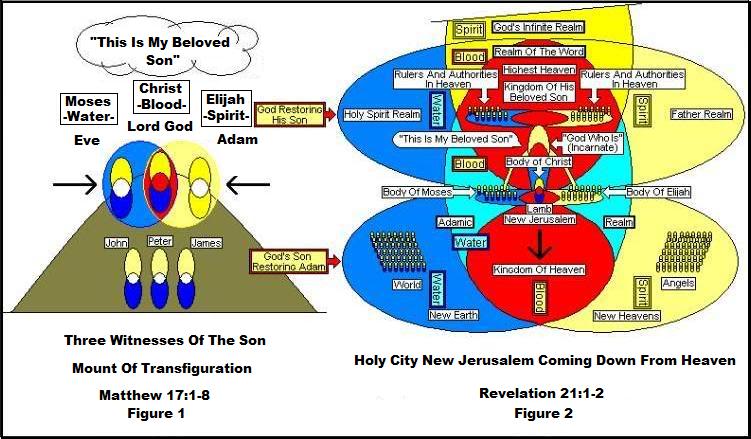
Moses and Elijah appear with Christ on the Mount of Transfiguration (Matt. 17:1-8), because these are the 'three' Begottens from the Garden of Eden. Moses is another 'skin' (Gen. 3:21) for your mother Eve (like Noah, Sarah, Bathsheba) and Elijah is another 'skin' for your father Adam (like Abraham, Joshua, David and John the Baptist). Adam and Eve are the two olive trees (human) and lampstands (angels) that "are standing by the Lord of the whole earth" (Zech. 4:14). The 'Body of Moses/Eve' (Jude 1:9 = 1Cor. 10:1-5) includes 'men' (All Living!) and the 'Body of Elijah/Adam' contains all the angels, as their greater super-halves. Rejoining the men and their angel half is what obtaining 'immortality' is all about 'and' this why why our mystery church judges the world (men) and the angels. 1Cor. 6:2-3.

The truth on this matter is a bit complicated, but here goes: The very first Scriptural verse where Adam and Eve walk this earth in human 'skins' is in Genesis 3:21!!!!! Adam was a heavenly host in Genesis 2:7 living in Paradise (before the Lamb) with Eve and her seed very much IN him.
Starting from the left: The Garden of Eden is a 'heavenly' abode standing between the heavens (invisible universe) and the earth (visible universe) and the garden pair are 'heavenly hosts,' until the fall forces them to earth in Genesis 3:21. The Lord God (Christ) then sends His olive trees in human skins as Noah (Eve) and Abraham (Adam) and Sarah (Eve) and Moses (Eve) and Joshua (Adam) and Elijah (Adam) and David (Adam) and Bathsheba (Eve) with a 'prophecy' of Elijah/Adam's return to end the Old Testament (Mal. 3:1, 4:5-6). John the Baptist is definitely another 'skin' (Mark 1:6 = like Elijah = 2Kings 1:8) for your father Adam, as Christ Himself (the Lord God) testifies in Matthew 11:14 and Matthew 17:12. However, John the Baptist denies being Elijah (John 1:21), because Elijah is just another skin for 'his' true identity (Adam).
Peter prophesies using the words of Moses/Eve that the 'prophet' is coming (Acts 3:22-23) 'and' David's words (Adam's words) are used to declare that the "Tabernacle of David/Adam" will indeed be restored (Acts 15:16-18). However (this is the important part), the "Messiah" of Daniel 9:24-27 is the incarnation of your father Adam 'and' your mother Eve in one 'prophet' from God!!!! That is right! The 1000 Year Day of the Lord is going to 'begin' with the appearance of this 'prophet' that is the two olive trees/lampstands in one man from God, which represents Adam as a 'singularity' BEFORE Eve was taken from his side! The Messiah (Adam/David/Elijah) will be 'cut off' (Dan. 9:26) in the sixty-second week (Dan. 9:25), which is about 56 years from the END of the Age (see diagram again). That is how your father Adam and your mother Eve return to heaven, BEFORE they are sent again as the 'two witnesses' of Revelation 11!!!
The Beast then kills Adam and Eve (Elijah and Moses) and they remain dead for the 3.5 days, before resurrecting from the dead and returning to heaven in order return on the clouds in Matthew 24:30-31 'with' the Body of Christ (that's us) that has been with the Lord since the 1000 Year Day of the Lord began about 1000 years earlier. The Body of Christ is the 'kings/rulers/judges,' while the Bride of Christ (Peter, John, James, etc.) are the Kingdom of Priests making intercession before the throne of the Lamb. The 'Elect' of Matthew 24:30-31 are the inhabitants of heaven having nothing to do with either the rulers (body of Christ) or the priests (bride of Christ) already called and gathered for our return with the Lord in glory.
Why ask a myriad of 'why' questions, when these readers want to see your explanation for a pre, post or mid-week rapture of our mystery church????
In Christ Jesus,
Terral
My question to the rapture is this, Why is it that so many disregard those who died in Christ long before the rapture is to occur ...
In other words, His is here to derail the OP Topic with a myriad of 'why' questions. Those who die in Christ are raised first (1Cor. 15:51, 1Thes. 4:16), THEN we see:
Most of you try to connect this 'mystery' (1Cor. 15:51) event to the END of the Age events of Matthew 24, but you are WRONG by just about 1000 years. Paul is describing how the 1000 Year Day of the Lord 'begins,' while Jesus Christ (Matt. 24) is describing how the same 1000 Year period 'ends.' The truth of this Rapture Topic is presented in Post #4, but the 'many' have no eyes for 'the truth.'Then (K)we who are alive and remain will be (L)caught up together with them (M)in the clouds to meet the Lord in the air, and so we shall always (N)be with the Lord." 1Thes. 4:17.
... and why can it not be seen that they are with the Lord already.
The dead in Christ 'are' in Christ, but they have yet to be raised. Everyone dying in Christ 2000 years ago to today will wake up at our mystery gathering as if sleeping for a single night. We are waiting to be raised when the 1000 Year Day of the Lord ... 'begins' ...
Look at Moses and Elijah appearing with Christ on the mount of transfiguration.
Moses and Elijah appear with Christ on the Mount of Transfiguration (Matt. 17:1-8), because these are the 'three' Begottens from the Garden of Eden. Moses is another 'skin' (Gen. 3:21) for your mother Eve (like Noah, Sarah, Bathsheba) and Elijah is another 'skin' for your father Adam (like Abraham, Joshua, David and John the Baptist). Adam and Eve are the two olive trees (human) and lampstands (angels) that "are standing by the Lord of the whole earth" (Zech. 4:14). The 'Body of Moses/Eve' (Jude 1:9 = 1Cor. 10:1-5) includes 'men' (All Living!) and the 'Body of Elijah/Adam' contains all the angels, as their greater super-halves. Rejoining the men and their angel half is what obtaining 'immortality' is all about 'and' this why why our mystery church judges the world (men) and the angels. 1Cor. 6:2-3.
Why can it not be seen that they can be the ones who come with Him to collect the church saints in the end and it not be the church saints raptured and coming back to earth again.
The truth on this matter is a bit complicated, but here goes: The very first Scriptural verse where Adam and Eve walk this earth in human 'skins' is in Genesis 3:21!!!!! Adam was a heavenly host in Genesis 2:7 living in Paradise (before the Lamb) with Eve and her seed very much IN him.
Starting from the left: The Garden of Eden is a 'heavenly' abode standing between the heavens (invisible universe) and the earth (visible universe) and the garden pair are 'heavenly hosts,' until the fall forces them to earth in Genesis 3:21. The Lord God (Christ) then sends His olive trees in human skins as Noah (Eve) and Abraham (Adam) and Sarah (Eve) and Moses (Eve) and Joshua (Adam) and Elijah (Adam) and David (Adam) and Bathsheba (Eve) with a 'prophecy' of Elijah/Adam's return to end the Old Testament (Mal. 3:1, 4:5-6). John the Baptist is definitely another 'skin' (Mark 1:6 = like Elijah = 2Kings 1:8) for your father Adam, as Christ Himself (the Lord God) testifies in Matthew 11:14 and Matthew 17:12. However, John the Baptist denies being Elijah (John 1:21), because Elijah is just another skin for 'his' true identity (Adam).
Peter prophesies using the words of Moses/Eve that the 'prophet' is coming (Acts 3:22-23) 'and' David's words (Adam's words) are used to declare that the "Tabernacle of David/Adam" will indeed be restored (Acts 15:16-18). However (this is the important part), the "Messiah" of Daniel 9:24-27 is the incarnation of your father Adam 'and' your mother Eve in one 'prophet' from God!!!! That is right! The 1000 Year Day of the Lord is going to 'begin' with the appearance of this 'prophet' that is the two olive trees/lampstands in one man from God, which represents Adam as a 'singularity' BEFORE Eve was taken from his side! The Messiah (Adam/David/Elijah) will be 'cut off' (Dan. 9:26) in the sixty-second week (Dan. 9:25), which is about 56 years from the END of the Age (see diagram again). That is how your father Adam and your mother Eve return to heaven, BEFORE they are sent again as the 'two witnesses' of Revelation 11!!!
The Beast then kills Adam and Eve (Elijah and Moses) and they remain dead for the 3.5 days, before resurrecting from the dead and returning to heaven in order return on the clouds in Matthew 24:30-31 'with' the Body of Christ (that's us) that has been with the Lord since the 1000 Year Day of the Lord began about 1000 years earlier. The Body of Christ is the 'kings/rulers/judges,' while the Bride of Christ (Peter, John, James, etc.) are the Kingdom of Priests making intercession before the throne of the Lamb. The 'Elect' of Matthew 24:30-31 are the inhabitants of heaven having nothing to do with either the rulers (body of Christ) or the priests (bride of Christ) already called and gathered for our return with the Lord in glory.
Why the great flight of fancy and jump to an unsubstantiated claim about the church.
hismessenger
Why ask a myriad of 'why' questions, when these readers want to see your explanation for a pre, post or mid-week rapture of our mystery church????
In Christ Jesus,
Terral
Last edited:
Upvote
0
Hismessenger
Senior Member
The word says at the last day. I personally take the word for truth and put aside all the doctrines of men.
hismessenger
hismessenger
Upvote
0
J
Jazer
Guest
The Tribulation is a time of Judgement for the World and the pouring out of God's Wrath. Paul tells us that we will be saved from this wrath.Why do you believe that 1 Thess refers to a pretribulational rapture of the Church?
- 1 Thessalonians 1:10
and to wait for his Son from heaven, whom he raised from the deadJesus, who rescues us from the coming wrath. - 1 Thessalonians 2:16b
- In this way they always heap up their sins to the limit. The wrath of God has come upon them at last.
- 1 Thessalonians 5:9
For God did not appoint us to suffer wrath but to receive salvation through our Lord Jesus Christ.
Upvote
0
Hismessenger
Senior Member
The tribulation is not a time of wrath for the saints but a time of testing to see if they will endure to the end the persecutions which will be brought against them by the anti christ. This is another case of confusion to what the scriptures have actually said. They never call the tribulation the wrath of God. Look at the destruction of Jerusalem of which Jesus spoke and which came about in 70ad. Did He call it wrath or tribulation? Man did that in error I might add. Look it up for yourself. Don't take my word for it but for God's sake and yours, seek earnestly for His truth and He will give it to you.
hismessenger
hismessenger
Last edited:
Upvote
0

And now it will be discussed here. Feel welcome to chime in. I like Biblewriter's stuff. I'm rusty on it myself. My wife is really up on this.I don't believe in any secret "rapture". I believe that Jesus will gather the saints at the last day.
I've discussed here: http://www.christianforums.com/t7457610/
H.
Upvote
0

The pre-tribulation rapture is neither a flight of fantasy nor an unsubstantiated claim. It is based on clearly stated scriptures.
The post-trib position is based on an unprovable assumption that the various terms used to describe a future coming of the Lord are all synonyms. The pre-trib position is based on an understanding that these varying terms are used because there is more than one future coming of the Lord described in scripture. Post-tribbers deny this, but I have never seen an even apparently successful attempt to demonstrate error in the argument presented in my two part article titled "A Scriptural Precedent" and presented as posts 5 and 6 in this thread.
C'mon Biblewriter, be honest now...there is not ONE scripture stating any of what you stated. The PREtrib rapture is just made up on assumptions based on misunderstandings of certain scriptures that are talking about the only 'return' of Christ, Christ talked about...
Every single verse you stated said zero about a PREtrib rapture, zilch. Every single verse you used was talking about the coming of the Lord. You were the one who inserted that it was PREtrib. Everywhere where Jesus, Peter, Paul mentions the coming of the Lord...it was clearly AFTER the trib...be objective now...
Upvote
0
The Tribulation is a time of Judgement for the World and the pouring out of God's Wrath. Paul tells us that we will be saved from this wrath.
and to wait for his Son from heaven, whom he raised from the deadJesus, who rescues us from the coming wrath.- In this way they always heap up their sins to the limit. The wrath of God has come upon them at last.
For God did not appoint us to suffer wrath but to receive salvation through our Lord Jesus Christ.
No, he doesn't. He says we will be saved from ALL and ANY of God's Wrath...back then, now, and in the future...but we arent getting a special UFO to zap us the "special" generation...?
Just like the Israelites were directed to Goshen during the plagues back then....God's people will be directed where to go and the 'earth will help her..." Rev 12 says during the plagues to the Anti-Christ...
Upvote
0
Similar threads

- Replies
- 51
- Views
- 969

- Replies
- 5
- Views
- 379


- Replies
- 53
- Views
- 1K

- Replies
- 5
- Views
- 447

- Replies
- 3
- Views
- 211
