• Starting today August 7th, 2024, in order to post in the Married Couples, Courting Couples, or Singles forums, you will not be allowed to post if you have your Marital status designated as private. Announcements will be made in the respective forums as well but please note that if yours is currently listed as Private, you will need to submit a ticket in the Support Area to have yours changed.

  • CF has always been a site that welcomes people from different backgrounds and beliefs to participate in discussion and even debate. That is the nature of its ministry. In view of recent events emotions are running very high. We need to remind people of some basic principles in debating on this site. We need to be civil when we express differences in opinion. No personal attacks. Avoid you, your statements. Don't characterize an entire political party with comparisons to Fascism or Communism or other extreme movements that committed atrocities. CF is not the place for broad brush or blanket statements about groups and political parties. Put the broad brushes and blankets away when you come to CF, better yet, put them in the incinerator. Debate had no place for them. We need to remember that people that commit acts of violence represent themselves or a small extreme faction.
  • We hope the site problems here are now solved, however, if you still have any issues, please start a ticket in Contact Us

  • The rule regarding AI content has been updated. The rule now rules as follows:

    Be sure to credit AI when copying and pasting AI sources. Link to the site of the AI search, just like linking to an article.

How would you solve Global Warming?

grasping the after wind

That's grasping after the wind
Jan 18, 2010
19,458
6,355
Clarence Center NY USA
✟252,647.00
Gender
Male
Faith
Lutheran
Marital Status
Married
Politics
US-Others
So since the average car gets less than 30 mpg - we can't lose by moving to electric powered vehicles, or hybrids. Add in the fact that most areas so NOT 100% rely on coal for electricity production (does anywhere in the US?) and you get a bigger benefit.

Ask the wiki author about that but if you accept that same author's word when that word is what you wish to hear, ask yourself why you would question it elsewhere?

Remove coal entirely, and we win all the way around. This should be primary our focus, IMHO, and is entirely doable, with technology that already exists.

You seem to think that such drastic changes are as simple, easy and free of unintended consequences as changing one's shirt. There is more than one issue here that needs to be addressed. Such a mass undertaking as you propose would clearly effect economies and bring into question some basic assumptions about human rights and the role of national and international governance and the idea of national sovereignty. I think that trying to impose such measures would be untenable but a gradual move in that direction brought on by truly persuasive reasoned argument rather than dismissive pontification might be successful. Whether any of these things would slow global warming is unknown. Once a process begins, many times it becomes self sustaining. What if global warming in itself produces increased levels of CO2 thereby increasing global warming? It may then take something more than a reduction in man caused atmospheric CO2 to have any effect. This is why I feel that using our own innate ability to adapt to our environment, which has proven to be a very successful strategy for survival , is a more reasonable solution to the problem than gambling on the possibility that we can make the environment adapt to us or return to a former state by ceasing to produce CO2.
 
Upvote 0
S

seeking Christ

Guest
You seem to think that such drastic changes are as simple, easy and free of unintended consequences as changing one's shirt.

Such a mass undertaking as you propose would clearly effect economies and bring into question some basic assumptions about human rights and the role of national and international governance and the idea of national sovereignty.

Sorry, when I commented that "we" should make our primary focus to stop burning coal, and that it is very doable, I was referring to the US. Still the biggest polluter per capita on the planet - by FAR. I don't know if you realize how destructive our procurement of that resource is, but you should realize it is a horribly inefficient way to go about producing electricity, especially in terms of its carbon footprint. We could produce more electricity by adding natural gas co-generators to other power plants, even without addressing our woefully deficient grid. We could reduce our national demand by a drastic amount by simple conservation measures such as turning off things when not in use.

Couple all these steps together and the US carbon footprint would change quite a bit, without even implementing electric transportation in any large scale way.
 
Upvote 0

Michael

Contributor
Site Supporter
Feb 5, 2002
25,145
1,721
Mt. Shasta, California
Visit site
✟343,148.00
Gender
Male
Faith
Christian
So since the average car gets less than 30 mpg - we can't lose by moving to electric powered vehicles, or hybrids. Add in the fact that most areas so NOT 100% rely on coal for electricity production (does anywhere in the US?) and you get a bigger benefit.

Remove coal entirely, and we win all the way around. This should be primary our focus, IMHO, and is entirely doable, with technology that already exists.

It should be pointed out that there are ways to sequester CO2 and still burn coal. The problem is more a matter of addressing the cost of retrofitting older plants and what to do about storage.

http://www.netl.doe.gov/energy-anal...rom Existing Plants Revised November 2007.pdf
 
Upvote 0

RickG

Senior Veteran
Site Supporter
Oct 1, 2011
10,092
1,430
Georgia
✟128,873.00
Faith
Presbyterian
Marital Status
Married
This raises an interesting question:

how does our CO2 change compare to either temperature, or rate of CO2 change, as measured in ice core samples?

Ice core samples as far as they go back, more than 800,000 years, show CO2 concentrations to be around or below the pre-industrial era which 280 ppm. We are currently at 390 ppm. Based on data from ice cores, marine sediment cores and other proxys, climate sensitivity to CO2 is agreed upon by most climatologists to be about 3 to 3.5 deg. C per doubling of CO2.


Carbon_Dioxide_400kyr_Rev.png


The above figure shows the variations in concentration of carbon dioxide (CO2) in the atmosphere during the last 400 thousand years as measured from ice cores. Throughout most of the record, the large changes can be related to glacial/interglacial cycles within the current ice age. Although the glacial cycles are most directly caused by changes in the Earth's orbit (i.e. Milankovitch cycles), these changes also influence the carbon cycle, which in turn feeds back into the glacial system.

Since the Industrial Revolution, circa 1800, the burning of fossil fuels has caused a dramatic increase of CO2 in the atmosphere, reaching levels which are likely unprecedented in the last 20 million years.

(source: File:Carbon Dioxide 400kyr Rev.png - Global Warming Art)
 
Upvote 0

Michael

Contributor
Site Supporter
Feb 5, 2002
25,145
1,721
Mt. Shasta, California
Visit site
✟343,148.00
Gender
Male
Faith
Christian
Ice core samples as far as they go back, more than 800,000 years, show CO2 concentrations to be around or below the pre-industrial era which 280 ppm. We are currently at 390 ppm. Based on data from ice cores, marine sediment cores and other proxys, climate sensitivity to CO2 is agreed upon by most climatologists to be about 3 to 3.5 deg. C per doubling of CO2.


Carbon_Dioxide_400kyr_Rev.png


The above figure shows the variations in concentration of carbon dioxide (CO2) in the atmosphere during the last 400 thousand years as measured from ice cores. Throughout most of the record, the large changes can be related to glacial/interglacial cycles within the current ice age. Although the glacial cycles are most directly caused by changes in the Earth's orbit (i.e. Milankovitch cycles), these changes also influence the carbon cycle, which in turn feeds back into the glacial system.

Since the Industrial Revolution, circa 1800, the burning of fossil fuels has caused a dramatic increase of CO2 in the atmosphere, reaching levels which are likely unprecedented in the last 20 million years.

(source: File:Carbon Dioxide 400kyr Rev.png - Global Warming Art)

To me at least, this is the one irrefutable "fact" that none of us can afford to ignore. Buckminster Fuller described 'spaceship Earth' a very long time ago. We live inside of a sealed environment. Anything that gets dumped into the air in China, ends up in my air here in the US. It's a global problem that requires global *action*.
 
Upvote 0

Michael

Contributor
Site Supporter
Feb 5, 2002
25,145
1,721
Mt. Shasta, California
Visit site
✟343,148.00
Gender
Male
Faith
Christian
Clearly what we need to do is invent a way of speeding up plant metabolism, so they ingest more CO2 w/o dying of a heart attack.

Plants seem to benefit from the extra C02, but who knows the long term effects on humans?

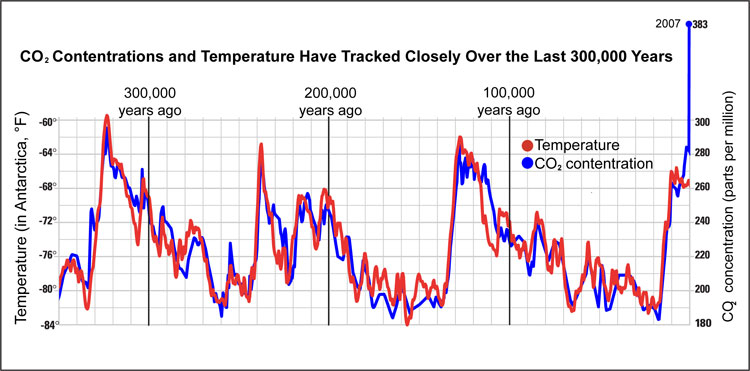
The other thing you'll see in those graphs however is the fact that global warming is a cyclical pattern that happens over time scales that are quite long. The recent global warming cycle began long before the industrial age and the spike in C02. There are *many* ways to look at global warming, but the C02 spike is way off scale, and it's clearly a result of human activity.

icecore_records.jpg
 
Upvote 0

RickG

Senior Veteran
Site Supporter
Oct 1, 2011
10,092
1,430
Georgia
✟128,873.00
Faith
Presbyterian
Marital Status
Married
Clearly what we need to do is invent a way of speeding up plant metabolism, so they ingest more CO2 w/o dying of a heart attack.

Too much CO2 is actually detrimental to plants. Plants are part of the carbon cycle, anthropogenic CO2 is not part of that cycle.

Lobell et al. 2008, Luo 2009, Zhao and Running 2010, Challinor et al. 2010, Lobell et al. 2011, Leaky et al. 2009, Long et al. 2006, Ainsworth 2005, Morgan et al. 2005

And there are many more studies.
 
Upvote 0

Loudmouth

Contributor
Aug 26, 2003
51,417
6,143
Visit site
✟98,025.00
Faith
Agnostic
This raises an interesting question:

how does our CO2 change compare to either temperature, or rate of CO2 change, as measured in ice core samples?

CO2 actually lags behind the increases in temperature. The main driver of past climate change seen in the ice core record has been the Milankovitch cycles where changes in the orbit and wobble of the Earth increase or decrease temperatures. CO2 acted as more of a feedback system where increases in temperature released CO2 from the oceans which in turn increases the temperature even further until you hit an equilibrium point. Prior to the Industrial Revolution we were at that maximum where CO2 was in equilibrium with the temperature. We have tipped that equilibrium by pumping more CO2 and we are now seeing temperatures rise again.
 
Upvote 0

Loudmouth

Contributor
Aug 26, 2003
51,417
6,143
Visit site
✟98,025.00
Faith
Agnostic
Ok, every long term change of cycle started off with a really steep increase. Can we say that the temperature rise was always caused by change's in earth's orbit, and the CO2 increase followed?

That's what it seems to indicate. The solubility of CO2 in water decreases with temperature so CO2 is pushed into the atmosphere by the initial increase in temperature. There are also other sources of feedback, such as lowering the albedo of the planet as ice melts and the melting of permafrost which releases massive amounts of methane, another strong greenhouse gas.
 
Upvote 0

RickG

Senior Veteran
Site Supporter
Oct 1, 2011
10,092
1,430
Georgia
✟128,873.00
Faith
Presbyterian
Marital Status
Married
Ok, every long term change of cycle started off with a really steep increase. Can we say that the temperature rise was always caused by change's in earth's orbit, and the CO2 increase followed?

Well, within the time of human concept time, not so steep, but geologically speaking yes.

CO2 works both as a forcing and a feedback. In the case of glacials and interglacials over the past 800,000 years CO2 was released due to warming, but keep in mind that it was still at or below pre-industrial levels. The natural thing in those cycles is for CO2 to lag, but as it increases, there is a point at which it begins acting as a forcing rather than a feedback. Also keep in mind that there are always other factors involved as well.
 
Upvote 0

Michael

Contributor
Site Supporter
Feb 5, 2002
25,145
1,721
Mt. Shasta, California
Visit site
✟343,148.00
Gender
Male
Faith
Christian
Ok, every long term change of cycle started off with a really steep increase. Can we say that the temperature rise was always caused by change's in earth's orbit, and the CO2 increase followed?

That is a *highly* likely scenario IMO. If we look at the last cooling cycle, there's an area of the graph where the C02 levels consistently track "higher than" the temperature line. That would suggest to me that rising and falling C02 levels may be an 'effect' more than a "cause' of global warming/cooling. In fact even the most recent "spike" is directly related to the last warming cycle when humans could finally populate the whole planet and improve their technologies during this relative "warm' period.

C02 however is detrimental to both plants and animals in high enough concentrations no matter how you view global warming and C02 to temperature ratios however.
 
Upvote 0

Loudmouth

Contributor
Aug 26, 2003
51,417
6,143
Visit site
✟98,025.00
Faith
Agnostic
This info is interesting to me, and the graphs show we truly are in uncharted waters. But we weren't really at the maximum as you state; it was still a good bit cooler than that.

We were at a temperature pretty close to that of previous interglacial periods. The fact that we don't have 2 mile thick ice sheets covering all of Canada seems to be a pretty good indication that we were at a warm period. ;)
 
Upvote 0

Michael

Contributor
Site Supporter
Feb 5, 2002
25,145
1,721
Mt. Shasta, California
Visit site
✟343,148.00
Gender
Male
Faith
Christian
This info is interesting to me, and the graphs show we truly are in uncharted waters. But we weren't really at the maximum as you state; it was still a good bit cooler than that.

icecore_records.jpg


The other interesting aspect of these long terms graphs is that upward trends tend to reach a "point" where the temperature starts back down. Once the downward cycle begins, it's not a straight line down. There are some bumps in the last downward cycle too. In terms of geological time scales, it's a little early to say whether human activity can even have a long term effect on such "natural" temperature fluctuation, but the last downward point actually began quite some time ago. The bumpy road down that other side toward the next ice age is inevitable, at least not without human intervention. :)
 
Upvote 0

eclipsenow

Scripture is God's word, Science is God's works
Dec 17, 2010
10,362
2,741
Sydney, Australia
Visit site
✟225,028.00
Country
Australia
Gender
Male
Faith
Anglican
Marital Status
Married
That is a *highly* likely scenario IMO. If we look at the last cooling cycle, there's an area of the graph where the C02 levels consistently track "higher than" the temperature line. That would suggest to me that rising and falling C02 levels may be an 'effect' more than a "cause' of global warming/cooling. In fact even the most recent "spike" is directly related to the last warming cycle when humans could finally populate the whole planet and improve their technologies during this relative "warm' period.
Co2 is not the primary cause of the glacial & interglacial cycle (or Ice Ages turning 'on' and 'off'), but an accelerant. If you think of the Milankovitch cycles (Earth's wobbles) as the 'trigger', then Co2 is the gunpowder... or a good percentage of that gunpowder anyway. OK, I'm stretching the analogy.

As the planet cools, co2 is trapped under ice and it cools further.
As the planet warms (due to wobbles), co2 is released warming it further.

It's a feedback in this particular, pre-industrial situation. It took a perfectly natural system and accelerated it something like 40%, from memory. It followed the earth's wobbles, and magnified the effects.

But right now we are the cause of Co2's release, and we are releasing far more than was released in the last 800,000 years of normal climate cycle. I think (from memory) that one has to go back 10's of millions of years for the last time Co2 was this high? Possibly 55million years ago, to an enormous (and castrophic) volcanic event that quite suddenly cooked the planet?

C02 however is detrimental to both plants and animals in high enough concentrations no matter how you view global warming and C02 to temperature ratios however.
Why the doubt in basic, demonstrable physics. We know what co2 does.
 
Upvote 0

Subduction Zone

Regular Member
Dec 17, 2012
32,629
12,069
✟230,471.00
Faith
Atheist
Marital Status
Single
icecore_records.jpg


The other interesting aspect of these long terms graphs is that upward trends tend to reach a "point" where the temperature starts back down. Once the downward cycle begins, it's not a straight line down. There are some bumps in the last downward cycle too. In terms of geological time scales, it's a little early to say whether human activity can even have a long term effect on such "natural" temperature fluctuation, but the last downward point actually began quite some time ago. The bumpy road down that other side toward the next ice age is inevitable, at least not without human intervention. :)


Yes, the overall shape of that graph is largely caused by Milankovitch cycles. If I remember correctly we are about midway between the end of the last ice age and the start of the next one using these cycles.

Do you see how that CO2 is spiking off of that chart? Don't you think it might be a significant factor?
 
Upvote 0