
• Starting today August 7th, 2024, in order to post in the Married Couples, Courting Couples, or Singles forums, you will not be allowed to post if you have your Marital status designated as private. Announcements will be made in the respective forums as well but please note that if yours is currently listed as Private, you will need to submit a ticket in the Support Area to have yours changed.

  • CF has always been a site that welcomes people from different backgrounds and beliefs to participate in discussion and even debate. That is the nature of its ministry. In view of recent events emotions are running very high. We need to remind people of some basic principles in debating on this site. We need to be civil when we express differences in opinion. No personal attacks. Avoid you, your statements. Don't characterize an entire political party with comparisons to Fascism or Communism or other extreme movements that committed atrocities. CF is not the place for broad brush or blanket statements about groups and political parties. Put the broad brushes and blankets away when you come to CF, better yet, put them in the incinerator. Debate had no place for them. We need to remember that people that commit acts of violence represent themselves or a small extreme faction.
  • We hope the site problems here are now solved, however, if you still have any issues, please start a ticket in Contact Us

  • The rule regarding AI content has been updated. The rule now rules as follows:

    Be sure to credit AI when copying and pasting AI sources. Link to the site of the AI search, just like linking to an article.

Global Average Temperature

RickG

Senior Veteran
Site Supporter
Oct 1, 2011
10,092
1,430
Georgia
✟128,873.00
Faith
Presbyterian
Marital Status
Married
Global average temperature (GAT) is what is used to determine whether Earth is getting warmer, cooler, and remaining about the same. I wonder what people in the CF actually know about GAT's and how climatologists determine them.

I would like to hear several points of view of how people here think they are derived and what they mean.

Please understand that this thread is intended as an educational thread and not a debate either for or against the theory of global climate change.
Let's try to learn from one another instead of arguing. :)
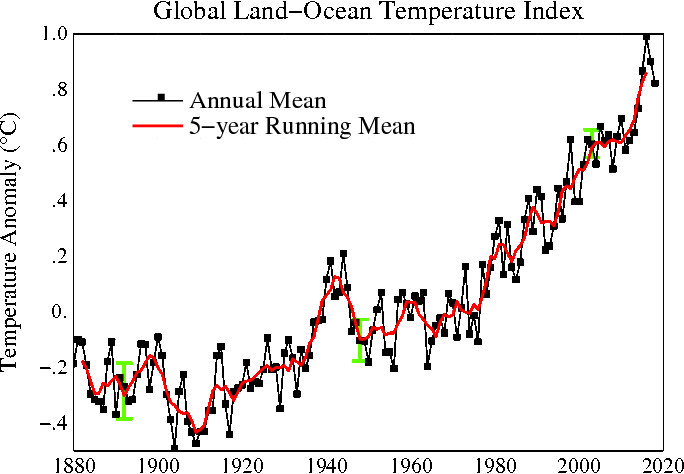
Fig.A2.gif


(source: NASA GISTEMP)
 

RickG

Senior Veteran
Site Supporter
Oct 1, 2011
10,092
1,430
Georgia
✟128,873.00
Faith
Presbyterian
Marital Status
Married
Upvote 0

Papias

Listening to TW4
Dec 22, 2005
3,967
988
59
✟64,806.00
Faith
Catholic
Marital Status
Married
Wiccan child wrote:

I have a question: why does the annual mean swing year after year? More or less every year is sandwiched between two colder years or two hotter years; why is that?

I count 70 instances of that, out of 132 points, giving a rate of 53%. Pure chance would give a number most likely somewhere between 40 and 60%, so I think your premise (that "More or less every year is sandwiched") is incorrect.

We evolved with pattern seeking brains, because the payoff in detecting a subtle pattern (say, when animals migrate and can be hunted) was much greater than the cost of the mistake of thinking there was pattern when there was none. So, study after study has shown that humans detect patterns where there are none. If one sees a few sandwiched years, then notices the many others, then it is easy to fool oneself into thinking there are more sandwich years than would be expected due to chance.

That's what 53% says to me at least.

Papias
 
Upvote 0

RickG

Senior Veteran
Site Supporter
Oct 1, 2011
10,092
1,430
Georgia
✟128,873.00
Faith
Presbyterian
Marital Status
Married
I have a question: why does the annual mean swing year after year? More or less every year is sandwiched between two colder years or two hotter years; why is that?

Good question!

And this is an area that most laypeople do not understand. The short answer but not entirely inclusive answer is the difference between what is weather and what is climate. The World Meteorological Organization (WMO) defines climate as the average of weather over a period of 30 years or more and this is also accepted as a baseline used by climatologist. Understand that this is not just an arbitrary figure. To establish a climatic trend that is statistically significant it takes that much data. Also, there are anomolies that occur year from year to year, many of which due to ocean currents, i.e., the El Nino Southern Oscillation (ENSO), a warm current, and its counter part, La Nina, a cool current in the Pacific Ocean that affects climate world wide. Volcanic eruptions also play a part as well as the 11 year solar cycle. All of those are oscillations, that is they come and go periodically. They only have a short term effect on the climate, they are not a climate driver or what climatologists call a "forcing". If you look at the graph I posted earlier, notice the red line which is a 5 year running average. This is shown to smooth out the noise from the oscillations so the "real" signal can be seen.

The important thing is to look at the overall trend over a period of 30 years or more to see what is really happening. Also, notice the the graph displays a temperature anomaly, not actual temperature. An actual global temperature average is not very meaningful. What is more meaningful is the change in temperature. This not only makes more sense but it eliminates wide swings over short distances. For instance a sea level temperature would much different from the temperature on a mountain peak only 60 miles away. But the difference in temperature change (anomaly) from each reporting station will be very similar. These anomalies of course must have a base line. That is a point of reference, not a zero point, because the anomaly can be either above or below the base line. The discussed above is from NASAGIS Surface Temp. It uses an anomaly base period from 1951 to 1980, that is the average temperature for each meteorological station over that period of time, and there are tens of thousands of reporting stations globally. I won't get into specifics now, but NASA uses 8,000 grids of equal area around the globe. Other climate units use similar grids and anomaly periods, but not the exact same. Nevertheless, they all show the same trends.

Here's one showing 10 different sources all on one graph.

Various_Temp_500.jpg
 
Upvote 0