

If God created everything, does that mean he created numbers? Are numbers necessary things or contingent?
Starting today August 7th, 2024, in order to post in the Married Couples, Courting Couples, or Singles forums, you will not be allowed to post if you have your Marital status designated as private. Announcements will be made in the respective forums as well but please note that if yours is currently listed as Private, you will need to submit a ticket in the Support Area to have yours changed.


So before he created 'things', [the emergent property of] numbers would not exist?Numbers are not things, but an emergent property of groups of things. 'Five' only exists insofar as I have five apples. More generally, 'five' is defined as the quantity of things in the set:
Yes he did, because if he didn't we'd all be stuck with going, "One, one, one, one, one, one, one. . . . . . . " And, "Yup I've got one leg, one ear and one eye. What you got? Ah, One leg, one ear and one eye also. Ain't life grand."If God created everything, does that mean he created numbers? Are numbers necessary things or contingent?
No, because numbers don't exist. They're an emergent property, not things in and of themselves. It's like velocity, or height: they doesn't exist, but rather are properties of things which do exist.So before he created 'things', [the emergent property of] numbers would not exist?
Well, Christianity posits that God created everything that was made. It says nothing about those things which weren't made. Numbers could fall into that category (depending on what one considers to be 'numbers').The other alternative as I see it is that the property of numbers existed before he started creating things. But that implies something (or a property of something) existing independently of God's creating process.


If God created everything, does that mean he created numbers? Are numbers necessary things or contingent?
Numbers are not things, but an emergent property of groups of things. 'Five' only exists insofar as I have five apples. More generally, 'five' is defined as the quantity of things in the set:
5 = | {{}, {{}}, {{}, {{}}}, {{}, {{}}, {{}, {{}}}, {{}, {{}}, {{}, {{}}}, {{}, {{}}, {{}, {{}}}}} |.
I don't see the difference. '5' is still the number of things I have. In the first case, I have five physical objects. In the latter, I have five abstract objects. Either way, the principle is the same.You seem to be mixing two incompatible philosophies of mathematics here -- empiricist ('Five' only exists insofar as I have five apples or five atoms, which means mathematics is essentially a subset of physics) and logicist (five is defined to be the set you described, which is an abstract object).
.KindergartenAlthough numbers are isomorphic to certain sets, Paul Benacerraf in "What numbers could not be" (The Philosophical Review, Vol. 74, Jan 1965, pp. 4773) points out the problem with this as a definition. When you learned in kindergarten that 2+3=5, did you use that set-theoretic definition of 'five', or another one, such as {{{{{{}}}}}}?
 ?
?
I don't see the difference. '5' is still the number of things I have. In the first case, I have five physical objects. In the latter, I have five abstract objects. Either way, the principle is the same.
 ).
).Thus, numbers are properties of things (as evident in the set definition), not things unto themselves.
Yes. Five isn't a thing in and of itself, but rather, it's a property of (among other things) the set {I think you agree with me then: 'five' refers to a number:
, , , , }.Because it is a useful way of introducing the more general concept of 'five'.It doesn't refer to that specific complex set, because in kindergarten you understood 'five' without getting into that particular set
Exactly. That's kinda why mathematics isn't subordinate to physics.And numbers are logically prior to things, so that 2+3=5 is an abstract truth, not an experimental fact of physics.
I said they're properties of things, but not specifically physical things.Or maybe you don't? If numbers are properties of physical things, then mathematics is subordinate to physics. I'm still having trouble placing your philosophical position.
Neither: it's a property of an abstract thing. And, indeed, though perfect circles don't exist in real life, π crops us all the time in physical equations.Let's try something else. The number pi = 3.14159265358979323846... is the ratio of the circumference to the diameter of an infinitely perfect circle. Is pi a property of physical things, or an abstract thing unto itself?
Yes. Five isn't a thing in and of itself, but rather, it's a property of (among other things) the set {
Neither: it's a property of an abstract thing. And, indeed, though perfect circles don't exist in real life, π crops us all the time in physical equations.
That question goes beyond the scope of this thread. Suffice to say, they are a property.The question is: what kind of property?
I do not believe that numbers are sets, abstract or otherwise. Properties of sets, yes, but not sets in and of themselves.You do seem to think that set theory is logically prior to numbers, and many mathematicians with that approach wind up defining a number to be a specific set, which I'm not really happy with (largely because I'm much more comfortable with the Peano axioms than the ZF axioms).
I disagree, though we might be quibbling over semantical minutiae.I would go further and say that π itself is an abstract thing, though also useful to physicists.
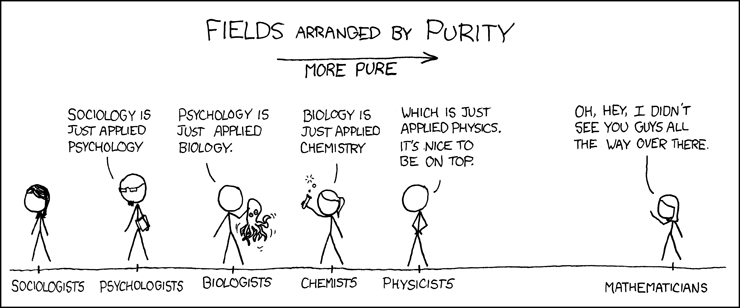
And then there's Logic waaaay over to the right.
That question goes beyond the scope of this thread. Suffice to say, they are a property.
I disagree, though we might be quibbling over semantical minutiae.
No, because numbers don't exist. They're an emergent property, not things in and of themselves. It's like velocity, or height: they doesn't exist, but rather are properties of things which do exist.
If you're a nominalist, then you don't buy that and you will say that abstract objects have no existence. But this thread is assuming that there is a God and He created things. So naturalism can't really apply here.


