• Starting today August 7th, 2024, in order to post in the Married Couples, Courting Couples, or Singles forums, you will not be allowed to post if you have your Marital status designated as private. Announcements will be made in the respective forums as well but please note that if yours is currently listed as Private, you will need to submit a ticket in the Support Area to have yours changed.

  • CF has always been a site that welcomes people from different backgrounds and beliefs to participate in discussion and even debate. That is the nature of its ministry. In view of recent events emotions are running very high. We need to remind people of some basic principles in debating on this site. We need to be civil when we express differences in opinion. No personal attacks. Avoid you, your statements. Don't characterize an entire political party with comparisons to Fascism or Communism or other extreme movements that committed atrocities. CF is not the place for broad brush or blanket statements about groups and political parties. Put the broad brushes and blankets away when you come to CF, better yet, put them in the incinerator. Debate had no place for them. We need to remember that people that commit acts of violence represent themselves or a small extreme faction.
  • We hope the site problems here are now solved, however, if you still have any issues, please start a ticket in Contact Us

  • The rule regarding AI content has been updated. The rule now rules as follows:

    Be sure to credit AI when copying and pasting AI sources. Link to the site of the AI search, just like linking to an article.

Ask a Climatologist

OldWiseGuy

Wake me when it's soup.
Site Supporter
Feb 4, 2006
46,773
10,979
Wisconsin
Visit site
✟1,005,302.00
Country
United States
Gender
Male
Faith
Protestant
Marital Status
Single
Politics
US-Others
Billy Madison Dumb Answer FULL SCENE [HD] - YouTube

Sorry, couldn't resist. :(

Climate question: I know this is more of a philosophical question than a technical one, but is it your sense that we as a species are on the right path toward mitigating our effect on the climate, or do we need to take more drastic measures?

What 'drastic' measures have we taken so far? We have no effective plan for mitigating climate change. In fact we haven't decided that global warming is a problem, based on my assertion that a 'problem' is identified by visible efforts to correct it.

For example, we allow drivers with multiple DUI offenses to continue to drive, thus indicating that their behavior isn't really a problem. If it were the government would impound the offending vehicle and any other vehicle that person is caught driving for the length of that persons driving privilege suspension.

Vehicles used in the commission of certain crimes, such as drug dealing, as well as hunting violations are routinely confiscated by some States. That drunk drivers have access to any vehicle during their suspension reveals that the State doesn't consider drunk driving a very serious problem.

If we as a species are unable to solve simple problems how are we to solve the complex ones?
 
Upvote 0

RickG

Senior Veteran
Site Supporter
Oct 1, 2011
10,092
1,430
Georgia
✟128,873.00
Faith
Presbyterian
Marital Status
Married
What 'drastic' measures have we taken so far? We have no effective plan for mitigating climate change. In fact we haven't decided that global warming is a problem, based on my assertion that a 'problem' is identified by visible efforts to correct it.

For example, we allow drivers with multiple DUI offenses to continue to drive, thus indicating that their behavior isn't really a problem. If it were the government would impound the offending vehicle and any other vehicle that person is caught driving for the length of that persons driving privilege suspension.

Vehicles used in the commission of certain crimes, such as drug dealing, as well as hunting violations are routinely confiscated by some States. That drunk drivers have access to any vehicle during their suspension reveals that the State doesn't consider drunk driving a very serious problem.

If we as a species are unable to solve simple problems how are we to solve the complex ones?

One thing that has already accelerated to the point where it is causing a serious problem is one that you don't hear about much, ocean acidification.

It has already been quantified from several independent avenues that the rise in carbon dioxide since the beginning of the industrial revolution is entirely due to human causes. Most people are unaware that half of that carbon dioxide is dissolved in the oceans, which lowers the pH, thus acidification of the oceans.

What it does is endanger the food chain, which is already being observed. There are a few newly published studies that document this showing that this problem is occurring faster than expected. Here are the links:

http://www.webpages.uidaho.edu/envs501/downloads/Feely et al. 2010.pdf
PLoS ONE: Rapid Environmental Change over the Past Decade Revealed by Isotopic Analysis of the California Mussel in the Northeast Pacific
Coupling primary production and terrestrial runoff to ocean acidification and carbonate mineral suppression in the eastern Bering Sea
The role of ocean acidification in systemic carbonate mineral suppression in the Bering Sea
 
Upvote 0

OldWiseGuy

Wake me when it's soup.
Site Supporter
Feb 4, 2006
46,773
10,979
Wisconsin
Visit site
✟1,005,302.00
Country
United States
Gender
Male
Faith
Protestant
Marital Status
Single
Politics
US-Others
One thing that has already accelerated to the point where it is causing a serious problem is one that you don't hear about much, ocean acidification.

It has already been quantified from several independent avenues that the rise in carbon dioxide since the beginning of the industrial revolution is entirely due to human causes. Most people are unaware that half of that carbon dioxide is dissolved in the oceans, which lowers the pH, thus acidification of the oceans.

What it does is endanger the food chain, which is already being observed. There are a few newly published studies that document this showing that this problem is occurring faster than expected. Here are the links:

http://www.webpages.uidaho.edu/envs501/downloads/Feely et al. 2010.pdf
PLoS ONE: Rapid Environmental Change over the Past Decade Revealed by Isotopic Analysis of the California Mussel in the Northeast Pacific
Coupling primary production and terrestrial runoff to ocean acidification and carbonate mineral suppression in the eastern Bering Sea
The role of ocean acidification in systemic carbonate mineral suppression in the Bering Sea

This statement from one of the articles makes my point:

"The observed suppression and undersaturation of Ωcalcite and Ωaragonite in the eastern Bering Sea are correlated with anthropogenic carbon dioxide uptake into the ocean and will likely be exacerbated under business-as-usual emission scenarios."
 
Upvote 0

Orogeny

Trilobite me!
Feb 25, 2010
1,599
54
✟24,590.00
Faith
Agnostic
Marital Status
Single
One thing that has already accelerated to the point where it is causing a serious problem is one that you don't hear about much, ocean acidification.

It has already been quantified from several independent avenues that the rise in carbon dioxide since the beginning of the industrial revolution is entirely due to human causes. Most people are unaware that half of that carbon dioxide is dissolved in the oceans, which lowers the pH, thus acidification of the oceans.

What it does is endanger the food chain, which is already being observed. There are a few newly published studies that document this showing that this problem is occurring faster than expected. Here are the links:

http://www.webpages.uidaho.edu/envs501/downloads/Feely et al. 2010.pdf
PLoS ONE: Rapid Environmental Change over the Past Decade Revealed by Isotopic Analysis of the California Mussel in the Northeast Pacific
Coupling primary production and terrestrial runoff to ocean acidification and carbonate mineral suppression in the eastern Bering Sea
The role of ocean acidification in systemic carbonate mineral suppression in the Bering Sea

Is seeding algal blooms an effective way to remove CO2 from the atmospher/ocean system, and how long does sequestration from this method last? Can this affect ocean pH levels?
 
Upvote 0

RickG

Senior Veteran
Site Supporter
Oct 1, 2011
10,092
1,430
Georgia
✟128,873.00
Faith
Presbyterian
Marital Status
Married
Is seeding algal blooms an effective way to remove CO2 from the atmospher/ocean system, and how long does sequestration from this method last? Can this affect ocean pH levels?

Honestly I haven't really looked into that other than just knowing about its possibilities by seeding with iron dust. I think one of the pitfalls of that would be how quickly could that sequestration take place, the problem being that CO2 dissolves in water rather quickly to form carbonic acid.

CO2 + H2O => H+ + HCO3-

If you have more information on it I would very much like to hear about it.
 
Upvote 0

RickG

Senior Veteran
Site Supporter
Oct 1, 2011
10,092
1,430
Georgia
✟128,873.00
Faith
Presbyterian
Marital Status
Married
For the past two decades global sea level has increased on average 3mm/yr. In 2010 it dropped by 6mm. Where did the water go? NASA explains.

earth20110823-640.jpg


NASA Satellites Detect Pothole on Road to Higher Seas - NASA Jet Propulsion Laboratory
 
Upvote 0

razeontherock

Well-Known Member
May 24, 2010
26,546
1,480
WI
✟35,597.00
Faith
Christian
Marital Status
Single
For the past two decades global sea level has increased on average 3mm/yr. In 2010 it dropped by 6mm. Where did the water go? NASA explains.

Happy New Year Rick! Please forgive me for being dense, but is the full explanation that so much water cooled as to reduce it's volume? I don't think so, so what am I missing?
 
Upvote 0

RickG

Senior Veteran
Site Supporter
Oct 1, 2011
10,092
1,430
Georgia
✟128,873.00
Faith
Presbyterian
Marital Status
Married
Happy New Year Rick! Please forgive me for being dense, but is the full explanation that so much water cooled as to reduce it's volume? I don't think so, so what am I missing?

No, it is not due to cooling, in fact the oceans are warming more than the atmosphere. Late 2010 through 2011 were years where were a number unusually significant flood events took place, especially in Australia and Brazil. Most of the moisture in the atmosphere comes from the oceans and during that time more than usual rain was dumped on land rather than back in the oceans. Much is absorbed by land which takes some time to finally get back to the oceans. This is verified by the NASA/German Aerospace Center's twin Gravity Recovery and Climate Experiment (Grace) spacecraft.

One thing that climate scientists have been observing is a change in climate patters. Some climate zones have received more rain than normal and others have become more arid than usual.

The overall trend of sea level has increased but like any trend there is noise (ups and downs). There is no doubt that sea level rise will continue in the coming years.
 
Upvote 0

RickG

Senior Veteran
Site Supporter
Oct 1, 2011
10,092
1,430
Georgia
✟128,873.00
Faith
Presbyterian
Marital Status
Married
It has been a while since there has been any activity in this thread so I have decided to pull it back to the surface.

Please, before posting, review the OP and be aware that this is an information thread. This thread is not intended for debate. Simply ask a question concerning climatology and I or someone else familiar with the field will answer it to the best our ability. Only climate science will be discussed here. If you wish to challenge any post, please do so with supporting scientific evidence from legitimate sources. I will ask the moderators to delete any ideological and/or off topic posts. Thank you. :)
 
Upvote 0

RickG

Senior Veteran
Site Supporter
Oct 1, 2011
10,092
1,430
Georgia
✟128,873.00
Faith
Presbyterian
Marital Status
Married
One of the tools available to climatologists in reconstructing past climates is through Marine Geology and Paleontology. Contained in sea floor sediments and cores are many markers that reveal surface climatic conditions at the time of their deposition. This includes organic, inorganic and biomarkers. Here's just a few of the things that can be seen through these proxies.


  • Variations in global ice volume
  • origin of floating ice bergs
  • Changes in deep water circulation
  • Sea surface salinity
  • Upper ocean temperature
  • Sea ice extent
  • Organic carbon flux
  • Terrigenous sediment input
  • climatic zone shifts
 
Upvote 0

RickG

Senior Veteran
Site Supporter
Oct 1, 2011
10,092
1,430
Georgia
✟128,873.00
Faith
Presbyterian
Marital Status
Married
This statement from one of the articles makes my point:

"The observed suppression and undersaturation of Ωcalcite and Ωaragonite in the eastern Bering Sea are correlated with anthropogenic carbon dioxide uptake into the ocean and will likely be exacerbated under business-as-usual emission scenarios."

One way it is known that the additional of CO2 in the atmosphere and oceans is through analysis of carbon isotope ratios, i.e., 13C/12C). Here are some papers on the subject I suggest.

http://citeseerx.ist.psu.edu/viewdoc/download?doi=10.1.1.199.525&rep=rep1&type=pdf

http://ww.aebrc.org/korean/files/the_oceanic_sink_for_.pdf

Stuiver, M., Burk, R. L. and Quay, P. D. 1984. 13C/12C ratios and the transfer of biospheric carbon to the atmosphere. J. Geophys. Res. 89, 11,731-11,748.

Francey, R.J., Allison, C.E., Etheridge, D.M., Trudinger, C.M., Enting, I.G., Leuenberger, M., Langenfelds, R.L., Michel, E., Steele, L.P., 1999. A 1000-year high precision record of d13Cin atmospheric CO2. Tellus 51B, 170–193.

Quay, P.D., B. Tilbrook, C.S. Wong. Oceanic uptake of fossil fuel CO2: carbon-13 evidence. Science 256 (1992), 74-79

And a good article here by Eric Steig posted by RealClimate.org

RealClimate: How do we know that recent CO2 increases are due to human activities?
 
Upvote 0

SkyWriting

The Librarian
Site Supporter
Jan 10, 2010
37,281
8,501
Milwaukee
✟411,038.00
Country
United States
Gender
Male
Faith
Non-Denom
Marital Status
Married
Politics
US-Others
If the science is settled why isn't anything substantial being done about global warming? Restating positions with charts and graphs does little to address the problem. It seems to me that everyone is waiting for someone else to do something about it. So with everyone sitting on their hands the science becomes irrelevant, doesn't it? :confused:

Because the world's economy depends on getting work accomplished at the lowest cost for the manpower put in.
Think of it this way. You need to haul a load of bricks to build a house with your pickup truck. You get paid by the hour.
Now convert that pickup truck to Solar power with panels or wind power with a sail. See how your productivity decreases when you move away from gasoline power? Suddenly my house costs 5 times as much to build.

Fossil fuels provide the greatest amount of work done at the least amount of effort. It's true that the US could convert all current housing to run on passive solar heating and wood burning stoves. So the US could reduce it's use of fossil fuels. By doing that. But emerging countries where most of humanity lives, are just now looking forward to having heated homes, cars, and ipads and lawn mowers.
The best options for reducing GH gasses is for the US to give up it's cars, and the rest of the world to put central heating dreams, cars, and electricity desires on hold. The US is not likely to do it, nor can we ask other countries to give up their desire to have the dream lifestyle that we are not likely to give up anyway.

- Then there is another factor. We could do all that and it might not work. One possibility is that the climate has been started on a cycle of it's own.

If fact, it's quit likely. Whether or not greenhouse gasses kicked a warmup, it may be a standard global cycle that must run it's course. So we could send the entire globe into a depression for no good reason. And keep in mind, we already eliminated all use of fossil fuel and there is no active economy in the world. Now we need to deal with moving people to better climates and out of flood zones....where most of the population lives. And build new housing and transportation for everyone that is zero emmission. And build it without using fuel.

I have a theory we already have. Just talking about reducing greenhouse gases has given us our current global recession because most economic models have concluded that "Confidence" is the greatest factor in the world economy. You can't have efficient production of anything without investment upfront. And if you predict the end of fossil fuel use.....nobody invests in the future. Would you invest in a factory that takes 5 years to build if the cost of everything will double?

- Then there is another possibility. That greenhouse gasses trail the change in temperature rather than lead it. That the earth is warming and co2 normally increases when that happens.

- That leads to another possibility. That the normal cycle of temperature swings for the planet is returning to it's normally chaotic state. I think this last one is the most accurate. I'm not interested in a world wide recession just to test out the other possibilities.

 
Last edited:
Upvote 0

RickG

Senior Veteran
Site Supporter
Oct 1, 2011
10,092
1,430
Georgia
✟128,873.00
Faith
Presbyterian
Marital Status
Married
Then there is another factor. We could do all that and it might not work. One possibility is that the climate has been started on a cycle of it's own.

It has been looked at extensively and continues to be looked at. There are no natural causes of climate change that are currently in effect. The suns total solar irradiance (TSI) has declined slightly since the 1970s while most of the warming has occurred since then. Milankovitch Cycles are not favorable for warming, ocean currents have not changed and continental drift is way to slow to have any effect in that short of time. Nevertheless, I am more than willing to entertain any suggestions you may have for natural causes.

- Then there is another possibility. That greenhouse gasses trail the change in temperature rather than lead it. That the earth is warming and co2 normally increases when that happens.
In the past interglacials have been triggered by Milankovitch Cycles. That definately is not the case now. However, in that case more CO2 is released as a result of warming and then amplifies the warming. Also consider that over the past 800,000 years (actually much longer) CO2 levels have been below 280 ppm. Since 1880, that amount is now breeching 390 ppm. Data from past climates and what has been observed since 1880 show that a doubling of CO2 will increase global average temperature (GAT) by approximately 3.5 deg. C., that's a lot considering the little ice age (LIA) only saw a change of less than 1 deg C.


That leads to another possibility. That the normal cycle of temperature swings for the planet is returning to it's normally chaotic state. I think this last one is the most accurate. I'm not interested in a world wide recession just to test out the other possibilities.
Weather is Chaotic, not climate.
 
Upvote 0

SkyWriting

The Librarian
Site Supporter
Jan 10, 2010
37,281
8,501
Milwaukee
✟411,038.00
Country
United States
Gender
Male
Faith
Non-Denom
Marital Status
Married
Politics
US-Others
Originally Posted by SkyWriting
Then there is another factor. We could do all that and it might not work. One possibility is that the climate has been started on a cycle of it's own.
RickG- It has been looked at extensively and continues to be looked at. There are no natural causes of climate change that are currently in effect. The suns total solar irradiance (TSI) has declined slightly since the 1970s while most of the warming has occurred since then.
I'mm not sein' it.
I am able to make out a general upward trend with my untrained squinty eye.
tim_tsi_reconstruction_2012.jpeg

Download the ASCII data file


And even if your technically correct, I'd expect a flywheel effect where the warming mass (see chart)
would continue right through any slight decline.

Originally Posted by SkyWriting
Then there is another possibility. That greenhouse gasses trail the change in temperature rather than lead it. That the earth is warming and co2 normally increases when that happens.
RickG- In the past interglacials have been triggered by Milankovitch Cycles.
That is an accepted theory. Though it has a list of problems.

That definately is not the case now. However, in that case more CO2 is released as a result of warming and then amplifies the warming. Also consider that over the past 800,000 years (actually much longer) CO2 levels have been below 280 ppm. Since 1880, that amount is now breeching 390 ppm. Data from past climates and what has been observed since 1880 show that a doubling of CO2 will increase global average temperature (GAT) by approximately 3.5 deg. C., that's a lot considering the little ice age (LIA) only saw a change of less than 1 deg C.

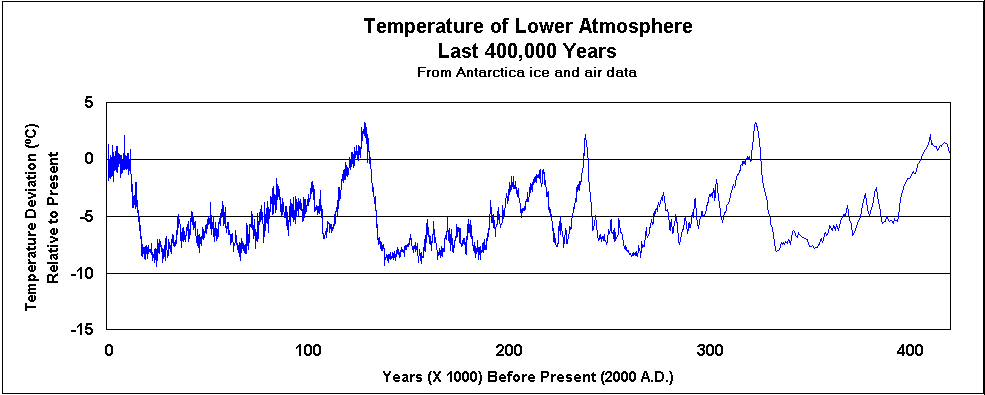
Aren't we due for a huge temp increase? It looks to me like we delayed a temp spike on the far left.
(read this trend from the right going left)
Temp_0-400k_yrs.gif


Then we should look a little farther.
"Especially astonishing are the very short times needed for major warmings. A temperature increase of 5C can occur in a few decades. "
Gee. What planet is this?

"The fast climatic variations observed in the d18O record of Greenland ice cores would attract only limited attention if they were only local in character. However, there is ample evidence that these fast climatic fluctuations are also affecting regions far away from Greenland. Indeed, there is good correlation between some of the fast climatic variations observed in the Greenland ice cores and variations observed in deep sea sediment cores from the North Atlantic. "
Gosh. That sounds local. Is the weather very chaotic then?

" The d18O records confirm that large and rapid temperature oscillations have occurred through most of the last 110,000 year period. They are of a scale that has not been experienced during the past 10,000 years in which human society mainly developed. "

So it wasn't due to humans then.
That all seems to lead to my last ignored point......

Originally Posted by SkyWriting
That leads to another possibility. That the normal cycle of temperature swings for the planet is returning to it's normally chaotic state. I think this last one is the most accurate. I'm not interested in a world wide recession just to test out the other possibilities.
RickG- Weather is Chaotic, not climate.
Not true and doesn't matter.
 
Last edited:
Upvote 0

RickG

Senior Veteran
Site Supporter
Oct 1, 2011
10,092
1,430
Georgia
✟128,873.00
Faith
Presbyterian
Marital Status
Married
I'mm not sein' it.
I am able to make out a general upward trend with my untrained squinty eye.
tim_tsi_reconstruction_2012.jpeg

Download the ASCII data file


And even if your technically correct, I'd expect a flywheel effect where the warming mass (see chart)
would continue right through any slight decline.

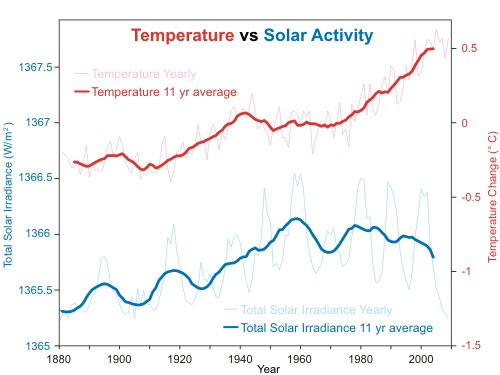
I agree with the chart you posted but I guess did not make myself clear of what I was trying to convey. Most of the warming has taken place over the past 35 - 40 years. During this time TSI has slightly declined. Approximately 10% of warming over the past 100 years (Lean 2008) has been attributed to the sun. From your graph it does look like mostly the sun, but when all forcings and feedbacks are taken into account, that is not the case. Especially when you consider that a strong forcing of sulfate aerosols was masking total warming which in part is contributed to GHG increase. To demonstrate the past 40 years look at the charts below.

comp06_ext_d41_62_1201.png

Source: World Radiation Center: PMOD

Solar_vs_temp_500.jpg


Annual global temperature change (thin light red) with 11 year moving average of temperature (thick dark red). Temperature from NASA GISS. Annual Total Solar Irradiance (thin light blue) with 11 year moving average of TSI (thick dark blue). TSI from 1880 to 1978 from Krivova et al 2007 (data). TSI from 1979 to 2009 from PMOD. (Source: Skeptical Science).

The thing to understand about Milankovitch Cycles is that they are comprised of three independent variables of different periodicity and it takes a combination of all three to pull the trigger. On "average", that trigger is pulled roughly every 100,000 years, so there is variation in those cycles. Also, consider that there are other variables (forcings and feedbacks) that come into play, but the overall trigger mechanism has been the Milankovitch Cycles.


Aren't we due for a huge temp increase? It looks to me like we delayed a temp spike on the far left.
(read this trend from the right going left)
Temp_0-400k_yrs.gif
I think you may be over reading the graph a little. Notice how the blue line in the graph gets darker showing more noise from right to left. Its a difference in available data. As you go out in time there is less data and therefore less noise. If there were as much data available 400,000 years ago, it would reflect much the same noise as the left side of the graph.

[/quote]Then we should look a little farther.
"Especially astonishing are the very short times needed for major warmings. A temperature increase of 5C can occur in a few decades. "
Gee. What planet is this? [/quote]

Yup! Dansgaard–Oeschger events.

"The fast climatic variations observed in the d18O record of Greenland ice cores would attract only limited attention if they were only local in character. However, there is ample evidence that these fast climatic fluctuations are also affecting regions far away from Greenland. Indeed, there is good correlation between some of the fast climatic variations observed in the Greenland ice cores and variations observed in deep sea sediment cores from the North Atlantic. "
Gosh. That sounds local. Is the weather very chaotic then?
Well, let's visit the difference between weather and climate. Here's how the World Meteorological Organization defines it.

Climate in a narrow sense is usually defined as the "average weather," or more rigorously, as the statistical description in terms of the mean and variability of relevant quantities over a period of time ranging from months to thousands or millions of years. The classical period is 30 years, as defined by the World Meteorological Organization (WMO). These quantities are most often surface variables such as temperature, precipitation, and wind. Climate in a wider sense is the state, including a statistical description, of the Climate system.(http://www.wmo.int/pages/prog/wcp/ccl/faqs.html)


Weather The state of the atmosphere, mainly with respect to its effects upon life and human activities. As distinguished from climate, weather consists of the short-term (minutes to about 15 days) variations of the atmosphere state. (NSIDC Weather (glossary definition))


" The d18O records confirm that large and rapid temperature oscillations have occurred through most of the last 110,000 year period. They are of a scale that has not been experienced during the past 10,000 years in which human society mainly developed. "
So it wasn't due to humans then.
That all seems to lead to my last ignored point......

Not true and doesn't matter.
Natural causes are not ignored at all. Understanding natural causes is the reason it is known that the current warming is mostly attributed to CO2. If you can show a natural cause that explains the current warming, please do so. I would like to know so I can share the Nobel Prize with you. :)
 
Upvote 0

SkyWriting

The Librarian
Site Supporter
Jan 10, 2010
37,281
8,501
Milwaukee
✟411,038.00
Country
United States
Gender
Male
Faith
Non-Denom
Marital Status
Married
Politics
US-Others
I think you may be over reading the graph a little. Notice how the blue line in the graph gets darker showing more noise from right to left. Its a difference in available data. As you go out in time there is less data and therefore less noise. If there were as much data available 400,000 years ago, it would reflect much the same noise as the left side of the graph.

I did notice. Yet every spike on the graph shows higher than current temps. It looks like we are due for a higher spike of 4 degrees, headed toward the left, with or without more data points. The increase in data points doesn't seem to effect the total temp change at all.

Temp_0-400k_yrs.gif


In either case relocating the bulk of the population and building new infrastructure will be slow in a world wide depression and using solar powered bulldozers and wind powered construction cranes.
 
Upvote 0

RickG

Senior Veteran
Site Supporter
Oct 1, 2011
10,092
1,430
Georgia
✟128,873.00
Faith
Presbyterian
Marital Status
Married
I did notice. Yet every spike on the graph shows higher than current temps. It looks like we are due for a higher spike of 4 degrees, headed toward the left, with or without more data points. The increase in data points doesn't seem to effect the total temp change at all.

Temp_0-400k_yrs.gif


.

Well, that's kind of hard to deduce from just looking at the graph. One really needs to look at the data a little closer. Actually on average interglacials last 11,500 years. Thus far the current interglacial has lasted 12,00 years. It's kind of interesting that one of the AGW skeptic arguments is that we are headed into another ice age.
 
Upvote 0

OldWiseGuy

Wake me when it's soup.
Site Supporter
Feb 4, 2006
46,773
10,979
Wisconsin
Visit site
✟1,005,302.00
Country
United States
Gender
Male
Faith
Protestant
Marital Status
Single
Politics
US-Others
Because the world's economy depends on getting work accomplished at the lowest cost for the manpower put in.
Think of it this way. You need to haul a load of bricks to build a house with your pickup truck. You get paid by the hour.
Now convert that pickup truck to Solar power with panels or wind power with a sail. See how your productivity decreases when you move away from gasoline power? Suddenly my house costs 5 times as much to build.

Fossil fuels provide the greatest amount of work done at the least amount of effort. It's true that the US could convert all current housing to run on passive solar heating and wood burning stoves. So the US could reduce it's use of fossil fuels. By doing that. But emerging countries where most of humanity lives, are just now looking forward to having heated homes, cars, and ipads and lawn mowers.
The best options for reducing GH gasses is for the US to give up it's cars, and the rest of the world to put central heating dreams, cars, and electricity desires on hold. The US is not likely to do it, nor can we ask other countries to give up their desire to have the dream lifestyle that we are not likely to give up anyway.

- Then there is another factor. We could do all that and it might not work. One possibility is that the climate has been started on a cycle of it's own.

If fact, it's quit likely. Whether or not greenhouse gasses kicked a warmup, it may be a standard global cycle that must run it's course. So we could send the entire globe into a depression for no good reason. And keep in mind, we already eliminated all use of fossil fuel and there is no active economy in the world. Now we need to deal with moving people to better climates and out of flood zones....where most of the population lives. And build new housing and transportation for everyone that is zero emmission. And build it without using fuel.

I have a theory we already have. Just talking about reducing greenhouse gases has given us our current global recession because most economic models have concluded that "Confidence" is the greatest factor in the world economy. You can't have efficient production of anything without investment upfront. And if you predict the end of fossil fuel use.....nobody invests in the future. Would you invest in a factory that takes 5 years to build if the cost of everything will double?

- Then there is another possibility. That greenhouse gasses trail the change in temperature rather than lead it. That the earth is warming and co2 normally increases when that happens.

- That leads to another possibility. That the normal cycle of temperature swings for the planet is returning to it's normally chaotic state. I think this last one is the most accurate. I'm not interested in a world wide recession just to test out the other possibilities.

Actually what I had in mind was more along the lines of CO2 sequestration by planting trees and promoting more grassland farming. Alternate energy sources don't really replace fossil fuels but instead account for some new energy sources coming on line (for every new solar water heater there are many more new gas and coal/electric heaters placed in service).

I also favor conservation as the very first substantial step in reducing fossil fuel use. Two major ones would be higher mileage standards for vehicles, and better insulation (and design) standards for buildings.

When I bought my apartment building I added 12 inches of insulation under the roof, and later insulated the basement walls. I have been blessed ever since with lower heat bills.

The amount of wasted heat from millions of poorly insulated buildings is staggering. There is a good place to start.

Simply enforcing the speed limit, or at least limiting the speed to 70mph on the interstate highways would save gazzillions of gallons of motor fuels, and perhaps some lives as well.

There's lots of things that can be done immediately to mitigate climate change without upsetting anyones apple cart. We just don't want to do it, and responsible folks like me and you are too few to make a difference. :D
 
Upvote 0

SkyWriting

The Librarian
Site Supporter
Jan 10, 2010
37,281
8,501
Milwaukee
✟411,038.00
Country
United States
Gender
Male
Faith
Non-Denom
Marital Status
Married
Politics
US-Others
Well, that's kind of hard to deduce from just looking at the graph.

I say it's easy pie to deduce. That's why we draw graphs. To show obvious trends and to see past the noise.


It's kind of interesting that one of the AGW skeptic arguments is that we are headed into another ice age.

Try to object only to what I actually say in my post.
It's a common problem you guys all have. ;)


I say we're headed 4 degrees higher, for an unknown length of time, before the countering forces kick in. Possibly the "heat wave" will be extended a long ways out and maybe higher before compensating factors kick in and bring everything back down. We need to kick the world economy into high gear with every form of energy utilization we can find. We have a lot of work to do and will need resources to deal with the coming heat.
 
Last edited:
Upvote 0