• Starting today August 7th, 2024, in order to post in the Married Couples, Courting Couples, or Singles forums, you will not be allowed to post if you have your Marital status designated as private. Announcements will be made in the respective forums as well but please note that if yours is currently listed as Private, you will need to submit a ticket in the Support Area to have yours changed.

  • CF has always been a site that welcomes people from different backgrounds and beliefs to participate in discussion and even debate. That is the nature of its ministry. In view of recent events emotions are running very high. We need to remind people of some basic principles in debating on this site. We need to be civil when we express differences in opinion. No personal attacks. Avoid you, your statements. Don't characterize an entire political party with comparisons to Fascism or Communism or other extreme movements that committed atrocities. CF is not the place for broad brush or blanket statements about groups and political parties. Put the broad brushes and blankets away when you come to CF, better yet, put them in the incinerator. Debate had no place for them. We need to remember that people that commit acts of violence represent themselves or a small extreme faction.
  • We hope the site problems here are now solved, however, if you still have any issues, please start a ticket in Contact Us

Geocentric or Heliocentric (what shape is the earth) ?

Job 33:6

Well-Known Member
Jun 15, 2017
9,767
3,309
Hartford, Connecticut
✟383,950.00
Country
United States
Gender
Male
Faith
Christian
Marital Status
Married
Politics
US-Republican
St. Gregory the Wonder-worker (213-270): “And the life of men weareth away, as day by day, and in the periods of hours and years, and the determinate courses of the sun, some are ever coming, and others passing away. And the matter is like the transit of torrents as they fall into the measureless deep of the sea with a mighty noise. And all things that have been constituted by God for the sake of men abide the same: as, for instance, that man is born of earth, and departs to earth again; that the earth itself continues stable; that the sun accomplishes its circuit about it perfectly, and rolls round to the same mark again; and that the winds in like manner, and the mighty rivers which flow into the sea, and the breezes that beat upon it, all act without forcing it to pass beyond its limits, and without themselves also violating their appointed laws.” [On Ecclesiastes, Ch 1]

St. Gregory of Nyssa (ca. 335-ca. 395): “The vault of heaven prolongs itself so uninterruptedly that it encircles all things with itself, and that the earth and its surroundings are poised in the middle, and that the motion of all the revolving bodies is round this fixed and solid center…” [On the Soul and Resurrection]

St. Athenagoras (ca. 133-ca. 190): “The Framer and Father of this universe does not need blood, nor the odor of burnt-offerings,...but the noblest sacrifice to Him is for us to know Who stretched out and vaulted the heavens, and fixed the earth in its place like a center.” [A Plea for the Christians, Ch. XIII, “Why the Christians do not Offer Sacrifices”]

St. Chrysostom (ca. 347-407): “For He not only made [creation], but provided also that when it was made, it should carry on its operations; not permitting it to be all immoveable, nor commanding it to be all in a state of motion. The heaven, for instance, hath remained immovable, according as the prophet says, ‘He placed the heaven as a vault, and stretched it out as a tent over the earth.’ But, on the other hand, the sun with the rest of the stars, runs on his course through every day. And again, the earth is fixed, but the waters are continually in motion; and not the waters only, but the clouds, and the frequent and successive showers, which return at their proper season.” [Homilies on the Statues, “Homily XII”]

St. Aphrahat (ca. 270-ca. 345): “For the sun in twelve hours circles round, from the east unto the west; and when he has accomplished his course, his light is hidden in the night-time, and the night is not disturbed by his power. And in the hours of the night the sun turns round in his rapid course, and turning round, begins to run in his accustomed path.” [Demonstrations, 24]

St. Clement of Rome (35-101): “The sun and moon, with the companies of the stars, roll on in harmony according to His command, within their prescribed limits, and without any deviation.” [First Epistle to the Corinthians, Ch XX]

St. Hippolytus (170-235): “For what richer beauty can there be than that of the circle of heaven? And what form of more blooming fairness than that of earth’s surface? And what is there swifter in the course than the chariot of the sun? And what more graceful car than the lunar orb? And what work more wonderful than the compact mosaic of the stars? And what more productive of supplies than the seasonable winds? And what more spotless mirror than the light of day? And what creature more excellent than man?” [Discourse on the Holy Theophany, 1]

The holy fathers also interpret the Scriptures, starting with Genesis Ch. 1, in a geocentric way. In examining their writings, we also glean additional details about the structure of the cosmos.
  • In the beginning God created the heaven and the earth.
St. Anastasius: “‘In the beginning God created the heaven and the earth [Gen. 1:1].’ Do not let the natural philosophers respond that God began to make the origin of heaven from the earth, as from a center. For they say the center is the beginning of every sphere.... That which fails for men, succeeds for God. Therefore, so that you might learn that God does not follow the laws of nature, but creates in a way beyond nature and technology, Moses says here, ‘God created the heaven’— which is the sphere—‘and then the earth’—which is the center.” [Hexaemeron, “Book 1,” § VI.2, p. 21]
  • But the earth was invisible (unsightly) and unfurnished, and darkness was over the deep, and the Spirit of God moved over the water.
St. Basil (ca. 330-379): “‘The earth was invisible.’ Why? Because the ‘deep’ was spread over its surface. What is ‘the deep’? A mass of water of extreme depth.” [“Hom. II(4),” Hexaemeron]
  • And God said, Let there be light, and there was light. And God saw the light that it was good, and God divided between the light and the darkness. And God called the light Day, and the darkness he called Night, and there was evening and there was morning, the first day.
St. Bede (ca. 673-735): “‘And there was evening and morning, one day.’ At this point one day was completed—without a doubt a day of twenty-four hours.... Hence, it is also preferred to say that there was evening and morning rather than night and day, in order to reveal that what was then done by the circuit of that first and most excellent light is now known to be performed day and night by the circuit of the sun.” [On Genesis, Book One [1:5], 48:74]
  • And God said, Let there be a firmament in the midst of the water, and let it be a division between water and water, and it was so. And God made the firmament, and God divided between the water which was under the firmament and the water which was above the firmament. And God called the firmament Heaven, and God saw that it was good, and there was evening and there was morning, the second day.
St. John of Damascus (ca. 675-ca. 749): “‘And darkness was upon the face of the deep. And the Spirit of God moved upon the face of the waters [Gen. 1:2].’ For the deep is nothing else than a huge quantity of water whose limit man cannot comprehend. In the beginning, indeed, the water lay all over the surface of the earth. And first God created the firmament to divide the water above the firmament from the water below the firmament. For in the midst of the sea of waters the firmament was established at the Master’s decree. And out of it God bade the firmament arise, and it arose.” [“Concerning the Waters,” An Exact Exposition, Bk. II, Ch. IX]

St. Basil: “‘Let it be dividing between water and water [Gen. 1:6].’ The mass of waters, which from all directions flowed over the earth, and was suspended in the air, was infinite, so that there was no proportion between it and the other elements. Thus, as it has been already said, the abyss covered the earth. Therefore, the prodigious mass of waters was spread around the earth; not in proportion with it and infinitely larger, thanks to the foresight of the supreme Artificer, Who, from the beginning, foresaw what was to come, and at the first provided all for the future needs of the world.” [“Hom. III(5),” Hexaemeron]

So we see that St. Basil called “the deep” a “mass of water of extreme depth,” “infinite” and “prodigious,” “infinitely larger” than the earth, which was like a small seed in the middle of the deep. St. John of Damascus also said, “The deep is nothing else than a huge quantity of water whose limit man cannot comprehend.” The Apostle Peter wrote, “By the word of God were there heavens of old, and an earth having stood together out of water and in water (2 Pet. 3:5).” So St. Peter says that the earth was “in water,” matching this description of “the deep.”
View attachment 358686
  • And God made the firmament, and God divided between the water which was under the firmament and the water which was above the firmament.
When the firmament was created, this huge sphere of water was separated from the proto-earth and stretched out to the very edge of today’s universe. The “waters above” are the boundary and limit of our universe, possibly a thin shell and possibly of ice due to the low temperature of space. The firmament is the ether, the medium in which the stars and other celestial bodies were placed on day four.

St. Bede: “It is certain that this firmament is in the midst of the waters, for we ourselves see the waters that were placed beneath it and in the air and lands, and we are informed about those that were placed above it, not only by the authority of this Scriptural passage, but also by the words of the prophet, who says, ‘Stretching out the heaven like a leathern curtain; the One covering His upper chambers in waters [Ps. 103:3].’... But if it puzzles anyone, how the waters, whose nature it is always to flow and to sink to the lowest point, can settle above heaven, whose shape seems to be round, he should remember holy Scripture saying about God, ‘He bindeth water in His clouds, and the cloud is not rent under it [cf. Job 26:8].’...Although He willed to fix the liquid waters there, is this any greater miracle than that, as Scripture says, ‘He upon nothing hangeth the earth [Job 26:7; cf. Is. 40:12].’” [On Genesis, Book One [1:6-8], 48:76, 77]

St. Basil: “Now we must say something about the nature of the firmament, and why it received the order to hold the middle place between the waters. Scripture constantly makes use of the word firmament to express extraordinary strength.... ‘I made firm her pillars [Ps. 75:3].’ ‘Praise ye Him in the firmament of His power [Ps. 150:1].’ It is the custom of Scripture to call firmament all that is strong and unyielding. It even uses the word to denote the condensation of the air. God says, ‘For, behold, I am He that strengthens the thunder [Amos 4:13].’... Here then, according to me, is a firm substance, capable of retaining the fluid and unstable element water; and as, according to the common acceptation, it appears that the firmament owes its origin to water, we must not believe that [the firmament] resembles frozen water or any other matter produced by the filtration of water. For I am taught by Scripture not to allow my imagination to wander too far afield.” [“Hom. III(4),” Hexaemeron]View attachment 358687

St. Ambrose (ca. 339-397): “He Who commanded the waters to be separated by the interposition of the firmament lying between them provided also the matter of their remaining in position, once they were divided and separated. The word of God gives nature its power and an enduring quality to its matter, as long as He Who established it wishes it to be so, as it is written: ‘He established them unto the age, and unto the age of the age; He Himself set an ordinance, and it shall not pass away [Ps. 148:6].’ He said this concerning these waters which you say cannot exist in the higher parts of the heavens; for listen to the words which precede: ‘Praise ye Him, the heavens of the heavens—and thou water, the one above the heavens [Ps. 148:4].’” [“Hom. 3,” Ch. 3(10), Hexameron, FC, 42:53, 54]

Since the Scriptures use the word “heaven” to denote different things, St. John of Damascus clarifies: “The heaven of heaven, then, is the first heaven which is above the firmament. So here we have two heavens, for God called the firmament also heaven. And it is customary in the divine Scripture to speak of the air also as heavens, because we see it above us.... So here we have three heavens, as the divine apostle said (2 Cor. 12:2)” [Exposition of the Orthodox Faith, Bk II, Ch 6]. Thus, according to St. John, the “third heaven” to which the Apostle Paul was carried off is the spiritual realm above the firmament and the waters above, which mark the boundary of the physical universe.

St. Basil further describes the properties of the firmament: “Therefore we read: ‘Let there be a firmament in the midst of the water, and let it be dividing between water and water [Gen. 1:6].’ I have said what the word firmament in Scripture means. It is not in reality a firm and solid substance which has weight and resistance; this name would otherwise have better suited the earth. But, as the substance of superincumbent bodies is light, without consistency, and cannot be grasped by any one of our senses, it is in comparison with these pure and imperceptible substances that the firmament has received its name.” [“Hom. III(7),” Hexaemeron]

It is true that sometimes the Church fathers made errors when they spoke about scientific topics. However, when it comes to geocentrism, they unanimously agree. There is a clear “consensus of the fathers.” After all, have the Church fathers ever been unanimously wrong about anything? (From: Geocentrism by Dormition Skete)
Well, I think that's what we are looking at here. I love the writings and content that you're sharing here. But, personally, I think that this interpretation, ya know, the Bible says what it says, there is no doubt.

But I think that the issue here is that, similar to the Catholic Church and Galileo incident, the whole geocentrism thing is just in error.

The issue being that, the church fathers may have assumed that the intent of these passages referenced above, was to tell us something scientific in nature. Rather than the text being theological in nature.

Because the planets and the earth do orbit the sun. Rather than the earth being in the middle with the sun and planets orbiting the earth.

And so, it's a combination. An error in scientific interpretation, but also, it's an error in understanding of how the Bible interacts with science. That Ecclesiastes for example, might reach geocentrism, that's just not correct.
 
  • Like
Reactions: Jerry N.
Upvote 0

Job 33:6

Well-Known Member
Jun 15, 2017
9,767
3,309
Hartford, Connecticut
✟383,950.00
Country
United States
Gender
Male
Faith
Christian
Marital Status
Married
Politics
US-Republican
I think we should agree to disagree on the scientific aspect of geocentrism, as it is a far larger topic than can be extrapolated on this forum. However, I would highly suggest Dr. Sungenis's 'Galileo was Wrong, the Church was Right' and 'The Principle' on the topic of pro-geocentricity. We can both agree, however, that the Church Fathers [and the Church as a whole] has historically taught and held geocentrism in its bosom, and as such has ramifications that are seen in different respects between the two of us. I think that your position is fair, and I would not consider you wrong or anything such as, but I will say that we both respectfully disagree with one another on the scientific matter, and thus we should revel in what we do agree on and expand our understanding thusly. Let us remember Romans 12:18: "If possible, so far as it depends on you, live peaceably with all." :heart: :hug:
Do you believe that the planets and sun orbit the earth?

Screenshot 2024-12-16 8.04.53 PM.png
 
Last edited:
Upvote 0

Akita Suggagaki

Well-Known Member
Jul 20, 2018
10,828
7,702
70
Midwest
✟393,606.00
Country
United States
Gender
Male
Faith
Catholic
Marital Status
Married
Politics
US-Others
Upvote 0

AveChristusRex

Well-Known Member
Nov 20, 2024
480
225
19
Bible Belt
✟52,129.00
Country
United States
Gender
Male
Faith
Catholic
Marital Status
Single
Do you believe that the planets and sun orbit the earth?

View attachment 358705
Not exactly, I generally agree with Tycho Brahe whereby the Sun, Moon, and sphere of stars orbit the Earth, while the five known planets (Mercury, Venus, Mars, Jupiter, and Saturn) orbit the Sun. This specific graph shows the objects that rotate around the Earth shown on blue orbits and the objects that rotate around the Sun shown on orange orbits:
1734399037969.png

Jesuits (such as Clavius, Christoph Grienberger, Christoph Scheiner, Odo Van Maelcote) supported the Tychonic system. See the Tychos here.
 
Upvote 0

Job 33:6

Well-Known Member
Jun 15, 2017
9,767
3,309
Hartford, Connecticut
✟383,950.00
Country
United States
Gender
Male
Faith
Christian
Marital Status
Married
Politics
US-Republican
Not exactly, I generally agree with Tycho Brahe whereby the Sun, Moon, and sphere of stars orbit the Earth, while the five known planets (Mercury, Venus, Mars, Jupiter, and Saturn) orbit the Sun. This specific graph shows the objects that rotate around the Earth shown on blue orbits and the objects that rotate around the Sun shown on orange orbits:
View attachment 358709
Jesuits (such as Clavius, Christoph Grienberger, Christoph Scheiner, Odo Van Maelcote) supported the Tychonic system. See the Tychos here.
I have to ask this but, why believe in a disproven model? For example, didn't Tycho's model fail because it couldn't explain the full phase of venus or that it couldn't explain stellar parallax? My understanding is that Tycho Brahe argued against stellar parallax because it would have disproven his model had he witnessed it, but such a thing was later discovered to be true and real upon the invention of modern telescopes.


Or what about the fact that we have things like drones on Mars and satellites that have flown around distant planets? Russia, China, the US, India, Japan, the UK, the European Union, Isreal, even the UAE has distant spacecraft that have navigated distant reaches of the solar system etc. Many nations have satellites spacecraft and drones that have gone into space, and all have affirmed Galileo's heliocentric model. What would you make of this? How could these nations land rovers on Mars or send satellites past Saturn or Jupiter while somehow not recognizing that the sun orbits the Earth?

Do you believe in global conspiracies?
 
Last edited:
Upvote 0

prodromos

Senior Veteran
Site Supporter
Nov 28, 2003
24,785
15,952
60
Sydney, Straya
✟1,554,429.00
Country
Australia
Gender
Male
Faith
Eastern Orthodox
Marital Status
Married
Not exactly, I generally agree with Tycho Brahe whereby the Sun, Moon, and sphere of stars orbit the Earth, while the five known planets (Mercury, Venus, Mars, Jupiter, and Saturn) orbit the Sun. This specific graph shows the objects that rotate around the Earth shown on blue orbits and the objects that rotate around the Sun shown on orange orbits:
View attachment 358709
Jesuits (such as Clavius, Christoph Grienberger, Christoph Scheiner, Odo Van Maelcote) supported the Tychonic system. See the Tychos here.
So the entire mass of the Milky Way galaxy makes a wobbly off centre orbit around the relatively insignificant mass of the Earth?
 
Upvote 0

AveChristusRex

Well-Known Member
Nov 20, 2024
480
225
19
Bible Belt
✟52,129.00
Country
United States
Gender
Male
Faith
Catholic
Marital Status
Single
I have to ask this but, why believe in a disproven model? For example, didn't Tycho's model fail because it couldn't explain the full phase of venus or that it couldn't explain stellar parallax? My understanding is that Tycho Brahe argued against stellar parallax because it would have disproven his model had he witnessed it, but such a thing was later discovered to be true and real upon the invention of modern telescopes.


Or what about the fact that we have things like drones on Mars and satellites that have flown around distant planets? Russia, China, the US, India, Japan, the UK, the European Union, Isreal, even the UAE has distant spacecraft that have navigated distant reaches of the solar system etc. Many nations have satellites spacecraft and drones that have gone into space, and all have affirmed Galileo's heliocentric model. What would you make of this? How could these nations land rovers on Mars or send satellites past Saturn or Jupiter while somehow not recognizing that the sun orbits the Earth?

Do you believe in global conspiracies?
It is not the Tycho Brae model specifically, but a modified model, sometimes called semi-tychonian geocentricity. As for the Stellar Parallax, historically speaking, if we could point to one cosmological phenomenon that has been consistently advocated as the vindicator of heliocentrism, it is stellar parallax. Science books by the hundreds have declared that Frederich Bessel finally discovered heliocentrism’s longawaited proof when in 1838 he observed a slight shift in the position of a nearby star (Cygnus) against the background of a more distant star. Copernican astronomers continue to praise Bessel, but invariably they do so without either the slightest indication that parallax does not prove heliocentrism, or any admission that there is a perfectly good alternative which allows one to interpret parallax from a geocentric perspective. To understand how parallax is formed, place a finger from your right hand at arms length and align it with a finger from your left hand at half an arm’s length, both in front or your face. Observe your fingers first with your right eye open, and then with your left eye open. As you switch your vision from one eye to the other, the nearer finger will appear to shift to the right. In the heliocentric system, parallax is said to occur when, on one side of the Earth’s orbit, say January 1, two stars are viewed at the same time in a telescope, one star near us and the other star far away (at least by conventional means to measure star distances). Let’s say that the two stars we view on January 1 are aligned vertically in the same plane, that is, one star is at a higher position in our telescope lens than the other but both are on the same vertical line. Six months passes and we look at the same two stars on June 1. If parallax is demonstrated, we will see that the stars are not in a vertical alignment any longer. Assuming the Earth has orbited in a counterclockwise direction, the nearer star appears to have shifted to the right. This is due to the fact that, in the interval of six months, one has looked at the two stars from two separate locations that are 185 million miles apart (the diameter of the Earth’s orbit). Since stellar parallax can now be detected among a select few stars, most astronomers predisposed to accepting the Copernican worldview interpret the phenomenon as proof for the Earth’s movement around the sun. What most people don’t know (and what most scientists keep from them) is that in the geocentric system the same optical phenomenon can be demonstrated. In the geocentric system, the stars are centered on the sun, (which is also true in the heliocentric system). The only difference, of course, is that in the geocentric system the Earth is fixed in space while both the sun and stars revolve around the Earth. Once again, on January 1, the two stars from our above example are in vertical alignment. When we look at these same two stars again on June 1, the nearer star will appear to have shifted to the right of the farther star, and it will do so at the same precise angle as in the heliocentric model. The same effect would occur, for example, if you stood near the non-rotating Chapter 4 Galileo Was Wrong 201 center of a merry-go-round and observed the horses rotating around you. As the merry-go-round rotates, the nearer horse to you would appear to shift its position when compared to the horse farther away. In this example, the horses represent the stars, while the center of the merry-goround represents the sun, and you are the observer on Earth. A more reliable way to see this effect is to view the animation of stellar parallax we have supplied with the compact disc.

The equivalence of geocentric parallax and heliocentric parallax is nothing out of the ordinary. Based on geometrical reciprocity, the two systems must be equal on all counts. The only difference is that in the heliocentric model the Earth is moving and the stars are fixed, while in the geocentric model the Earth is fixed and the stars are moving. Everything else is exactly the same. What is out of the ordinary, however, is that the natural equivalence between the two systems has been systematically suppressed out of virtually every science book written since the days of Newton, yet it is as simple and natural as the symmetry between one’s right hand and left hand. Simply put, parallax does not prove heliocentrism. Rather, history shows that the phenomenon of parallax only proves there has been a rush to judgment in favor of heliocentrism that was based on nothing more than preference, not scientific fact.

One stumbling block toward understanding the equivalence between the heliocentric and geocentric concepts of parallax is that the original model of geocentrism advocated by Tycho Brahe did not have the stars centered on the sun; they were centered on the Earth. That being the case, no parallax would be forthcoming, at least based on the above mechanics and geometric proportions. That is, the stars would be in the same vertical alignment when one looked at them six months apart. Perhaps no one in Bessel’s day (circa 1838) realized that the only thing required to bring the geocentric model into conformity with the results of heliocentric model was to shift the center of the stars from the Earth to the sun. Consequently, the geocentric model that had the stars centered on the sun never gained its rightful place in the halls of astronomy. Tycho Brahe had not presented such a model because in his day (1546- 1601), no one had yet discovered a stellar parallax (laying aside the claims of Giovanni Pieroni cited earlier), and, in fact, this lacuna in the astronomical evidence was one of the arguments Tycho used to discredit heliocentrism. As it stands now, however, unless some astronomical proof is forthcoming that demonstrates that the stars are not centered on the sun (which is virtually impossible to do based on observation), then geocentrism has the same mechanical answer to the phenomenon of parallax as the heliocentric model. All that is needed is a slight modification to the original Tychonic model, which most geocentrists know as the modified Tychonic or neo-Tychonic model.

The neo-Tychonic model has been known to modern astronomy for quite some time and is still mentioned in some circles. For example, at the department of physics at the University of Illinois, one class lecture states: "It is often said that Tycho’s model implies the absence of parallax, and that Copernicus’ requires parallax. However, it would not be a major conceptual change to have the stars orbit the sun (like the planets) for Tycho, which would give the same yearly shifts in their apparent positions as parallax gives. Thus if parallax were observed, a flexible Tychonean could adjust the theory to account for it, without undue complexity. What if parallax were not observed? For Copernicus, one only requires that the stars be far enough away for the parallax to be unmeasurable. Therefore the presence or absence of parallax doesn’t force the choice of one type of model over the other. If different stars were to show different amounts of parallax, that would rule out the possibility of them all being on one sphere, but still not really decide between Tycho and Copernicus."

The same course material adds the following conclusion: "In fact, if we don’t worry about the distant stars, these two models describe identical relative motions of all the objects in the solar system. So the role of observation is not as direct as you might have guessed. There is no bare observation that can distinguish whether Tycho (taken broadly) or Copernicus (taken broadly) is right." Regarding the size and limits of the universe, if there is one cosmological phenomenon that has been consistently avocated as the vindicator of heliocentrism, it is stellar parallax. Science books by the hundreds have declared that Frederich Bessel finally discovered heliocentrism’s long-awaited proof when, in 1838, he observed a slight shift in the position of a nearby star (Cygnus 61) against the background of a more distant star. Copernican astronomers continue to praise Bessel, but invariably they do so without either the slightest indication that parallax does not prove heliocentrism, or any admission that there is a perfectly good alternative which allows one to interpret parallax from a geocentric perspective. For example, Alan Hirshfeld, writing one of the more recent books on parallax, attempts to convince his reader that parallax is last word of the heliocentric/geocentric debate: "In Newton’s day, the Ptolemaic system and the Keplerian version of the Copernican system were taught side by side in the universities of the world. But the pendulum of belief had swung irreversibly to the Copernican side. In the minds of most scientists, the heliocentric universe had become fact…Yet there remained a crucial missing element in what was otherwise a complete and compelling picture of the universe: Not one shred of indisputable observational proof existed that the Earth moved through space. Here then was the holy grail of many an astronomer. To prove that the Earth in fact revolved in a wide orbit around the Sun, the parallax of just one star – any star – had to be detected. The hunt for stellar parallax was on." (From 'Galileo Was Wrong The Scientific, Scriptural, Ecclesiastical and Patristic Evidence for Geocentrism: Volume I, The Scientific Evidence' by Drs. Robert A. Sungenis, Ph.D. and Robert J. Bennett, Ph.D.)
 
Last edited:
Upvote 0

AveChristusRex

Well-Known Member
Nov 20, 2024
480
225
19
Bible Belt
✟52,129.00
Country
United States
Gender
Male
Faith
Catholic
Marital Status
Single
So the entire mass of the Milky Way galaxy makes a wobbly off centre orbit around the relatively insignificant mass of the Earth?
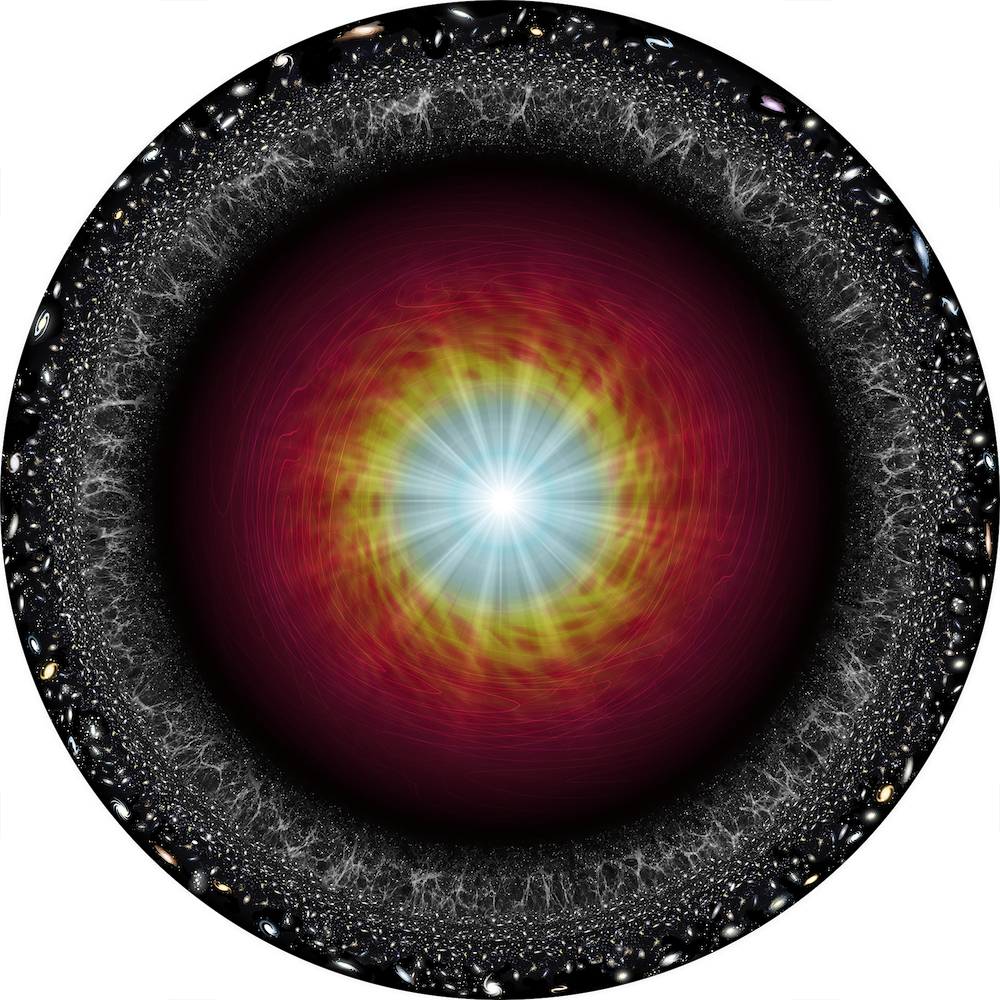
Recent space probe data readings for the so called cosmic microwave background and sky surveys by the Sloan Earth-based, digital telescope mapping the visible stars from the Earth has revealed that our own Milky Way is at the axis or center of the known universe as we know it. Scientists have found the same CMB line of the visible cosmos from the sky, space probe and ground digital telescope data gathering projects have created a very interesting map of the known universe: galaxies are aligned in concentric spheres around the Earth and the Milky Way and that the cosmic microwave background converges on the Earth along its equator and on its axis making the Earth the center of the known universe. The SDSS 3-dimensional map is the latest visual map of the known universe visible from the Earth. Each point represents a galaxy with around 100 billion stars each. Galaxies are colored according to the ages of their stars, with the redder, more strongly clustered points showing older galaxies.

NASA's COBE (1989), WMAP (2001) and PLANCK (2009) satellites were initially sent out to find proof of evidence of the Big Bang by measuring the cosmic microwave background (CMB) as a uniform energy fallout across space (isotropic energy dispersal). But the satellite probes showed the map of the universe was not a uniform dispersal of stars in chaos but had galaxies aligned in seven known concentric circles each 250 million light years apart along the axis of the Earth and across its equator. Copernican principles would remark that the Earth's Milky Way is just one among many random galaxies, one that may be at the corner of the known universe as previously believed. But the data map of universe show that the Earth and the Milky Way as factually depicted- are really located at the center of the known universe. The discussion revolves around the power spectral analysis of the CMB. Because the instrument used to look for the very fine variations (anisotropies) in the 2.725 K temperature is a differential microwave radiometer, one can only compare the temperature of one part of the sky with another. This means that those wonderful false coloured images of the temperature variations that you see published6 have a certain degree of arbitrary indeterminism (figure 1). The analysis is carried out on an angular scale by sampling various angle sizes and a power spectrum of the result is determined as a function of reciprocal angle or beam size on the sky.

Further analysis has highlighted even more problems for the inflationary big bang theory.
To analyze the result, the anisotropies are expanded in a series of spherical harmonic functions (or modes that describe how a sphere can vibrate) that when overlapped should form a random picture across the sky when projected onto a sphere (figure 2). The dipole term is the result of the well-understood motion of the solar system through space. When we look toward the direction of our motion, we see a blueshift in those temperatures of the order of 10−3, and when we look behind, we see an equivalent redshift. The magnitude of the effect is much (~40 times) larger than the fine variations of 70 μK that were ultimately discovered. So it must be subtracted. Then it is expected that higher order multipole expansion terms would have random alignments—they should not align with each other, or with any preferred direction in space.

9315-fig2
Figure. Calculated CMB quadrupole (above) and octopole (below) modes appear to be very closely aligned to the same spatial axis. (After Tegmark et al.) In addition, the inflation stage originally added to the big bang model by Alan Guth, and expanded upon and modified by others, requires that the amplitudes of all of these modes are random with Gaussian distributions and that the power in each should be about the same. The idea is that this ‘inflation’ of space itself, faster than the speed of light, in the early stages after the big bang, smoothed out all of the early structure of the universe and now it all should be a featureless uniform scale. Each mode, on average, should have an amplitude of zero.

At low angular scales, it is found that when the intensities of the microwave energy are compared at various points on the sky they are correlated, but above 60 degrees, it is found that they are completely uncorrelated. This is in striking disagreement with inflationary theory. Each multipole mode has been analysed to see where it falls on the sky and it was discovered that the octopole and quadrupole modes have axes that are very closely aligned (figure 2). Their intensities are also much lower than expected from inflationary cold dark matter models.

Analyses by Starkman and Schwarz and others seem to indicate that these octopole and quadrupole modes are aligned in some fashion with the direction of the two points on the sky where the projection of Earth’s equator onto the sky crosses the ecliptic. This lies very close to 90 degrees to the direction the solar system moves through space. All this seems to be telling us that at least a component on low angular scales is correlated with the solar system. Further evidence tells us that on some scales there exists a correlation with nearby extragalactic sources. But the fact that there is poor correlation on large scales, even when corrections are taken into account, suggests that the cosmological contribution is very weak indeed. This then is very bad news for the standard big bang model. However, this is the evidence we would expect for a galactocentric universe, with certain special features even attributed to the solar system. (From Dr John G. Hartnett's 'CMB Conundrums')

With this in mind, one of the more common objections to geocentrism is the claim that Isaac Newton’s laws of motion prove that the Earth, because it is smaller, must revolve around the sun, which is larger. In reality, Newton proved no such thing. A close examination of his laws reveals that he merely stated, of two or more bodies in a rotating system, all bodies will revolve around the center of mass. As Newton himself put it: “That the center of the system of the world is immovable….This is acknowledged by all, although some contend that the Earth, others that the sun, is fixed in that center.”434 Granted, in a closed system where the only two bodies existent are a massive sun and a small Earth, the center of mass will be much closer to the sun than the Earth, and thus, in that system the Earth would, indeed, revolve around the sun. But this is precisely the problem with the appeal to Newtonian mechanics: the appeal invariably limits the system to two bodies, the sun and the Earth, while it ignores the rest of the universe. When the rest of the universe is incorporated into the system, we now have a center of mass that is dependent on far more than the local forces we experience in our tiny solar system. On that basis, as we shall see, even Newton could not object to the Earth being the center of mass for the universe. The grand summation of his three laws of motion (namely, in a closed system the acceleration of the center of mass equals zero), will allow an immobile Earth to be the center, that is, if the universe is included in Newton’s integral calculus. As the eminent cosmologist Fred Hoyle admitted about those who quickly run to Newton to defend heliocentrism: "Although in the nineteenth century this argument was believed to be a satisfactory justification of the heliocentric theory, one found causes for disquiet if one looked into it a little more carefully. When we seek to improve on the accuracy of calculation by including mutual gravitational interactions between planets, we find – again in order to calculate correctly – that the center of the solar system must be placed at an abstract point known as the “center of mass,” which is displaced quite appreciably from the center of the Sun. And if we imagine a star to pass moderately close to the solar system, in order to calculate the perturbing effect correctly, again using the inverse-square rule, it could be essential to use a “center of mass” which included the star. The “center” in this case would lie even farther away from the center of the Sun. It appears, then, that the “center” to be used for any set of bodies depends on the way in which the local system is considered to be isolated from the universe as a whole. If a new body is added to the set from outside, or if a body is taken away, the “center” changes."

As we can see from Hoyle’s account, even if there is only one star to take into account, its mass and gravitational force must be added into the formula for determining the universe’s center of mass (or barycenter). In short, our sun, Earth and planets are not an isolated system. Advocates of heliocentrism can mount no opposition to this logic since they believe that our solar system is revolving around the Milky Way, which, of course, it cannot do unless it is experiencing a strong gravitational attraction from the center of the Milky Way. Using that same principle, when we add to our galaxy the billions of other galaxies present in the universe, we can certainly conclude that they will have a substantial effect on determining the universe’s barycenter. As all modern physicists agree (even if they don’t prefer the geocentric model): “Mass there governs inertia here.”436 These distinguished authors are referring to the total mass of the galaxies and other objects in the universe that have a direct effect on the inertia we experience on Earth. Inertia is a force, and therefore, according to modern physics, the stars transmit an inertial force to the Earth. Moreover, modern physics also says that inertial force is intimately related and indistinguishable from gravitational force. If that is the case, then certainly the total mass of the universe is an integral factor in determining both the inertial and gravitational forces that affect the Earth, as well as the forces that create the barycenter of the universe. Certainly no one can object, then, if God had decided long ago to put the Earth in that very barycenter. (From 'Galileo Was Wrong The Scientific, Scriptural, Ecclesiastical and Patristic Evidence for Geocentrism: Volume I, The Scientific Evidence' by Drs. Robert A. Sungenis, Ph.D. and Robert J. Bennett, Ph.D.)
Do you believe in global conspiracies?
No. I think that those that do are not fully following the Scripture: "Do not call conspiracy everything this people calls a conspiracy; do not fear what they fear, and do not dread it. The Lord Almighty is the one you are to regard as holy, he is the one you are to fear, he is the one you are to dread." (Isaiah 8:12-13)
 
Upvote 0

Job 33:6

Well-Known Member
Jun 15, 2017
9,767
3,309
Hartford, Connecticut
✟383,950.00
Country
United States
Gender
Male
Faith
Christian
Marital Status
Married
Politics
US-Republican
It is not the Tycho Brae model specifically, but a modified model, sometimes called semi-tychonian geocentricity. As for the Stellar Parallax, historically speaking, if we could point to one cosmological phenomenon that has been consistently advocated as the vindicator of heliocentrism, it is stellar parallax. Science books by the hundreds have declared that Frederich Bessel finally discovered heliocentrism’s longawaited proof when in 1838 he observed a slight shift in the position of a nearby star (Cygnus) against the background of a more distant star. Copernican astronomers continue to praise Bessel, but invariably they do so without either the slightest indication that parallax does not prove heliocentrism, or any admission that there is a perfectly good alternative which allows one to interpret parallax from a geocentric perspective. To understand how parallax is formed, place a finger from your right hand at arms length and align it with a finger from your left hand at half an arm’s length, both in front or your face. Observe your fingers first with your right eye open, and then with your left eye open. As you switch your vision from one eye to the other, the nearer finger will appear to shift to the right. In the heliocentric system, parallax is said to occur when, on one side of the Earth’s orbit, say January 1, two stars are viewed at the same time in a telescope, one star near us and the other star far away (at least by conventional means to measure star distances). Let’s say that the two stars we view on January 1 are aligned vertically in the same plane, that is, one star is at a higher position in our telescope lens than the other but both are on the same vertical line. Six months passes and we look at the same two stars on June 1. If parallax is demonstrated, we will see that the stars are not in a vertical alignment any longer. Assuming the Earth has orbited in a counterclockwise direction, the nearer star appears to have shifted to the right. This is due to the fact that, in the interval of six months, one has looked at the two stars from two separate locations that are 185 million miles apart (the diameter of the Earth’s orbit). Since stellar parallax can now be detected among a select few stars, most astronomers predisposed to accepting the Copernican worldview interpret the phenomenon as proof for the Earth’s movement around the sun. What most people don’t know (and what most scientists keep from them) is that in the geocentric system the same optical phenomenon can be demonstrated. In the geocentric system, the stars are centered on the sun, (which is also true in the heliocentric system). The only difference, of course, is that in the geocentric system the Earth is fixed in space while both the sun and stars revolve around the Earth. Once again, on January 1, the two stars from our above example are in vertical alignment. When we look at these same two stars again on June 1, the nearer star will appear to have shifted to the right of the farther star, and it will do so at the same precise angle as in the heliocentric model. The same effect would occur, for example, if you stood near the non-rotating Chapter 4 Galileo Was Wrong 201 center of a merry-go-round and observed the horses rotating around you. As the merry-go-round rotates, the nearer horse to you would appear to shift its position when compared to the horse farther away. In this example, the horses represent the stars, while the center of the merry-goround represents the sun, and you are the observer on Earth. A more reliable way to see this effect is to view the animation of stellar parallax we have supplied with the compact disc.

The equivalence of geocentric parallax and heliocentric parallax is nothing out of the ordinary. Based on geometrical reciprocity, the two systems must be equal on all counts. The only difference is that in the heliocentric model the Earth is moving and the stars are fixed, while in the geocentric model the Earth is fixed and the stars are moving. Everything else is exactly the same. What is out of the ordinary, however, is that the natural equivalence between the two systems has been systematically suppressed out of virtually every science book written since the days of Newton, yet it is as simple and natural as the symmetry between one’s right hand and left hand. Simply put, parallax does not prove heliocentrism. Rather, history shows that the phenomenon of parallax only proves there has been a rush to judgment in favor of heliocentrism that was based on nothing more than preference, not scientific fact.

One stumbling block toward understanding the equivalence between the heliocentric and geocentric concepts of parallax is that the original model of geocentrism advocated by Tycho Brahe did not have the stars centered on the sun; they were centered on the Earth. That being the case, no parallax would be forthcoming, at least based on the above mechanics and geometric proportions. That is, the stars would be in the same vertical alignment when one looked at them six months apart. Perhaps no one in Bessel’s day (circa 1838) realized that the only thing required to bring the geocentric model into conformity with the results of heliocentric model was to shift the center of the stars from the Earth to the sun. Consequently, the geocentric model that had the stars centered on the sun never gained its rightful place in the halls of astronomy. Tycho Brahe had not presented such a model because in his day (1546- 1601), no one had yet discovered a stellar parallax (laying aside the claims of Giovanni Pieroni cited earlier), and, in fact, this lacuna in the astronomical evidence was one of the arguments Tycho used to discredit heliocentrism. As it stands now, however, unless some astronomical proof is forthcoming that demonstrates that the stars are not centered on the sun (which is virtually impossible to do based on observation), then geocentrism has the same mechanical answer to the phenomenon of parallax as the heliocentric model. All that is needed is a slight modification to the original Tychonic model, which most geocentrists know as the modified Tychonic or neo-Tychonic model.

The neo-Tychonic model has been known to modern astronomy for quite some time and is still mentioned in some circles. For example, at the department of physics at the University of Illinois, one class lecture states: "It is often said that Tycho’s model implies the absence of parallax, and that Copernicus’ requires parallax. However, it would not be a major conceptual change to have the stars orbit the sun (like the planets) for Tycho, which would give the same yearly shifts in their apparent positions as parallax gives. Thus if parallax were observed, a flexible Tychonean could adjust the theory to account for it, without undue complexity. What if parallax were not observed? For Copernicus, one only requires that the stars be far enough away for the parallax to be unmeasurable. Therefore the presence or absence of parallax doesn’t force the choice of one type of model over the other. If different stars were to show different amounts of parallax, that would rule out the possibility of them all being on one sphere, but still not really decide between Tycho and Copernicus."

The same course material adds the following conclusion: "In fact, if we don’t worry about the distant stars, these two models describe identical relative motions of all the objects in the solar system. So the role of observation is not as direct as you might have guessed. There is no bare observation that can distinguish whether Tycho (taken broadly) or Copernicus (taken broadly) is right." Regarding the size and limits of the universe, if there is one cosmological phenomenon that has been consistently avocated as the vindicator of heliocentrism, it is stellar parallax. Science books by the hundreds have declared that Frederich Bessel finally discovered heliocentrism’s long-awaited proof when, in 1838, he observed a slight shift in the position of a nearby star (Cygnus 61) against the background of a more distant star. Copernican astronomers continue to praise Bessel, but invariably they do so without either the slightest indication that parallax does not prove heliocentrism, or any admission that there is a perfectly good alternative which allows one to interpret parallax from a geocentric perspective. For example, Alan Hirshfeld, writing one of the more recent books on parallax, attempts to convince his reader that parallax is last word of the heliocentric/geocentric debate: "In Newton’s day, the Ptolemaic system and the Keplerian version of the Copernican system were taught side by side in the universities of the world. But the pendulum of belief had swung irreversibly to the Copernican side. In the minds of most scientists, the heliocentric universe had become fact…Yet there remained a crucial missing element in what was otherwise a complete and compelling picture of the universe: Not one shred of indisputable observational proof existed that the Earth moved through space. Here then was the holy grail of many an astronomer. To prove that the Earth in fact revolved in a wide orbit around the Sun, the parallax of just one star – any star – had to be detected. The hunt for stellar parallax was on." (From 'Galileo Was Wrong The Scientific, Scriptural, Ecclesiastical and Patristic Evidence for Geocentrism: Volume I, The Scientific Evidence' by Drs. Robert A. Sungenis, Ph.D. and Robert J. Bennett, Ph.D.)

Sorry, this is all completely made-up. There is no working model for all of this. This is completely imaginary and makes no sense.

Stars orbiting the Earth in a way that precisely mimics Earth's motion around the Sun would be unnecessarily convoluted and bizarrely complex.

Not only would the stars have to revolve around the Earth daily (and not over 6 months) but they would also need to execute additional precise movements to mimic parallax. Considering that stars are light-years away, the speed required for these motions becomes absurdly high. Several times the speed of light.

I won't even bother debating this one.

And of course this doesn't include the whole global conspiracy topic in which dozens of nations across the planet have already flown satellites and drones beyond distant planets and have verified that the sun doesn't orbit the earth.
 
Upvote 0

prodromos

Senior Veteran
Site Supporter
Nov 28, 2003
24,785
15,952
60
Sydney, Straya
✟1,554,429.00
Country
Australia
Gender
Male
Faith
Eastern Orthodox
Marital Status
Married
Sorry, this is all completely made-up. There is no working model for all of this. This is completely imaginary and makes no sense.

Stars orbiting the Earth in a way that precisely mimics Earth's motion around the Sun would be unnecessarily convoluted and bizarrely complex.

Not only would the stars have to revolve around the Earth daily (and not over 6 months) but they would also need to execute additional precise movements to mimic parallax. Considering that stars are light-years away, the speed required for these motions becomes absurdly high. Several times the speed of light.

I won't even bother debating this one.

And of course this doesn't include the whole global conspiracy topic in which dozens of nations across the planet have already flown satellites and drones beyond distant planets and have verified that the sun doesn't orbit the earth.
Yep! I'm going with Occam's razor on this.
 
Upvote 0

AveChristusRex

Well-Known Member
Nov 20, 2024
480
225
19
Bible Belt
✟52,129.00
Country
United States
Gender
Male
Faith
Catholic
Marital Status
Single
Yep - The simplest explanation is usually the one closest to the truth.
I don't think that prodromos or Job 33:6 would disagree with me in saying that the simplest explanation for the perception of the horizon is that the earth is round, yet the details on how the world revolves is a little more complex and requires a lot more than occam's razor.
 
Upvote 0

Apple Sky

In Sight Like Unto An Emerald
Site Supporter
Jan 7, 2024
10,303
1,567
South Wales
✟344,140.00
Country
United Kingdom
Gender
Female
Faith
Christian
Marital Status
Married
yet the details on how the world revolves is a little more complex and requires a lot more than occam's razor.

No it doesn't this also is simple, as the earth does not revolve, the earth is unmovable. It is the sun, moon & the stars that move not the earth.
 
Upvote 0

Akita Suggagaki

Well-Known Member
Jul 20, 2018
10,828
7,702
70
Midwest
✟393,606.00
Country
United States
Gender
Male
Faith
Catholic
Marital Status
Married
Politics
US-Others
Upvote 0

AveChristusRex

Well-Known Member
Nov 20, 2024
480
225
19
Bible Belt
✟52,129.00
Country
United States
Gender
Male
Faith
Catholic
Marital Status
Single
Although it's hard to imagine, there is no center — or edge — to our cosmos.
I think this is based on the Copernican Principle, which discounts the idea that the Earth is the center of the universe in totality. However, Edwin Hubble said (The Observational Approach to Cosmology): "…Such a condition would imply that we occupy a unique position in the universe, analogous, in a sense, to the ancient conception of a central Earth…This hypothesis cannot be disproved, but it is unwelcome and would only be accepted as a last resort in order to save the phenomena. Therefore we disregard this possibility…. the unwelcome position of a favored location must be avoided at all costs…. such a favored position is intolerable…Therefore, in order to restore homogeneity, and to escape the horror of a unique position…must be compensated by spatial curvature. There seems to be no other escape.” Moreover, George Ellis, a famous cosmologist in Scientific American, “Thinking Globally, Acting Universally,” October 1995: "People need to be aware that there is a range of models that could explain the observations,” Ellis argues. “For instance, I can construct you a spherically symmetrical universe with Earth at its center, and you cannot disprove it based on observations.” Ellis has published a paper on this. “You can only exclude it on philosophical grounds. In my view there is absolutely nothing wrong in that. What I want to bring into the open is the fact that we are using philosophical criteria in choosing our models. A lot of cosmology tries to hide that.”
 
Upvote 0

d taylor

Well-Known Member
Oct 16, 2018
14,351
6,124
61
Mississippi
✟347,956.00
Country
United States
Gender
Male
Faith
Protestant
Marital Status
Single
Out of curiosity, do heliocentric flat earthers exist?
-
I am sure you could find someone or a group who may believe that.

But in general flat earth believers believe the sun moves over a flat stationary earth.
 
Upvote 0

prodromos

Senior Veteran
Site Supporter
Nov 28, 2003
24,785
15,952
60
Sydney, Straya
✟1,554,429.00
Country
Australia
Gender
Male
Faith
Eastern Orthodox
Marital Status
Married
But in general flat earth believers believe the sun moves over a flat stationary earth.​
And still they cannot explain sunsets without contradicting themselves.
 
Upvote 0