- Jun 27, 2012
- 159
- 8
- Gender
- Male
- Faith
- Pentecostal
- Marital Status
- Married
- Politics
- US-Republican
Starting today August 7th, 2024, in order to post in the Married Couples, Courting Couples, or Singles forums, you will not be allowed to post if you have your Marital status designated as private. Announcements will be made in the respective forums as well but please note that if yours is currently listed as Private, you will need to submit a ticket in the Support Area to have yours changed.


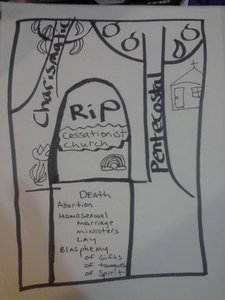
I see, you've pointed out that there are two primary streams within the Full Gospel movement which lead to the Heavenly Realm, with the first being the Pentecostals and with the Charismatic movement which began in the 60's and 70's; and where cessationism is essentially dead in the ground with no feet to stand on.there must be divisions to see who is approved of God. See attached art

I see, you've pointed out that there are two primary streams within the Full Gospel movement which lead to the Heavenly Realm, with the first being the Pentecostals and with the Charismatic movement which began in the 60's and 70's; and where cessationism is essentially dead in the ground with no feet to stand on.
With your "Blasphemies of gifts..." I presume that you meant to say "Blasphemies against the gifts...".
PS. As many contemporay Christians don't always see the important difference between the Pentecostal and charismatic movements this means that your chart could easily be misunderstood.
What do you mean by the "spiritual gifts" exactly?Truth and power. I somewhat agree but there are other spirits that masquerade as the Holy Spirit and the gifts of the Holy Spirit.
What do you mean by the "spiritual gifts" exactly?
Actually, 1 Cor 12 has 2 different lists, and you missed a few.1 Corinthians 12
Word of knowledge, word of wisdom, faith, tongues, interpretation of tongues, prophecy, discerning of spirits, administrations.
Actually, 1 Cor 12 has 2 different lists, and you missed a few.
The first list: 1 Cor 12.8-10 (9 total)
word of wisdom
word of knowledge
faith
gifts of healing
miracles
prophecy
discerning of spirits
tongues
interpretation of tongues
The 2nd list: 1 Cor 12.28 (8 total)
apostles
prophets
teachers
miracles
gifts of healing
helps
administrations
tongues
And there are other lists in Romans 12, Ephesians 4, and 2 Pet 4.
That's okay, your typo has been forgiven.Alright, I missed healing and miracles.
Of the 8 Congregational Offices, I would deem only four to be Spirit initiated (in bold) whereas the remaining four are based more on our temperament, character and personality.
As my position is that Paul never uses the term “spiritual gifts”, where I follow 1Cor 12:1 Περὶ δὲ τῶν πνευματικῶν, which is ‘spiritual matters or things’ and with 12:4 Διαιρέσεις δὲ χαρισμάτων, which is ‘varieties of free-graces’ and most importantly with 1Cor 12:7 φανέρωσις τοῦ πνεύματος ‘operations/manifestations of the Spirit’; in light of this, if you had both the time and patience I could ask you to spend a bit of time where you could possibly answer the question for me.And where would you place all the ministry gifts from Romans 12?
6 Since we have gifts that differ according to the grace given to us, each of us is to exercise them accordingly: if prophecy, according to the proportion of his faith; 7 if service, in his serving; or he who teaches, in his teaching; 8 or he who exhorts, in his exhortation; he who gives, with liberality; he who leads, with diligence; he who shows mercy, with cheerfulness.
1 Prophecy
2 Service
3 Teaching
4 Exhortation
5 Giving
6 Leading
7 Mercy
You should find my reply interesting. Even though Paul certainly included a few Hebraisms this post should hopefully be able to demonstrate that Paul’s thought was indeed Greek where he (and/or his scribes) followed the principles of Graeco-Roman rhetoric.Biblicist - I would submit that your analysis is way too Greek and not near enough to Hebraic thought to be of use. The Greek approach is to subdivide everything thing down to component parts; (exactly what you are doing) while Hebraic thought looks at everything as a whole or part of a whole. Specifically with spiritual gifts Paul uses the various giftings as different parts of the same body (read 1 Cor 12)]/quote]
I see your differentiation between "operation of the Spirit" giftings and "temperament, character and personality" giftings to have no biblical merit.
Remember Paul was not trained under the tutelage of Aristotle or Socrates; but Gamaliel the Great, grandson of the Jewish sage Hillel. But he was writing to people who were more familiar with Aristotle than Hillel. So he used one to explain the other.
It does seem that your position is difficult to substantiate and as Paul's family were Roman citizens then we are compelled to acknowledge that he would have had some exposure to Graeco-Roman education. Most importantly, as he wrote his letters in Greek and not Hebrew where his rhetorical style was fully Hellenistic, then any Hebraisms that he employed were understandably encased within Hellenistic thought and not Hebrew.So I submit that he was NOT "raised within a Hellenistic culture," but rather used his intense Hebraic training to educate the Gentiles he was called to with the knowledge of the God of Israel in terms they could comprehend.
ETA: I would encourage you to read some Messianic takes on Paul, like Brad Young's "Paul the Jewish Theologian," or Joseph Shulam's "Commentary on the Jewish Roots of Romans."
It makes no sense to believe that Paul would spend his time writing complex letters to the Churches in the Greek speaking empire; if he had followed Hebraic thought then his letters would have made no sense where his readers would have laughed them off.
I went and had a quick look at Young's material on Google Books but unfortunately the copy they supplied did not contain any footnotes so I was unable to see where he was reviewing his peers.While it was true his family were Roman citizens, he also says they were Pharisees. That means Jewish to the core. That also means they (his forefathers) had to be trained at one of the Pharisaic training schools, discipled by a Pharisee master.
Acts 23:6 But when Paul perceived that the one part were Sadducees and the other Pharisees, he cried out in the council, Brethren, I am a Pharisee, a son of Pharisees: touching the hope and resurrection of the dead I am called in question.
Not so. Paul was highly intelligent and the Hebraic style and thought are clearly there but only to those who recognize it. Since he was writing to helenists, he wrote in their language; so fluently that his underlying Hebraic thought pattern goes unrecognized by most.
Again I suggest you look at the books I recommended, especially the one by Brad Young.