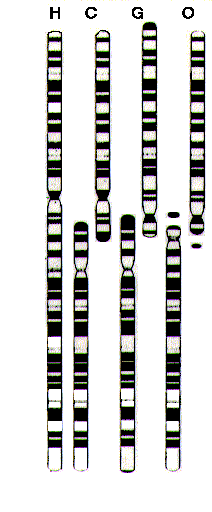
Second Jerry Smith post
Alone, the evidence from transitional fossils may be incomplete. Together with the other, independent, lines of evidence, it is conclusive.
Anatomically speaking, our nearest relative is the chimpanzee, Pan troglodytes. The adult chimpanzee has an average cranial capacity of 350-420cc. If we have a common ancestor, it would have to be one that could reasonably have descendants with brains the size of chimpanzees, and others with brains our size. The simplest scenario is that the common ancestor had a brain size roughly the same as chimps, and that that characteristic has changed little in chimps and more in humans. The actual historical scenario is likely to be the same. Let us get started with the proposition that it is likely that no other vertebrates have brains as large as humans, and since there is no indication that they ever did, that we evolved from creatures with brains similar in size to or slightly smaller than the chimpanzee's brain.
We could look at all the more technical and detailed characteristics and get a much better view (teeth, leg joints, skull shape, etc.), and we would still find much the same pattern as I will show you with skull sizes. Bear in mind that not all of these transitional forms are direct ancestors of humans. Without question, Homo erectus is. Others may be direct ancestors, or they may be cousins of our direct ancestors, proto-human organisms that had diverged from the line that eventually would lead to us. Nevertheless, all are transitional in that all are in most ways representative of their genus, and their genera are absolutely transitional in morphology (the way their bodies were made) between humans and a more ape-like creature that would be the common ancestor of humans and other modern apes.
I will list them in roughly chronological order (oldest first), along with their brain-size. Note that the oldest australopithecines have chimp-sized brains. They are transitional because of the fact that they had begun to walk upright, and carry a few other characteristics of Homo.
Bear in mind, the chimp has a cranial capacity of 350-420cc.
Australopithecus afarensis:
cranial capacity: 400 - 500cc
Fossils found in age ranging from 3.5 - 3.0 million years old.
Australopithecus africanus:
cranial capacity: 400 - 500cc
Fossils found 2.8 - 2.3 million years old
Paranthropus boisei:
cranial capacity 450 - 550cc
Fossils found 2.3 - 1.4 million years old
Homo rudolfensis (closest to Homo habilis, which I omit from the list) :
cranial capacity: 750 - ca 800cc
Fossils found 2.4 - 1.9 million years old
Homo ergaster (close relative of homo erectus - species name reflects smaller cranial capacity and range of distribution limited to Africa):
800 - 850cc
1.8 - 1.5 million years old
Homo erectus:
1,043cc
500,000 - 300,000 years old
Homo heidelbergensis:
1,300cc
0.6 - 0.2 million years old
Homo neanderthalensis (or Homo sapiens neanderthaensis)
1200 - 1750cc
300,000 - 30,000 years old (not thought to be directly ancestral to modern humans)
This information is taken from the australian museum on-line human evolution exhibit
And finally, about 100,000 years ago, modern humans appear (Homo sapiens sapiens), sporting a cranial capacity of 1200 - 1700 cc.
Evolution strongly predicts that there were intermediates between the common ancestor of apes and humans and modern humans: evolution says that the differences between us and chimps are great enough that they should have taken several intermediate "steps." Finding several intermediate steps as fossils, that date (according to conventional methods) to the proper period (after the first great apes, before the first humans) is strong evidence in favor of evolution.
Special creationism has difficulty accounting for them. Creationists must maintain that any one of these must be either
1) a big-brained walking ape, specially created separately from humans, or
2) a human, specially created from any of the apes.
The problem is that those which are specially created apes can clearly "evolve within their kind", and there is little that separates them from the ones labelled human. Special creationism has another problem. Their theory is inconsistent. If you will follow this link:
http://www.talkorigins.org/faqs/homs/compare.html
And, if you will scroll just past the first group of photos, you will find a chart of creationist classifications of some of the fossil hominids. What better proof that they are transitional in morphology than when the same fossil is "100% human" in the eyes of one scientific creationist, and "100% ape" in the opinion of another scientific creationist?
I am leaving out quite a bit (including much that I had hoped to cobble together for this post. I meant for it to be more than just a stripped down list of ages and skull sizes.) I just cannot organize the vast amount of information (and the vast number of creationist criticisms) of the fossil evidence from the hominids. In fact, I did not list all of the fossil hominids that have been found. If you would like more detail on any particular issue, please ask & one of us will be glad to help you find it. If there is a creationist criticism of some part of this data that seems like it may be strong enough to counter the support this gives for human evolution, please post it and let us answer it.
Even though Lucaspa's post is too technical for easy digestion, it shows that even between these fossil transitionals, we find more intermediate steps!
Transitional hominid fossils are a kind of evidence we would never even think to look for should we take the creationist perspective, but we must consider the likelihood of finding if evolution is true. The fact that they exist, and bridge the "gap" between apes and humans so closely is powerful confirmation of evolution.
So now we have a recent arrival of humans, a law that says all complex life (humans for instance) comes from the reproduction of similar parents, the fact of "micro-evolution" (that the differences between parents and offspring introduces novelty that may give some of those differences enough of an advantage the characteristics of the species change), apes which preceded humans and are very similar, and several transitional fossils that are each similar to apes, but are more similar to humans than apes are! We see that the oldest of these is so similar to apes that they could easily have evolved from apes, and the most recent are so similar to humans that humans could easily evolved from them. Between, we find "stepping stones".
At this point, having very briefly reviewed the paleontological evidence, and having seen the difficulties creationism must face to explain it away, it would be easy to conclude that apes and humans are closely related with a fair degree of certainty, and dismiss the creationist position. We might chalk this up as a fluke, though, if we were not aware of all of the other paleontological evidence that seems to link so many groups of living and extinct organisms together. Instead of repeating this performance for all of the many, many, organisms known to be related, I will move on in my next post to the molecular data: to me, the most convincing.