• Starting today August 7th, 2024, in order to post in the Married Couples, Courting Couples, or Singles forums, you will not be allowed to post if you have your Marital status designated as private. Announcements will be made in the respective forums as well but please note that if yours is currently listed as Private, you will need to submit a ticket in the Support Area to have yours changed.

  • CF has always been a site that welcomes people from different backgrounds and beliefs to participate in discussion and even debate. That is the nature of its ministry. In view of recent events emotions are running very high. We need to remind people of some basic principles in debating on this site. We need to be civil when we express differences in opinion. No personal attacks. Avoid you, your statements. Don't characterize an entire political party with comparisons to Fascism or Communism or other extreme movements that committed atrocities. CF is not the place for broad brush or blanket statements about groups and political parties. Put the broad brushes and blankets away when you come to CF, better yet, put them in the incinerator. Debate had no place for them. We need to remember that people that commit acts of violence represent themselves or a small extreme faction.

Some of the evidence for chimp-human common ancestry.

WinAce

Just an old legend...
Jun 23, 2002
1,077
47
41
In perpetual bliss, so long as I'm with Jess.
Visit site
✟31,806.00
Faith
Atheist
Marital Status
Married
Politics
US-Others
Evidence that apes and humans share a common ancestor comes from many fields. Below will be only a partial list, to give you an idea of just how overwhelming it is.

(1) Fossil intermediates morphologically intermediate between modern apes and modern humans.

Exhibit A, below, taken from the TalkOrigins 29 'Evidences' for Evolution FAQ:
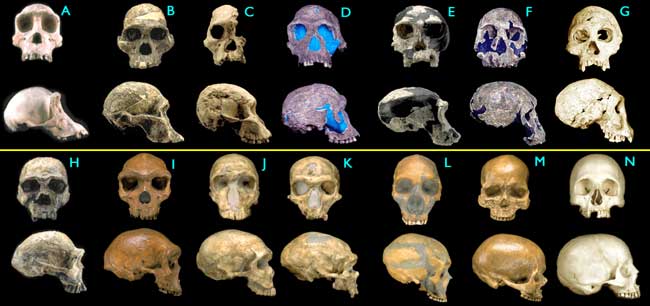
hominids2.jpg


Fossil hominid skulls. The first, A, is a modern chimpanzee. The last, N, is a modern human. Those in-between are some of the more important fossils we've found, arranged in linear order. Notice how the earliest fossils are more and more ape-like, whereas the later ones are more and more human-like. The ones in-between more or less completely blur the line between human and ape, possessing excellent combinations of primitive and derived traits. Especially note the less elongated jawline and increasing brain size from earliest to latest skulls.

The theory of common ancestry imposes very stringent restrictions on what we should find and (and not find!) in the fossil record. Since we see a linear change from less human to more human, the theory is spectacularly corroborated. Since we don't ever see any fossils that are totally prohibited by evolution, such as apes with eagle eyes or other mix-and-match uses of the best designs available, evolution is doubly corroborated.

Both tests (as well as others) are an empirical experiment that tests evolution's validity. It passes with flying colors.

(2) Identical pseudogenes in apes and humans that corroborate the powerful fossil evidence.

Taken from the TalkOrigins Plagiarized Errors and Molecular Genetics FAQ:

Pseudogenes are formerly active genes that have been been the victims of crippling mutations and no longer express protein. Our genomes are littered with them, from the GLO pseudogene that produces vitamin C to dozens that control the olfactory systems in other mammals.

Normally, genes are preserved quite well by natural selection, and individuals with crippled genes are filtered out of the population. Occasionally, however, a gene with no mission-critical function will get deactivated and the organism can get along equally well without it. For example, a gene coding for the production of a protein that's abundant in the animal's diet anyway is irrelevant to its reproductive fitness.

Crippling mutations come in literally dozens of varieties: parts of the gene may become overwritten with another; parts of the gene may be cut out; random detritus can be spliced in, breaking its function; two genes can be merged together; parts of the gene can be shuffled with other parts; etc. We know they occur because we observe them in the lab and can even artificially induce them.

The causes of mutations range from errant cosmic rays to toxins in the environment. The common adage of "no two snowflakes are alike" applies even more here, as the odds of getting the same crippling mutation twice are somewhere in the astronomical range.

This leads us back to the newly formed pseudogene. As long as it bears no selection disadvantage, random genetic drift can establish the damaged gene in a small population. Should that population be successful and displace the others, the gene will be established in the entire species as a molecular vestige.

Any two offshoot species will hence be identifiable as related if they share the same crippled mutations in damaged genes. Does this apply to humans and apes?

The answer is a resounding "Yes!". Examples are listed below.

Primates, unlike all other mammals (with the exception of guinea pigs), cannot synthesize Vitamin C. In days long past, this led to tragic outbreaks of scurvy on seafaring voyages. Using the predictions of evolution, scientists hypothesized that the gene for vitamin C production would be found in humans as well, despite our not being able to produce it.

Lo and behold, a GLO (ascorbic acid pseudogene) was identified in humans at exactly the same spots other mammals have functional vitamin C genes. What's more, the other great apes (chimps, gorillas and orangutans) had an identical broken pseudogene!

The common ancestor of apes and humans lived in a fruit-rich environment and had no need to synthesize their own vitamin C, making the loss of that gene entirely neutral. Guinea pigs also have a damaged GLO pseudogene, but the mutation that crippled it is different, as expected if it was an independent occurence.

Other occurences of shared pseudogenes include the one coding for Urate Oxydase, which make our species vulnerable to gout, and dozens of them that code for powerful smell in other animals but are crippled in humans, but one should suffice for now.

Observations in the area of pseudogenes that would falsify evolution include finding the same pseudogene in humans and dogs but not apes; since apes and humans share a closer ancestry than dogs and humans, any pseudogenes found in dogs and humans MUST be found in humans and apes because they belonged to the common ancestor of the latter. Hence, the theory of evolution passes this series of empirical experiments as well.

(3) Atavisms. Lost traits indicative of our species' history that occasionally resurface in modern individuals and again corroborate hypothesized evolutionary relationships.

Taken from here:

tail.jpg


Exhibit B, X-ray image of an atavistic human tail. The subject is a 6-year old girl.

Note: pseudotails are an entirely different phenomenon and unrelated to real human tails. Pseudotails are merely abnormal protrusions of skin and muscle in the sacral region, whereas some real human tails have nerve ganglia, cartilage, additional vertebrae, and can be consciously moved and contracted. In addition, cases have been reported where they've been inherited in families.

Human fetuses are frequently covered in a minute fur (called lanugo) that becomes reabsorbed shortly before birth. Rarely, this feature is retained, resulting in what is known as Werewolf Syndrome by the press - a human covered in thick, animal-like fur.

This evidence more or less speaks for itself, but I'll offer a few additional comments. Atavisms are another empirical test for evolution's validity. The theory predicts only those atavisms that reflect traits in ancestral species will be found. This, for example, means that finding wing atavisms on a human, gills on a whale, fur on a fish, or some such, immediately and uncontrovertably falsifies evolution.

On the other hand, finding excessive fur on a human, developed hind legs in whales or snakes, or other atavisms totally consistent with their hypothesized evolutionary history is a strong confirmation.
 
  • Like
Reactions: h2whoa

WinAce

Just an old legend...
Jun 23, 2002
1,077
47
41
In perpetual bliss, so long as I'm with Jess.
Visit site
✟31,806.00
Faith
Atheist
Marital Status
Married
Politics
US-Others
>>>>>> Continued <<<<<<

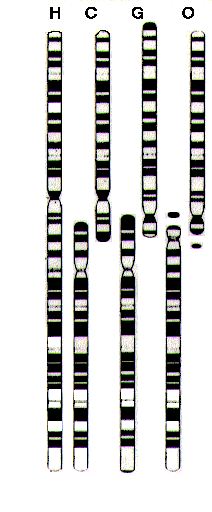
(4) Human chromosome 2 is an exact duplicate of two ape chromosomes, but they're fused together. Humans also have 1 less chromosome than apes. Coincidence?

From here:

A rare mutation exists that can fuse two chromosomes into one. It's been observed in the lab and accounts for several cases of chromosome number discrepancy between domestic horses and wild ones, species of mice, and others. While it normally results in infertility and death, occasionally no important DNA is affected by the chromosome fusion and it can be passed on to descendants.

It's long been known that humans and apes have a different number of chromosomes; some have argued this is evidence they are not related, in fact. But biologists hypothesized that the discrepancy was accounted for by a chromosome fusion and made several tantalizing and very unlikely successful predictions as to how our genome should look.

hum_ape_chrom_2.gif


Exhibit C; human, chimp, gorilla and orangutan chromosomes lined up. Notice the banding patterns on human chromosome 2 and how they look identical to 2 different ape chromosomes. Both arrangements work equally well, as location on chromosomes does not affect activity of genes; nevertheless, instead of two different chromosomes or one large one, ours is fused as a perfect evolutionary vestige.

But do mere looks tell us that indeed, this is a genuine fused chromosome from our ape-like ancestor? The conclusion would already be reasonable given the evidence, but the theory of common ancestry predicts yet more observations.

Chromosomes end in what are known as "telomeres" that are identifiable repeats of the same DNA bases. Conversely, they also contain characteristic "centromeres" near the middle. If our chromosome 2 was fused from two ape-like chromosomes, we would expect to find the inverse; telomeres in the middle, where the two old ones met, and centromeres halfway toward each end from the middle, as opposed to the middle itself.

Both predictions are true. Centromeres and telomeres have been identified in human chromosome 2 exactly as evolution told us they would.

This was another experiment to demonstrate the truth of evolution: had humans had no traces of the fusion, we would be hard-pressed to account for the discrepancy without seeing any remnant of the missing one. Not only would hundreds of genes on the chromosome be deleted in the process, almost assuredly rendering the mutant infertile or worse, but mutations that delete entire genes or chromosomes without leaving a trace are spectacularly rare.

Had this been due to deliberate design, we would likely see two different fused human chromosomes. Or one large one, but without the bizarre misplaced centromeres and telomeres that only lead to the conclusion of common ancestry. Both would be falsifications of evolution.

(5) Endogenous retroviral infections from the ancient past and their role in confirming what is already painfully obvious.

Taken from here:

Retroviral infections can occasionally infect a germ line cell. The resulting offspring will have bits and pieces of the virus stuck in every cell in its body. We've observed this very rare process in the lab, and the odds of getting two independent infections to leave the same bit of viral DNA at the same exact locus are astronomically unlikely.

Like pseudogenes, the viral fragments can piggyback on the success of an individual and become established in the species. The chances of any particular viral fragment, even if inserted identically in two seperate cases, becoming established in two seperate populations (a rare event in and of itself) makes this not just improbable, but more or less impossible without divine intervention ;)

Any offshoot species will have the same unlikely and easily identifiable ERV, enabling us to construct accurate phylogenies from an independent line of evidence.

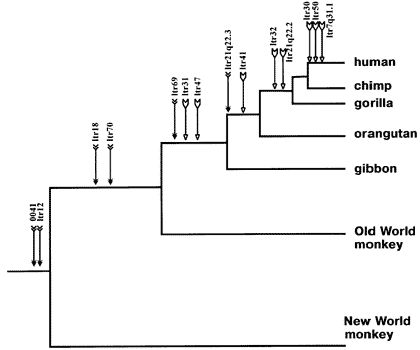
retrovirus.gif


Exhibit D; human endogenous retrovirii insertions in identical chromosomal locations in various primates. Notice just how well the standard evolutionary phylogeny (humans and chimps closest, then orangutans and gorillas, then gibbons, then old world monkeys, then new world monkeys) is represented by this line of evidence.

ERVs have also been used to reconstruct the relationships between dogs, jackals, wolves and foxes; various breeds of domestic cat and wild cat; and even to establish the shared ancestry of cows and whales. (In the last case, two independent viral infections accounting for the evidence is impossible - whales and cows do not even share the same environment, much less are exposed to the same diseases!)

Needless to say, this offers numerous falsification avenues for evolution. Any ERV shared between organisms farther on the phylogenetic relationship than humans and apes must *also* be found in both. For example, ERVs found in New World Monkeys and chimps MUST be present in humans (aside from a few very rare cases where they've been deleted, but we can tell when a deletion has occured) or evolution is falsified.

An ERV in dogs and humans but not chimps would put the theory on its deathbed; so would a phylogeny reconstructed from these viral fragments if it differed significantly from the accepted phylogeny based on morphological, fossil, pseudogene, anatomical, and other evidence. This is the strongest evidence for evolution I've ever come across; a truly powerful and damning smoking gun.

Conclusion

These 5 lines of evidence (and there are many more) are all not just explained by evolution, but predicted by it. Each one could mean falsification and relegation to the scientific dust bin of history, along with phlogiston and a geocentric earth, or repeated vindication to the point where "nothing in biology makes sense except in light of evolution", as stated by Theodore Dobzhansky.

Each is an empirical experiment that most certainly establishes that common descent is not only science, but one of the most well-supported theories in all of science.

Whether one believes in god(s) or not, the evidence is clear - apes and humans share a common ancestor. The origin of that evolutionary process is a seperate question entirely and the scientific facts cannot (as of yet) clue us in on whether deity(ies) were involved, so evolution is not a threat to religious beliefs.
 
Upvote 0

euphoric

He hates these cans!!
Jun 22, 2002
480
5
50
Visit site
✟30,771.00
Faith
Atheist
Marital Status
Single
Politics
US-Republican
Today at 05:38 AM Pete Harcoff said this in Post #4


I would be surprised if any creationists bothered to respond at all.

Well, if we hold to pattern, we'll sit around waiting for one and posting pithy comments about their absence.&nbsp; After a page and a half or so, a YEC will make a feeble and desperate attempt to dismiss the evidence and we'll have a nice chuckle.

-brett
 
Upvote 0

jon1101

Well-Known Member
Dec 31, 2001
1,030
5
40
Hillsdale, Michigan
Visit site
✟1,871.00
Faith
Christian
Yesterday at 11:46 PM euphoric said this in Post #5


Well, if we hold to pattern, we'll sit around waiting for one and posting pithy comments about their absence.&nbsp; After a page and a half or so, a YEC will make a feeble and desperate attempt to dismiss the evidence and we'll have a nice chuckle.

-brett

Hey now, you forgot to mention the occasional YEC who comes to realize the validity of evolution. ;)

-jon
 
Upvote 0

euphoric

He hates these cans!!
Jun 22, 2002
480
5
50
Visit site
✟30,771.00
Faith
Atheist
Marital Status
Single
Politics
US-Republican
Today at 06:40 AM jon1101 said this in Post #7


Hey now, you forgot to mention the occasional YEC who comes to realize the validity of evolution. ;)

-jon

I view a YEC converting the same way I view heaven.&nbsp; It'll be wonderful if it happens, but I ain't holding my breath.

Though it does happen, and perhaps that's not a fair comparison.&nbsp; After all several of our resident old earthers were once YEC's themselves IIRC.

-brett
 
Upvote 0

JohnR7

Well-Known Member
Feb 9, 2002
25,258
209
Ohio
✟29,532.00
Faith
Pentecostal
Marital Status
Married
Today at 04:10 AM euphoric said this in Post #9


I view a YEC converting the same way I view heaven.&nbsp; It'll be wonderful if it happens, but I ain't holding my breath.&nbsp;

Holding your breath would not get you there anyways.

A few years ago I went to Hong Kong. Thinking that Hong Kong must be a wonderful place did not get me there. I had to get on the plane.

If you want to go to Heaven, there are things you have to do to get there. Jesus is the Plane and you have to get on board. You have to take the new and the living way. He provides&nbsp;the abundant life for us to live that will take us to heaven.

The good news is, out ticket is already paid. All we need to do is get on board.
 
Upvote 0

euphoric

He hates these cans!!
Jun 22, 2002
480
5
50
Visit site
✟30,771.00
Faith
Atheist
Marital Status
Single
Politics
US-Republican
Today at 09:56 AM JohnR7 said this in Post #10


Holding your breath would not get you there anyways.

A few years ago I went to Hong Kong. Thinking that Hong Kong must be a wonderful place did not get me there. I had to get on the plane.

If you want to go to Heaven, there are things you have to do to get there. Jesus is the Plane and you have to get on board. You have to take the new and the living way. He provides&nbsp;the abundant life for us to live that will take us to heaven.

The good news is, out ticket is already paid. All we need to do is get on board.

You seem to be neglecting one critical difference between your scenario and mine.&nbsp; You have a reasonable assurance that Hong Kong actually exists.

-brett
 
Upvote 0

joelazcr

Active Member
Jan 2, 2003
89
4
Visit site
✟229.00
Faith
Non-Denom
Fossil intermediates morphologically intermediate between modern apes and modern humans.


The March 28 issue of Science has a perspective by Tim White which discusses this
type of broad brush linear evolutionary path from an apelike precursor to man.

Early Hominids--Diversity or Distortion?

Recent years have seen the discovery of numerous new hominid species, and the hominid evolutionary tree is now commonly drawn as a complex bush. In his Perspective, White raises a cautionary note, arguing that some fossils may be so distorted that assignment to a new species is premature. Furthermore, natural variation among species must be taken into consideration. The author concludes that it is too early to say whether many more hominid lineages are waiting to be found and recognized in Africa, or whether just a few hominid species expanded their ranges and invaded new habitats.


Nature journal also recognizes this:

Flat-faced Man in family feud
Palaeontologist claims geology set human relative apart

"Geology, not genes, gave the Flat-faced Man his distinctive looks, White reckons. Over time, he explains, fine-grained rock invaded tiny cracks in the skull and distorted its shape in an irregular way.

White has seen the Flat-faced Man, but has not conducted a full study. His suggestions are based mainly on the state of other fossils, especially some 30-million-year-old skulls of flat-headed pig relatives called oreodonts found in the early 1900s in the western United States. These were "flattened and narrowed by geological deformation, not natural selection", White says.

It is plausible that the same process has muddled the K. platyops story, says Elwyn Simons, who studies primate evolution at Duke University in Durham, North Carolina. Once again, he says, "the evidence may not support the description of a new genus".


It seems like the experts cannot agree on this linear evoluionary path, while
talkorigins boasts of its existence.

&nbsp;
White shows two very different looking skulls of modern female chimpanzees.&nbsp; One is narrow, the other broad; one profile has a pronounced slant, and the other is compressed.&nbsp; The teeth, brow ridges, skull cap and eye sockets are remarkably different - yet they are both the same species and the same sex.&nbsp; White points out that "This variation is normal in a single sex of an extant species; even more variation is present in other extant ape species." Yet an amateur would almost surely classify these skulls separately.
&nbsp;
Tim White concludes his article: "Confusing true biological species diversity with analytical mistakes, preservational artifacts, diachronic evolution, or normal biological variation grossly distorts our understanding of human evolution.&nbsp; Past hominid diversity should be established by the canons of modern biology, not by a populist zeal for diversity."&nbsp;&nbsp;&nbsp;&nbsp;

&nbsp;
The theory of common ancestry imposes very stringent restrictions on what we should find and (and not find!) in the fossil record. Since we see a linear change from less human to more human, the theory is spectacularly corroborated. Since we don't ever see any fossils that are totally prohibited by evolution, such as apes with eagle eyes or other mix-and-match uses of the best designs available, evolution is doubly corroborated.

What are these stringent restrictions of common ancestry which
predict the linear path of human evolution?&nbsp; How much has fossil distortion and natural variation&nbsp;among species been considered when plotting this evolutionay path?


&nbsp;
 
Upvote 0

jon1101

Well-Known Member
Dec 31, 2001
1,030
5
40
Hillsdale, Michigan
Visit site
✟1,871.00
Faith
Christian
Yes, but considering the "then you can't be a TRUE Christian" and the "your faith must have been pretty worthless all along" sorts of comments they can look forward to, they could be forgiven for not mentioning it.

Indeed. I've come across some of that--I got some very interesting (and demeaning)&nbsp;looks when I mentioned my belief in evolution to the rest of my small group at a meeting in which YECism was to be discussed--but I think there are a healthy number of Christians who don't take that approach. Even at my very creationistic church, most mature people don't question my faith simply because I disagree with their reading of Genesis.

Today at 03:10 AM euphoric said this in Post #9


I view a YEC converting the same way I view heaven.&nbsp; It'll be wonderful if it happens, but I ain't holding my breath.

Though it does happen, and perhaps that's not a fair comparison.&nbsp; After all several of our resident old earthers were once YEC's themselves IIRC.

-brett

Well, I used to be a YECist of the worst sort but, after having every Hovind-esque argument I could&nbsp;dig up&nbsp;torn to pieces, I resigned my position and accepted the validity of evolution. But you're right, YECs don't convert very often at all, although I can think of a few. Maybe I just hadn't been indoctrinated thoroughly&nbsp;enough.

-jon
 
Upvote 0

WinAce

Just an old legend...
Jun 23, 2002
1,077
47
41
In perpetual bliss, so long as I'm with Jess.
Visit site
✟31,806.00
Faith
Atheist
Marital Status
Married
Politics
US-Others
Hello, joelazcr. I commend you on your masterful use of the

red_herring.jpg


Notice that I never claimed each species in my list was directly ancestral to the next. They merely occur in linear order.

Now, would you like to address the evidence? Specifically, why are the earliest hominid skulls more ape-like, why do the ones in the middle blur the line between human and ape, and why do the latest become unmistakeably human?

Of course, the fact that a second-year paleontology student would never confuse a homo erectus with a modern human speaks volumes in and of itself.

Evolution predicts that the fossil record will show us organisms morphologically intermediate between species X and species Y, ones that are their common ancestor or related to it, as species have a habit of branching off into many dead-ends that have no descendants.

For example, if wolves evolve into mice-sized marine canines in 10 millions years, cat-sized dogs from before that trend fully realized itself will qualify as transitional fossils. So will cat-sized canines with better swimming ability that live near the water. So will rat-sized canines with partially degraded hind legs that now swim most of the time. And so on.

None of them are required to be directly in the ancestral line because we can't really tell a direct ancestor from a close relative of it from mere fossils. The fact that such intermediate creatures exist at all is inconsistent with a simultaneous origin of distinct modern 'kinds', whatever they are.

Evolution merely requires they appear in linear order, with newer fossils in general possessing more traits in common with the modern species and less and less of the ones that it descended from. Fossil distortion and abnormalities are incapable of changing a modern human skull to look like that of an ape with human features.

And I doubt you'd want to admit that "natural variation" can eventually give an ape human-like features. Next thing you know, natural variation could be responsible for increased brain size, upright walking, and cognitive abilities ;)

Your focusing on a particular (irrelevant) facet of the fossil record alone and wisely leaving the other 4 independent lines of evidence that unambigously corroborate it ignored is duly noted, however.

jon1101: you're welcome :)
 
Upvote 0

joelazcr

Active Member
Jan 2, 2003
89
4
Visit site
✟229.00
Faith
Non-Denom
&nbsp;"Identical pseudogenes in apes and humans that corroborate the powerful fossil evidence"

The notion of "junk DNA", the selfish gene, and pseudogene, are the result of evolutionary assumptions about the nature of noncoding DNA.

Noncoding DNA, as long as it lacks function, may be searched for evidence of life's
distant evolutionary past, like an archaeologist searching a garbage dump for clues
to a culture's past.
&nbsp;
Functionality is now being assigned to these noncoding DNA regions.

What was once touted as evidence of life’s evolutionary history because of
its lack of function is now interpreted as evidence of the same thing
because it is functional.

Introns seem to play an essential role in gene expression.&nbsp; They also may provide flexibility for coding regions to join in multiple ways, extending the information content of the DNA. There are other possibilities for introns like gene backup, redundancy, and error handling.

Duplicate genes appear to have a function of protecting the integrity of the genome.

Evolutionists argue that finding the same "junk" pseudogenes" in two different organisms proves they had a common ancestor, because the "mistakes" were introduced before their lineages diverged. A Creator would not make the same mistake twice.

But other explanations are possible, even if pseudogenes eventually prove to have no function.&nbsp; There is much to learn about lateral gene transfer and transposition. Not all mutations in pseudogenes appear to be random. Two different organisms might gain the same mutation in a pseudogene by the same retrovirus or other process, apart from any common ancestry.

As long as noncoding DNA appears functionless, that is
what evolutionary theory predicts, but if it is functional, then
evolutionary theory provides an equally accommodating framework
in which to fit the data.
&nbsp;
 
Upvote 0

WinAce

Just an old legend...
Jun 23, 2002
1,077
47
41
In perpetual bliss, so long as I'm with Jess.
Visit site
✟31,806.00
Faith
Atheist
Marital Status
Married
Politics
US-Others
1st April 2003 at 02:09 PM joelazcr said this in Post #16

The notion of "junk DNA", the selfish gene, and pseudogene, are the result of evolutionary assumptions about the nature of noncoding DNA.


It's customary to give a source when you quote things. I assume this is from Woodmorappe's article on AiG?

Noncoding DNA, as long as it lacks function, may be searched for evidence of life's distant evolutionary past, like an archaeologist searching a garbage dump for clues to a culture's past.

Incorrect. Should a function be discovered for pseudogenes, their roles as smoking guns of common ancestry will remain just as strong. The key issue is not their functionality (or lack of it), but that (1) we can identify genes that have been broken by mutations (2) no two crippling mutations are exactly alike.

From these facts, any identical pseudogenes are smoking gun proof of a common ancestral gene that was broken and passed on to daughter species.

Functionality is now being assigned to these noncoding DNA regions.

We've known some non-coding DNA regions have had an unknown function since we discovered them. Regions that are conserved between many species indicate they have a selection pressure for maintenance being applied.

Conversely, regions that differ greatly even in species we know for a fact are related (like foxes and wolves) indicate no selection pressures exist that keep harmful mutations out.

What was once touted as evidence of life’s evolutionary history because of its lack of function is now interpreted as evidence of the same thing because it is functional.

That statement is meaningless because it rests on false premises. Moreover, it's wrong even if function is the only criterion that decides if a feature is evidence of evolution.

Introns seem to play an essential role in gene expression. They also may provide flexibility for coding regions to join in multiple ways, extending the information content of the DNA. There are other possibilities for introns like gene backup, redundancy, and error handling.

Introns aren't even pseudogenes!

Duplicate genes appear to have a function of protecting the integrity of the genome.

Duplicate genes can work if the original is mutated towards a different function. How they relate to crippled pseudogenes that don't express protein is a mystery to me.

Evolutionists argue that finding the same "junk" pseudogenes" in two different organisms proves they had a common ancestor, because the "mistakes" were introduced before their lineages diverged. A Creator would not make the same mistake twice.

It's not even that a creator wouldn't make the same mistake twice; there might be fallible creators, after all. The fact that we know how these mistakes originate (via crippling mutation) is what counts. No one's ever observed a pseudogene created de novo by divine fiat, whereas examples of them being created by naturally occuring mutations is plentiful.

If you find a dead body with a knife in it, I don't think "ghosts could have framed her husband" is a valid hypothesis to account for the data, since we already know how dead bodies with knives on their backs originate.

But other explanations are possible, even if pseudogenes eventually prove to have no function.

There is much to learn about lateral gene transfer and transposition.

An alternative hypothesis that's been considered and rejected, yes. It fails for various reasons detailed below.

Not all mutations in pseudogenes appear to be random.

Certain parts of genes can be more likely to be crippled than others, yes. However, this can only narrow the coincidence down from "several wrong sentences inserted in the same book" to "several wrong sentences inserted in the same chapter" and doesn't refute the low likelihood of independent occurence.

Two different organisms might gain the same mutation in a pseudogene by the same retrovirus or other process, apart from any common ancestry.

Cows and whales share several common ERV insertions but aren't susceptible to the same virii and live in totally different environments. Independent insertion is falsified.

Moreover, even if it were the case that a virus independently inserted identical bits of itself in different species, we would expect, for example, to find humans and pigs, humans and chickens, and others to share insertions that apes don't have. In other words, the insertions would reproduce viral infection patterns instead of the double-nested evolutionary chart of relatedness ("phylogeny").

So basically,

(1) function isn't the criterion that decides whether pseudogenes are evidence of common descent, but merely a convenient red herring.
(2) independent insertion of the same pseudogenes and ERVs fails to account for the data and is a falsified hypothesis.

Identical pseudogenes and ERVs continue to be smoking-gun evidence of common ancestry that reinforce the other, independent lines of evidence like evolutionary patterns of morphological similaries, transitional fossils, recurrent atavisms, chromosome fusion, and others.
 
Upvote 0